Stat 2000, Section 001, Homework Assignment 4 (Due 10/1/2001 11:59pm)
This homework should be part of your
preparation for Quiz 1.
Try to work on as many questions as possible before Friday.
In any case, I will distribute solutions this Wednesday (9/26/2001)
in class.
- 0) Review: Section 1.1 - 1.3, Additional Handouts & Lecture Notes,
Homework Solutions
- 1) The following questions are based on the data for the
``Weider Empire'' from USA Today (May 15, 1998) reprinted below.
When you write down your answers, you should indicate which values are assigned to the
variables you use (e.g., n=20, x(15) = 20,000) and which formula you use.
This will guarantee you at least partial credit in case that your final
result is incorrect. (12 Points)
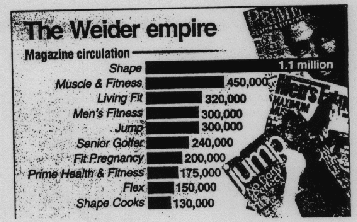
- Determine the mean magazine circulation
for the ``Weider'' empire.
- Determine the median magazine circulation for the ``Weider'' empire.
- Assume you are the press speaker of the ``Smith'' magazine group that also has
10 magazines with a mean circulation of 310,000 and a median circulation of 300,000.
Which number(s) would you report when comparing your group with the ``Weider'' empire.
Explain.
- Calculate the range of the magazine circulation for the ``Weider'' empire.
- Construct a stem-and-leaf display of the magazine circulation.
- Are you happy with the data provided by USA Today? Isn't some
important information missing?
- Do you think that the 1.1 million circulation for ``Shape'' is the
absolute truth? Think of possible manipulations (hint: ``TV Guide'' published
4 collector's covers of Seinfeld in their May 9-15, 1998, issue - how might this
effect the circulation?).
- Assume the
``Weider'' group only possesses these 10 magazines. Calculate
the variance using our shortcut formula
and make a clear statement whether you are calculating a population
or a sample variance. (Hint: It might be useful to know that
1.1 million can be expressed as 1.1E06, 450,000 as 0.45E06, etc.).
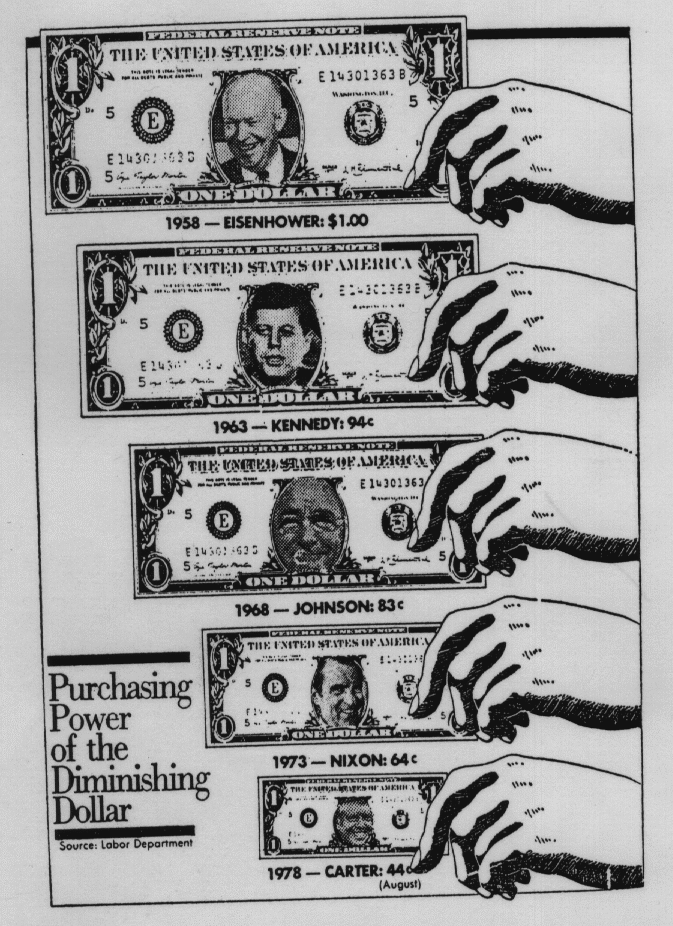
- 2) Below is a graphic taken from Wainer's
`Visual Revelations' book, first published in the
Washington Post. First guess under which US President the
Dollar lost most of its value. Then redraw the graphic
in a better way. It might be reasonable as well to look
into a history book or find a source with respect to
US Presidents on the Web... After redrawing your graphic
answer the question again under which US President the
Dollar lost most of its value. Can you explain the
main problem with the initial graphic?
(7 Points)
- 3) Please work on the following textbook exercises in Moore/McCabe:
- Exercise 1.110 (2 Points)
- Exercise 1.109, 1.111, 1.114, 1.115 (1 Point each)