Stat 2000, Section 001, Homework Assignment 4 (Due 10/2/2002 11:59pm)
This homework should be part of your
preparation for Midterm 1.
Try to work on as many questions as possible before Friday.
In any case, I will distribute solutions this Wednesday (9/25/2002)
in class.
- 0) Review: Section 1.1 - 1.3, Additional Handouts & Lecture Notes,
Homework Solutions
- 1) The following questions are based on the data for the
``Weider Empire'' from USA Today (May 15, 1998) reprinted below.
When you write down your answers, you should indicate which values are assigned to the
variables you use (e.g., n=20, x(15) = 20,000) and which formula you use.
This will guarantee you at least partial credit in case that your final
result is incorrect. (12 Points)
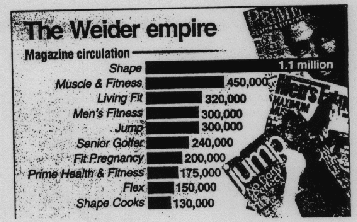
- Determine the mean magazine circulation
for the ``Weider'' empire.
- Determine the median magazine circulation for the ``Weider'' empire.
- Assume you are the press speaker of the ``Smith'' magazine group that also has
10 magazines with a mean circulation of 310,000 and a median circulation of 300,000.
Which number(s) would you report when comparing your group with the ``Weider'' empire.
Explain.
- Calculate the range of the magazine circulation for the ``Weider'' empire.
- Construct a stem-and-leaf display of the magazine circulation.
- Are you happy with the data provided by USA Today? Isn't some
important information missing?
- Do you think that the 1.1 million circulation for ``Shape'' is the
absolute truth? Think of possible manipulations (hint: ``TV Guide'' published
4 collector's covers of Seinfeld in their May 9-15, 1998, issue - how might this
effect the circulation?).
- Assume the
``Weider'' group only possesses these 10 magazines. Calculate
the variance using our shortcut formula
and make a clear statement whether you are calculating a population
or a sample variance. (Hint: It might be useful to know that
1.1 million can be expressed as 1.1E06, 450,000 as 0.45E06, etc.).
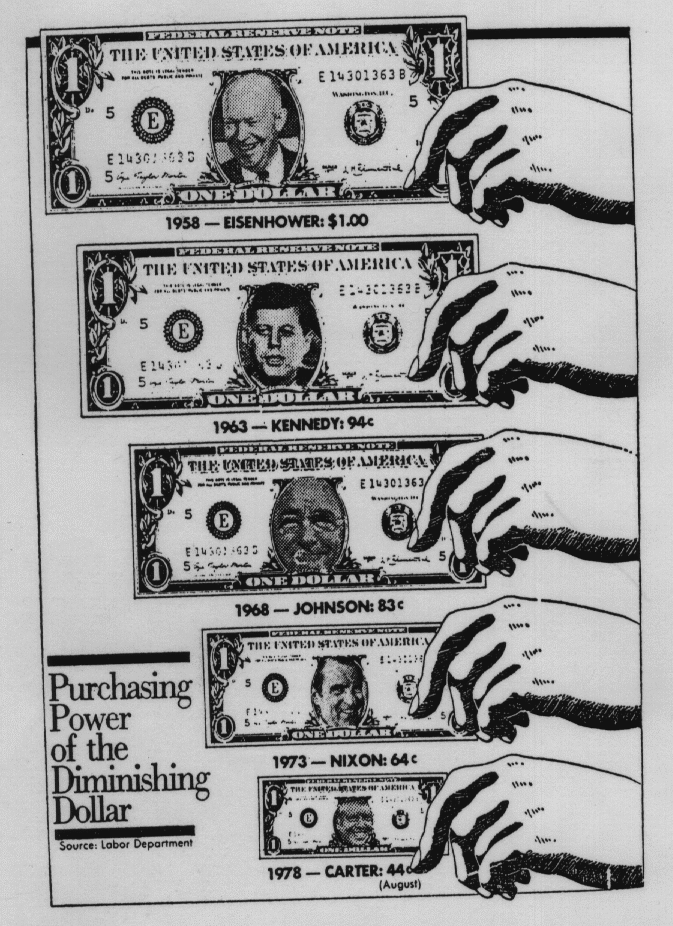
- 2) Below is a graphic taken from Wainer's
`Visual Revelations' book, first published in the
Washington Post. First guess under which US President the
Dollar lost most of its value. Then redraw the graphic
in a better way. It might be reasonable as well to look
into a history book or find a source with respect to
US Presidents on the Web... After redrawing your graphic
answer the question again under which US President the
Dollar lost most of its value. Can you explain the
main problem with the initial graphic? (7 Points)
- 3) Please work on the following textbook exercises from
Moore/McCabe (3rd Edition):
- Exercise 1.109 (1 Point):
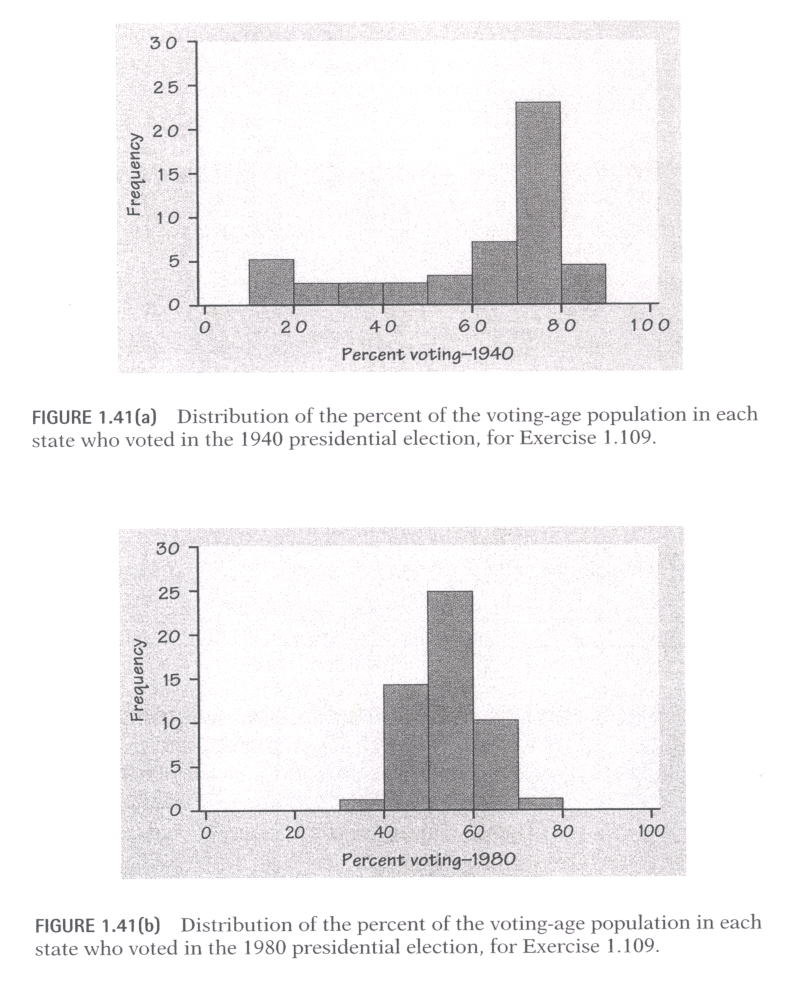
Voting patterns in the United States were affected by many social
changes in the years between 1940 and 1980. Prior to the civil rights
movement of the 1960s, blacks were effectively prevented from voting in
some southern states. Until 1971, citizens between the ages of 18 and
21 could not vote in national elections. Figure 1.41(a) is a histogram
of the percent of the voting-age population who actually voted in the
1940 presidential election in each of the 48 states that existed at
that time. Figure 1.41(b) shows the distribution of the percent of the
voting-age population who voted in the 1980 presidential election in
the 50 states and the District of Columbia. To allow a direct
comparison, the horizontal and vertical scales and the class widths are
the same for the two histograms. Describe the most important changes
in the shape of the distribution between 1940 and 1980.
- Exercise 1.110 (2 Points):
Deborah is a student at a midwestern college who lives off campus. She
records the time she takes to drive to school each morning during the
fall term. Here are the times (in minutes) for 42 consecutive
weekdays, with the dates in order along the rows:
| 8.25 |
7.83 |
8.30 |
8.42 |
8.50 |
8.67 |
8.17 |
9.00 |
9.00 |
8.17 |
7.92 |
| 9.00 |
8.50 |
9.00 |
7.75 |
7.92 |
8.00 |
8.08 |
8.42 |
8.75 |
8.08 |
9.75 |
| 8.33 |
7.83 |
7.92 |
8.58 |
7.83 |
8.42 |
7.75 |
7.42 |
6.75 |
7.42 |
8.50 |
| 8.67 |
10.17 |
8.75 |
8.58 |
8.67 |
9.17 |
9.08 |
8.83 |
8.67 |
|
|
(a) Make a graph of these drive times. Is the distribution roughly
symmetric, clearly skewed, or neither? Are there any clear
outliers?
(b) The data show three unusual situations: the day after Thanksgiving
(no traffic on campus); a delay due to an accident; and a day with
icy roads. Identify and remove these three observations, and give a
numerical summary of the remaining 39 drive times.
(c) Are these data reasonably close to having a normal distribution
when the unusual days are removed? How do you know?
(d) Make a time plot of the drive times. Do the data show any
trend? For example, do drive times increase over time because the
weather gets worse later in the term?
- Exercise 1.111 (1 Point):
The 1996 Statistical Abstract of the United States reports
FBI data on murders for 1994. In that year, 57.8% of all
murders were committed with handguns, 12.2% with other firearms,
12.7% with knives, 5.3% with ``personal weapons'' (usually the hands
or feet), and 4.1% with blunt objects. Make a graph to display
these data. Do you need an ``other methods'' category?
[We have already seen this solution - just recall how the ideal
solution looks like and rescetch it without looking at the old
handouts. No need to formally answer this questions - a free
point for everyone ;-)
- Exercise 1.114 (1 Point):
The Chapin Social Insight Test evaluates how accurately the subject appraises
other people. In the reference population used to develop the test, scores
are approximately normally distributed with mean 25 and standard deviation 5.
The range of possible scores is 0 to 41.
(a) What proportion of the population has scores below 20 on the Chapin test?
(b) What proportion has scores below 10?
(c) How high a score must you have in order to be in the top quarter of the
population in social insight?
- Exercise 1.115 (1 Point):
The scores of a reference population on the Wechsler Intelligence Scale
for Children (WISC) are normally distributed with
mu = 100 and sigma = 15.
A school district classifies children as ``gifted'' if
their WISC score exceeds 135. There are 1300 sixth graders in the
school district. About how many of them are gifted?