
Plaques
USU no longer offers some of these options, but a tribute gift page can be created for donors to give in your loved one’s honor to an area that was meaningful to them.
9/11 Monument

In front of Utah State University’s Eccles Business Building stands a modest yet powerful three-foot-tall monument—a tribute to the victims of terrorism and tyranny, and to the enduring values of freedom and democracy. Dedicated by the National Society of Collegiate Scholars (NSCS) on September 11, 2003, the memorial honors all who have suffered as a result of global acts of terror, including Utah State University alumnus Brady Kay Howell, who lost his life in the attack on the Pentagon on September 11, 2001.
The monument’s inscription reads:
“In the darkness of tyranny and terrorism, the valor of democracy lights the world. The victims and oppressed of such action stand as memorials to our belief in ‘life, liberty and the pursuit of happiness.’ In remembrance of all who suffer as a consequence of tyranny and terrorism in the world.”
During the dedication ceremony, Logan City police officers conducted the posting of colors, and Rev. Clarence Sandoval of St. Thomas Aquinas Church offered a dedicatory prayer. Ken and Jeanette Howell, Brady’s parents, cut the ribbon to unveil the plaque, making the moment deeply personal for the USU community. While Brady’s name is not etched on the monument, his story and sacrifice inspired its creation.
Former NSCS president Joe Barnard, who led the effort, described the memorial as a symbol of resolve: “Freedom is a gift. It belongs to all people everywhere. It is a gift that transcends governments and armies, a gift that has cost the blood and dreams of generations of our sons.” The memorial continues to serve as a place of quiet reflection—a reminder of the price of liberty and the personal connections that unite global tragedy with the Aggie family.
Brady Kay Howell, a 1999 graduate of Utah State University in Political Science, was known for his leadership, optimism, and service to others. As a student, he was active in campus life and a member of the National Society of Collegiate Scholars, the organization that would later dedicate the memorial in his honor. Following his time at USU, Brady earned a master’s degree in Public Administration from Syracuse University and began a promising career in public service at the Pentagon, where he worked for the Chief of Naval Operations.
At just 26 years old, Brady’s life was tragically cut short on September 11, 2001. He was posthumously awarded the Superior Civilian Service Medal and the Defense of Freedom Medal for his dedication and sacrifice. Remembered for his faith, integrity, and kindness, Brady embodied the spirit of Utah State University—a commitment to learning, service, and the pursuit of a better world. His legacy endures through the scholarship established in his name and through the generations of Aggies who pass the Eccles Building and pause at the memorial that honors his life and the freedoms he cherished.
Allen Stokes Memorial Tree (1914-1996)

Allen Woodruff Stokes was born in 1914 in Germantown, Pennsylvania. His family belonged to the Quaker faith (Society of Friends) and his early schooling was at private institutions of Quaker affiliation. He attended Harvard in the 1940s and the University of Wisconsin-Madison, studying wildlife management.
In 1952, Allen accepted a position as professor in the Forestry School at Utah State Agricultural College. He received a National Science Foundation fellowship for 1958-59, and used it to study animal behavior in England. In 1959, he organized and was president of the Animal Behavior Society in Logan. In 1975, Allen was the first professor from the College of Natural Resources to receive a Robins Award for Teacher of the Year. He was an active participant in the Bridgerland Audubon Society and helped found the Utah Audubon Council in 1985. Allen was also a member of the Logan Forestry Board and he created the Allen Stokes Conservation Award to recognize people or organizations who made substantial contributions toward conservation.
Allen was involved in many organizations on the Utah State University campus and in the community at large, including United Way, Friends of the Cache Libraries, Hospice of Cache Valley, Planned Parenthood and the Gay Lesbian Alliance. He helped found the Logan Friends Meeting, Society of Friends in 1965.
A plaque was placed near the maple tree which reads, “Allen W. Stokes 1914-1996 Planted by the Students of The College of Natural Resources in honor of a man who inspired the lives of so many.”
Alice Stokes Memorial Tree (1915-2009)

Longtime Utah State University and Cache Valley community supporter Alice Stokes is remembered with a memorial tree in the courtyard on the east side of the Biology-Natural Resources building.
Stokes died March 19, 2009, at the age of 93. She and her husband, the late Allen Stokes, moved to Cache Valley in 1952, when Allen joined the USU faculty as a professor of wildlife science. Alice earned a master’s in communicative disorders from Utah State and helped to coordinate some of the first deaf education classes in Cache Valley.
A plaque was placed near the maple tree which reads, “Alice H. Stokes 1915-2009. In honor of a woman who inspired the lives of so many.”
Andy Hays Bench

Joseph Andrew Hays serves as a consultant to the CEO of Tribune Co., and has also established the Hays Group, a consulting firm that provides counsel to companies on communications policy and enhancing shareholder value and to not-for-profit organizations on strategic planning and fund raising.
During his time at USU, Andy was involved with Sigma Alpha Epsilon and also played basketball. After military service in the United States Air Force, Andy graduated from the Indiana University School of Law in 1959. He then worked for Kennecott Copper, an international mining company.
April Barker Jensen Memorial Bench (1974-2015)

April Barker Jensen was born on April 26, 1974 in Evanston, Wyoming to Gary and Sandra Barker, where she grew up with her three brothers and sister on the family ranch.
April graduated from Evanston high school in 1992 and from USU with a bachelor’s in ornamental horticulture in 1998. April continued her education, receiving her master’s in human resources in 2009.
April married her best friend Chris Jensen on March 17, 2007 in the Logan temple for time and all eternity. She loved to travel and enjoyed getting together with family and friends. She loved doing crafts, gardening, and growing a variety of flowers and vegetables. April worked at USU for 17 years, where she last held the title, assistant vice president of Advancement. She enjoyed attending athletic events and supporting the Aggies.
Arthur “Art” Mahoney Memorial Bench

Dr. Arthur W. Mahoney served as a professor in the Department of Nutrition and Food Sciences for 22 years. He died in 1992.
Arvilla Watts Raymond Memorial Piano (1913-)

Arvilla Watts was born in October 1913 in Rexburg, Idaho. Arvilla and her husband, Ace, met each other in high school at Madison High in Rexburg, Idaho. Later, while attending Ricks College, they began dating.
The Watts family moved to Logan and brought Ace with them so he and Arvilla could continue to keep company during the two years she would attend the Utah State Agricultural College. During her first year at the school, Arvilla was elected homecoming queen.
Arvilla earned a bachelor’s in secretarial science in 1935 from the Utah Agricultural College. Her daughter-in-law, Melanie Raymond, donated the piano in her memory.
Chuck Johnson Memorial Tree

Charles Wayne Johnson was born March 15, 1945, in Chicago, Illinois. He attended the Military Academy at West Point and served in the United States Army. He received his bachelor’s in history from DePaul University and his master’s and doctorate in philosophy from Michigan State. He completed the doctorate in a record time of two years. Chuck began as a professor of philosophy at Utah State University in 1972.
At USU, Chuck spent many years training the drum line of the marching band. He participated in the USU Percussion Ensemble and played the bass drum in a Civil War-era brass band. He also trained dancers to drum for the USU-sponsored Glenn Miller Show.
As a professor in the philosophy program, Chuck was revered by generations of students for his dry wit, his sharp mind and his love of Ludwig Wittgenstein. Chuck the Logician was enthralled with clarity and elegance in reasoning. Alongside his faith, family, drumming and teaching, Chuck had a love of air and space travel and the technical aspects of flight. He studied government reports of air crashes and often knew before anyone why a plane had crashed. Chuck had a passion for the sea, tropical rain-forests and the island of Kauai.
Darwin B. Nielsen Memorial Tree

Darwin Blaine Nielsen was born Sept. 26, 1932, in Hyrum, Utah. Following graduation from South Cache High School, he joined the Air Force and served in Texas, California, Japan and New Mexico.
After discharge from the Air Force, Darwin returned to Cache Valley, where he began attending Utah State University along with working on the family dairy farm. He graduated from USU with bachelor’s and master’s degrees. He then attended Oregon State University in Corvallis, Oregon, where he received his doctorate in economics. After spending a year-and-a-half working for the U.S. Department of Agriculture in Bozeman, Montana, he returned to USU and began his teaching career. He retired in 1997. While at USU, he was honored with the Distinguished Professor of the Year Award (1994) and inducted into the USU Alumni Hall of Honor (2006). Along with his teaching, Darwin was adviser for USU Rodeo for over 25 years and also served as National College Rodeo Advisor.
Frederick P. Champ Drive

By resolution of the Board of Trustees on March 3, 1995, the entire West Wing of Old Main was named for Champ. Concurrently, the roadway extending south from the Field House, around Old Main, past the Ray B. West and Family Life buildings to the junction with Highway 89 was designated Champ Drive.
At the intersection between the Family Life and the Quad, the sign reads, “Named in the Spring of 1995 in recognition of his leadership and service as a Member and President of the Board of Trustees 1925-1941 during a period of extraordinary and historic development at Utah State University.”
Gary Kiger Memorial Bench
Bench in Old Main

Gary Kiger was a prolific researcher and writer. He was passionate about his teaching and the intellectual development of his students. He joined the sociology faculty at Utah State University in 1983 after receiving a bachelor’s from the University of Colorado in 1975, a master’s from McGill University in 1978 and a doctorate from the University of Colorado in 1983.
Gary loved the academic life at Utah State University and is remembered for his dedication to scholarship and learning. He was equally capable as a leader and team member. He served for 25 years as a faculty member, was head of the Department of Sociology, Social Work and Anthropology, and was dean of the College of Humanities, Arts and Social Sciences. Gary had a warm, friendly smile and made every effort to greet and compliment others. His great compassion and unfailing optimism are well known. A good listener, he was sincerely interested in others.
A bench in Old Main commemorates Gary Kiger (1953-2008), “Dean of the College of HASS and professor of sociology. He will be remembered as a beloved colleague, a stellar leader and an extraordinary teacher. As you take your ease, honor Gary by reflecting on those whose teaching inspires and uplifts.”
George E. Hart Memorial Tree (1929-1989)

George E. Hart was a professor in Utah State University’s Forest Resources Department for 23 years. George was a pioneer in the watershed science program in the S.J. and Jessie E. Quinney College of Natural Resources, where he was a valued teacher, colleague and mentor. George graduated from Yale University and the University of Michigan.
A tree was planted in his memeory in the Biology-Natural Resources Courtyard. A plaque reads, “George E. Hart 1929-1989, For the Love of People, Water and the Woods... May he shine on.”
Hello Walk – Walkway of Friendship

Plaque inscription: “Hello Walk – Walk-way of Friendship, Utah State University, September 25, 1961”
Located on the west sidewalk of the Quad between Old Main and Widstoe Hall, the Hello Walk is a symbol of Utah State University’s enduring spirit of friendliness and connection. The plaque, placed on September 25, 1961, marks the creation of this tradition, which encourages students, faculty, and visitors to greet one another with a simple “hello” as they pass.
The Hello Walk was established to foster a welcoming campus culture where kindness and community thrive. Over the decades, it has become a cherished part of Aggie life—reminding all who walk this path that even the smallest gesture, like a smile or greeting, can make a lasting impact. Today, the Hello Walk continues to be celebrated through events and campaigns that promote connection, belonging, and mental well-being across campus.
Herm Olsen - Utah Handball Legend Plaque
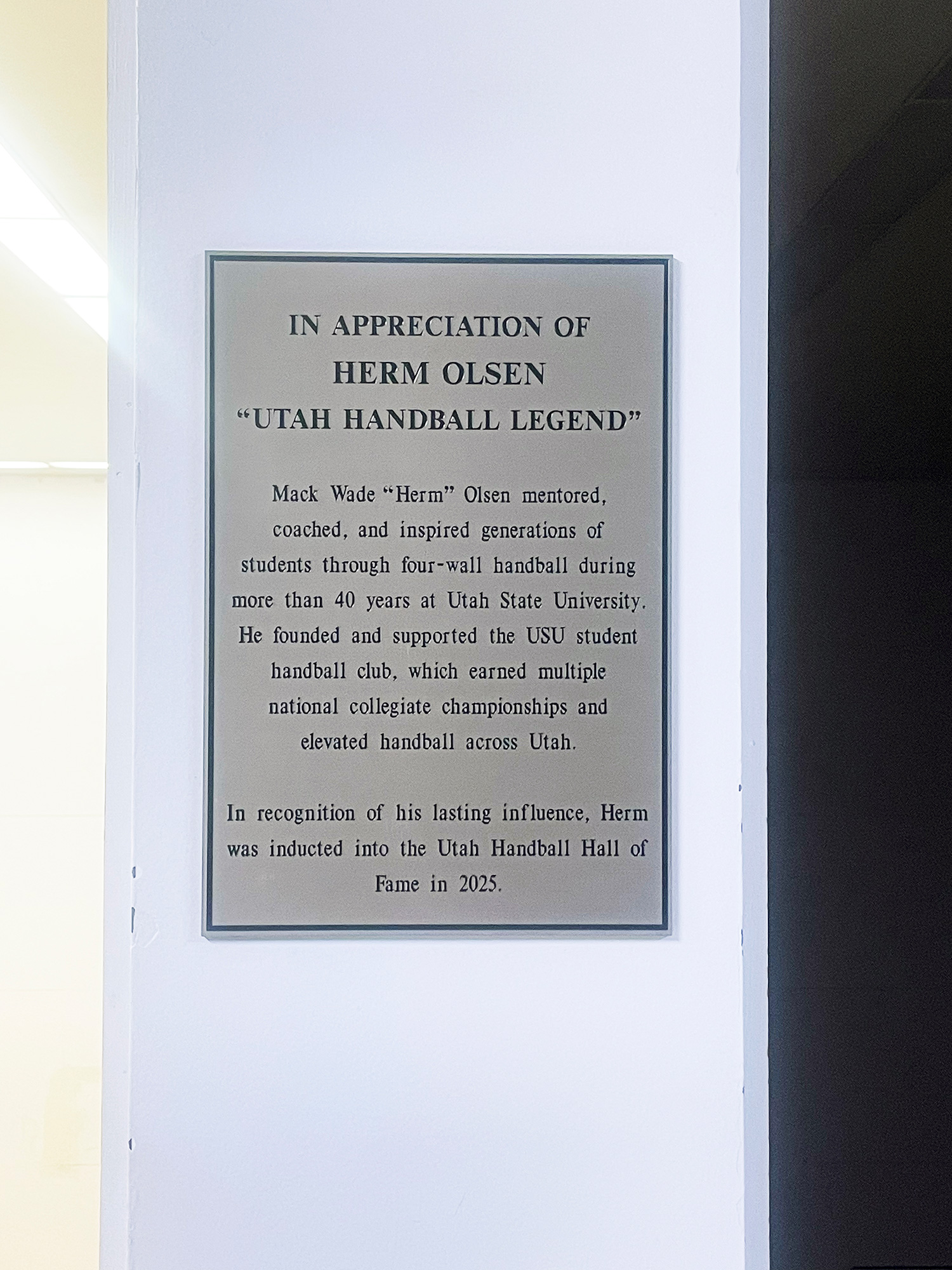
“Herm” (Mack Wade) Olsen shared 4-wall handball with hundreds of young USU students. At the USU HPER handball courts, he has been a mentor, coach, and friend to male and female students for over 40 years, teaching them “the perfect game.” He started and supported the USU student handball club that won singles, doubles, and team championships at the National Collegiate Handball Tournament. USU’s collegiate team became a highlight for handball in the state of Utah. Herm Olsen was a great recruiter, promoter, and ambassador for Utah handball. In 2025, Herm was inducted into the Utah Handball Hall of Fame.
Jack B. Parson Drive

Logan local, Jack B. Parson Jr., began working with his father at the age of 14, building roads in Utah and Idaho. Parson graduated from Logan High School and later from Utah State University from the College of Business.
John Charles Nelson Memorial Bench

John Charles Nelson is a Utah State University alum who took many more class hours than required and still ended up graduating early. He later went on to receive a medical doctorate from University of Utah’s School of Medicine.
John practiced privately as an obstetrician and gynecologist in Salt Lake City. During his career, he served as deputy director of the Utah Department of Health, as well as on on the governor’s board of preventing child abuse and preventing teenage pregnancy in Utah. He served as president of the Utah Medical Association and Salt Lake County Medical Society and helped the American College of Emergency Physicians deal with sexually assaulted victims. John also previously served on the Salt Lake City Boys and Girls Club.
With all of John’s leadership experience, he was elected as president-elect for the American Medical Association board of trustees. Nelson was a member of the AMA since 1994. Nelson is the second known Aggie to have served as the president of the AMA.
Lars Hansen Drive

Lars Peter Hansen was born in Champaign, Illinois in the United States and studied at Utah State University in Logan, where his father was a professor of biochemistry, obtaining bachelor’s degrees in both mathematics and political science with a minor in economics. Lars received his doctorate from the University of Minnesota in Minneapolis and St Paul in 1978. He worked at Carnegie-Mellon University in Pittsburgh 1978-81, and then moved to the University of Chicago.
For many, the rise and fall of stock prices symbolizes economic development. Eugene Fama demonstrated that stock price movements are impossible to predict in the short-term, while Robert Shiller discovered that stock prices can be predicted over a longer period. In 1982, Lars Peter Hansen developed a statistical method for testing stock price movement. His method is now used within all economics research. Lars Hansen Drive was dedicated after Hansen received the Nobel Peace Prize in Economics in 2013.
Lynn Langer Meeks Memorial Bench
Bench in Old Main

Born June 4, 1946, Lynn Langer Meeks graduated from Jerome High School in 1964, took her bachelor’s at the College of Idaho in 1968, her master’s in English literature from Arizona State in 1977, and, while working full-time as a teacher, she completed her doctorate in English from Arizona State in 1985. She taught high school for many years in Scottsdale, Arizona.
In 1985, Lynn joined the English faculty at Utah State. In 1988, she became the Language Arts Consultant for the State of Idaho. In 1994, upon marrying USU History Professor Norm Jones, she returned to USU where she became a full professor of English, director of writing and director of the Utah Writing Project. Lynn loved students, and she loved to teach. She believed that every student could learn to write, and she demonstrated it in her teaching and her scholarship. A proud Idahoan, she was always involved with the family ranch and her nieces´ 4-H projects.
A bench in Old Main commemorates Lynn Meeks, “I am a teacher at heart, and there are moments in the classroom when I can hardly hold the joy. - Park J. Palmer. In Memory of Lynn Langer Meeks (1946-2006) Professor of English.”
Maria Isela Chiu Memorial Tree

Maria Isela Chiu earned a bachelor’s and a master’s from the University of Texas, El Paso and a doctorate in Spanish from the University of Kansas.
She began her faculty tenure at Utah State University in 1982, during which time she published two books and numerous scholarly articles; in addition, Maria repeatedly won awards for the best departmental, college and university adviser, a testimony to her devotion to her students.
Quigley Memorial Tree

Glen Quigley was born April 9, 1915, in Moab, Utah to Lewis Thomas Quigley and Lilly Belle Moore. On Nov 22, 1940, he married Audrey Burgess in Elko, Nevada. He graduated from Grand County High School in 1933 and worked his way through Utah State University receiving his degree in forestry in 1939. Following a career with the U.S. Forest Service, Glen retired in 1977. He is a Lifetime Member of the Society for Range Management. In addition, his love of gardening earned him several Civic Beautification Awards.
Audrey Burgess Quigley was born in St. George, Utah, March 10, 1917 to Milton Burgess and Clara Cannon. She attended and graduated from Woodward School in St. George, Dixie High School as Valedictorian, Dixie College and Utah State University. She began her teaching career at West Weber High School and taught at Kanosh and Fillmore elementary schools. She taught home economics at Millard High School for 17 years and retired in 1982.
Renate Posthoffen Memorial Tree
Renate Posthoffen was an accomplished scholar and was greatly loved by her students. She had published three books, as well as numerous articles. Renate taught German, and spent time serving as past president of the Utah chapter of the American Association of Teachers of German and as a past member of the executive board of the Utah Foreign Language Association. She received many grants and awards for her work.
Russell L. Maughan Dawn to Dusk Memorial Plaque
Located to the east of the athletic field on the south side of the Dee Glenn Smith Spectrum.

Courageous USU alumnus Russell L. Maughan was the first pilot to fly coast to coast between dawn dusk. He made the historic flight from New York City to San Francisco on June 23, 1924.
Lieutenant Russell L. Maughan of the U.S. Air Service and a native of Logan, Utah, made the first daylight flight across the American continent on June 23, 1924. Flying solo in a Curtis PW-8 aircraft, Maughan left Mitchell Field, New York at dawn and arrived at Crissy Field, San Francisco, one minute before office dusk, his flight time was 18 hours and 20 minutes with an average speed of 150 m.p.h.
Maughan was born March 28, 1893, to Peter W. and Mary NAEF Maughan and is the grandson of Cache Valley pioneer Peter Maughan. In 1917 he graduated from the Utah State Agricultural College (USAC) and joined the Army. As a pilot in World War I, he shot down four German planes and received the Distinguished Service Cross for saving the life of another pilot by flying between his crippled aircraft and an attacking German plane. In World War II, he served as a colonel in the 8th Air Force in Britain. Maughan remained in the service until his retirement in 1946, and was awarded the Distinguished Service Cross and the Distinguished Flying Cross.
His cross-country flight in 1924 was not his only record-setting achievement. In 1922 he won the Pulitzer Flying Cup by setting a new world speed record of 205.8 m.p.h. Maughan’s achievements as a pilot in war and peace demonstrate that he was a man of great dedication and valor during the golden age of aviation. This was confirmed on the 50th anniversary of the dawn-to-dusk flight, when the Smithsonian Institution in Washington, D.C. added his flight to the Milestones of Flight, which highlights the most important moments in the history of aviation.
He died on April 21, 1958, and is buried in the Logan City Cemetery.
The Story Behind a Plaque in Old Main

Hanging in the main hall of Old Main is a plaque that says, “In memory of Samuel Parkinson Cowley, Class of 1925, who died in the service of his country November 28, 1934 for the cause of justice and the safety of his fellow men.”
Cowley’s story is fascinating. It sounds more like a B movie drama than real life. But for his parents, his siblings, his wife LaVon and their two infant sons, the drama that resulted in the death of Sam Cowley at 35 was too real.
Born in Franklin County, Idaho, Samuel went to school in Logan and Preston and graduated from LDS High School in Salt Lake City. He had joined the division of investigation in the Department of Justice (later to become the FBI) in 1929 after receiving a law degree from George Washington University. He worked as an agent in Detroit, Los Angeles, Chicago, Salt Lake, Washington, D.C. and Butte, Montana. Samuel moved up rapidly and was an inspector at the time of his death.
Placed in charge of the pursuit of the John Dillinger gang by J. Edgar Hoover, Samuel moved to Chicago and, after months of searching, he and his men located Dillinger in Chicago. Samuel was in charge the night government agents waited for Dillinger to exit a movie theatre so they could capture him alive. Sensing trouble, Dillinger tried to run and was shot.
“Pretty Boy” Floyd was next to fall into the net spread by Samuel and his men. After a manhunt led by Melvin Purvis closed around him, Floyd was shot trying to elude capture in Ohio.
The hunt for Lester Gillis, better known as Baby Face Nelson, centered in Chicago after agents learned he had returned there from Nevada. Samuel had men watching several old hideouts of Nelson’s including Niles Center.
Two agents watching Niles Center encountered Nelson, his wife Helen and a man named John Chase. The outlaws, armed with superior weapons, took off after the lawmen. Speeding down the road they passed Samuel and his partner Herman Hollis, who whirled around to come to the aid of their comrades.
The agents in the lead car were unaware that Samuel and Hollis were in the chase and didn’t know their rescuers had overtaken the Nelson car. They raced on.
Exactly what happened is unknown. Nelson apparently used his wife as a shield and both Hollis and Samuel were cut down quickly. Hollis died immediately. Through mortally wounded, Samuel managed to release a burst of machine gun fire at the fleeing criminals. One of the 45-caliber bullets from his machine gun killed Nelson, whose body was dumped by his companions. Though he lived for a few hours, Samuel died before Nelson’s body was found. He was 35.
Samuel Cowley became a hero. Newspapers throughout the country eulogized him and wrote glowing editorials about this quiet man who never sought the limelight. His brothers from Sigma Chi Fraternity at the Utah Agricultural College presented the plaque to his alma mater to honor him.
USU Agriculture Memorial Plaza

On September 26, 2005, tragedy struck the Utah State University community when eight agriculture students and their instructor, Evan Parker, lost their lives in a van accident while returning from a field trip. The devastating crash deeply affected the university, particularly the College of Agriculture, where the victims were known for their dedication to the land, their studies, and their futures in agriculture.
In their memory, a 20-foot bronze and concrete memorial was created, originally housed in the Taggart Student Center and later relocated to the Memorial Plaza outside the Agricultural Sciences and Research Building. The memorial features nine bronze panels—one for each life lost—and serves as a daily place of remembrance and reflection. A surrounding bench, donated by ASUSU Agriculture Senator Cody Bingham, bears an inscription honoring the lives lost, the families affected, and the agricultural community forever changed by the tragedy.
The victims—Steven D. Bair, Dusty Dean Fuhriman, Justin W. Gunnell, Justin Huggins, Jonathan Dennis Jorgensen, Curt A. Madsen, Ryan Wayne McEntire, Bradley G. Wilcox, and Evan Parker—remain part of the Aggie legacy. Their memory continues to inspire students, faculty, and all who pass by this enduring tribute.
William F. Campbell Memorial Tree
Dale and Adele Young Teaching Greenhouse

On September 23, 2008, the Campbell Family planted a Cardinal Royal Mountain Ash Tree in honor of William F. Campbell’s 80th birthday. The tree is marked by a plaque that reads, “In honor of Dr. William F. Campbell, professor in Crop Stress Physiology, on his 80th birthday from his children.” The tree was donated by Craig Aston.
Lt. Col. David Cary Watkins (1936-2021)

Lt. Col. David Cary Watkins was a decorated Marine Corps aviator, public servant, and community leader whose life embodied courage, service, and determination. A native of Cleveland, Ohio, Cary earned a B.S. from the University of Nebraska and an M.B.A. from Pepperdine University before beginning a distinguished 20-year career in the United States Marine Corps.
During the Vietnam War, he flew more combat missions than any other Marine officer—first as a fixed-wing aviator and later as a helicopter pilot—earning the Silver Star, two Distinguished Flying Crosses, a Purple Heart, and numerous other honors. After retiring, Cary built a successful second career in Apple Valley, California, before moving with his wife, Lucy, to North Logan, Utah, where he served as mayor and co-founded Art on the Lawn, supporting local student artists.
Cary was also a friend, teacher, and volunteer “Assistant Coach” to Utah State University students learning the game of handball. For over 30 years, he gave countless hours teaching fundamentals, strategy, and sportsmanship—often funding student trips to national tournaments. His humor, generosity, and love of the game inspired generations of players.
A lifelong learner and athlete, Cary lived with integrity and purpose, leaving behind a legacy of leadership, kindness, and service. We will miss his presence on these courts. Semper Fi.
*Note: All bios are current and up-to-date as of Summer 2022.