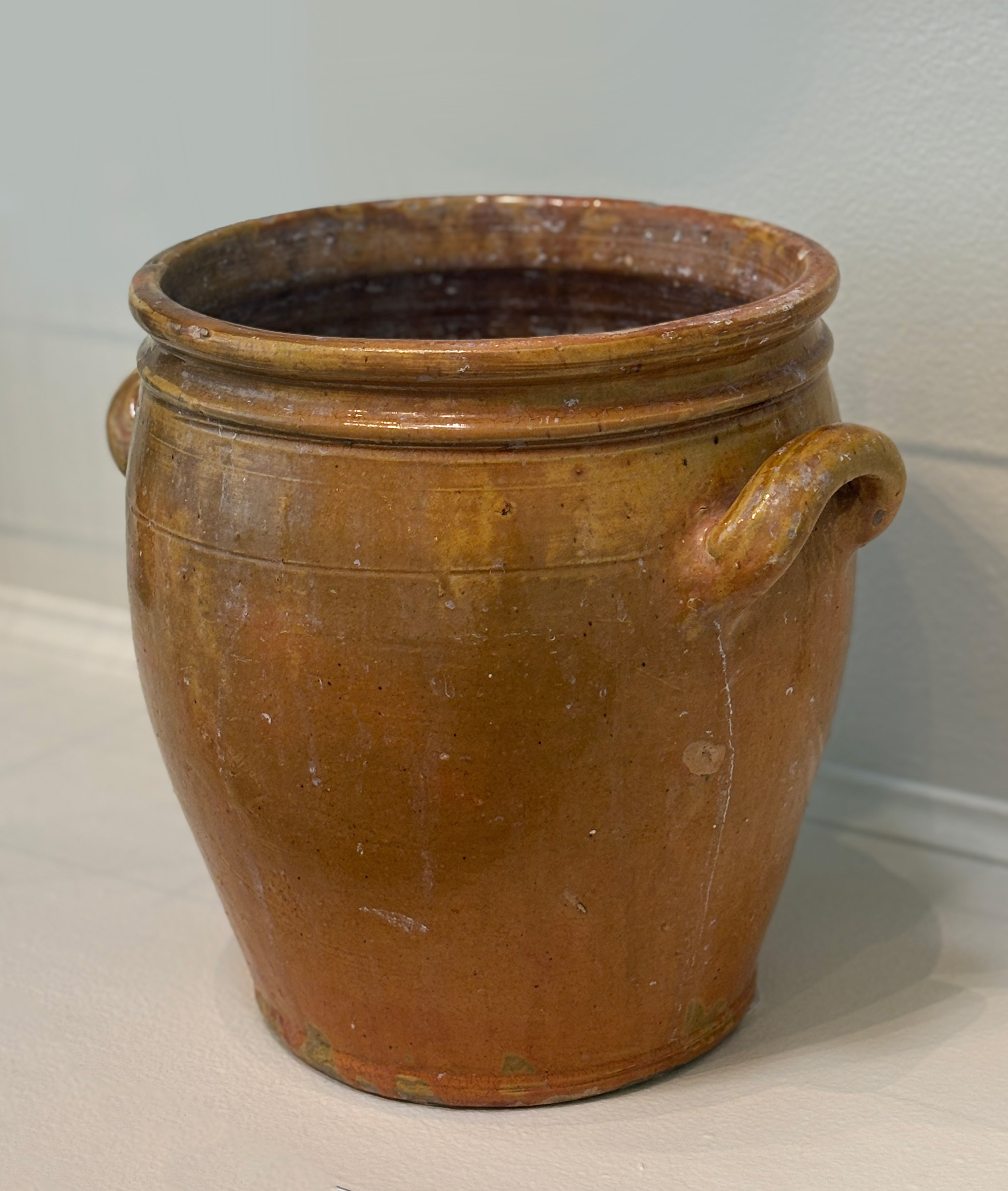
Utah Crocks
May 1, 2026 - December 12, 2026
Bruce and Shauna Crane are pleased to loan this selection of crocks from their collection to NEHMA. Bruce has collected most of his life, and after settling in Logan, he started to see early Utah crocks become available. Already having a collection of early Utah items about and from the Church of Jesus Christ of Latter-day Saints, the crocks were a natural addition. Bruce researched the locations of potters in Cache and Box Elder counties.
Imagine a life without any containers! The pots and jars in this display case are called “crocks” and are important examples of early Utah earthenware, created between 1850 and 1880. When pioneer settlers arrived in Utah, few households had functional crockery. The situation was so desperate that in 1849, Brigham Young told Latter-day Saint missionaries in Britain, “We want a company of potters, we need them.” He committed $17,000 to the Deseret Pottery Company to create crocks and plates for the thousands of immigrants heading West.
Unfortunately, early efforts to create a crockery industry failed because the first pioneer potters had experience in European factories that used high-fired stoneware and porcelain/refined clay. Utah’s rustic earthenware clay was more suited to low-fire and hand-made efforts. European ceramics were fired in kilns reaching blazing temperatures of 2380°F, whereas early Utah earthenware clay needed to be fired at lower temperatures around 1800°F. As settlers continued to move to Utah, potters from Denmark, England, and the Eastern United States learned to use native clays and minerals for glazes, building a short but thriving pottery commerce.
Creating crockery in the late 19th century was an arduous process, but critical for storing dry foodstuffs and liquid provisions. Potters also needed to farm, and thus, lived a busy life. In summer, clay was dug up, hauled in wagons, shoveled into large soaking pits to remove debris, and then piled into evaporation pools. The mixture was then churned by “horsepower” to further remove impurities. Large amounts of wood needed to be cut, hauled, and split to fire the kilns. During the winter, potters would wedge (knead) the clay, throw it on a potter’s wheel, and prepare glazes for the pots. Small, local potteries were integral parts of each settlement that was lucky enough to have a potter. Eventually, four dozen Utah potteries were established throughout the state from Cache Valley to St. George. Each became a critical part of its community, and potters would often trade crockery for other goods such as furniture, clothing, butter, or grain.
The brown- and mustard-colored glazes on these crocks come from galena ore, a soft mineral potters found in abundance west of Salt Lake City. Glazes were needed to make the porous clay watertight and durable, but galena ore contains toxic lead. Many potters became ill or died from the lead commonly used in glazes.
Most of the Utah pioneer potteries stayed in operation until the 1880s. With the opening of the transcontinental railroad, mass-produced and more intricate goods began arriving from the East, making it impractical for local potters to compete. Collectively, these early crocks convey an important, but short-lived chapter in the history of Utah’s pioneer settlement.
This mini-exhibition was curated by Dr. Billie Sessions with the help of Bruce and Shauna Crane.