Combining Physics and Machine Learning-based Models for Full-Energy-Range Solar Energetic Particles Events Prediction
Solar flares and coronal mass ejections (CMEs) accelerate solar energetic particles (SEPs) into the heliosphere. When SEPs are directed towards Earth, they cause impacts for human technology. They can cause satellite damage, high dosages of harmful radiation for astronauts, and many other effects. This project develops a new SEP prediction model, led by an early-career female PI. Two graduate students will be supported. This project includes an outreach plan to impact students at all educational levels in Utah from middle school to college level through lecture series talks in Utah State University Library, college-level presentations, and solar crafts activities during summer camp. The PI also will organize a public Kaggle competition to promote scientific research on SEP events prediction. The PI will prepare a monthly ?Space Weather? five-lectures series that will take place at the USU library. Additionally, the research results will be taught as part of the data mining-related classes curriculum across many Utah State University regional campuses, which includes campuses located in rural areas of Utah.
Inspired by the success of machine learning (ML) in several areas of physical and life sciences, the project will implement new advanced methods to augment current datasets, improve SEP forecasts, and answer essential scientific questions. To achieve this vision, the new model will identify SEP predictive features based on the wealth of existing spatiotemporal and physical metadata of SEP parent events. These features will be extracted from image parameters and trajectory metadata of active regions and solar prominences preceding CMEs and solar flares parents? events. The newly engineered features will improve our understanding of the underlying processes leading to particles acceleration following fast CMEs and solar flares events (Thrust 1). The second challenge that the project will address is the small amount of SEP events that total merely 349 occurrences across all the energy ranges to this day. The project will augment the current SEP events catalog and time series dataset by generating new realistic synthetic solar events (Thrust 2). Finally, the project will build an accurate and robust ensemble model that combines state-of-the-art physics-based models, machine learning-based models, and new spatiotemporal methods for full-energy-range SEP events prediction (Thrust 3). One of the by-products of this research will be a one-of-its-own kind augmented SEP catalog supplemented with the new spatiotemporal metadata that will be freely available through Application Programming Interface (API) for its potential usage e.g., to train machine-learning-based and physics- based models. The final operational ensemble model will be deployed at the Community Coordinated Modeling Center (CCMC), supported by NSF and NASA, and deposited in publicly available repositories.
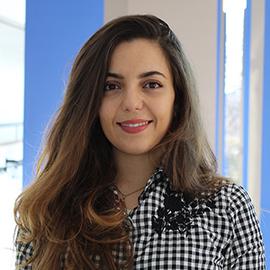
Soukaina Filali Boubrahimi
Associate Professor of Computer Science
My research interests include Data Science; Time Series and Spatiotemporal Pattern Discovery; Machine Learning; Deep Learning; and Visualization.