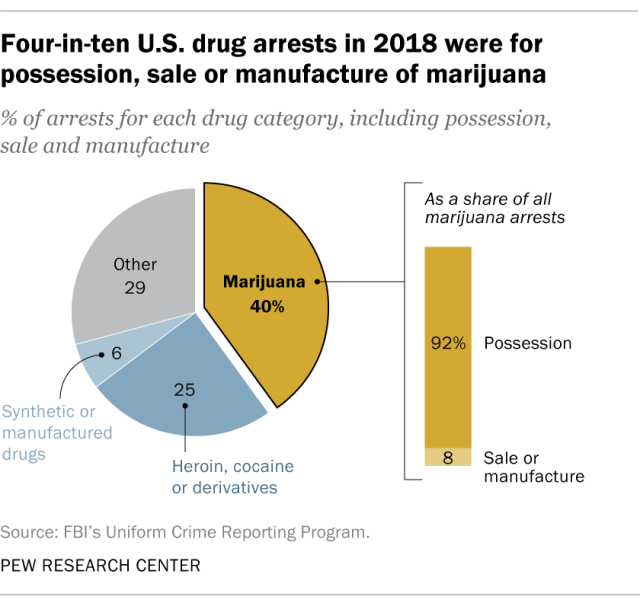
According to a
report by the Pew Research Center, 40% of US drug arrests in 2018 were due to marijuana related offenses.
Of those, 8% were related to the sale or manufacture of drugs.
What percentage of US drug related arrests in 2018 were due to the sale or manufacture of marijuana?
Let A be the event that a 2018 US drug arrest was related to marijuana and let B denote the event that
it was related to the sale or manufacture of drugs. P(A) = 0.4 and P(B|A) = 0.08.
How do we find P(A∩ B)?
The formula for conditional probability, $\small{P(B|A)=\frac{P(A\cap B)}{P(A)}}$, indicates that $\small{0.08 =\frac{P(A\cap B)}{0.4}}$ so
$\small{(0.08)(0.4) = P(A\cap B)}$. Thus $\small{P(A \cap B) = P(B|A)P(A)}$.
$\small{P(A ∩ B) = P(B | A)\cdot P(A)}$
The probability that a US drug related arrest in 2018 was due to the sale or manufacture of marijuana,
$\small{P(A \cap B)= P(B|A)P(A) = 0.08(0.4) = 0.032}$.
3.2% of US drug related arrests in 2018 were due to the sale or manufacture of marijuana.
The formula for the probability of an intersection can be extended to more than 2 events.
$$\small{\begin{array}{rcl}
P(A \cap B \cap C) & = & P(A)\cdot P(B|A)\cdot P(C|A \cap B) \\
P(A \cap B \cap C \cap D) & = & P(A)\cdot P(B|A)\cdot P(C|A \cap B)\cdot P(D|A \cap B \cap C)
\end{array}}$$
Example: Varroa Mites and Honeybees
An apiologist (person who studies bees) wants to compare 2 treatments for
Varroa mites in honey bees: formic acid and oxalic acid. She has seven hives. To
assign treatments, she writes formic acid on 3 slips of paper and oxalic acid on 4 pieces
of paper and randomly selects one for each hive, discarding each slip after it has been chosen.
What is the probability that the first hive will be assigned formic acid and the second will be assign oxalic acid?
Let $F$ denote the event that the first hive is assigned to the formic acid treatment, and let $O$ denote the event that the second hive
is assigned to oxalic acid.
$\small{P(F \cap O) = P(F)P(O|F)}$.
On the first draw, three of the slips say 'formic acid' and four say 'oxalic acid'
thus $\small{P(F)=\cfrac{3}{7}}$.
On the second draw, six slips remain and only two of those say 'formic acid' so $\small{P(O|F)=\cfrac{4}{6}}$.
The probability that the first hive is assigned to formic acid and the second to oxalic acid is 0.286.
Let B be the event a researcher was wearing blue, G be the event a researcher
was wearing green, and O be the event a researcher was wearing orange. Let C be the event that a capture attempt was successful.
The probability that a randomly selected capture attempt was made by a researcher wearing green and was successful is P(G ∩ C).
From the problem statement, P(G)=0.339 and P(C|G) = 0.662.
$$\small{\begin{array}{rcl} P(G ∩ C) & = & P(G)P(C|G) \\ & = & 0.339(0.662)\\ & = & 0.224\end{array}}$$
The probability that a randomly selected capture attempt was made by a researcher wearing green and was successful is 0.224.
Denote the probability that a random student who was surveyed is male and has taken a higher math class as P(F' ∩ C).
Multiply the probabilities along the path representing this intersection.
$$\small{\begin{array}{rcl} P(F'∩ C) & = & P(F')P(C|F')\\ & = & 0.742(0.66)\\ & = & 0.490\end{array}}$$
The probability that a random student who was surveyed is male and has taken a higher math class is 0.49.
Independence
Example: Varroa Mites and Honeybees
An alternate approach to assigning treatments to the hives is to use only two slips of paper, and randomly choose between the two for each hive.
With this approach, the apiologist would retain both slips of paper throughout the assignment proces.
In this scenario, what is the probability that the first hive is assigned formic acid and the second oxalic acid?
The apiologist randomlys choose between the two slips for each hive, so the probability of choosing formic acid on the first draw is $P(F) = \frac{1}{2}$.
Since both slips are retained, the probability of choosing oxalic acid for the second draw is $P(O|F)=\frac{1}{2}$.
In this scenario, the fact that formic acid was chosen on the first draw does not affect the probability of choosing oxalic acid on the second draw.
In other terms, $P(O|F) = P(O)$, the events are independent.
→ Events are independent if the occurrence of one does not affect the probability that the other occurs.
Events A and B are independent if any (and therefore all) of the following statements is true.
P(A|B) = P(A)
P(B|A) = P(B)
P(A ∩B) = P(A)P(B)
The percentage of violent crimes that are aggravated assaults is very different in some of the cities than in others. For instance,
if a violent crime was committed in West Jordan it was more likely to be an aggravated assault than if the violent crime were committed in
Salt Lake City. The occurrence of one event, a violent crime takes place in West Jordan, does affect the probability that it is an aggravated
assault. Aggravated assault and city are not independent.
One of the conditions of independence states that A and B are independent if P(A|B) = P(A). From the statement above, P(A|L) = 0.44 and P(A) = 0.59.
0.44 ≠ 0.59, thus A and L are not independent.
Another condition indicates that if A and B are independent then P(A ∩ B) = P(A)P(B). P(L' ∩ A) = 0.47, P(A) = 0.59, and, by the
complement rule P(L') = 1-0.26 = 0.74. Thus P(L')P(A) = 0.74(0.59) = 0.44 ≠ 0.47. So L' and A are not independent.
 According to a