Violent crimes (crimes that involve actual force or a threat of force) compose a small percentage of the
total crimes in Utah's big cities (population over 100,000). In Salt Lake City, the percentage of all crimes
in 2019 that were violent was 11.1%. In Provo, the percentage was 8.5%. It was 8.6% in West Jordan and 18.7% West Valley city.
Moreover, 56.3% of Utah's big city crimes in 2019 took place in Salt
Lake, 23.5% in West Valley, 12.1% in West Jordan, and 8.1% in Provo.
Define the following events:
A: a crime took place in Salt Lake.
B: a crime took place in West Valley.
C: a crime took place in West Jordan.
D: a crime took place in Provo.
V: a crime that took place was violent.
From the information above:
P(A) = 0.563, P(V|A) = 0.111.
P(B) = 0.235, P(V|B) = 0.187.
P(C) = 0.121, P(V|C) = 0.086.
P(D) = 0.081, P(V|D) = 0.085.
The Law of Total Probability
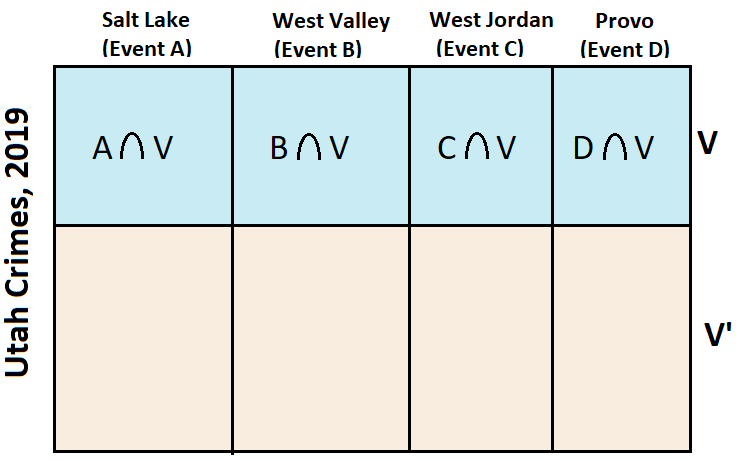
We can use the information above to find the probability that a crime reported in one of Utah's big cities was violent. The diagram below
illustrates that the crimes in Utah big cities can be divided into violent and non-violent and that we can divide each of those events
between the cities in which the crimes were committed.
The probabilities of the intersections identified in the diagram are:
$\small{P(A\cap V) = P(A)\cdot P(V|A)}$
$\small{P(B\cap V) = P(B)\cdot P(V|B)}$
$\small{P(C\cap V) = P(C)\cdot P(V|C)}$
$\small{P(D\cap V) = P(D)\cdot P(V|D)}$
Since each of the intersections is disjoint from each of the others (e.g. if a crime took place in Salt Lake and was violent,
it couldn't have been a violent crime in Provo) the probability that a crime was violent is the sum of the probabilities of these intersections.
$$\small{\begin{array}{lcl} P(V) & = & P(A \cap V) + P(B \cap V) + P(C \cap V) + P(D \cap V)\\ & = & P(A)P(V|A) + P(B)P(V|B) + P(C)P(V|C) + P(D)P(V|D) \\
& = & 0.563(0.111) + 0.235(0.187) + 0.121(0.086) + 0.081(0.085)\\
& = & 0.124\end{array}}$$
About 12% of crimes in Utah's big cities in 2019 were violent.
The process we went through above to find P(V) can be formalized into a rule called The Law of Total Probability. The rule
indicates that the probability of an event can be found by summing the probabilities of mutually exclusive constituent pieces.
Given a set of disjoint events $A_1, A_2, \ldots, A_n$ such that $\cup_{i=1}^nA_i=S$ and event B
$$\small{P(B) = \sum_iP(A_i\cap B) = \sum_iP(B|A_i)P(A_i)}$$
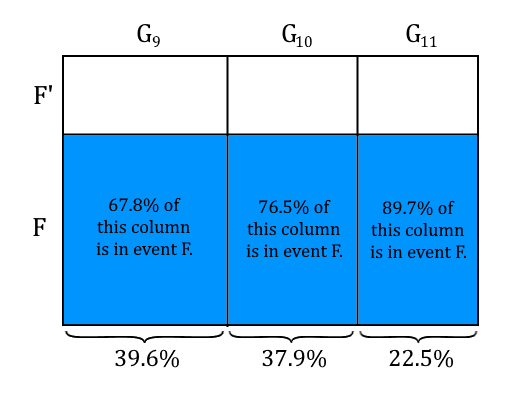
Let G9, G10, and G11 be the event that a teen is in 9th grade, 10th grade,
and 11th grade respectively. These are disjoint events (because one cannot be both a 9th grader and a 10th grader) whose union is the sample space
(because all survey participants were in one of these grades).
Let F be the event that a teen uses Facebook.
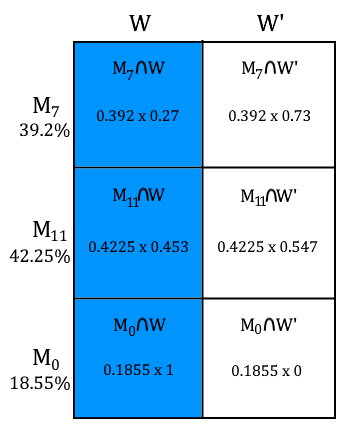
All zebrafish either have a KO7 mutation, a KO11 mutation, or no mutation so the union of these events is the sample space.
No fish fits into more than one of these categories, so the events are disjoint. Let M7 denote the KO7 mutation, M11 denote the
KO11 mutation, and M0 denote no mutation. Let W denote that a fish is wild-type. Find P(W).
Bayes' Rule is a formula that formalizes a way to find a conditional probability where the order of conditioning is the reverse of
known conditional probabilities. This formula builds on the ideas described above in the discussion of the law of total probability. Consider again
crimes in Utah's big cities.
Violent crimes constitute a small percentage of the total crimes in Utah's big cities.
Recall:
A: a crime took place in Salt Lake.
B: a crime took place in West Valley.
C: a crime took place in West Jordan.
D: a crime took place in Provo.
V: a crime that took place was violent.
P(A) = 0.563, P(V|A) = 0.111.
P(B) = 0.235, P(V|B) = 0.187.
P(C) = 0.121, P(V|C) = 0.086.
P(D) = 0.081, P(V|D) = 0.085.
If a crime was violent, what was the probability that it took place in Salt Lake City?
By the formula for condtional probability, $\small{P(A|V) = \frac{P(A \cap V)}{P(V)}}$.
By the multiplication rule $$\small{P(A \cap V) = P(V|A)P(A)}$$
By the law of total probability $$\small{P(V) = P(A)P(V|A) + P(B)P(V|B) + P(C)P(V|C) + P(D)P(V|D)}$$
$$\small{\begin{array}{lcl} P(A|V) & = & \frac{P(A \cap V)}{P(V)}\\
& = &\frac{P(A)P(V|A)}{P(A)P(V|A) + P(B)P(V|B) + P(C)P(V|C) + P(D)P(V|D)}\\
& = &\frac{0.563(0.111)}{0.124}\\
& = & 0.504
\end{array}}$$
Given a set of disjoint events $A_1, A_2, \ldots, A_n$ such that $\cup_{i=1}^nA_i=S$ and event B
$$P(A_j|B) = \frac{P(B|A_j)P(A_j)}{\sum_iP(B|A_i)P(A_i)}$$
The prompt indicates that P(F) = 0.258, P(F') = .742, P(C|F) = 0.72, and P(C|F') = 0.66. Find P(F|C). The conditioning in the
desired probability is reversed from the conditioning in the given probabilties; this is a good indication that Bayes' Rule will be helpful.
$$\begin{array}{lcl}
\small{P(F|C)} & = & \frac{P(F)P(C|F)}{P(F)P(C|F)+P(F')P(C|F')}\\
& = & \frac{0.258(0.72)}{0.258(0.72)+0.742(0.66)}\\
& = & 0.275
\end{array}$$
27.5% of students who have taken a higher math class are female.
Tree Diagrams and Bayes' Rule
Tree diagrams can be used to apply Bayes' Rule without need of the formula.
Given events A, B, C, and D such that:
Events A, B, and C are mutually exclusive and comprise the entire sample space.
D is an event that intersects each of the other three.
P(A) = 0.4, P(B) = 0.35, P(C) = 0.25
P(D|A) = 0.2, P(D|B) = 0.5, and P(D|C) = 0.8.
Tree 1 represents these events and probabilities.
To find P(B|D), recall that P(B|D) = P(B ∩ D)/P(D).
For the denominator, consider all the paths that where D occurs (highlighted on Tree 2).
The total probability associated with these paths is P(D). That is, the sum of the underlined path probabilities.
The numerator probability, P(B ∩ D), is found by multiplying along the single path that corresponds to these outcomes. This is circled in the diagram.
Let B, G, and O be the events a researcher was wearing blue, green, and orange respectively. Let C be the event that a capture attempt was successful.
The tree shows the the given probabilities. What is P(B|C')?
All the paths that include C' are highlighted in the tree; the sum of the corresponding probabilities is P(C').
P(B ∩ C') can be obtained from the path that includes both B and C' (this probability is circled).
$$\small{P(B|C') = \frac{0.142}{0.142+0.115+0.055} = 0.455}$$
The probability that an unsuccessful capture attempt was by a researcher wearing blue is 0.455.