
November 1902
Our story begins in November 1902 as Student Life, a twenty-page magazine dedicated to showing and expressing the interests of the Agricultural College of Utah.

1904
For the first few years of Student Life, acommencement issues was produced around graduation. This is the commencement issue of 1904.

November 13, 1908
In 1908, the Student Life Office was spruced up with some deep cleaning, a coat of paint, and cabinets. The staff was pretty excited that the office is now "a thing of joy and pride for ever."

1909
"A Staff Confession" article published in a issue of Student Life claims that the staff has for 9 months tried to lead readers astray and has "rustled up" facts. Looks like fake news started in 1909.

1909
The Buzzer is a school year book that ran from 1909 to 1971. This article talks about how The Buzzer is a great work and those following will have their work cut out for them.

1909
Advertising has changed drastically since 1909. Click on the image to take a look at how simple advertising used to be.

January 15, 1909
Most people are familiar with Prohibition during the 1920s that outlawed liquor. Interestingly enough, this idea of temperance started early. "In Logan City $165,000 are spent annually for liquor." Read the full article for the debate on Prohibition laws.

March 12, 1909
Helicon West is a program still around today. It started in 1909 to add classroom study of Shakespeare, Milton, Tennyson, and other literary authors to the discussion. On Thursday, March 4 Longfellow poems were discussed with Oliver Wendell Holmes as the next author. "In a word, the Helicon offers supplementary literary education and is, therefore, justly becoming popular in the U.A.C."

March 19, 1909
Should students who recieve an "A" in a class be exempt from finals? In the article "Final Examinations," the question if examinations actually give a correct understanding of students' knowledge is brought to light--a debate still going on today.

1914
1914 was the first year a fraternity was on USU campus. The chapter members of the Delta Nu Fraternity put in a lot of work to get it established here. Today, there are many fraternities on campus. This truly marked the beginning of a legacy.

1914
"War and the Poor" argues that the poor are always the ones to fight and to volunteer, not because they want to, but because it is necessary. The article further argues how unfair it is for these people and advocates that the government should be clear on what is going on.

1915
How does war effects the world? What is the driving force between war? This piece exposes the state of war in the world. At the end, the article states that there will not be a change until people come together to create one united nation.

1915
In 1915, Helen Keller visited Logan and spoke at the Logan Tabernacle about happiness. Helen Keller's teacher, Mrs. Anne Sullivan Macy, spoke as well. There was also a QnA with Keller. The author of the article wrote "Her visit will be remembered by all who were present."

1915
The front of this Student Life has a picture of most of the members of the Senior Class in 1915. Below is a list of all of the senior class members.

January 8, 1915
Student Life did many special edition issues. In this issue The Buzzer staff got to talk about The Buzzer and how it will be different and more exciting in 1915 than it was in the past. They talked about putting in as many individual pictures as possible, as one of the many changes. They were excited for this edition and everyone to be excited as well.

March 5, 1915
This special issue is dedicated to the junior class. The top photo is of the six junior class officers.

April 9, 1915
The Green Hat Issue of Student Life is dedicated to the story 'As the Green Hat Saw it'. The physical issue of this Student Life really does have green hats stamped on the page.

April 30, 1915
The front cover photo shows what the campus of the Utah Agriculture College looked like up to 1902. Below is an article about the Chemistry Club that this issue of Student Life is dedicated to.

June 10, 1915
On the left is a photograph of J. W. Sanborn the first Agricultural College President. On the right was the current president of the time, Dr. John A. Widtsoe.

July 7, 1915
Photographs on the front page of Student Life show what campus buildings looked like back in 1915. Check out the article right below 'A Faculty Ideal' to hear how faculty really feel about credits.

1921
The Student Life Staff had a lot of fun creating new and special editions of the magazine-turned newspaper. From commencement issues, to Student Lies editions, printing on blue paper and getting censored, they did it all.

1939
In 1939, Polish student, Bernard Immerdauer, was interviewed about the present European crisis, "The suppression of Poland by Herr Hitler's army didn't come as abruptly as the newspapers would have us think. It has been coming for years." He also said that he believed that Poland would become a free state again. To read more of the article click on the article.

1939
With World War II looming, this article sheds a light on propaganda issues. Who is causing a bigger problem? It also talks about both Germany and England and the differences in their tactics.

1939
This 50 year Photocade features pictures that depict the changes that had occured over the first 50 years of USU history.

October 12, 1939
After several years of contemplation, a tentative plan for a union building is estimated to cost more than $325,000 for two of a planned three units. The purpose of the union building is to provide extended facilities to meet students' needs "for many years to come." If carried out, construction will include two two-story wings, extension of the chapel or auditorium, and other main building improvements and renovations.

1940
Student Life put out a Forester's Edition where the front page featured stories about the folklore character Paul Bunyan arriving. Some other stories include "Found! Famed Off-Spring Of Babe The Blue Ox" and include a picture of "Paul's Assistant" along with a story about "Bunyan, Godfather Of Forestry Introduces New Tree To World In Great Conservation Move."

May 8, 1940
Student Lies was a mock issue of Student Life published every spring around April Fool's Day for a few years. It was complete with a section "Sasseity." Read for some quality entertainment.

1943
This mock issue of Student Life was realeased in 1943. The focus of this edition seems to be the war. This edition featured headlines such as "Servicemen Told to Vamoose" and "'Teeth" Found Murdered; Fails To Pose For Picture".

February 11, 1943
This extra edition was the first in USU history. The first picture of The Extra Edition has the headline "Army Assigns 1,000", and talks about the changes coming to the university and how the first group of Air Corps Cadets will be arriving to complete training at USU. The second is the article talking about the historical significance of the issue.

February 7, 1958
The first of a series of semi-weekly live broadcasts was heard from the new radio station, KVSC, on campus. The broadcasts were scheduled on Tuesdays and Thursdays from 7-7:30 p.m. The FM station was located in the Student Union building and arrangements were made with Logan radio stations to rebroadcast specific student programs that start on campus. Live shows were directed mostly to students, campus employees, and community members. Campus news and sports items were included in the shows.

1969
The Forward USU Forum wanted to upgrade the outside structure of Utah State and get away from the Aggie handle by picking up the Highlander. A 48 foot by 24 foot wide painting of a Scottish highlander was unveiled at a football game. A group of bagpipers were brought up from Salt Lake City complete with their kilts. The student body and alumni revolted against the reveal chanting, "we're still Aggies!"

November 26, 1969
A plan of campus drawn up by the Boston firm in 1912 was redone with a new plan, the Master Plan. The Master Plan removed unncessary buildings nad supplied new facilities on campus. Many buildings were moved to fourth north. Parking is still an issue, however, "the best use for limited campus land is obviously not for parking lots." Additionally, enrollment would have to reach 30,000 for the escaprment to be utilized.

1970
Chris Pederson was chosen by the Publications Council as the editor-in-chief for the 1970-71 school year. Improvements he hoped to make as editor-in-chief include better communication with other institutions linking other schools and hiring a secretary for the paper.

March 27, 1970
The new business building would allow the business college to have their own space instead of spreading out amongst 12 different buildings and offices in 6 different locations around campus. The nine story building cost $1,800,000 and consists of 7 seminar rooms, 5 departmental conference rooms holding 8-20 students. Three floors are dedicated to classrooms, leaving five floors to faculty offices with each department on a separate floor. The George S. Eccles Business Building was the tallest building on the Logan Main Campus and in Cache Valley prior to the new Jon M. Huntsman building, dedicated in 2016.

May 18, 1970
300 people marched in a parade from USU campus down through downtown Logan to protest the war in Asia. Protestors included high school and college students and faculty members. Three home-made bombs were thrown at the vigil keepers. Although about 15 people were sleeping in the area, no one was injured.

May 18, 1970
A group of USU students protested for 12 days their opposition to the Kent State killings and the U.S. involvement in Cambodia. They emphasized their peaceful protest which saw some conflict from "more conservative elements on campus." Bombs were thrown into the Quad three nights and "in a limited way participants viewed them as successful."

June 5, 1972
A full page of the Student Life is dedicated to the discussion of racial discrimination including an article on Oklahoma's first black judge speaking to USU students. It also includes an exclusive on the life of a black female student, and 'Blacks don't trust whites'.

1974
The editorial article 'Students are adults' received wide-spread attention and angered administration and other leaders. It criticized a dress code rule, smoking regulations, dorm visitation, and prior criticism the magazine received for using freedom of press. This editorial is one of many that angered leaders including a previous editorial 'Destructive Missions' criticizing LDS missionary service. These editorials saw many letters to the editor and eventually an editorial was written as an apology for what was said.

1974
Did you know Nigeria became a nation in 1960? Student Life commemorates the 14th anniversary of Nigeria as a nation. According to the article, the name "Nigeria" comes from the word "Niger" meaning great river. "Nigeria" means "Land of the Mighty River" or "The Country fo the Great Waters." Click on the image to read more about the birth of Nigeria.

October 18, 1974
Title IX of the 1972 Education Amendments caused features writer, Linda Perry, to wonder what Congress will decide after 90 days of deliberation. "Would everything go co-educational? Bathrooms, showers, dorms, intercollegiate sports, and clubs . . . opponents say yes. Contrast this to today's arguments on Title IX and equality in bathrooms.

1976
"In the late '70s the newspaper office was on the third (second?) floor of what we then called the UC -- Union Center. [. . .] I was literally dragged to Student Life, as the paper was called then, by the arm by the faculty adviser, Dick Harris--I think I was kicking and screaming -- and that was the start of my writing career [. . . ]. Anyway, we had a very talented staff, many of whom went on to very nice journalism careers -- photographers Al Hartmann and Ron Hendricks, editors Becky Cairns and Rich LaRocco, as well as our hilarious outdoor editor Randall Stutman. We had a darkroom -- no digital images of course -- and we hired an off-campus company (in Brigham City, I recall) print the paper, but first we had to lay out the paper without the use of electronics, with pencils and dummy sheets, on which we pasted the headlines, cutlines and copy to be printed. There were hazards -- one time an entire page or two was missing and we didn't notice until it had been distributed on campus. We also could not use the internet, since there was none, so we had to do background research the old-fashioned way -- phone calls and clip files. As I write this, I am amazed we actually put out a paper regularly [. . . and] that it actually came together each time. I somehow became sports editor soon after I started there and knew almost nothing. Then, as I recall, I was editor of the paper one summer. I think it's the last time I ever edited or laid out a paper, thankfully for all involved. [. . .]. I know everybody thinks the old days are better, but I believe the current student paper is better in almost every way, including the name. It's very well done."
November 14, 1977
A four-member committee consisting of Publication Board members met to discuss the possibility of the paper printing five days a week instead of the current three-day a week schedule. The committee also discussed changing the name of Student Life, but approval for the new name would come after one was selected.

March 24, 1978
The new "Carousel Square" is "a pleasant well-illuminated, bright-colored room with decorative panels, accenting woodwork, and trellised ceillings." Utah State University Food Services renovated the old USU cateria in the University Center to make meals more appetizing. Carousel Square uses a rotating service counter; loaded from the kitchen side; complete with hot, neutral, and cold tables.

April 3, 1978
The USU Publications Board okayed the purchase of computerized typesetting equipment for Student Life. About $10,000 from increased student fees is available to purchase the equipment. The board also talked about the paper publishing five times a week. A full-time adviser will be hired to handle the transition to five times a week and the new equipment. This adviser would get a salary of $11,000 which is around $41,000 today adjusting for inflation.

April 12, 1978
Sigma Nu celebrated 40 years with more than 220 alumni, members, and guests at a banquet and a reception. Judge J. Robert Bullock, the first person to be initiated into the USU Sigma Nu Chapter (founded in 1938) was the guest speaker. The chapter received the Rock Award from the Simga Nu Executive Director. This award is the highest award a Sigma Nu chapter can receive from their national headquarters, signifying "the chapter's excellence among the more than 200 chapters across the nation."

September 27, 1978
After 76 years as Student Life, the newspaper changes its name to a more newspaper-sounding name, The Utah Statesman. Along with the name change, the Statesman received $20,000 worth of new equipment allowing students to go from on campus to camera-ready. Larry Baker was hired to replace Dick Harris as the first full-time adviser for the student newspaper.

October 6, 1978
Glen L. Taggart, 11th president of Utah State University, is forced to retire as he hits his 65th birthday. He considered a job in Washington, D.C., where he would work in international affairs in economic and agricultural development of less developed areas of the world. He and his wife planned to remain in their Logan home during retirement.

October 9, 1978
Demands of parking due to the construction of The Residence Center led to the creation of a shuttle system. With the construction, 85 student parking stalls and 70 staff parking stalls are lost.

October 18, 1978
The publications board received an update on the Statesman's progress after the new adviser, Larry Baker, came on board and new equipment was purchased. Board members were told that the staff was adjusting well to the new equipment and the possibility of the tri-weekly paper turning into a daily was discussed. A daily paper would generated much-needed advertising revenue.

November 28, 1978
The last Student Life before the name change was published on Monday, August 7, 1978. Front page articles included 'State Board of Regents set tough fiscal priorities', "78 American West Festical called 'most successful'", and 'Upper Atmosphere Research reoports delivered'.

January 15, 1979
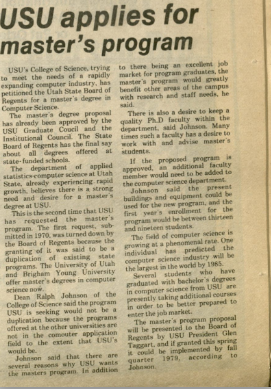
USU's College of Science petitions the Utah State Board of Regents for a master's degree in Computer Science in order to meet the expanding computer industry. The State Board of Regents has the final say about all degrees offered at state-funded universities. The first request was submitted in 1970, but was declined because it would be a duplicate of existing state prorgrams.
March 21, 1979
Grade point averages have been in a steady decline. Students "naturally prefer more liberal grading and often pressure professors to give easier A's," said Karl Lambert. Pressure from the public and professional schools influenced universities to tighten grading procedures 2 years prior.

April 23, 1979
Stanford Cazier, a former history teacher and vice provost at Utah State, was named the new president of Utah State University. Prior to returning to USU, he was president of Chico State University for 8 years. Cazier replaced Glen L. Taggart as the 12th president.

May 2, 1979
A bus was purchased at $42,500 to help with parking shortages expected during the construction of the Kellogg Building and Parking Terrace. This bus's route circled the outside of campus and took students to and from the center of campus. Most of the funding for this purchase came from traffic fine money which usually went to scholarships.

May 7, 1979
A new entrance and reception area for Old Main was dedicated in 1979 honoring Frederick Percival Champ, late president of the Utah State University Board of Trustees. The Champ family donated the funds to renovate and furnish the entrance which connects main entrances, principal administrative offices, and the auditorium.

1984
The Utah Statesman produced a special issue that featured the fire in Old Main, the damage that occured and changes in where the classes would be located.

1984 - 1985
In late October of 1984, owners of The Cache Citizen proposed to donate the newspaper in stages to USU in order to train student journalists. However, this idea caused a lot of drama as students invovled with the Citizen were discouraged from involvement with the Statesman. Eventually the partnership fell apart.
2001 - 2002
In both 2001 and 2002 Utah State Men's Basketball made it to the NCAA Championships.

September 12, 2001
9/11, 'day of infamy', caught the attention of the world including those at USU. TVs were set up in common areas around the Taggart Student Center for students and faculty members to stay informed as new developments were given.

2003 - 2006
"I remember having to crawl under a railing to get to my seat in the old Romney Stadium press box. Sitting literally shoulder to shoulder with other writers while brushing away dead flies was a unique experience. But it never bothered me, because I was just excited to be writing for the Statesman!"
2004
In 2004 the fee board recommended a decrease in student fees. That year only two fee increases were approved. One fee that was approved was a $0.25 fee increase for The Utah Statesman. The proposed student fees total was $261.75 for Fall 2004 compared to the $ 535.07 fee that full-time students paid Fall 2017. The fee board for this year just decided to increase the student fees for Fall 2018.

November 5, 2008
America elects first black president, Barack Obama, and Cache County reacts to the election.

November 24, 2008
A USU freshman died during what was part of the initiation process for membership to Sigma Nu fraternity. The offical cause of death was still under investigation at the time, but his blood alcohol content was "very high."

2009
"When I first started doing a show on Aggie Radio, I didn't use my real name. Despite this, every now and again I would go into the Aggie Ice Cream shop, and the workers there would recognize me by my voice. This was sort of weird because Aggie Radio was on UPR's HD3 channel at the time, which meant we had virtually 0 listeners. In fact, those people at the ice cream shop might have been our only listeners. It made my day and made me feel like I was doing something meaningful. Besides that, most of what I remember is hour after hour of cutting and producing clips and sound effects for my show and for others' shows, most of which was crap, but all of which provided me some meaningful exposure to media editing software, a skill I took into the workforce after I graduated. I'm very glad to have been involved."
2010
These pictures, from former editor-in-chief Benjamin Wood, shows what production nights looked like.

February 12, 2010
"My favorite memory of The Statesman involves The Logan Lurker, a Peeping Tom/burglar with a penchant for pilfering ladies' undergarments during the 2009-2010 school year. I was [the] assistant features editor at the time, and during an editorial board meeting I suggested that the newspaper coin a nickname for the criminal, in the mode of the Zodiac Killer, Unibomber, etc. [. . .]. Aaron Foote ultimately pleaded guilty to the crimes, but when he was first apprehended by the authorities, the Statesman ran a front page headline declaring that the Logan Lurker had been caught. In class that morning, my journalism professor held up a copy of The Statesman and bellowed 'THIS. IS. LIBEL!' It wasn't my story, or my headline, but I remember the profound shame and embarrassment that the paper had broken the cardinal sin of crime reporting. I took that lesson to heart when I became editor-in-chief the following year, and to this day I double check that I'm toeing the 'alleged' lines in any reporting that includes accusations of criminal and ethical violations. As a side note: The nickname 'Logan Lurker' became so ubiquitous that it was included in coverage of the crimes by non-student media outlets like the Deseret News and Cache Valley Daily. Those reporters attributed the moniker to "USU coeds," but those of us on the Statesman staff knew — and know — where the real credit belongs."

2013
In 2013, the Statesman switched offices with SOAR moving from TSC 115 to TSC 311 next door to the Office of Women and Gender.

March 27, 2013
After 50 years, the Huntsman School of Business needs to expand again. The new building cost $50 million dollars in order to accomodate the growing business schools. Dignataries at the Grand Opening Ceremony included Governor Gary Herbert, President Stan L. Albrecht, Jon M. Huntsman, and Elder M. Russell Ballard.

August 27, 2013
After long-time adviser Jay Walmsley retired in May of 2013, Nathan Laursen was hired to take the position advising the Statesman, Aggie Radio, and ASUSU Public Relations.

October 24, 2013
A vote was taken October 22nd and 23rd to decide whether ASUSU should become USUSA or something similar. The final results were 71% for and 29% against. This result caused the Student Association name to be changed to USUSA as it is known today.
October 21, 2014
On September 15, 2014 the FCC allowed Aggie Radio to become an FM radio station. Tune into Aggie Radio 92.3 FM KBLU-LP.

April 6, 2015
The first meeting was held in The Utah Statesman conference room the night of Monday, April 6. There about ten or twelve interested writers who brought ideas for radio shows and within an hour, the white board was covered. We settled on three viable shows and were split into three groups of three. On the Quad, Chasing the Grey, and The Revolutionaries were the three shows we started with.

November 21, 2015
On the Quad was the first Aggie Radio Theater episode published.
2016
Aggie Radio launched an FM station, 92.3 KBLU-LP, a culmination of nearly three years worth of work. Tune in to Aggie Radio 92.3 KNLU-LP for music, shows, sports broadcasts and more.

October 27, 2016
In 2016, Noelle Cockett accepted the invitation to lead Utah State University as the new president. She is the first female president of Utah State University.

December 8, 2016
After 11 years as university president, Stan Albrecht retired in 2016. Three hundred faculty, staff, and students said goodbye to President and first lady Albrecht, lining the walkways from Old Main to the TSC.

September 11, 2017
The Statesman was the first media outlet to break the news of the Department of Justice's investigation into the USU Title IX office for how it handles sexual assault complaints.

October 2017
Once again, the Statesman moved locations from TSC 311 to TSC 118 not far from its previous first floor location. The Statesman is now combined with Aggie Radio to make USU Student Media. Stop by our office!
2017
The Student Media Center was created taking the spot that Zion’s Bank used to fill in TSC 118.

Today
The Statesman has seen growth online and on social media. Student Media has done well in the awards circle winning many journalism, design, and multimedia awards on the stake and national level. In addition to the newspaper and Aggie Radio, Student Media produced a new special magazine, Highlander, and continues to grow.