
Spring 2022 Newsletter
The purpose of our newsletter is to inform stakeholders about our team's recent work and accomplishments. We produce an annual report in November of each year that comprehensively documents our research results, funding, and plans for the coming year. This newsletter provides a preview to the upcoming annual report and a less formal look at our teams' goings-on. The purpose of all this is to get you involved in our work. If you have questions or suggestions, please reach out!
Team News
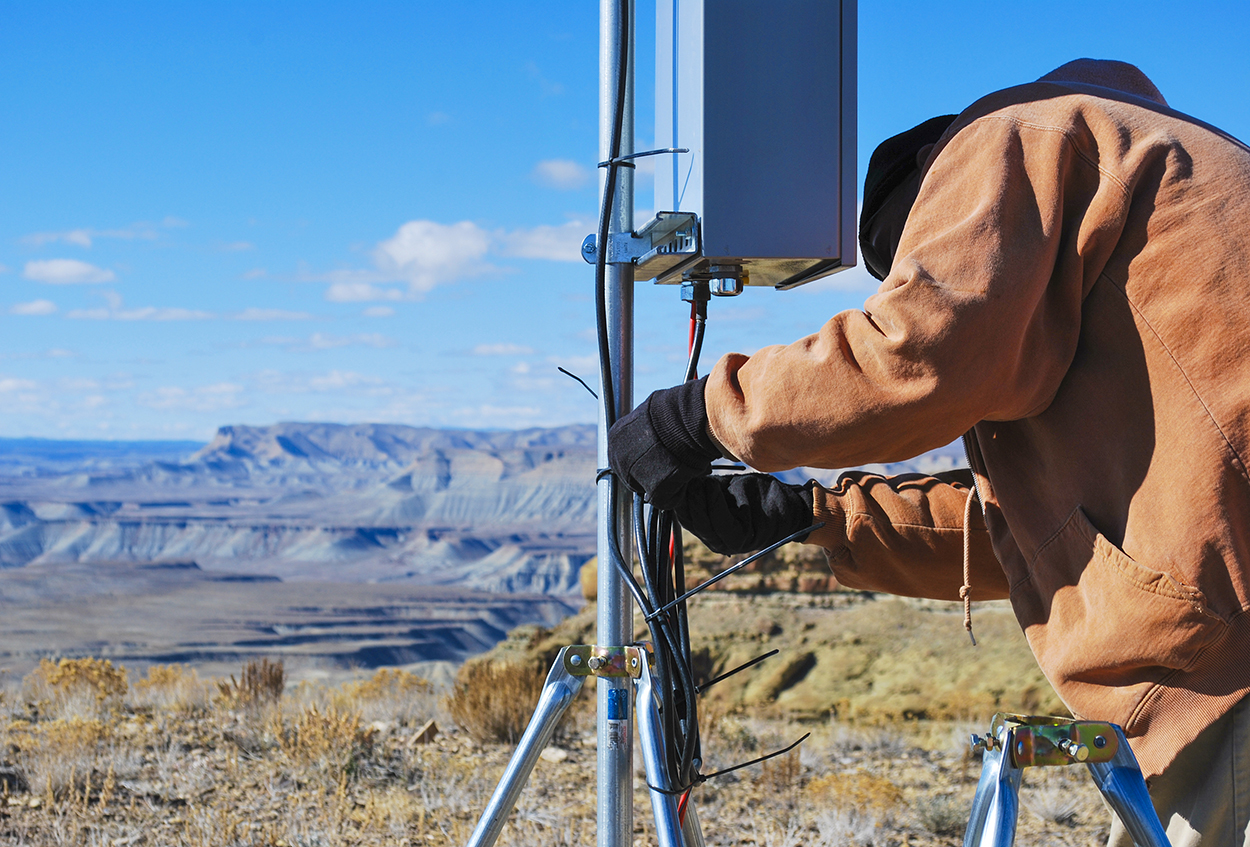
 Makenzie Holmes accepted into the nurse practitioner program at the University of Utah: Makenzie Holmes worked with us for several years while an undergraduate at USU-Uintah Basin. She managed complex analytical processes in our lab, helped with a number of different field and lab projects, and was a coauthor on a peer-reviewed publication. The picture at right shows her working at one of our portable organic compound sample collection stations. Makenzie graduated this spring, and she was recently accepted into the highly-ranked nurse practitioner program at the University of Utah. Makenzie's goal is to become a health care provider in the Uinta Basin. We are proud to have been a part of her educational path.
- Seth Lyman appointed a member of the UCAIR board of directors: The Utah Clean Air Partnership (UCAIR) is a nonprofit organization dedicated to promoting actions that improve air quality in the state. Its work includes public-oriented messaging, programs like yard equipment exchanges that reduce emissions, and a grants. UCAIR is very interested in pursuing projects and awarding grants in eastern Utah. Contact Seth for information about how you can get involved.
- Team participates in Air Quality: Science for Solutions Conference: Our team recently helped organize and participated in the sixth annual Air Quality: Science for Solutions conference, a Utah-centric air quality research conference. The following is a list of the presentations we gave. Ask us if you'd like a copy of any of them, or visit the conference website.
- Ozone and NO2 in the Uintah Basin (Liji David)
- Assessing Wintertime Ozone Prediction Sensitivity to Photochemical Mechanism (Greg Yarwood of Ramboll, Huy Tran)
- Atmospheric Mercury in the Rocky Mountain Region (graduate student Tyler Elgiar)
- Using Methane Observations to derive Top-down Estimates of VOC and NOx Emissions from Oil and Gas Production in the Uinta Basin (John Lin of U of U, Seth Lyman)
- Oilfield Pumpjack Engines Emit Much Less NOX and More Organics Than Previously Assumed (Seth Lyman)
Pumpjack Engines Emit Less NOX and More Organics than Inventories Assume
Seth Lyman
We recently completed a study (primarily funded by the Utah Division of Air Quality) to measure a comprehensive suite of pollutants emitted from natural gas-fueled engines used to power pumpjacks. We measured emissions from 58 engines used by three oil and gas production companies in the Uinta Basin.We found that average emissions of NOX from these engines was only 9% of those in the 2017 regulatory emissions inventory (Utah DAQ is updating the inventory to account for this new information; our comparisons were against inventory version 1.89). Additionally, average emissions of VOC were 15 times higher than inventoried values. We aren't certain why these large discrepancies exist, but it may be due to low engine loads or other differences in how engines are operated during emissions testing done for regulatory purposes versus actual operation in field conditions. Our final project report and an upcoming peer-reviewed publication have many more details about this project.
 Histogram of measured and inventoried NOX emissions from natural gas-fueled engines. Y-axes show the frequency of occurrence for each emission rate bin. The figure shows that measured NOX emissions were much lower than inventoried values.
Interannual Trends in Ozone, NO2, and Organic Compounds
Liji David
 Previous work in the Uinta Basin showed that ozone concentrations and the number of ozone exceedance days during winter inversions has been decreasing. We used annual and seasonal monthly ozone and NO2 (a precursor of ozone) data to study how Basin air quality has been changing across all seasons. We found that:
- Ozone and NO2 are trending downward in the central Basin (which is dominated by gas wells), though there is a difference of only ~5 ppb in the current annual mean ozone concentration compared to 2010-2013. NO2 shows a more significant change of more than 50%.
- In the western Basin (which is dominated by oil wells), NO2 is trending downward but the trend is not statistically significant. The current annual mean ozone concentrations are comparable to the 2011-2013 values.
- The seasonal trend shows a statistically significant increase in ozone at sites on the northern rim of the Basin in summer and fall.
We also looked at the satellite tropospheric NO2 vertical column densities (VCDs) to quantify the trend in oil and natural gas emissions. The NO2 VCD has decreased in the central Basin, and is associated with a reduction (by more than 50%) in gas production (Figure 1). On the other hand, increased oil production (>80%) since 2016 in the western Basin has led to an increase in NO2 VCD (Figure 1).
 In the rural U.S., ozone tends to be sensitive to NOx emissions. Therefore, we analyzed the annual mean ozone in three regions of the Uinta Basin (central, western, and northern) to examine if ozone follows NO2 trends. Ozone has increased overall in all three regions since 2015, but NO2 has decreased in the central and northern Basin. We also analyzed the other ozone precursor – organic compounds. The surface record of organic compounds in the Uinta Basin has been inconsistent, so we looked at satellite column formaldehyde as a proxy for organics emissions. The column formaldehyde has been increasing in the Basin since 2015, indicating an increase in organics emissions, which lead to ozone production.
Also, ozone has been increasing in much of the Basin during summer and fall, and these increases are associated with smoke from wildfires (Figure 2). These are the months when precursor emissions outside the Basin have the biggest impact on ozone production. Ozone exceedances due to wildfires have occurred during recent summers, which can impact attainment of the EPA ozone standard.
Impact of Seasonality on Ozone Chemistry
Marc Mansfield
Ozone formation in the atmosphere is a very complex chemical process, but it is well known that two chemical families, nitrogen oxides (NOX) and volatile organic compounds (VOC), are both required. Control strategies for reducing ozone are therefore focused on reducing either NOX or VOC emissions and concentrations, or both. However, ton for ton, ozone concentrations may be more sensitive to reductions in NOX, say, than to VOC, and we would say that the airshed is NOX-sensitive and VOC-insensitive. Conversely, an airshed may be VOC-sensitive and NOX-insensitive, or it may be sensitive to both. This aspect of an airshed is called its “photochemical regime.” A determination of the photochemical regime is important: It would be wasteful to impose costly NOX reductions, say, if the ozone concentration is insensitive to NOX. Indeed, sometimes an airshed has negative sensitivity to NOX: An incremental reduction in NOX can cause ozone to increase slightly. Certain measurements allow a tentative assignment of the photochemical regime; however, an accurate determination is non-trivial: One needs to run well-designed computer models informed by accurate measurements of NOX and VOC concentrations.The photochemical regime of the wintertime Uinta Basin has never been determined accurately, although since 2013 the data have suggested that the photochemical regime actually shifts from lower to higher NOX-sensitivity as winter progresses. We have now verified this trend with computer models of 24 different ozone events occurring between 2013 and 2021. The figure below displays our modeling results. It plots the incremental sensitivity both to NOX and to VOC in each of the models. (The incremental sensitivity, S, measures the response of the ozone concentration to a small modulation of the precursor concentration: A 1% reduction in precursor concentration produces an S% reduction in ozone concentration.) The models are more sensitive to VOC in early winter, with negative NOX sensitivity common in early winter. In late winter the models are equally sensitive to NOX and VOC. The extreme outlier at 6 February 2017 had exceptionally low NOX and exceptionally high VOC – conditions expected to produce a large NOX-sensitivity.
Based on these results we expect that incremental reductions in VOC emissions will reduce ozone more than equivalent incremental reductions in NOX, except in late winter. On the other hand, controls that effect large reductions in either NOX or VOC should both be beneficial.

Carbonyls During Uinta Basin Winters
Trevor O'Neil
We are investigating trends in ambient carbonyl concentrations at two measurement sites in the Uinta Basin, Horsepool and Castle Peak. Horsepool is in an area dominated by natural gas development, and Castle Peak is dominated by oil development. Formaldehyde, acetaldehyde, acetone and other carbonyls tend to be higher at both sites in the early winter, when less sunlight is available and inversion episodes tend to be longer and stronger. These conditions cause a buildup of emitted carbonyls under inversions, with less sunlight available to photolyze them.
The figure below shows daytime and nightime carbonyls at the Castle Peak site during winter 2020-21. Black dots represent the 24-hour average ozone for the day of each carbonyl sample. The stacked columns are carbonyl compounds, which we collected as 3-hour integrated samples. We collected daily samples with start times that alternated between noon and midnight. 
Atmospheric Mercury in the Rocky Mountain Region
Tyler Elgiar (graduate student)
 Mercury emitted into the atmosphere via natural and man-made sources has the potential to negatively impact wildlife and human health. Mercury can be emitted as either elemental mercury or in an oxidized form, and can dynamically convert between the two. Oxidized forms of mercury are much more reactive, soluble, and are readily taken up by ecosystems. Not much is understood about how mercury is oxidized in the atmosphere. Therefore, it is crucial that efforts are made to better understand the mercury cycle so stakeholders can make informed decisions on how best to mitigate mercury's negative impacts on humans and the environment.
We have developed a dual-channel oxidized mercury measurement system capable of measuring mercury in the atmosphere at ultra-trace levels. We have also developed a custom-built automated calibrator that can verify measurements made by the dual-channel system. In March 2021, we deployed the dual-channel system and automated calibrator at the mountaintop Storm Peak Laboratory in Steamboat Springs Colorado in an attempt to better understand the sources and behavior of oxidized mercury. The image at right shows these two instruments at Storm Peak. The dual channel system was in operation from March to October 2021. Early this spring (March 2022), we started the dual channel system and calibrator back up to continue our second year of measurements. We are finding high oxidized mercury during periods where air from the upper atmosphere descends upon the mountain. The upper atmosphere is rich in oxidants than can convert elemental to oxidized mercury.
Coming Up Next
- We are finalizing Uinta Basin ambient measurement data from the 2021-22 winter. Watch for more updates in our 2021 Annual Report, to be released in November.
- We have been working on several papers. Watch for peer-reviewed papers to be released in the coming months on the topics of engine emissions, temporal trends in Uinta Basin air quality, the region's photochemical regime, air quality modeling, and atmospheric mercury.