Ancient Greek Poet Sappho Highlighted at Aggie Talks Presentation
By Kirsten Reither |
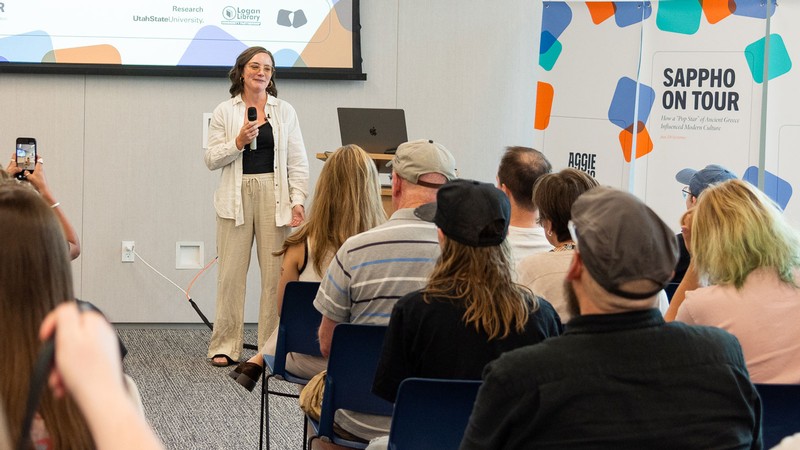
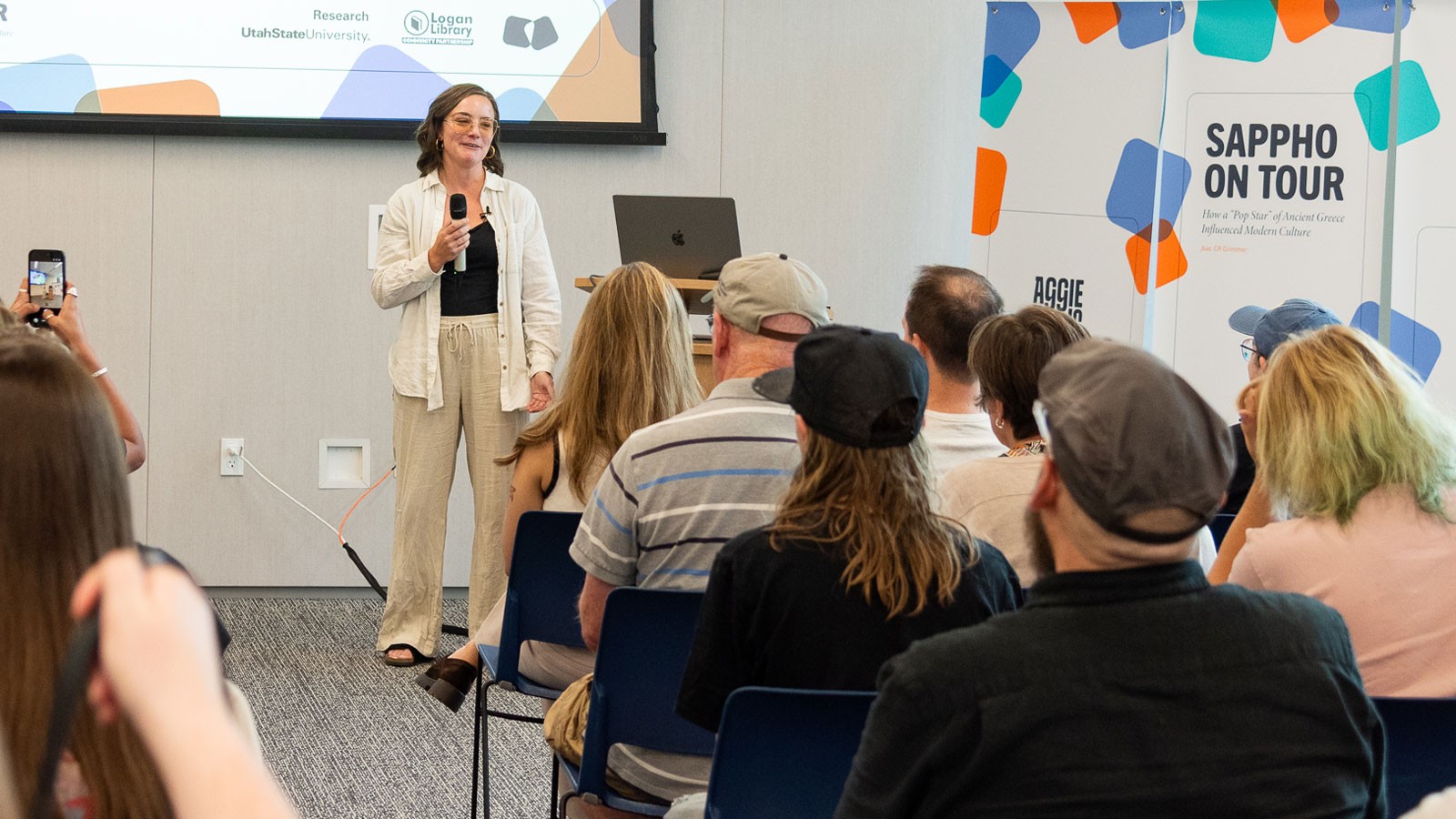
C.R. Grimmer presented at the Logan Library as part of Utah State University’s Aggie Talks series on Wednesday. The presentation, titled “Sappho on Tour: How a ‘Pop Star’ of Ancient Greece Influenced Modern Culture,” focused on the impact that the ancient poet Sappho has had on modern society, as well as how humanities scholars connect their work with the community.
Grimmer is a poet and an assistant professor in the Department of English. Their work bridges poetry, public scholarship, digital media and literary criticism.
“Poetry, for me, is about identity and the identities that are erased over time,” Grimmer said. “My first book was looking at poetry and queerness, disabilities, letters to doctors, families, lovers and pets.”
Grimmer’s current project is a digital interactive mapping project entitled “Sappho on Tour: Mapping Poetry, Place and Cultural Memory.” This mapping project focuses on connecting the artifacts and information that remain of Sappho with the place and culture in which she existed, as well as the culture in which she exists today.
“When you look for Sappho, there’s only fragments,” Grimmer said. “If I want to work with Sappho’s fragments and think about the thinking she was doing, how can I do that and acknowledge all the fragments of her?”
Part of why information on Sappho is so scarce is because her work was systemically erased by the norms and cultures that existed at the time.
“Sappho, because she wrote so much about sexuality and desire and love, was very made fun of,” Grimmer said. “The dominant ideas of the time said we shouldn’t [know about her].”
Because of the nature of Sappho’s writing, she has had a lasting impact on culture today, particularly on the LGBTQ community. The terms “sapphic” and “lesbian” originate from Sappho and her home island of Lesvos. Sappho also made a lasting impact on poetry as an art form — she had her own lyrical style of writing, and Plato considered her the tenth and only non-fictional muse, Grimmer said.
When visiting Lesvos to work on their mapping project, Grimmer described how they engaged in place-based writing for their poetry. They described fully immersing in the environment and how they emulated Sappho’s poetic style through their own writing.
“I’m trying to get a sense of every piece of the environment while I’m writing about it,” they said. “I wanted to be in that space and see what happened to my poems over time.”
When designing the digital mapping project, Grimmer emphasized the importance of immersion and community involvement. They discussed their work with both institutional and community partners to make the project as thorough, accessible and community-focused as possible.
“In my work, it’s also important to have community partners who aren’t tied to any institution but are aware of the community and what the community needs,” they said.
With this project, Grimmer hopes to connect modern communities with Sappho as she existed in Ancient Greece and as she exists today.
“What would it look like to create something that respects a place as it is but brings other people into Sappho and her heritage?” Grimmer said.
Within the mapping project, there are three levels of information: biographical information about Sappho, information about the places and rituals that took place, and information about “afterlives”— the memories and identities of Sappho that communities hold today and how they engage with them.
The project will also include three forms of learning. First, users can read or listen to Sappho’s poetry, translations and instrumental pieces on the lyre. Second, they can learn about existing research on Sappho. Finally, audiences can engage with place-based augmented reality and writing prompts.
Grimmer is still in the middle of planning and designing the interactive digital mapping project, a process that has spanned years and included multiple trips to Lesvos to research and meet with community partners.
“I want to highlight the time it takes. 2024 to 2027 is three years of essentially planning, meeting and revising, and then you start to build it,” Grimmer said. “If you want to do it quicker, you have to do it individually, and then you don’t get to engage with the community.”
Aggie Talks is a presentation series designed to highlight research in the humanities and the arts through community outreach. The series is presented by Utah State University’s Office of Research in partnership with the Logan Library. For more information or to view a recording of the presentation, visit the Aggie Talks website.
WRITER
Kirsten Reither
Research Communications
kirsten.reither@usu.edu
CONTACT
C.R. Grimmer
Assistant Professor
Department of English
cr.grimmer@usu.edu
SHARE
Comments and questions regarding this article may be directed to the contact person listed on this page.