Award-Winning Research Offers Guidance for Integrating Air Taxis Into Cities
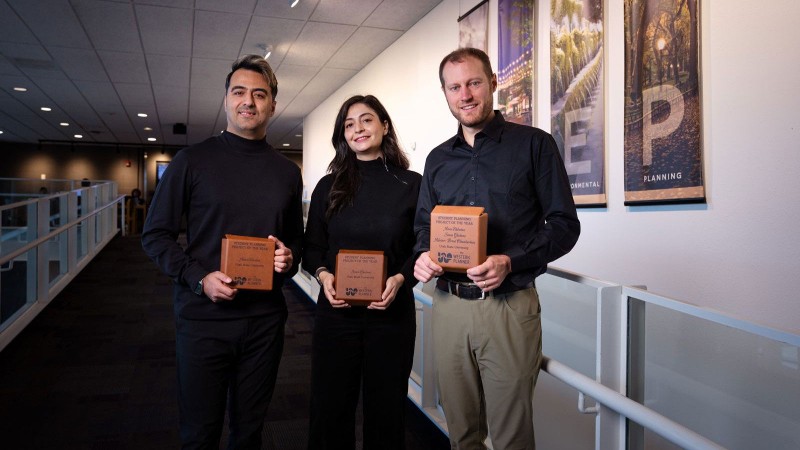
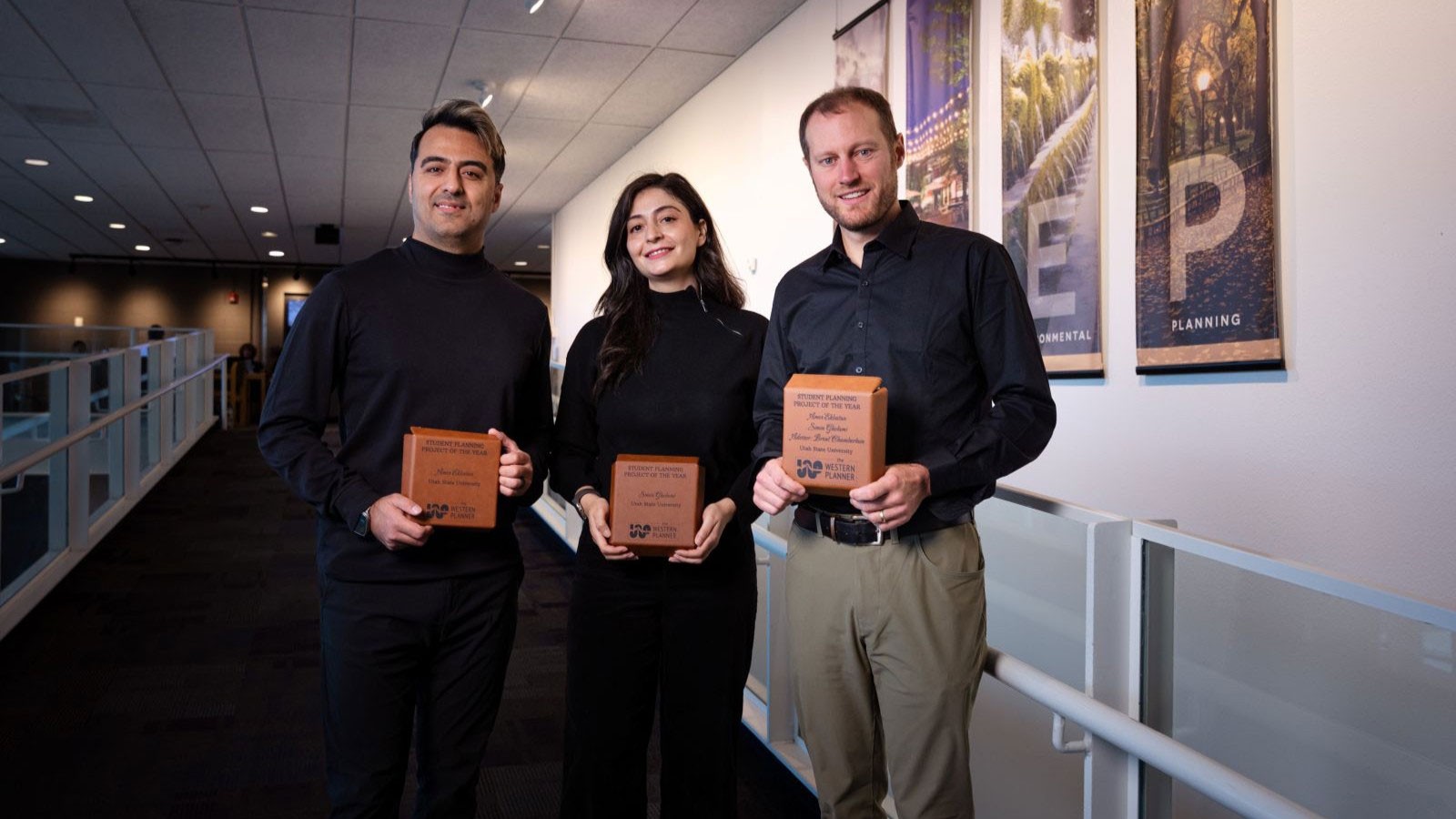
From right, Landscape Architecture & Environmental Planning doctoral students Ames Samavatekbatan and Simin Gholami, and their mentor, Professor Brent Chamberlain were recently honored with the Western Planner 2026 Student Planning Project of the Year Award, and the Airport Cooperative Research Program's Graduate Research Award. (Photo credit: USU/by Bronson Teichert)
When a city wants to create a takeoff and landing spot for electric air taxis — called vertiports — a federal rulebook explains how to build and operate one safely. Those guidelines cover essential aviation details like flight paths and physical design. But Utah State University Department of Landscape Architecture and Environmental Planning doctoral students Ames Samavatekbatan and Simin Gholami, along with Professor Brent Chamberlain, noticed a major gap: The rulebook doesn’t account for the unique characteristics of the city itself.
Their research project, Integrating Vertiports into Urban Systems, addresses this gap by connecting aviation guidance with urban planning. Cities are like puzzles, where each piece affects the ones around it. A vertiport can influence where people build homes, how buses and cars move, where parks and trees fit, how loud or quiet a neighborhood feels, and how residents experience their community.
Samavatekbatan and Gholami created a planning framework that considers the city as a whole, each bringing their own focus. Samavatekbatan examines environmental systems, connectivity, and transportation networks. Gholami studies urban form, greenspace, and how physical environments shape human health and well-being. Together, they’ve built a more complete “rulebook” for integrating vertiports into cities. One that looks beyond technical feasibility and considers the people, places, and landscapes that make each city unique.
Their work is already earning important recognition: The Western Planner 2026 Student Planning Project of the Year Award and an Airport Cooperative Research Program Graduate Research Award, highlighting both the technical and planning dimensions of their research.
One challenge they faced was translating technical aviation requirements into criteria planners could evaluate and apply to urban environments. Another was recognizing that cities aren’t blank slates; people will live next to, hear, and interact with vertiport infrastructure. This raised a key question: How can cities adopt new air mobility while protecting environmental quality, landscapes, and community well-being?
Their framework encourages planners to evaluate transportation, land use, environmental conditions, and community needs together. A technically feasible site may still be a poor choice if it disrupts greenspace, burdens environmental systems, or fails to connect with existing networks. The goal is shifting the focus from site selection toward helping cities plan for infrastructure that is compatible with future growth and resilient to long-term change.
Samavatekbatan and Gholami hope to shift the conversation from “Where can we build a vertiport?” to “How can this infrastructure support mobility while fitting into the landscapes and communities around it?” For them, early involvement from planners and designers is essential. The real question is not only whether the technology works, but what kind of cities it will ultimately shape.
WRITER
Natalie Kae Humpherys
Marketer/ Development Research Assistant
S.J. and Jessie E. Quinney College of Agriculture & Natural Resources
(435) 797-2140
n.humpherys@usu.edu
CONTACT
Brent Chamberlain
Professor
Department of Landscape Architecture and Environmental Planning
435-797-0213
brent.chamberlain@usu.edu
SHARE
Comments and questions regarding this article may be directed to the contact person listed on this page.