Beyond 3-D: USU Data Scientist Introduces Novel AI Tool to Interpret Complex Biological Data
DSAI Center Director Kevin Moon, with colleagues at USU and other institutions, describes RF-PHATE, a supervised data visualization method that enables exploration of multi-dimensional biological structures and processes, in a June 30 online paper in the journal Nature Computational Science.
By Mary-Ann Muffoletto |

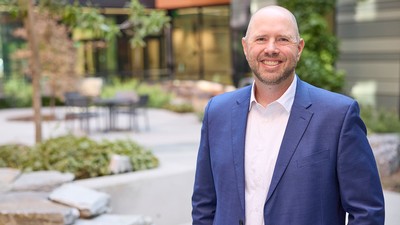
USU data scientist Kevin Moon is the corresponding author of a collaborative, multi-institution paper in the June 30 online issue of Nature Computational Science, introducing a novel AI tool to interpret large, complex biological datasets. Moon is director of the USU Data Science and AI Center. (Photo credit: USU/M. Muffoletto)

As humans, our eyes take in two-dimensional images our brains convert to three-dimensional experiences. This ability enables us to be aware of our position in space, judge distances, perceive depth and visually examine and enjoy all manner of objects and happenings.
But trying to envision sub-visible structures and high-dimensional processes that our human-engineered scopes can’t capture is a challenge for data scientists and visualization experts, who turn to machine learning and AI tools to amplify visual exploration.
“Biological processes are an example of complex, high-dimensional data,” says Kevin Moon, director of USU’s Data Science and Artificial Intelligence Center and associate professor in the Department of Mathematics and Statistics. “One of the datasets we’re using to test our AI tools, for example, is clinical data measured from multiple sclerosis patients. These datasets include hundreds of thousands of data points on disease progression at the cellular level, along with treatments and clinical outcomes.”
Moon is corresponding author on the paper, “Gaining Biological Insights through Supervised Data Visualization,” which was posted online June 30 in Nature Computational Science.
The paper was published in collaboration with:
Lead author and USU alum Jake Rhodes (Ph.D.’22, statistics), assistant professor at Brigham Young University.
Adele Cutler, professor emerita of USU’s Department of Mathematics and Statistics.
Anhong Zhou, professor in USU’s Department of Biological and Chemical Engineering.
USU alum Wei Zhang (Ph.D.’21, biological engineering), researcher at the University of Utah.
The team, whose research is supported by the National Institutes of Health and the IVADO Visiting Scholar Program, includes additional national and international collaborators.
“In this paper, we introduce RF-PHATE, which is an acronym for Random Forest-Potential of Heat-diffusion for Affinity-based Trajectory Imbedding,” Moon said. “That’s a mouthful, but it’s a supervised data visualization method that enables us to explore relevant data relationships in multi-dimensional datasets.”
To understand this, he said, it helps to explore the capabilities of previously developed unsupervised and supervised data visualization methods.
“Commonly used unsupervised methods, including PHATE, t-SNE and UMAP, and existing supervised methods help us visualize the structure of big datasets,” Moon said. “But each has some weaknesses. Some tend to over-emphasize differences between groups of data, and fail to take into account how those groups relate to each other. RF-PHATE does a much better job of preserving the structure of how they relate to each other.”
Demonstrating the model’s capabilities in the paper, the team documents how RF-PHATE provides evidence of a previously suspected multiple sclerosis sub-type.
“Identifying sub-types is crucial, because MS affects each patient differently, and knowing the specific type guides treatment decisions,” Moon said.
Additional datasets used to investigate the RF-PHATE model included COVID-19 patient plasma data and antioxidant-treated lung cancer cell data, but Moon notes the model is not limited to biological data.
“RF-PHATE can be applied to many other disciplines, and can also be used to develop more interpretable AI models, as well as to analyze the models themselves,” he said. “This is still a very active area of research for our group.”
Moon encourages both undergraduate and graduate students to explore this area of research, along with other interdisciplinary opportunities facilitated by the USU DSAI Center.
“We support AI for Science — an international movement that encourages the use of artificial intelligence and machine learning to accelerate research, analyze massive datasets and simulate complex systems,” he says. “Through interdisciplinary collaborations, we can develop and use AI tools to analyze scientific data more effectively and foster discovery.”
Collaborating institutions on the paper, in addition to Utah State University, include:
Brigham Young University.
Université de Montréal.
Mila-Québec AI Institute.
Centre Hospitalier de l’Université de Montréal.
University of California, San Francisco.
University of Utah.
Charles LeMoyne Hospital.
University of Lausanne.
McGill University.
WRITER
Mary-Ann Muffoletto
Communications Specialist
College of Arts & Sciences
435-797-3517
maryann.muffoletto@usu.edu
CONTACT
Kevin Moon
Associate Professor
Department of Mathematics and Statistics
435-797-0749
kevin.moon@usu.edu
TOPICS
Research 1181stories Technology 221stories Biology 210stories Innovation 132stories Artificial Intelligence 43storiesSHARE
Comments and questions regarding this article may be directed to the contact person listed on this page.