Breaking Ground at ASPIRE: ASPIRE Studies Pavement Integrity With University of Texas at El Paso
By Lucy Larson |
Researchers at ASPIRE are not only looking at ways to build electrification up but also studying the ways it breaks down.
The Utah Department of Transportation sent a truck equipped with a falling weight deflectometer to the research center on Sept. 23. In this effort with ASPIRE’s team at the University of Texas at El Paso, researchers sought to test different pavement materials and whether they can withstand the same wear and tear as traditional roads.
One of the goals of ASPIRE’s dynamic wireless power transfer, or DWPT, project is building confidence in electrified roadways. Because these roads need wireless charging pads embedded in the pavement, it’s important to know how well they hold up under real traffic.
“The question we wanted to answer is whether having that pad in the road changes how the pavement carries traffic loads,” said Pedram Balooch Sirgani, a civil engineering doctoral candidate with ASPIRE at University of Texas at El Paso. “In the lab we control almost everything. At the EVR we got to see how the same ideas hold up at full scale with a real truck and real pavement layers.”
Sirgani has been with ASPIRE since 2023. His doctoral research focuses on wireless charging systems embedded in asphalt pavements, a direct connection to the project at ASPIRE’s headquarters, the Electric Vehicle & Roadway research facility. At the USU site, Sirgani was in the field during the drop tests and has since been working on processing the fiber optic and deflection data.
“That includes turning millions of strain readings into profiles and animations that show how the pavement responds as the truck tire moves over the pad,” he said.
A Look Inside the Pavement
Fiber optic sensors were embedded through the pads sitting beneath concrete, asphalt, and interlocking pavers. The team used distributed strain sensing fiber optics that measure the response of the pavement sections as a loaded electric truck drives over them. At the same time, the falling weight deflectometer truck applied controlled impulse loads to the pavement surface, which measured the resulting surface deflections.
“As the truck moves across the pavement, these sensors capture the strain response continuously along the section,” said Cesar Tirado, University of Texas at El Paso associate professor. “That allows us to see whether the embedded DWPT components and their interfaces affect how the pavement responds to traffic loads, which is directly tied to its long-term structural performance and service life.”
Tirado became involved with the project through University of Texas at El Paso and the Center for Transportation Infrastructure Systems. Through collaboration with ASPIRE on pavement systems and dynamic wireless power transfer research, Tirado helps with the coordination of UTEP’s pavement and instrumentation research and mentors the students who carry out much of that research.
“At UTEP, we usually study pavement performance in controlled settings. The EVR takes that work to full scale,” Tirado said. “It is not separate from our work at UTEP. It is an extension of it, and it gives our students the opportunity to connect modeling and laboratory research with a real-world application.”
From Prediction to Real-World Application
Finding out the strain is instrumental in determining the life of the pavement and estimating how long it’s going to last. It’s better to determine these figures before being laid under real traffic by designing models here at ASPIRE.
“For transportation agencies, a central question is whether embedded charging systems will compromise pavement performance or shorten service life,” Tirado said. “The field data will help ASPIRE evaluate DWPT designs that provide charging capability while preserving the structural performance expected of a roadway.”
Tyler Munk, ASPIRE’s engineering and infrastructure project manager, has operated as the project lead and liaison between ASPIRE and the Concrete Masonry & Hardscapes Association — who supported the paving stone installations that were among the pavements tested. He believes that this research will strengthen ASPIRE’s capacity to seamlessly integrate wireless power transfer systems into various scenarios.
“Each pavement type has its own pros and cons to installation, cost, durability, longevity,” Munk said. “We’d really like to understand what strain our electrical system is seeing underneath each of those pavement types so we can identify the rights times and the right cases to use each pavement type.”
While the field testing might be over, the research surrounding pavement integrity is far from complete. ASPIRE researchers at UTEP are still interpreting the data gathered from the FWD and fiber optic cables in hopes of furthering real-world electrified roadway deployment.
“We are still analyzing the data so I would not draw conclusions yet,” Tirado said. “But seeing that level of detail in a full-scale electrified pavement was exciting. It is one thing to predict the pavement response in a model; it is another to measure that response directly in the field under a real vehicle load.”
For the latest news, publications, and research highlights from ASPIRE, visit aspire.usu.edu.
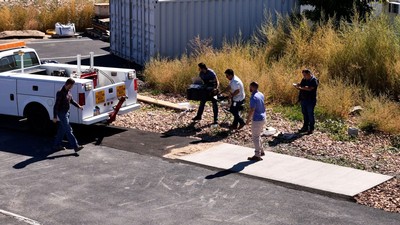
Researchers set up the falling weight deflectometer truck at ASPIRE's test track.


Pedram Balooch Sirgani collecting data at ASPIRE's test track.

WRITER
Lucy Larson
Communications Specialist
ASPIRE
a02438271@usu.edu
CONTACT
Kat Webb
Brand & Strategic Communication Manager
ASPIRE
kat.webb@usu.edu
SHARE
Comments and questions regarding this article may be directed to the contact person listed on this page.