Bucking Trends: What New USU Research Says About Mule Deer in Utah
By Lael Gilbert |
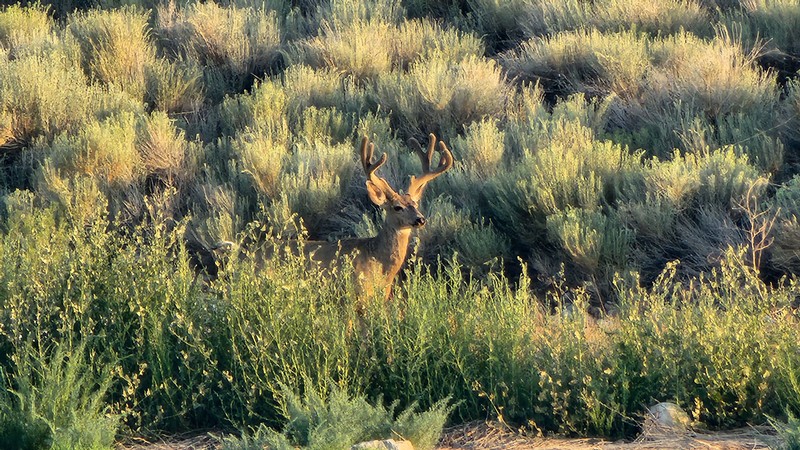
(Photo credit: Adam Wixom)
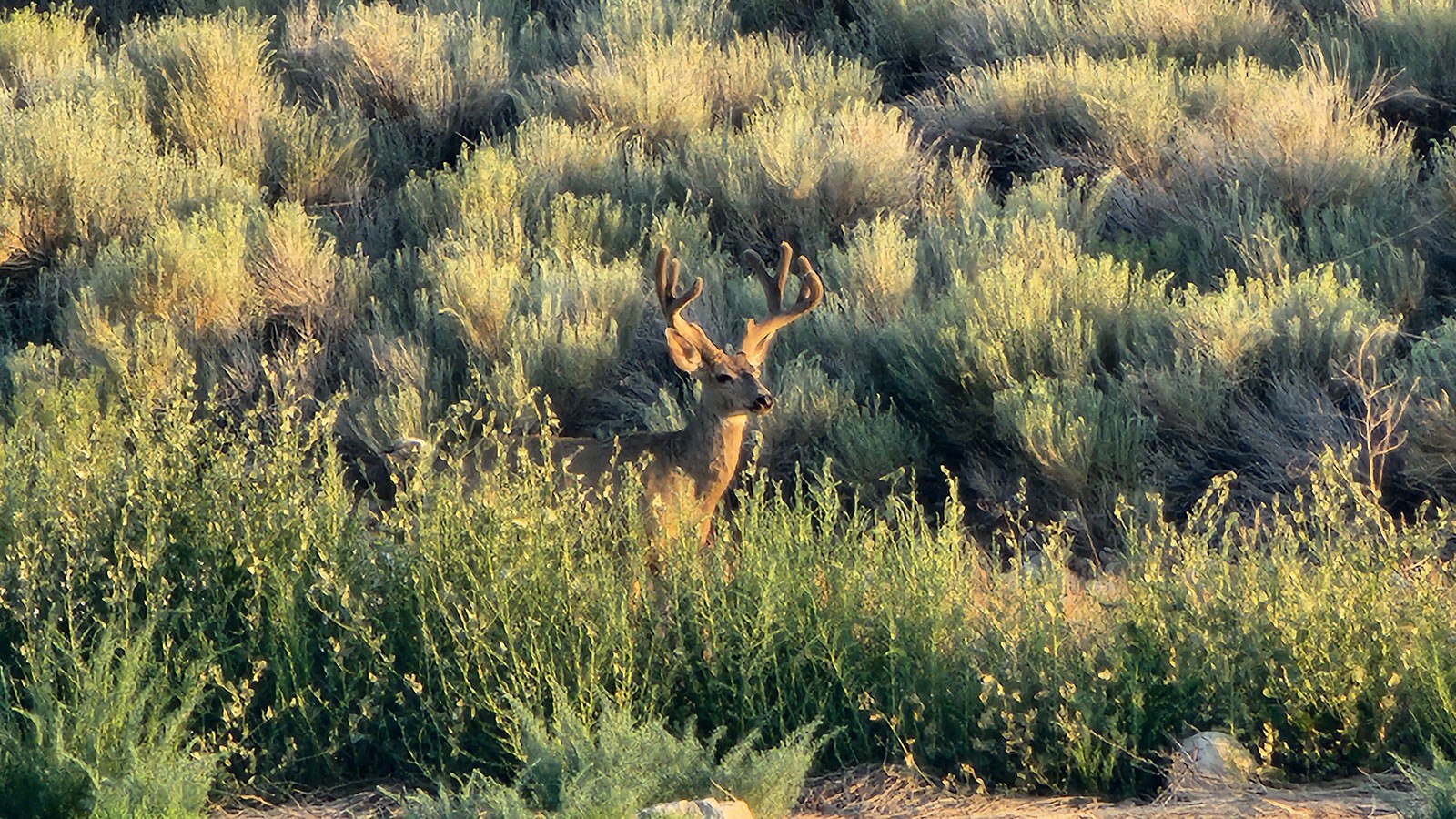
Utahns have a deep affinity for mule deer — they enjoy seeing them browse sagebrush slopes, love to pursue trophy bucks and appreciate the role they play in Utah’s unique ecosystems.
Wildlife ecologists in USU’s Department of Wildland Resources study mule deer health, behavior and movement to support land managers who make complex decisions about deer populations in the state. In partnership with the Utah Division of Wildlife Resources and Brigham Young University, USU scientists are pushing forward important research to keep deer herds strong and to address some of the biggest threats to their health.
Based on their recent research, here’s what USU mule deer experts want you to know.
Do we have too many or too few mule deer in Utah?
Deer populations naturally shift, said David Stoner, wildlife Extension ecologist from the Department of Wildland Resources, largely in response to the amount of good habitat and food available to them. New research from Stoner and others shows that long-term drought, such as what we are experiencing now in Utah and Nevada, reduces the kinds of habitat that deer favor by 10%, and extreme drought conditions decrease fawn survival by more than 34%.
Deer populations have always fluctuated in Utah, Stoner said. The 1980s brought a series of especially wet years when plants thrived and mule deer multiplied. Some consider those numbers the benchmark for what Utah wildlands can support. But Utah’s climate won’t support high numbers indefinitely, especially with increasingly variable precipitation, Stoner said.
Mule deer tend to be sensitive to climatic shifts — more than elk, which are generally more adaptable to changing environmental conditions. Long droughts, deep snow and wildfires impact deer population quickly. Managers have tools they can apply to support populations, but they also have to work within the limits imposed by nature.
What are the biggest challenges to building healthy herds in the state?
Wildlife disease ecologist Kezia Manlove studies patterns of animal movement to grapple with one of the major threats facing mule deer — chronic wasting disease. It is a contagious neurological illness that affects deer, elk, moose and other cervids, and is nearly always fatal. (There has never been a documented case of chronic wasting disease crossing to humans.)
Utah has so far avoided the high prevalence of chronic wasting disease seen in some neighboring states, but several Utah hotspots are slowly expanding. One of the biggest challenges to controlling the disease is that there aren’t great management options once it is present in a herd, according to Manlove. Research shows that keeping buck-to-doe ratio low (fewer bucks) seems to be associated with lower rates, though it’s not yet clear precisely why.
Chronic wasting disease moves through herds through direct contact, deceased animals, soil and from mother to fawn. Chronic wasting disease is not caused by a bacteria or a virus, but a prion, which can endure in soil for years. Non-migrating deer herds that reside in towns and cities seem to be more prone to spreading the disease, and Manlove’s team is determined to better understand why. In cooperation with the Division of Wildlife Resources, USU researchers are collecting samples from hundreds of hunt-harvested deer through volunteer road-side check stations to understand where chronic wasting disease exists, how it spreads and how to hold it in check.
“This is vital science coming directly from hunters — and an incredible way for the people who care about healthy deer herds to contribute to solving this serious problem,” Manlove said.
What tools do land managers have?
Research from Erica Stuber, wildlife ecologist in the Department of Wildland Resources and Utah Cooperative Fish and Wildlife Research Unit, is showing that large-scale habitat restoration is one of the most powerful tools for supporting mule deer.
Through Utah’s Watershed Restoration Initiative, agencies invest in projects that improve the quality of the forage on lands mule deer depend on. Teams remove overgrown pinyon-juniper woodlands that shade out the grasses, forbs and shrubs that deer need for food.
Managers then use native seed to jump-start the return of diverse, nutritious vegetation. Research led by Jack Rasmussen, a graduate student working in Stuber’s lab, shows that mule deer use these restored areas more, and spend a lot of time in them, a sign the restoration efforts seem to be working.
These projects matter, Rasmussen said, because deer survival hinges on the kind of high-quality habitat that lets them put on fat in summer and find forage in winter. Restoration efforts on state, federal and partner lands are designed to protect and improve critical winter ranges by removing less nutritious tree cover and boosting sagebrush and other key plants.
“It comes down to whether deer can build fat and find forage to get them through to spring,” Rasmussen said. “If they can do those things, they’re more likely to survive and reproduce.”
What drives mule deer into developed areas?
Often mule deer move into urban, suburban and agricultural areas because they are places that they've been using for decades, said Tayler LaSharr, a movement and nutritional ecologist in the Department of Wildland Resources. Mule deer are extremely faithful to their seasonal ranges, returning to the same places, year after year. As human development expands into mule deer range, animals continue following the same routes — even when they now run through suburban neighborhoods and roads.
Decisions about risk and food also shape how deer use agricultural and urban land, LaSharr said. Some animals seek pockets of land where the trade-off between risk and reward for facing roads, dogs and fences are worth it to get access to calorie-dense gardens and landscaping.
LaSharr’s recent research highlights how very risky a mule deer’s first migration can be, especially for young animals moving through agricultural lands. One research project looked at how a mother's decisions about migration shaped the survival of her young. Those that migrated through areas with more agricultural land had offspring that faced greater risk for mortality during their first migration. Juvenile deer are inexperienced and tend to be comparatively bold, LaSharr said. When they cross areas with farms and fields, they can be slowed down by unfamiliar obstacles or trapped on unfamiliar terrain, making them more vulnerable to accidents and predators.
USU research shows that healthy mule deer depend on more than population numbers alone. Climate, disease, habitat quality and human development shape their future, and understanding those factors can help managers make decisions to keep mule deer on Utah lands.
WRITER
Lael Gilbert
Public Relations Specialist
S.J. and Jessie E. Quinney College of Agriculture & Natural Resources
435-797-8455
lael.gilbert@usu.edu
CONTACT
David Stoner
Researcher
Wildland Resources Department
david.stoner@usu.edu
TOPICS
Research 1181stories Ecology 195stories Land Management 174stories Wildlife 163stories Animals 152storiesSHARE
Comments and questions regarding this article may be directed to the contact person listed on this page.