Creating Connections: Students From California Explore Opportunities at USU
By Andrea DeHaan |
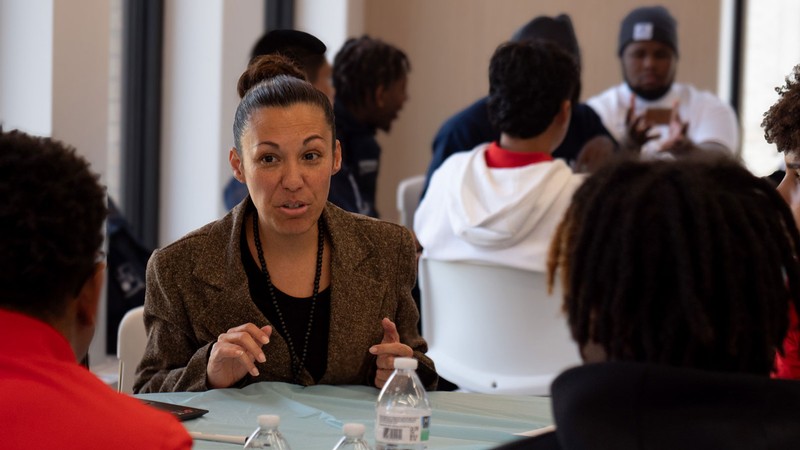
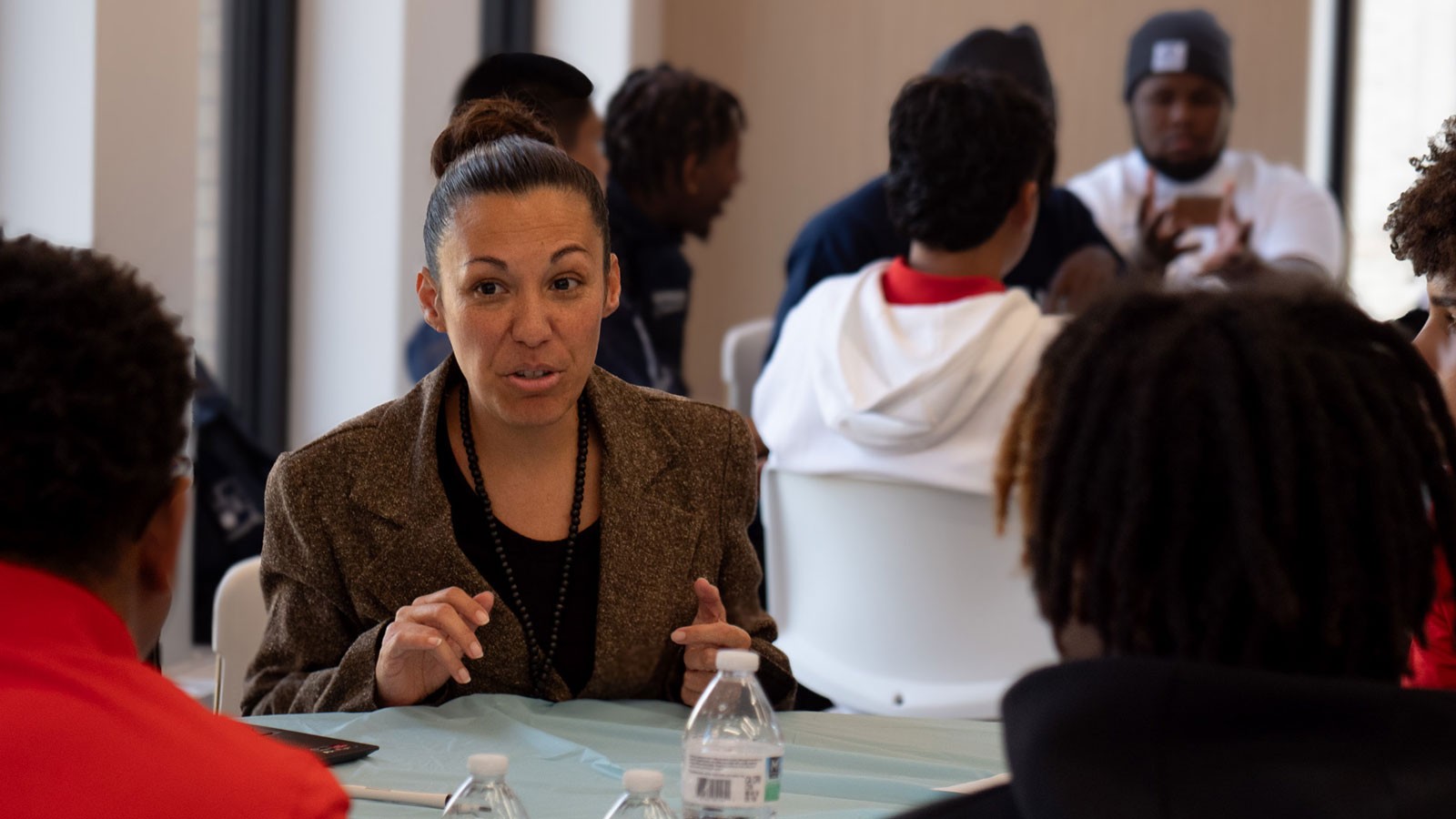
Lecturer and Program Coordinator Tasha Iglesias speaks to students from the Urban Student Athlete Development Academy at USU's Express Lane to Excellence event on Nov. 6.
Several days after the first snow of the season arrived in Logan, 23 middle and nine high-school-aged students from California found themselves at Utah State University. They were at USU’s main campus to explore programs, meet with clubs, discover research opportunities and learn about the college application process.
“The moment I stepped foot on campus, I felt a sense of family, a sense of belonging, and I feel like our students are really gaining a lot of knowledge … It's been a wealth of information, and we're loving our experience so far,” said Bryce Keyes, senior program manager for Brotherhood Crusade — one of two organizations to organize a trip to USU alongside efforts to expand college access for underrepresented students.
Organized by faculty and alumni in the College of Humanities and Social Sciences, USU’s inaugural Express Lane for Excellence event happened on Nov. 6 in partnership with the Jon M. Huntsman School of Business and two nonprofits led by CHaSS alumni Charisse Bremond-Weaver and Dion-Jay Brookter.
Cree Taylor, the CHaSS associate dean for inclusive excellence and belonging, planned a day of college exploration that included tours of the campus and a chance to meet with other students. She spoke of her own time as a student at USU and the importance of collecting a variety of skills in college.
“How many USU students here today have connections to more than one college?” she asked, noting her own experience of majoring in English but earning her teaching credentials through the Emma Eccles Jones College of Education and Human Services.
Several students who raised their hands were dual majors in CHaSS and in Huntsman, and Taylor asked the school-aged attendees if they had heard of a certain cookie franchise (they had), telling them how it had originated in Logan while its co-founder was taking an entrepreneur class but majoring in communication studies.
After a morning at the Huntsman School, students gathered for lunch in the Mehdi Heravi Global Teaching and Learning Center before meeting with representatives from student clubs and CHaSS-affiliated research centers.
“I'm always excited to talk to students before they enter higher ed because we want to catch them from the beginning,” said Nora Tavana, the Heravi Peace Institute’s program coordinator, who has worked with a lot of first-generation students and sees value in helping them discover new opportunities.
“They might know, or think they know what peace is … but not a lot of them have thought about themselves as peacebuilders, and in these few minutes, I have the chance to tell them that no matter what field you're in, you can still [be] a peacebuilder,” she said.
Associate Professor Jessica Schad sat at a table with students wearing white polos embroidered with the Brotherhood Crusade insignia. Several were also donning their new Huntsman sweatshirts.
“You’ve probably thought about water and drought before, living in California, in Los Angeles,” she said.
There to share information about the Community and Natural Resources Institute, Schad briefly discussed the implications of climate change in Utah and the studies USU faculty and students are conducting to inform policymakers looking for possible solutions.
“Not only do you get to take classes, but we’re one of the best institutions in the country for getting students involved in undergraduate research,” Schad said to the group before describing some of the ways CANRI works with communities to gather data.
Across the room, USU Black Student Union Secretary Ta’Mariah Jenkins, a senior majoring in political science, was asking middle schoolers from the Urban Student Athlete Development Academy — the group sponsored by San Francisco-based nonprofit Young Community Developers — what they hoped to get out of college.
“So, you want to be a student-athlete? It depends on how much you want it and whether you’re willing to put in the work,” Jenkins said, calling college an investment, even for students who benefit from financial incentives.
Following the speed round with USU representatives, Taylor encouraged the visiting students to meet with CHaSS advising or ask additional questions about the programs on view. Taylor said there were also Emma Eccles Jones College and Caine College of the Arts faculty on hand, alongside CHaSS and Huntsman ambassadors, creating opportunities for candid conversations.
“We wanted the students from California to know that they have the power within themselves to make meaningful decisions for their lives. Leaving California to attend college out of state will be challenging and may feel daunting, but it is such a low-risk way to learn more about their future possibilities,” Taylor said. “Maybe they learn that they don't want to build their lives in California. Maybe they also learn that they want to go back home, but they will bring with them the new knowledge and skills they acquired while they were in college.”
The students then toured USU facilities and met with the Office of Admissions to preview the college application process. Their visit to Logan coincided with True Blue College Access Day and included taking in an Aggie basketball game that USU won 101-46 against Alcorn State University.
“We're a nonprofit organization focused on youth development and removing the barriers that deter our young people from being successful in school and life,” Keyes said. “We teach them the important aspects that go along with that as well as … the importance of responsibility, critical thinking, how that factors in problem-solving. So, we're introducing all of these things while they get to see it in real-time.”
This was the first time the Brotherhood Crusade brought students to USU — it was the second for the Urban Student Athlete Development, whose sponsor, Young Community Developers, organized San Francisco-based internships for USU students earlier this year.
Taylor hopes that CHaSS will continue to develop reciprocal partnerships with nonprofits like these so “We can work with, learn from, and serve each other for the benefit of every single student involved.”
WRITER
Andrea DeHaan
Communications Manager
College of Arts & Sciences
435-797-9947
andrea.dehaan@usu.edu
SHARE
Comments and questions regarding this article may be directed to the contact person listed on this page.