Deciphering the Numbers for Utah's Record-Breaking Snow Drought Winter
By Lael Gilbert |


The vast majority of Utah’s water comes from snowpack — up to 95%. In a normal year, high elevations catch and store vast amounts of frozen precipitation, holding and releasing it slowly in warmer months when it is most needed for farms, orchards, trees and kitchen taps for millions of people in Utah and beyond. This year is different.
Jon Meyer, assistant state climatologist at the Utah Climate Center and research assistant professor in the Department of Plants, Soils & Climate, explains what the current snow numbers mean and which ones to watch as spring runoff approaches.
Q. How is Utah’s snowpack doing?
A. In early February, Utah was at the zero percentile for snowpack. That means in 45 years of observations, this year tracks lower than any year recorded for the date. After a higher-than-average start in October, the state faced three consecutive warm, dry months. Many places around the state are at 30% to 40% of median snow water equivalent.
Q. Can you explain what “snow water equivalent” means?
A. One inch of water can produce anywhere from 2 to 50 inches of snow, Meyer said. Snow water equivalent measures the amount of actual liquid in the snowpack — how much water it contains if melted. It is often reported as a percentage, comparing the current SWE to the historical median for that date. A basin at 100% of normal is on track for an average water supply for that date. At 30%, that means we have less than one-third of the snow water content that we would expect for this time of year.
Q. Could the winter still turn around?
A. There is a little bit of runway left, Meyer said. Snowpack typically hits the highest point near the beginning of April — though dramatic improvement is looking less and less likely this year. There have been a couple of years that have looked similar to date, and then had some level of — not recovery, but less of a disaster, he said. Though with six to eight weeks of winter left, storms are currently trending warmer, likely bringing rain rather than snow.
Q. Doesn’t rain provide the same benefit?
A. Any moisture is helpful, but rain is not nearly as efficient for recharging reservoirs. A gallon of rain water does not equal a gallon of snowmelt. Rain, especially during winter storms, falls faster than soils can absorb it. The water moves downstream before it can be stored. Utah’s water system is built for delayed release, Meyer said.
Rain also runs across exposed surfaces where more water evaporates before reaching reservoirs, while frozen snow can minimize evaporation.
Q. What does the dry winter mean for this summer and beyond?
A. The outlook for the remainder of the water year is concerning, Meyer said. The lack of snowpack is made worse by the fact that 94% of the state is currently in a drought.
The situation presents immediate and long-term challenges. Summer will likely bring reduced water allocations for agriculture and restrictions for Utah communities.
Utah’s reservoirs act as savings accounts to cover two to three years of below-average precipitation, he said. Utah is now entering its second year of water deficits, meaning those savings are being depleted and the state's buffer against a third dry year is disappearing.
Impacts will be made worse by dry soils, which absorb runoff before it can reach reservoirs. Sustained drought could drive the Great Salt Lake back toward dangerous record lows, affect the struggling Colorado River Basin and contribute to hotter summers, as dry soils radiate more heat into the atmosphere.
And repercussions may not be limited to a single year. Even if the state receives a normal snowpack next year, supply could remain below average because of "soil moisture debt,” Meyer said. After an especially dry year, spring melt has to saturate the soil before water can reach rivers or recharge reservoirs. This feedback loop means that the record dry year will have a carryover effect and impact future snowmelt.
“This year will be one remembered for its extremes,” Meyer said. “It’ll be on that list — the flood year of 1983, the year the tornado hit Salt Lake City in 1999 — and 2026, the year we didn’t have a winter.”
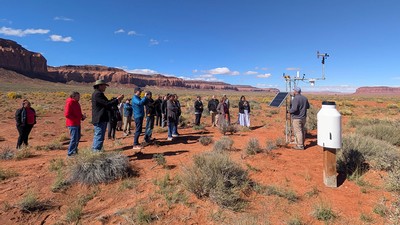
The Utah Climate Center at USU is the state’s official repository for weather and climate data, with one of the West’s most comprehensive climate archives. The center collects and quality-controls data from hundreds of monitoring stations across Utah, manages historical climate records, collects real-time data and performs climate analysis to support water management, agriculture, wildfire preparedness and infrastructure planning.
WRITER
Lael Gilbert
Public Relations Specialist
S.J. and Jessie E. Quinney College of Agriculture & Natural Resources
435-797-8455
lael.gilbert@usu.edu
CONTACT
Jon Meyer
Assistant State Climatologist
Utah Climate Center
(435) 797-2190
jon.meyer@usu.edu
SHARE
Comments and questions regarding this article may be directed to the contact person listed on this page.