Diné Experience, New Data: Weather Stations Enrich Navajo Nation Record With Real-Time Monitoring
By Lael Gilbert |
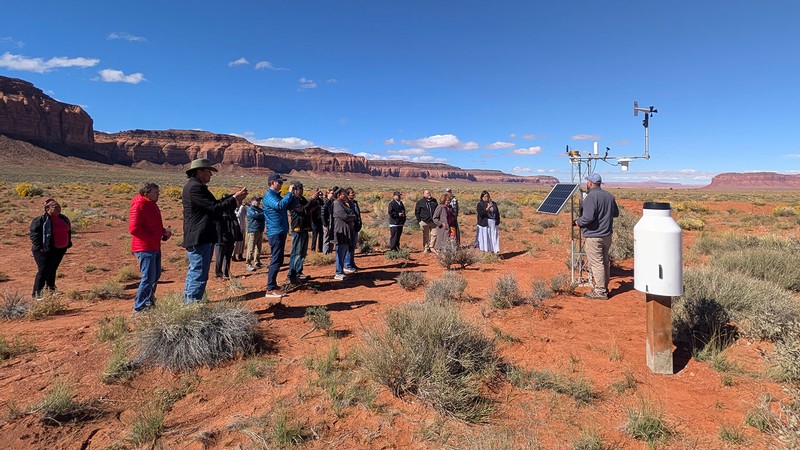
(Photo credit: Utah Climate Center/Andrew Bailey)
Across more than 16 million acres of the southwestern U.S. is the Navajo Nation, a dramatic and varied landscape of sandstone, communities, and desert, roughly the size of Ireland. The people who live and work here have a thousand-year history of stewardship and traditional ecological knowledge, tracking conditions that their livelihoods depend on.
In the last few decades things have begun to shift. Across the narrow canyons, rangelands, and arroyos rainfall has decreased. When it comes, the soil doesn’t hold it. Groundcover is disappearing, temperatures are climbing, and there isn’t enough livestock forage to go around.
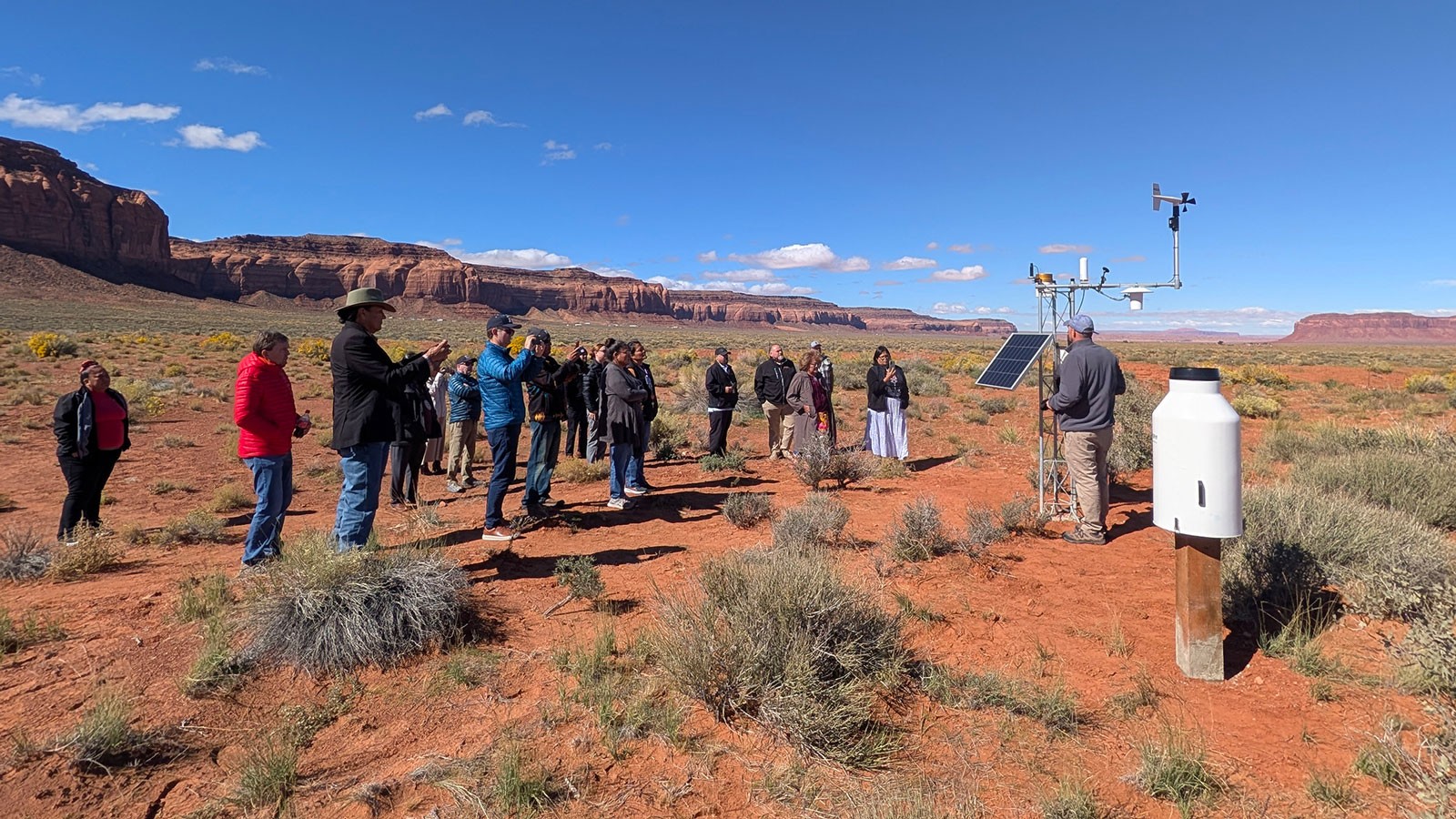
Reagan Wytsalucy is determined to find ways for these communities to adapt. She is Utah State University’s Extension associate professor of agriculture and natural resources and San Juan County Extension director. Her efforts have started at ground level this month, with the installation of the first of six new real-time weather stations at key locations within the Navajo Nation that will fill vital gaps in the regional climate record.
Most people in the U.S. take for granted that real-time, hyperlocal weather information will be conveniently, constantly at their fingertips. The weather information on your phone comes from data collected by weather stations, often at airports managed by the National Weather Service, and thousands of other sites managed by various groups that collect and share it in larger networks. But on the Navajo Nation gaps in weather data from the topographically diverse region have made forecasts less accurate and good information harder to get.
“Satellites might say there’s a storm overhead, but there’s no rain reaching the ground,” Wytsalucy said. “Forecasts say to prepare for rain, but the clouds just move around the area. We need on-the-ground information about what’s contributing to these patterns, to know accurately when precipitation is falling.”
Wytsalucy saw an open opportunity to monitor and track the area, as well as begin to ask questions and pursue research that can help communities adapt to change.
Accurate information about weather can empower ranchers, land managers, emergency crews, and water managers to make important safety and planning decisions. It is essential for long-term planning, especially important because Navajo rangelands are already under severe strain from ongoing drought. But the data currently used for long-range planning and on-the-ground decisions about things like grazing permits is more than a century old.
“The rules we are trying to use were written for another time,” Wytsalucy said.
Active grazing permits determine how many animals can forage a given piece of land. The outdated data means that current grazing exceeds ecological carrying capacities, with overgrazing removing ground cover plants and leaving soils dry and even hydrophobic.
“We really can’t address these problems without starting with accurate information. Communities have been asked to develop conservation management plans without the basic knowledge they need to make the best decisions for the current situation,” Wytsalucy said.
With the help of USU’s Utah Climate Center and regional partners, six new weather stations are planned to capture storm movements and microclimates at strategic locations including Oljato-Monument Valley, Mexican Water, Montezuma Creek, the U.S. Highway 191 corridor near Aneth, and two sites along Navajo Mountain.
Environmental data collected by the network will feed directly into national databases, including USU's Mesonet system and further, to agencies of the State of Utah and the federal agency, the National Oceanic and Atmospheric Administration, ensuring Navajo Utah communities are represented in state and federal climate reporting.
The Utah Climate Center operates a Mesonet network of around 140 stations. The network enhances the accuracy of local weather forecasts, severe storm warnings, agricultural planning, and regional climate reporting for historically underrepresented areas.
“By establishing Utah’s Mesonet and building it out with these weather stations, the Utah Climate Center is furthering its mission to offer access to climate data and information and to use expertise in atmospheric science to interpret climate information in accurate ways,” said Robert Gillies, director of the Utah Climate Center.
The data will also be valuable for local management and education, Wytsalucy said.
Tribal leaders want to create ways that this new data becomes connected to traditional ecological knowledge — the skills of observation of patterns, seasonal cycles, and direct awareness, Wytsalucy said. She plans to work with students and partners to gather, record, and document these skills and incorporate them into educational materials that can be shared in Extension work and school programs.
“We get to use this data to acknowledge and to retain a traditional connection,” she said.
And to consolidate what they know — through weather data, observation, tradition, and community — to adapt important practices like grazing, improve soil health, manage feral livestock, support healthy rangelands, and protect traditional crops and native plants used for ceremonial and medicinal purposes, she said.
“You have to be able to look at all of these systems as a whole,” she said. “We can’t think of any one action as independent anymore. When you honor and incorporate good practices, you see recovery in ecosystems. Life gives back.”
With the new weather stations, she wants not only to document problems but to create a path to solutions. All these strategies start with good data, she said.
WRITER
Lael Gilbert
Public Relations Specialist
S.J. and Jessie E. Quinney College of Agriculture & Natural Resources
435-797-8455
lael.gilbert@usu.edu
CONTACT
Reagan Wytsalucy
Extension Associate Professor
Agriculture and Natural Resources
Reagan.Wytsalucy@usu.edu
SHARE
Comments and questions regarding this article may be directed to the contact person listed on this page.