Houston-Bound: USU GAS Team Headed to NASA's Microgravity University
For the second year in a row, Utah State University student researchers will experience zero-gravity flight in a “chance of a lifetime” as they conduct an innovative heat transfer experiment of their own design aboard NASA’s ‘Vomit Comet.’
Seven members of USU’s Get Away Special Team, one of 14 university teams selected for participation in NASA’s 2011 Reduced Gravity Student Flight Opportunities Program, travel to Houston’s Johnson Space Center June 2-11 for more than a week of astronaut training that will culminate in weightless flight aboard a specially modified Boeing 727.
“I’m so excited,” says Troy Munro, team leader and a veteran flyer from last year’s program, who’ll serve as a ground crew member this year. “From last year’s experience, we know more of what to expect and we’ve designed our new experiment to be more user friendly in microgravity. We have a whole new team of flyers this year and it’s going to be a great learning experience.”
In addition to Munro, Aggies participating in the 2011 NASA program, also known as “Microgravity University,” are Rob Barnett, flyer (and a veteran ground crew member from the 2010 program); flyers Landon Hillyard, Ryan Martineau, Ian ‘Iggy’ Matheson and Jenica Sparrow, as well as alternate flyer, Matt Wallace.
The team’s experiment, called “Follow-Up Nucleate Boiling On-flight Experiment 2.0” or FUNBOE 2.0, builds on last year’s experiment and a previous GAS Team experiment that flew on Space Shuttle Endeavour in 2001.
The FUNBOE experiments examine fundamental questions about boiling water and other liquids in space. FUNBOE 2.0 will also test a novel idea of cooling using boiling heat transfer on a micro-fabricated silicon chip.
“What the students are asking is ‘Can we use a heater to increase cooling?’” says GAS faculty mentor Heng Ban, associate professor of mechanical and aerospace engineering. “It sounds counterintuitive, but boiling takes away a lot of heat very quickly.”
Ban says the ability to control bubble generation and use boiling as a mechanism of heat transfer could have multiple applications, including thermal management solutions critical for long-term space travel to Mars and beyond. The students’ experiment, he says, contains a potentially patentable idea.
Aboard NASA’s microgravity aircraft, the Aggies will experience weightlessness as the plane follows a parabolic path and repeatedly climbs and dives from 32,000 feet in a series of about 32 controlled free falls.
Martineau, a junior mechanical and aerospace engineering major, says he looks forward to the trip with great anticipation.
“We still have ground testing and shipping to complete, so it’s nerve-wracking and exciting all at the same time,” says the 2007 graduate of Utah’s Bear River High School. “The adrenaline is always flowing and that helps me focus on finishing. We’re hoping for another successful experiment.”
Organized in 1976, the USU GAS team is largely responsible for one of the university’s most well known achievements: Utah State has sent more student-built experiments into space than any other university in the world.
The USU community is invited to follow along with the GAS team’s ‘Vomit Comet’ adventure on the team’s Facebook page and the team’s website.
Related links:
- “Houston, We Have a Solution,” Utah Public Radio (Audio)
- “Houston, We Have a Solution,” Utah State Magazine
- “Utah State Students Take a Ride in Zero-G,” KSL-TV News
- “USU Students Win Chance to Test Theory in NASA ‘Vomit Comet,’” Salt Lake Tribune
- NASA Microgravity University
Contact: Troy Munro (USU student team member), 801-558-4780, troy.munro@aggiemail.usu.edu
Contact: Heng Ban (USU faculty mentor), 435-797-2098, heng.ban@usu.edu
Writer: Mary-Ann Muffoletto, 435-797-3517, maryann.muffoletto@usu.edu

Meet the team (back row, l to r): Ryan Martineau, flyer; Rob Barnett, flyer; Matt Wallace, alternate flyer; and Landon Hillyard, flyer; (front row, l to r): Iggy Matheson, flyer; Jenica Sparrow, flyer and Troy Munro, ground crew and veteran flyer.
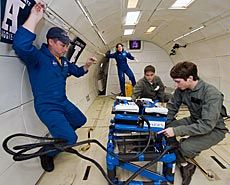
The Aggies head to Houston's Johnson Space Center June 2-11 to fly their experiment aboard NASA's 'Vomit Comet.' (Pictured at right are 2010 USU team members Frank McCown and Justin Koeln on the microgravity aircraft. Photo courtesy of NASA.)
TOPICS
NASA 106storiesSHARE
Comments and questions regarding this article may be directed to the contact person listed on this page.