Meet USU Eastern's New and Transitioning Technical Education Faculty
As a new academic year begins at Utah State University Eastern, students are learning from faculty who bring professional experience, industry knowledge, and strong connections to the communities they serve.
USU Eastern is introducing new and transitioning faculty, highlighting five members in Technology, Design, and Technical Education:
- Katie Horsley, engineering, drafting, and design.
- Jaime Cowdell, business.
- Mark Aldred, aviation maintenance technology.
- Leona Bowden, cosmetology.
- Krikit Butcher, medical assisting, and phlebotomy.
While their fields are very different, each brings an emphasis on connecting classroom learning with the skills students will use in the workforce.
Katie Horsley, engineering, drafting, and design lecturer, brings both local roots and professional industry experience to the classroom. A Price native, Horsley began her education at Utah State University before serving a mission in Poland and later returning to USU Eastern to complete her education. Her professional background includes civil, structural, and architectural drafting and design, along with experience using a variety of drafting software.
Horsley said she enjoys the combination of creativity and structure the field provides and wants students to develop skills that go beyond learning software commands. Through hands-on creating, modeling and real-world design problems, students develop accuracy, communication, troubleshooting and problem-solving skills that prepare them to enter the workforce and continue learning.
“If you enjoy creating things, solving problems, or working with technology, give it a try,” Horsley said. “Drafting can lead to a lot of different careers, and you may discover something you really enjoy.”
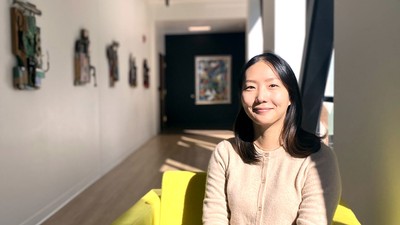
Jaime Cowdell is no stranger to USU Eastern. After six years as part of the Eastern community, Cowdell is moving into the classroom as a professional practice assistant professor in the business department.
Cowdell holds an MBA from the Jon M. Huntsman School of Business and has spent much of her career working with businesses, community partners, and university colleagues. She hopes to bring those relationships and experiences directly into her teaching.
“What excites me most is helping students see how business concepts connect to the real world,” Cowdell said. “I want students to leave my classes with more than just knowledge from a textbook.”
Her goal is to incorporate real-world projects, technology, problem-solving, communication, teamwork, and connections with local businesses and community leaders into students’ education.
Cowdell also sees business as a strong option for students who may not know exactly where their careers will take them.
“You don’t have to know exactly what career you want when you start,” she said. “A business education can give you a strong foundation while you figure out where your interests and strengths fit.”
For Aviation Maintenance Technology students, Lecturer Mark Aldred brings more than 30 years of aerospace experience into the classroom.
His career has included work on aircraft ranging from small two-seat Cessnas to Boeing 747s, with experience in aircraft maintenance and manufacturing in both civilian and Department of War environments. He has also been in quality engineering and management positions with companies including Lockheed and Bell Helicopter and spent time working with NASA.
That experience now helps Aldred prepare students for careers in an industry with opportunities extending far beyond traditional aircraft maintenance.
“I love teaching in this field for the amazing opportunities it can offer my students,” Aldred said.
Hands-on learning is central to his classroom. Aldred strives to have students working with their hands during every class period, whether completing a lab project or performing maintenance on the program’s twin-engine Piper Navajo. He records many lectures for students to complete outside of class, creating additional time for practical work.
While graduates may begin their careers “turning wrenches,” Aldred points out that aviation maintenance experience can also lead to careers in quality, reliability, engineering support, training, and other areas of the aerospace industry.
In cosmetology, Leona Bowden is helping students build their skills progressively throughout USU Eastern’s 1,250-hour program.
During the first two semesters, students focus on foundational theory and hands-on education. As they progress, instruction expands beyond technical cosmetology skills to include the business side of the profession.
Students learn about the many directions a cosmetology career can take, including the possibility of owning their own business. They are introduced to basic steps involved in starting a business and the resources and organizations they may work with along the way.
“It is always our goal to give students as much information as we can in order to begin a successful career, whatever direction they wish to take in the future,” Bowden said.
Rather than overwhelming students with everything at once, Bowden said the program is structured so students build their knowledge and confidence as they progress through their required hours.
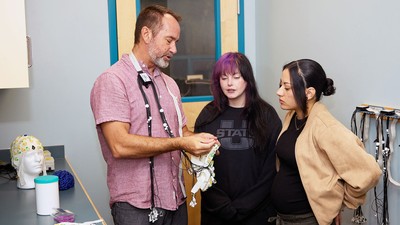
Krikit Butcher, medical assisting and phlebotomy instructor, brings nearly 30 years of experience as a medical assistant to her students.
Her career has included direct patient care, phlebotomy, assisting with office procedures, surgery scheduling, authorizations, coding, and other clinical and administrative responsibilities. Along the way, she worked with numerous healthcare providers who helped shape her approach to patient care.
After nearly three decades in the field, Butcher chose to bring that experience into education.
“I absolutely love my job and have had so many experiences and have so many skills I can bring and share with the students at USUE,” Butcher said.
Butcher wants students to graduate with more than technical ability. She emphasizes empathy, compassion, teamwork, putting patients first, and being willing to continue learning.
“I can teach the skills, the knowledge and confidence to perform the tasks at hand,” she said, “but if I do not teach the things I have mentioned above, I have not performed my job as an educator.”
Students in the medical assisting program receive classroom and lab instruction before completing an externship that includes both administrative and clinical experience. The two-semester program prepares students to enter the workforce after completing the program and certification requirements, while also providing a foundation for those who want to continue their education in healthcare.
From an engineering and design classroom to an aircraft hangar, cosmetology lab, healthcare setting, or local business, these five faculty members bring students something that cannot come from a textbook alone: experience.
Their backgrounds allow students to learn not only the technical knowledge required in their fields, but also the communication, problem-solving, professionalism, and adaptability needed to build successful careers.
Together, Horsley, Cowdell, Aldred, Bowden, and Butcher represent the hands-on, career-focused education at the heart of USU Eastern’s Technology, Design and Technical Education programs. To learn more about USU Eastern’s School of Professional & Technical Education, visit: qanr.usu.edu/spte.
CONTACT
Brad Watson
Director of Community and Campus Engagement
USU Eastern
(435) 613-5587
brad.watson@usu.edu
SHARE
Comments and questions regarding this article may be directed to the contact person listed on this page.