Playing With Fire: USU Author Explores Hilarious-Turned-Tragic Consequences
English Professor Jennifer Sinor will discuss her new novel, "The Beautiful Plain," on Utah Public Radio's Access Utah program 9 a.m. Oct. 6.
By Mary-Ann Muffoletto |
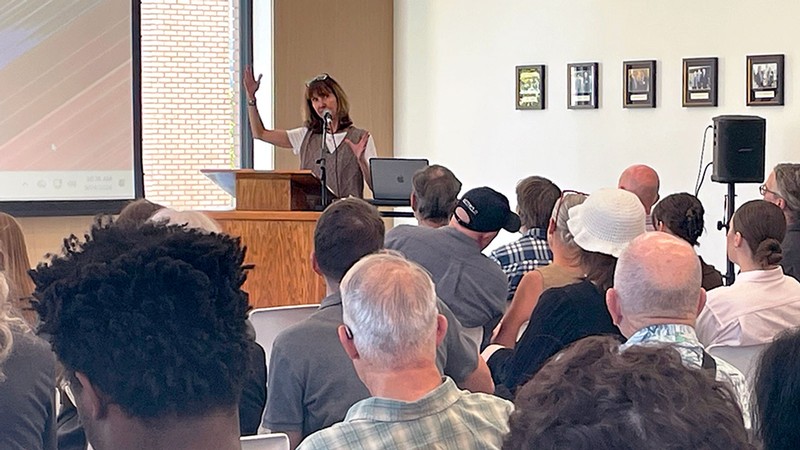
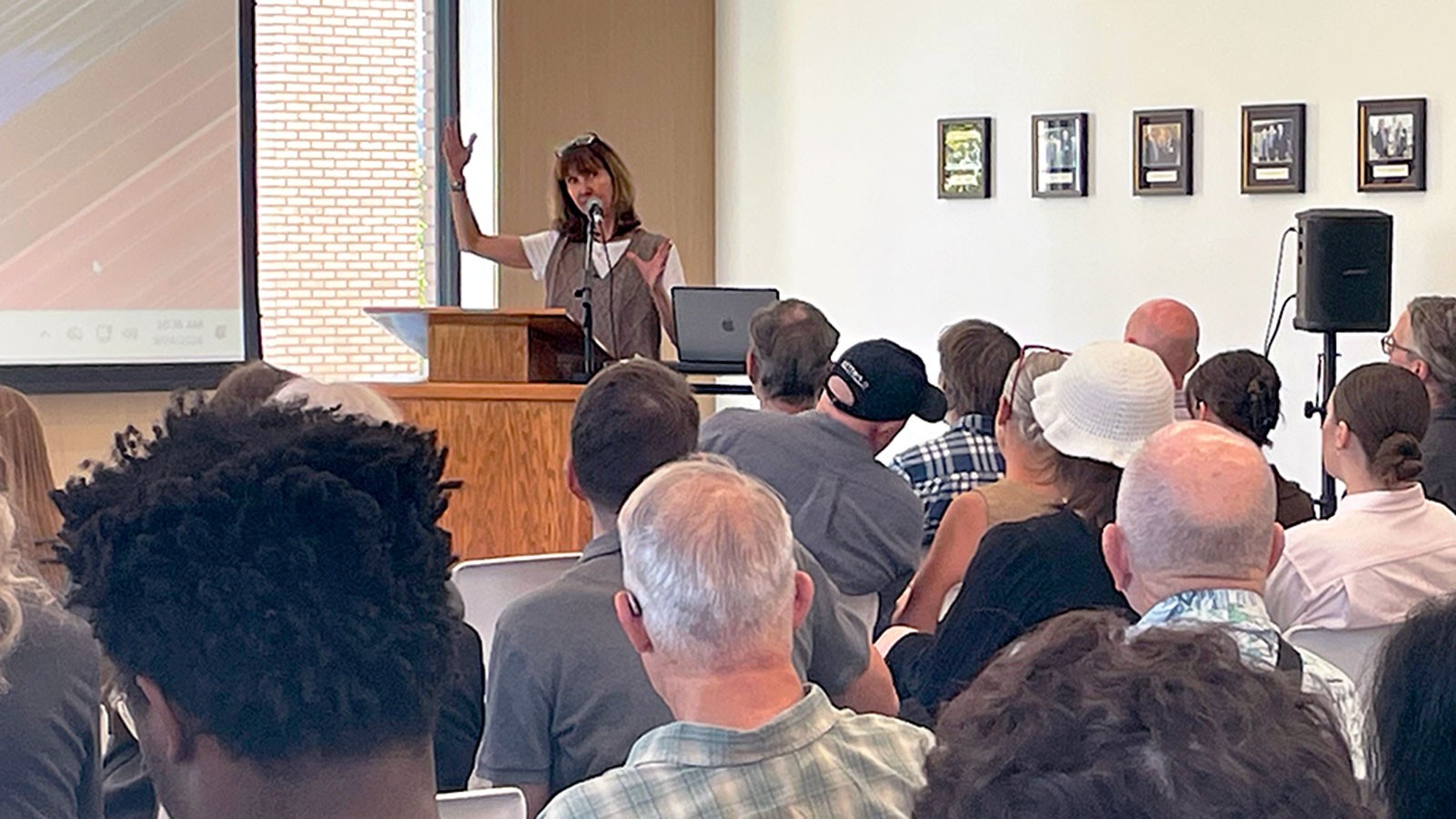
Jennifer Sinor, professor and associate department head in USU's Department of English, addresses a group at Utah State. The author released the new novel, "The Beautiful Plain," Oct. 1, which she’ll discuss on Utah Public Radio’s “Access Utah” program Oct. 6.
Childish pranks are part of being a kid. Calling a random number and asking if the caller’s refrigerator is running and, if so, to catch it; switching the plastic bags inside cereal boxes so Lucky Charms become shredded wheat; short-sheeting the bed; birthday candles that cannot be extinguished; the perennial whoopie cushion. But what happens if the prank isn’t quite so childish and the results are far from laughter?
Utah State University author Jennifer Sinor explores this question in her new book, “The Beautiful Plain,” released Oct. 1 by the University of Nebraska Press.
The novel opens on an August afternoon with three teenage girls hauling a cardbox box filled with another girl up to the loft of a barn. They tell the girl inside she is about to be pushed from the second-floor window as part of her initiation into their club.
“I’m interested in what happens when something that appears ordinary ends up causing grief for decades,” said Sinor, professor and associate department head in USU’s Department of English.
While this is her first novel, this is not the first time Sinor, author of other works, has considered ordinary trauma. Ten years ago, she published “Ordinary Trauma: A Memoir,” in which she explored a military childhood set amid explosive-filled speed bumps and men humping machine guns along the side of the road. Even longer ago, she wrote about the very ordinary diary of her great, great, great aunt, Annie Ray, who homesteaded the Dakotas in the late 1800s. In much of her work, the ordinary is not the backdrop to the subject, but the very thing to be considered.
“The ordinary is where we spend our lives,” Sinor said. “We tend to tell stories of the extraordinary, but the ordinary tells the story of who we are.”
Sinor’s novel follows Laura Runnell, one of the girls who carries the box up the barn stairs in 1982, and alternates between Laura’s childhood and her current life as a new professor at a Nebraska state school, where she struggles as a young teacher and a single mother. Failure is a story Laura knows well. As someone who has chased the shiny her entire life, she finds herself back in Nebraska, licking her wounds in a state she wanted to escape.
“Nebraska reminds me a lot of Hawaii,” Sinor said of her setting.
A military child, Sinor moved eight times in the first 18 years of her life and ended up at the University of Nebraska for college, even though she had never lived in the state.
“My father kept his residency in Nebraska, so I was oddly an in-state student,” she said.
Sinor was fairly certain she was the only student attending UNL with a family living 2,000 miles away on an island.
“The first year was hard,” she said, “but I saw the ocean in the grasses of the plains, and it reminded me of home.”
The landscape is a character in “The Beautiful Plain,” and one Laura often struggles against. Place matters to Sinor.
“I set out to write a Nebraska novel,” she said. “I wanted the land to be part of what made the characters who they were, even though I readily acknowledge that I, myself, have never felt at home in a place.”
Sinor said she also set out to write the kind of novel she enjoys reading. She began writing it the summer after the pandemic ended, during a time in which she turned to fiction with strong plots and vibrant characters who were facing the regular challenges of being human.
“Things were so bleak then,” Sinor said. “I wanted something that pulled up rather than down.”
Her students recognize Sinor in her fiction as readily as her nonfiction. One her former students, Millie Tullis, author of “These Saints are Stones,” wrote to Sinor: “The opening chapter really hooked me – such well-handled tension. So much heart and guts. Reading your work always feels a lot like spending time talking with you, generous and smart and big-hearted.”
Another former student, Cami Pack, wrote Sinor, “Thank you for sharing your warmth and devotion to naming the full range of our experiences, while we make sense of how it's all come to be,” Pack wrote. “And for what you said about trauma being totalizing. So many layers. It was captivating, and I'm grateful. Grateful for Laura's character, for her innocent desire to belong, and for the experience of swimming with her toward that belonging, clothes on.”
In response to the generous words of her former students, Sinor said she was thankful for her time at Utah State.
“I have been teaching in the Department of English for twenty-six years, and have sat with thousands of students and their words,” she said. “Of my role as a teacher, I could not be more grateful for my job and the way I spend my days. It is a gift.”
Sinor will be a guest on the “Access Utah” program on Utah Public Radio at 9 a.m. Oct. 6. “The Beautiful Plain” can be ordered wherever books are sold.
WRITER
Mary-Ann Muffoletto
Communications Specialist
College of Arts & Sciences
435-797-3517
maryann.muffoletto@usu.edu
CONTACT
Jennifer Sinor
Professor and Associate Department Head
Department of English
435-797-3304
jennifer.sinor@usu.edu
SHARE
Comments and questions regarding this article may be directed to the contact person listed on this page.