Space Dynamics Lab Innovates Layered Defense Against Unmanned Aircraft Systems
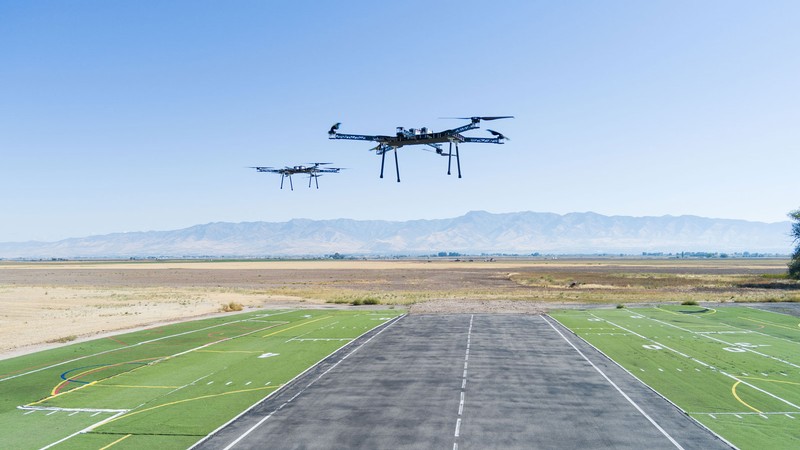
Two SDL Unmanned Aerial Vehicles are pictured flying during testing of system sensor components. (Photo credit: SDL/Kelden Peterson)
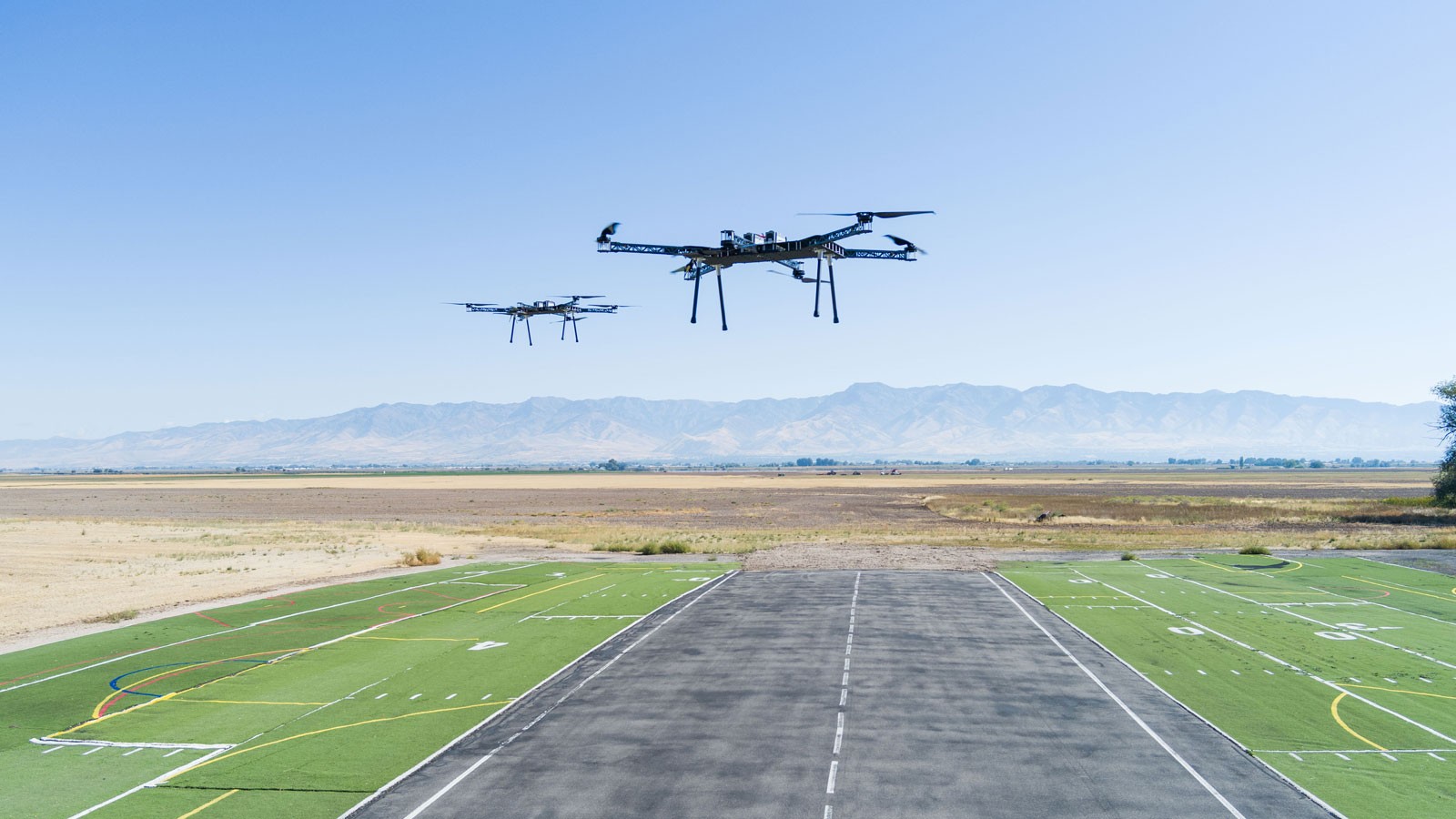
NORTH LOGAN, Utah — As unmanned aircraft systems become more capable and widely available, Utah State University's Space Dynamics Laboratory is helping protect against this emerging threat by developing new technologies. Engineers at SDL are inventing systems that address multiple stages of the counter-UAS mission, from detection and tracking to identification and defeat.
"The challenge isn't simply stopping a drone," said SDL Distinguished Engineer and Scientist Morgan Davidson. "It takes multiple technologies working together throughout the counter-UAS mission. We’ve focused on developing sensor and data fusion capabilities to bring together complementary sensors into an integrated, layered defense.”
SDL and Davidson were recently awarded a patent, Object Tracking, for technology that uses advanced data association and filtering techniques to determine which new sensor observations belong to the same object over time, helping systems accurately follow multiple moving objects in complex environments.
Accurate object tracking is foundational to countering UAS threats as well as threats in other domains. Sensors collect new observations every fraction of a second, and by correctly matching those observations to the same drone over time, the system can maintain an accurate track. This is achieved even when multiple drones are moving through the same area or when detections are temporarily interrupted.
"Developing and maintaining a precise and stable track is the basis for everything in the decision chain that follows," Davidson said. "Once you know that you're consistently tracking the same object, you can begin determining what it is, better characterize its state by combining information from multiple sensors and ultimately provide more meaningful information to decision makers responding to the threat."
The awarded patent complements three additional technologies currently under patent review.
Davidson has invented a system that uses event cameras to detect and characterize aircraft. Unlike conventional cameras that capture full image frames, event cameras record changes in brightness as they occur. SDL's approach processes and analyzes those event streams to estimate aircraft characteristics including position, attitude, velocity, acceleration, propeller signatures and other identifying features. The technology is intended to detect, classify and identify aircraft, including drones, even when traditional imagery is blurred or difficult to interpret because of motion, marginal illumination or complex backgrounds.
A second patent application addresses target size estimation through sensor fusion. The method combines measurements from multiple sensors to estimate the physical dimensions of a target while simultaneously calculating its position and motion. By fusing complementary measurements, the system can improve target classification and identification, providing more accurate information for tracking and engagement systems.
The third application focuses on the final stage of the counter-UAS mission by introducing a counter-swarm device that deploys engineered streamers intended to entangle drone propellers. The design emphasizes a layered defense concept in which low-cost, low-collateral, scalable effectors create a persistent, volumetric effect — a cloud of counter-UAS flak — that can disable one or more drones by interrupting propeller thrust rather than relying only on kinetic or directed-energy systems. The technology includes deployment methods that increase the volume of the streamer cloud and improve the likelihood of interaction with drone propellers.
Although SDL is widely recognized for its contribution to space systems, the laboratory also develops technologies that support operations across the land, maritime, air and cyber domains. Much of that work is conducted through SDL’s C4ISR Systems Division, which develops command, control, communications, computers, intelligence, surveillance and reconnaissance technologies that help military operators collect information, understand the operational environment and make informed decisions. Drawing on expertise in sensing, autonomy, data fusion and mission systems, the division develops capabilities that help government partners address evolving threats.
Headquartered at USU’s Innovation Campus in North Logan, SDL is an independent nonprofit corporation owned by USU that solves technical challenges faced by the military, science community, and industry and supports NASA’s vision to explore the secrets of the universe for the benefit of all. SDL has field offices in Albuquerque, New Mexico; Chantilly, Virginia; Huntsville, Alabama; Ogden, Utah; and Stafford, Virginia. For more information, visit sdl.usu.edu.
CONTACT
Eric Warren
Director, Public Relations
Space Dynamics Laboratory
435-881-8439
eric.warren@sdl.usu.edu
SHARE
Comments and questions regarding this article may be directed to the contact person listed on this page.