Student Bill Tracking Effort Helps Utah Stakeholders Follow Major Natural Resource Legislation

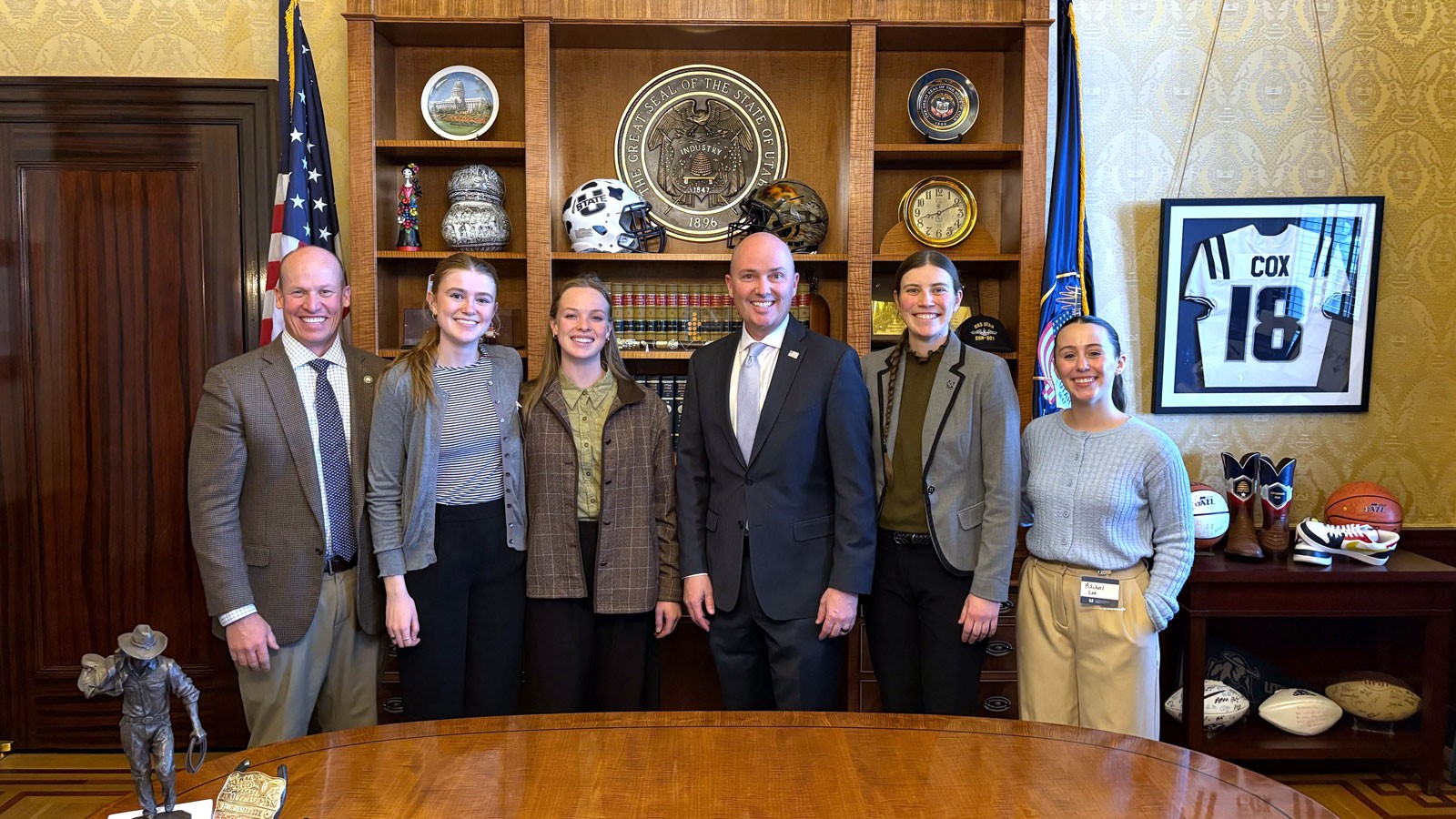
Students at Utah State University helped stakeholders and the public follow major land, water, air and energy legislation during the 2026 Utah legislative session through the work of the Janet Quinney Lawson Institute for Land, Water & Air’s student-led policy pod.
That work was highlighted March 26, when the institute hosted a student chapter event summarizing some of the session’s largest natural resource bills. The event featured a legislative overview presented by institute Executive Director Brian Steed.
“Many bills discussed and passed during this past legislative session will have a large impact on Utah’s natural resources,” Steed said. “Having students involved with tracking the legislation was extremely helpful for everyone who wanted to understand how decisions were made.”
The policy pod is made up of four undergraduate employees at the Institute: Sierra Campbell, Emmy Ferry, Rachel Lee and Auden Smith. Their work reflects one of the Institute’s central priorities: creating meaningful professional development opportunities for students while helping make complex policy issues more accessible to communities and stakeholders across Utah.
“In past years, we typically had one student focused on legislative tracking,” said Anna McEntire, managing director of the institute. “This year, we had several students who already understood the pace and the process, and that gave us the chance to do more and do it better. I jokingly started calling them the policy pod, and it’s been fun to see the name stick.”
During the legislative session, the students tracked natural resource bills as they moved through the process, covering both bills that passed and bills that failed. Their work was shared through the institute’s website, newsletter, weekly legislative newsletter and the annual report’s condensed bill summaries.
During the active session from January through March, the institute’s live bill tracker was updated daily with bill statuses and summaries, allowing readers to follow legislative changes in real time. Past years of compiled bill summaries are also available on the institute’s website alongside the live tracker.
“Our bill tracker became a resource that many groups relied on during the session to stay abreast of what was happening,” Steed said. “That included organizations such as the Salt Lake Chamber, the Utah Department of Natural Resources, federal representatives and others who were looking for a clear way to follow the session’s major land, water, air and energy bills.”
For students involved, the work was also a close-up lesson in how policymaking happens.
“Being part of the policy pod was a really great way to learn more about how our state government works for Utah,” said Rachel Lee, a member of the policy pod. “Legislation can move quickly during the session, and tracking bills on a regular basis helped me understand many of the factors that state leaders need to consider when drafting policy.”
That engagement often extended beyond formal summaries. Auden Smith said the students became so invested in the process that they created a separate group chat to react to especially eventful committee hearings and floor discussions.
“Some of the bills got so interesting, and some of the committee meetings got so lively, that we had a separate group chat just to share our unofficial reactions,” Smith said. “It made the process feel very immediate and gave us another way to stay engaged with what was happening in real time.”
That learning also extended beyond the office. Through the policy pod, students had opportunities to meet with Gov. Spencer Cox and Joel Ferry, executive director of the Utah Department of Natural Resources, sit on the House of Representatives floor with Rep. Jill Koford, and connect with legislators and state officials both at the Capitol and at institute events.
McEntire said those opportunities help students build both professional skills and a deeper understanding of how policy is shaped.
“Student experiences such as the policy pod increase their understanding and skills in policy development and communication,” McEntire said. “They established relationships with legislators who were actively working on land, water, air and energy bills. It is exciting to watch state leaders interacting with students and taking an interest in their educational experience.”
The policy pod will continue refining its 2026 bill summaries and providing updates during the interim session this fall. Those interested in following that work can do so through the institute’s newsletter and policy updates.
About the Janet Quinney Lawson Institute for Land, Water and Air
The Janet Quinney Lawson Institute for Land, Water and Air at Utah State University connects decision-makers with high-quality research to support informed land, water, and air policy in Utah. Through applied research, public convening, and cross-sector collaboration, ILWA helps the state address complex natural resource challenges. Learn more at usu.edu/ilwa.
CONTACT
Anna McEntire
Managing Director
Janet Quinney Lawson Institute for Land, Water, and Air
(435) 881-1323
anna.mcentire@usu.edu
TOPICS
Utah 501stories Water 345stories Environment 344stories Hands-on Learning 330stories Land Management 168stories Energy 110stories Politics 94stories Air Quality 68storiesSHARE
Comments and questions regarding this article may be directed to the contact person listed on this page.