Undergraduate Researchers Gain Experience, Take Home Awards
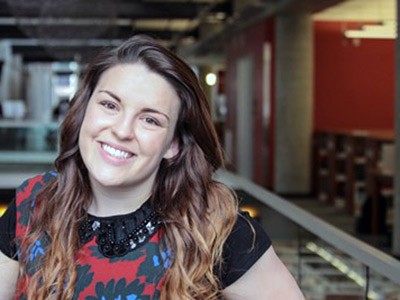
USU undergraduate researcher Daisha Cummins.
Daisha Cummins, a junior majoring in exercise science and biology at Utah State University, is an award-winning undergraduate researcher from a nurturing lab.
And while she still has another year of undergraduate work ahead of her — and several more years of graduate work after that — she is already seeing the benefits of research in the Sensory Motor Behavior Lab in the Health, Physical Education and Recreation Department found in the Emma Eccles Jones College of Education and Human Services.
She’s been applying to medical schools.
“They ask for research experience on the application,” she said.
After USU Research Week, she could add that she won the oral component of the undergraduate research symposium. (After that, she went on to do a poster presentation at the National Council on Undergraduate Research at Eastern Washington University.)
Cummins said her work in the lab has had other benefits, too.
“I’ve been lucky to work in a research opportunity where we’ve been one-on-one with our participants,” she said. “I’ve loved that aspect.”
She’s also learned about working as a team, moving through the scientific process of an experiment, and treating research participants with respect. For example, she learned to be patient with participants while they were performing tasks, even if they didn’t follow protocol on the first try. Protocol was important, because it made the difference between good and sloppy science.
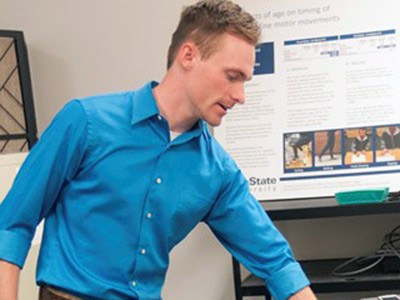
Undergraduate researchers in the Sensory Motor Behavior Lab have worked on projects examining movement in different populations. One project — the one she presented on — looked at children who were and were not on the autism spectrum to see the differences in how they would rotate a cylinder or hand a tool to the researcher.
And there were differences. The subjects on the ASD spectrum were more likely to persist with a specific action, even if meant adopting a more uncomfortable hand position. They were also more likely to hand a hammer to the researcher head first (which was less helpful) than those who did not have ASD.
The researchers said the differences may show that children with ASD plan their movements differently, and that they have a harder time relating to the preferences of the person they are “helping” when they hand them a tool.
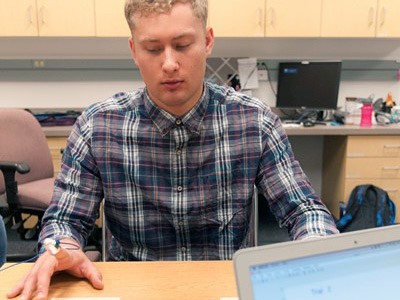
Zach Skabelund, another undergraduate researcher from the same lab, won an honorable mention for his oral presentation at Research week. He presented on the lab’s research on discreet and smooth movements in adults, as it related to rhythm. They asked participants to tap with their fingers, first in time with a metronome and later without the sound to guide them. They were also asked to walk in time to the sound of a metronome, and then on their own while still keeping rhythm.
These results were compared to smooth movements — circle drawing and cycling — that were also performed in rhythm, with and without a metronome. Their findings so far show that older adults had more variance when walking or tapping, but in the smooth tasks — circle drawing and cycling — they performed as well as younger individuals.
Previous research had shown that the timing of smooth and discreet movements were controlled by a different mechanism in the brain when it came to small motor movements. The lab’s researchers are concluding that the same might hold true with big movements involving large muscle groups. What’s more, the mechanism that controls the smooth movements appears to be better preserved over time.
Breanna Studenka leads the lab. She was in the room as Zach and fellow researcher Kodey Meyers discussed their work, but she let them do the talking. It’s good for them to field questions on their own, she said. It helps them learn how to present their research to people unfamiliar with it.
The mentorship is paying off. In addition to Cummins and Skabelund’s recognition during research week, Meyers was named the HPER Student Researcher of the Year.
“She’s a great teacher,” Cummins said. “Ever since I’ve started, Bree’s one of the reasons I’ve stayed in research. … She’s so patient.”
Related links:
- USU Sensory Motor Behavior Lab
- USU Research Week Student Research Symposium Winners
- USU Department of Health, Physical Education and Recreation
- USU Emma Eccles Jones College of Education and Human Services
Contact: Breanna Studenka, breanna.studenka@usu.edu
Writer: JoLynne Lyon, (435) 797-1463, jolynne.lyon@usu.edu
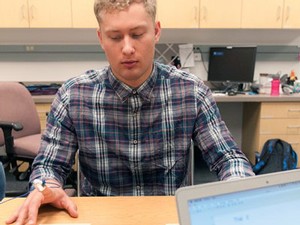
Zach Skabelund shows how the lab measures performance on the tapping task.
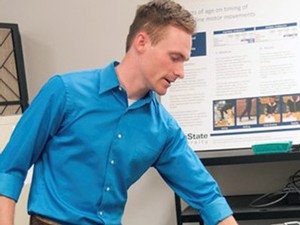
Kodey Meyers worked with research subjects to study differences in how children with and without ASD plan their movements.
SHARE
Comments and questions regarding this article may be directed to the contact person listed on this page.