U.S. Army Research Institute Awards Early-Career Grant to Assistant Professor of Psychology
By Schae Darelli |
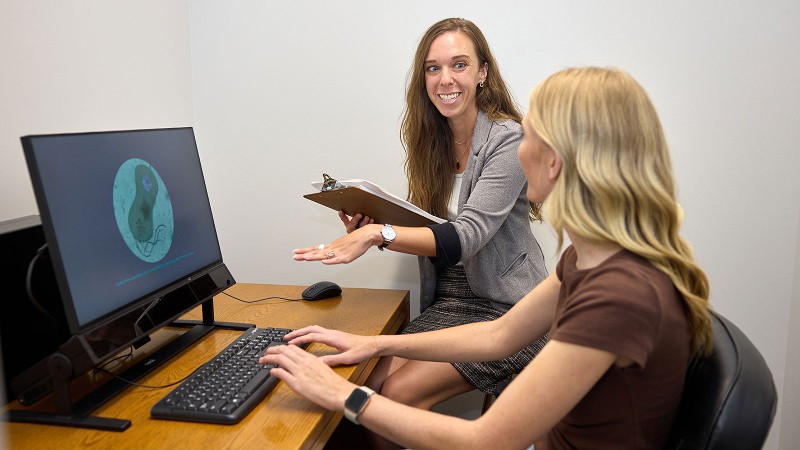
Assistant Professor Emily Weichart works with undergraduate student Taylor Mathis in her Quantified Cognition Lab.
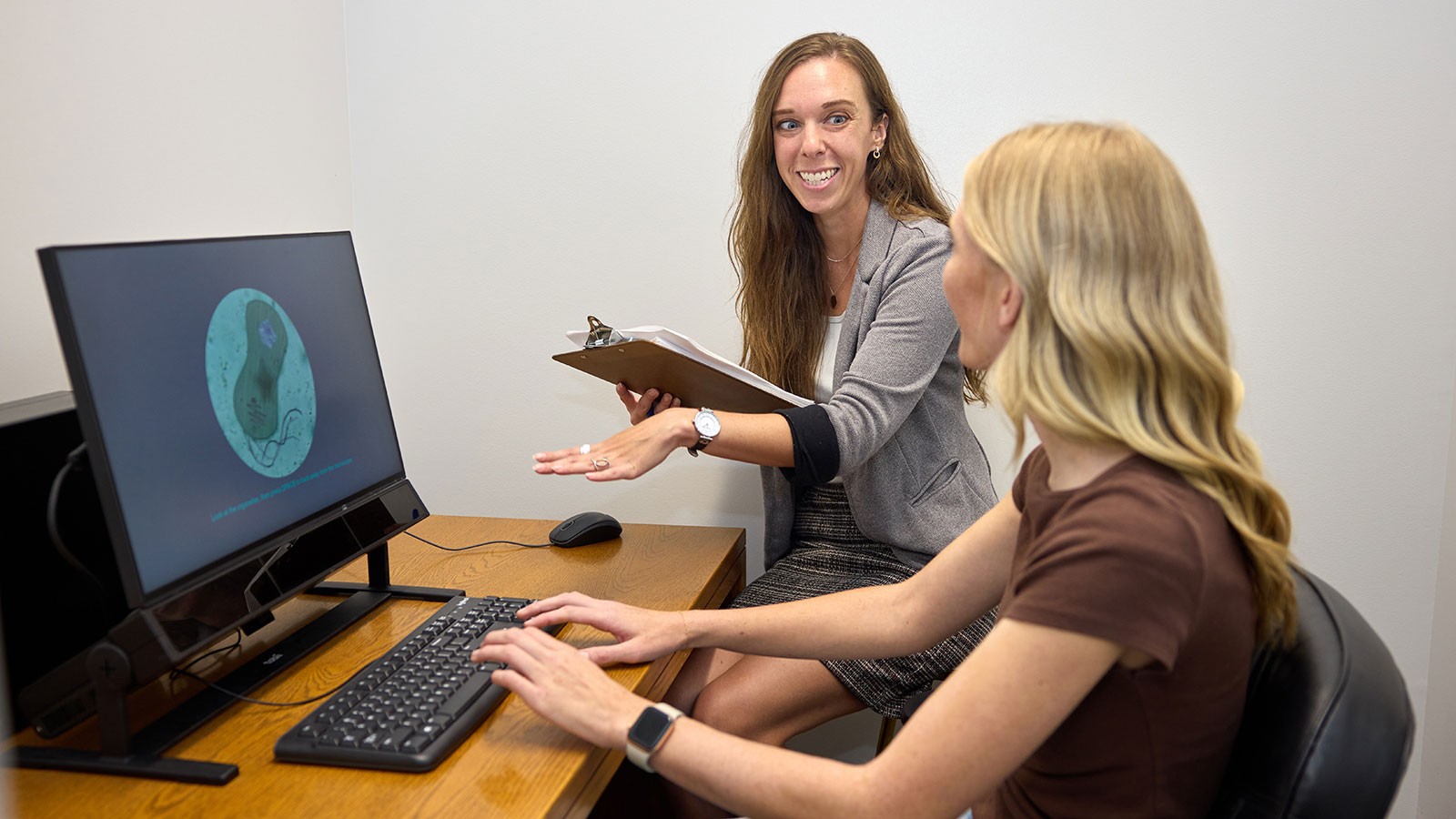
Emily Weichart, assistant professor of psychology at Utah State University, has been awarded a one-year, early-career grant from the U.S. Army Research Institute for the Behavioral and Social Sciences (ARI) to support her research on gaze insights and decision-making.
“This grant represents the confidence other people see in my research and its potential,” Weichart said. “I’m deeply grateful to receive this support from the ARI, and I’m excited to advance my research and pursue new opportunities.”
Scott Bates, head of the Psychology Department at Utah State, said: “Dr. Weichart is doing really interesting work at the intersection of cognitive psychology and computational science. It’s wonderful to see the U.S. Army Research Institute recognize the value of her fundamental research into how people gather information, learn, and adapt. I’m excited about this work and genuinely delighted that Emily has the support to pursue it.”
Weichart’s research for this grant aims to understand how people learn, adapt, and make decisions, with specific applications for military personnel. Following training in standard operating procedures, military personnel must be able to make quick decisions in the field and decide where to focus their attention. For example, they may need to decide which information is safe to share or how to respond in a high-stakes situation.
“The way trainees think can greatly impact the success of a mission and those involved, which is why it’s important to understand the science behind people’s behavior, particularly in the military,” Weichart said. “As we study how people focus and adapt to new changing circumstances, we hope to improve military training programs and better prepare personnel for real-world situations.”
To better understand these thinking processes, Weichart is conducting a study involving 150 USU undergraduate students using eye-tracking cameras and computer simulations. The study will record eye movements to understand how people focus on a task while paying attention to their surroundings. It also captures how people adjust their attention as the situation changes.
Eye movements are strongly connected to how the brain processes information, Weichart said. Eye tracking studies can reveal how memory formation, emotion processing, and decision making develop as visual data enters the brain.
“With eye tracking, I can look at what draws someone’s attention and how they process information in real time,” Weichart said. “These results can offer insights far beyond what people can report themselves after the fact.”
Weichart noted that while her research for this grant focuses on military applications, the results could impact learning and training across many fields.
“My research has the potential to make a meaningful difference in people’s lives by helping them learn, adapt, and perform more efficiently in whatever they might pursue,” Weichart said.
Weichart’s broader research in her Quantified Cognition Lab examines how different people understand events and organize information. She hopes that by studying patterns that influence decision-making, she can better understand how and why these individual differences occur.
To learn more about Weichart’s research lab, click here.
WRITER
Schae Darelli
Public Relations
Department of Psychology in the Emma Eccles Jones College of Education, Health, and Human Sciences
schae.richards@usu.edu
CONTACT
Alicia Richmond
Director of Public Relations & Marketing
Emma Eccles Jones College of Education, Health, and Human Sciences
alicia.richmond@usu.edu
SHARE
Comments and questions regarding this article may be directed to the contact person listed on this page.