USU Archaeologist Receives USFS Grant to Study Impact of Hurricane Helene on Historic Sites
Grant Snitker, assistant professor in USU's School of Social Sciences, is principal investigator of a project using high-tech remote sensing technology and machine learning to assess and protect cultural resources in South Carolina forests.
By Mary-Ann Muffoletto |
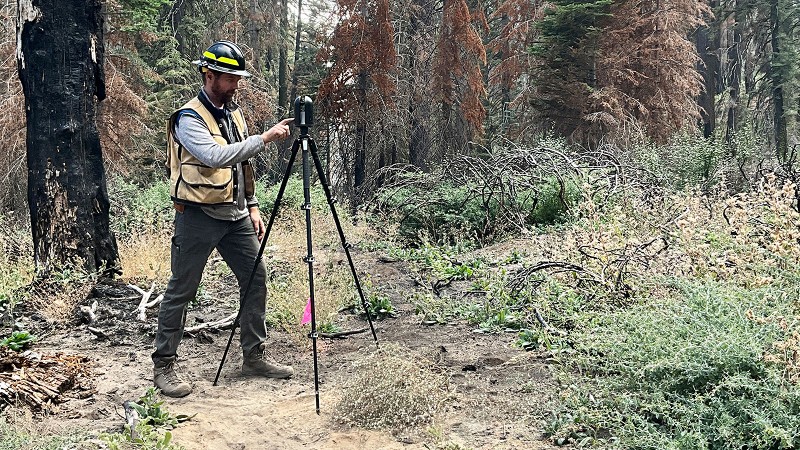
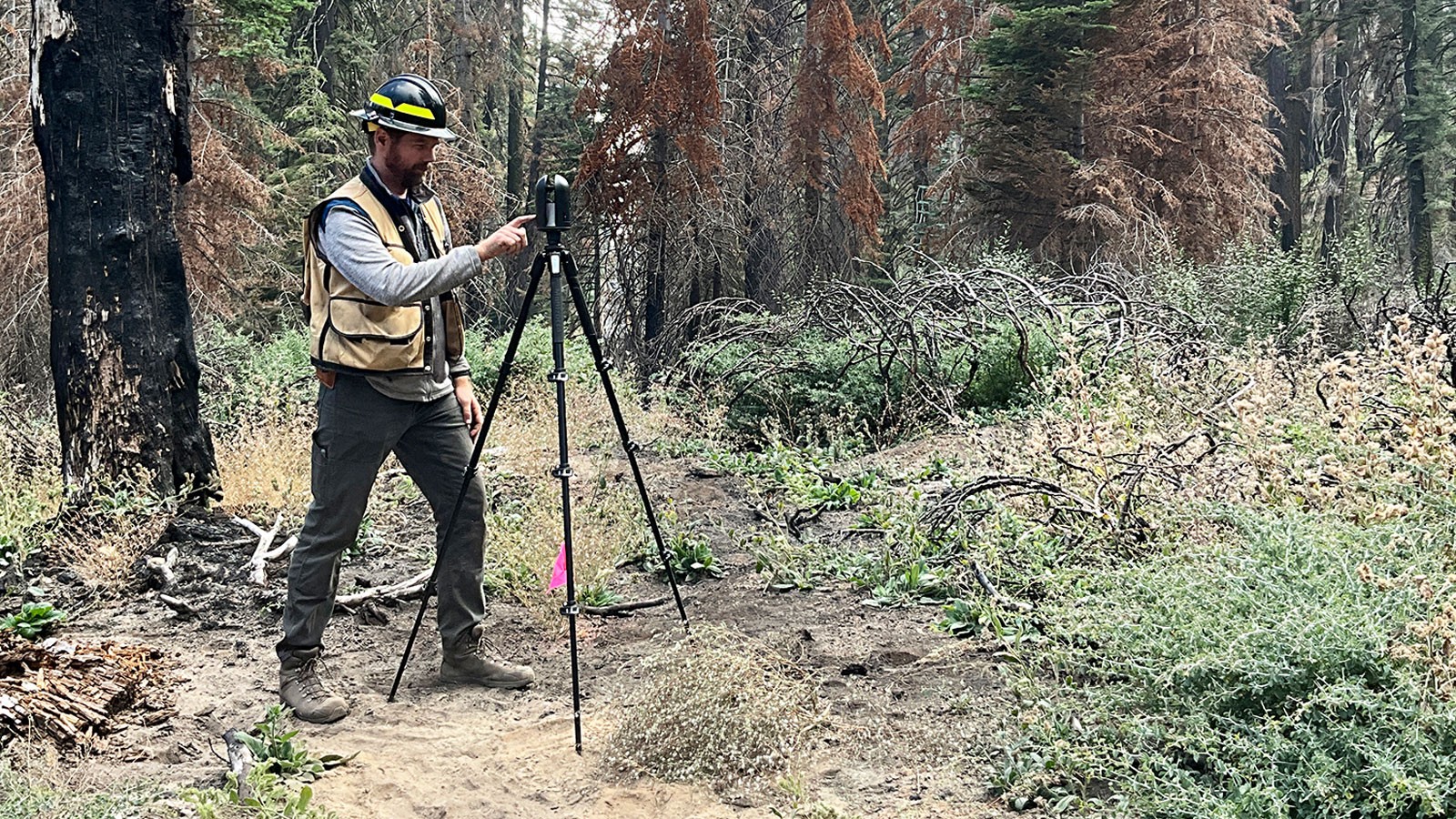
USU archaeologist Grant Snitker uses a terrestrial lidar scanner to collect data in California's Sequoia and Kings Canyon National Park following the KNP Complex fire. Snitker and colleagues received a USFS grant to study damage from Hurricane Helene in South Caroline forests. (Photo credit: USU/Alex Fetterhoff)
Hurricane Helene, which slammed into Florida’s coastal Big Bend on Sept. 26, 2024, and carved a path of destruction northward through Georgia, South Carolina, Tennessee and North Carolina, claimed the lives of more than 250 people. In the powerful, fast-moving storm’s aftermath, communities — including inland areas unaccustomed to hurricanes — scrambled to provide emergency response and begin the lengthy journey toward rebuilding shattered lives and infrastructure.
Flooded, wind-ravaged homes, schools, hospitals, businesses, roads, and water systems were among top priorities, but waiting in the wings were efforts to evaluate historic sites pounded with wind, water, and debris.
Utah State University archaeologist Grant Snitker is among scholars and managers assessing damages to natural and cultural resources, timber inventories and surface archaeological sites and features in South Carolina’s Francis Marion and Sumter National Forests.
“Once the immediate needs for the communities of South Carolina were met, we were ready to evaluate how the hurricane impacted the archaeological heritage of the region,” said Snitker, assistant professor in USU’s School of Social Sciences and director of the Archaeology and Public Lands Laboratory.
With colleagues from the University of Oregon and the Center for Applied Fire and Ecosystem Sciences in the New Mexico Consortium, Snitker is the recipient of a $566,000 grant from the U.S. Forest Service aimed at using lidar data and machine learning to develop assessments and risk models for archaeological sites affected by the hurricane across more than 500 square miles of South Carolina’s national forests.
“We’re fortunate to have access to aerial lidar datasets collected by the Forest Service shortly after the hurricane,” said Snitker, principal investigator for the project. “We will apply next-generation tools in data analysis and machine learning to help the forest service use all of the lidar data to locate and assess vulnerabilities of existing historic sites to damage from this hurricane and future hurricanes.”
Lidar, he says, is an active remote sensing technology and uses pulsed laser light to measure distances with high precision.
“Lidar stands for ‘light detection and ranging’ and provides high-resolution digital point cloud datasets describing the topography, vegetation, infrastructure and other landscape features of the studied area,” Snitker said. “This tool provides us with detailed information about particular sites and their features. We know what’s there.”
But knowing what’s there and getting to what’s there are two different things, he said.
“Thick vegetation, sediment, the steep topography, along with hurricane debris make accessing the archaeological sites very challenging,” Snitker said. “Physically accessing all of these sites would be difficult and cost-prohibitive. That’s why modeling with high-tech tools is critical.”
Among the urgency for knowing the state of sites and how Hurricane Helene affected them is knowing how vulnerable they are to subsequent weather events, including flooding and wildfires.
“We think of wildfire as primarily a threat in the western U.S., but wildfire danger is increasing in eastern U.S. states,” he said.
Applying new technologies, he added, including computer modeling with high resolution data and machine learning, is increasingly effective and accessible.
“Equipping our students with these advanced techniques enhances their readiness to pursue careers in archaeology and cultural resources management with public agencies, universities and private entities,” Snitker said. “This project affords meaningful, hands-on learning opportunities for our scholars, in addition to advancing efforts to protect irreplaceable heritage sites.”
WRITER
Mary-Ann Muffoletto
Communications Specialist
College of Arts & Sciences
435-797-3517
maryann.muffoletto@usu.edu
CONTACT
Grant Snitker
Assistant Professor
School of Social Sciences
(435) 797-2870
grant.snitker@usu.edu
SHARE
Comments and questions regarding this article may be directed to the contact person listed on this page.