USU Biological Engineering Department Hosts New York High School Interns
While teenagers around the country ticked away their summers in front of video games or lying by the pool, a small group of high-schoolers were busily at work in Utah State University’s labs, working to engineer solutions to some of the world’s most pressing problems.
They were six students from New York’s Uniondale High School, and they wrapped up a six-week intensive research program in Utah State’s Biological Engineering Department the week of Aug. 8. They each conducted their own research in a field within biological engineering, and each was guided by a faculty mentor from within the Biological Engineering Department.
During their time in Logan, the teenagers behaved and were treated like experienced graduate students, working full time in their labs. Their research could have implications for human health, forest ecology, waste management, renewable energy and other areas of increasing concern.
The program gave the students extensive real-world experience in research and a valuable head start on college.
“My knowledge of scientific processes has greatly increased,” says Ayodele Dechinea, one of the student interns.
As part of the program, the students created posters to illustrate their research and worked on oral presentations, which they presented before judges Aug. 8. They plan to later present their research at national science competitions, where potential prizes can total up to $100,000. Their participation in these competitions will benefit both the students and USU, said Anne Martin, recruiter for the Biological Engineering Department.
“We’re now going to have ambassadors on the East Coast presenting research they did here at Utah State at very prestigious competitions,” Martin says.
Paul Lichtman, research adviser at Uniondale High School, says the six students who came to Utah State were selected to participate because of their high interest and ability in science. To qualify for such a program requires students to be self-motivated, disciplined and mature. These six students met and exceeded those criteria, Martin says.
Lichtman says he is thrilled by the depth of experience and learning the students received while at Utah State. He’s been involved with similar programs at other universities where the students weren’t given much responsibility or trust. At USU, the students took direct responsibility for their research and made measurable progress, he says.
“It exceeded my expectations. We’re coming back next year,” Lichtman says. “I’ve already made reservations at the University Inn.”
In addition to academic experience, the program gave the students a chance to get acquainted with a part of the country they were unfamiliar with. Rural Utah is much different than the students’ home town on Long Island, Martin says. The students spent time getting to know USU’s campus and Logan, as well as spending time in its mountains.
Biological Engineering professor Jixun Zhan is currently applying for a grant that would set up a summer internship program to bring more such students to the Biological Engineering Department in future years.
“It’s the biggest and best thing that’s happened in my teenage life,” program participant Elizabeth Osei, said of her internship. “We’re secreting bioplastics from E. coli. Where else can you do that?”
The students and their research:
Sophia Powell conducted research with professor Jixun Zhan on curcumin, a compound found naturally in curry, which has been shown to combat the effects of food allergies. When consumed in curry, the compound is not effective in countering food allergies because it is quickly broken down and flushed from the body. Powell assisted in research into engineering lactic acid bacteria to produce curcumin while in the body, which could counter the effects of food allergies.
Ayodele Dechinea conducted research with professor Ronald Sims seeking a way to better separate algae from water at wastewater lagoons, such as those owned by Logan City. Currently, alum is most frequently used to separate algae from water, but Dechinea conducted research into the potential effectiveness of food starches instead, which would be less potentially damaging to the environment.
Katherine De Paz conducted research with professor Foster Agblevor into the production of biodiesel fuel from used cooking oil from Logan restaurants. De Paz researched which oil was most productive as biodiesel and determined that oil that had been reused multiple times was least productive.
Elizabeth Osei conducted research with professor Charles Miller on the creation of bioplastics by e. coli bacteria. Osei and Miller researched whether procedures carried out on bacteria were causing breaking of their cell walls. Bioplastic is made from secretions from the bacteria, and can be used to create plastic products that are far more biodegradable than conventional plastic.
Godwin Sotome worked with doctoral candidate Curtis Adams on research into the production of C-16, a lipid used in the food industry as an alternative to unhealthy trans fats. The lipid, which can be used to keep food products in a semi-solid state at room temperature, is found in palm oil. To prevent the deforestation that can come with extensive harvesting of palm oil, researchers are working to produce saturated C-16 by algae. Sotome researched whether the algae’s temperature affected its output of saturated C-16.
Manuel Flores-Bonilla, working under professor David Britt, conducted research on inorganic zinc oxide nanoparticles to determine how it is affected in the presence of a bacterial growth medium. Zinc Oxide is used as an antimicrobial agent and is used in cosmetic products such as sunscreen. Flores-Bonilla’s research helps address ecological concerns raised by its use.
Related links:
USU Department of Biological Engineering
Contact: Anne Martin, 435-797-1181, anne.martin@usu.edu
Writer: Devin Felix, devinfelix@gmail.com

Summer interns in the Department of Biological Engineering from Uniondale High School. (l-r) Manuel Flores-Bonilla, Katherine De Paz, Godwin Sotome, Sophia Powell, Elizabeth Osei, Ayodele Dechinea. (All photos by Devin Felix.)
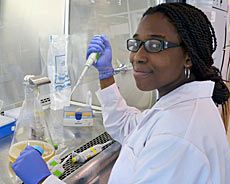
Uniondale High School student intern Sophia Powell conducts research in a USU lab.
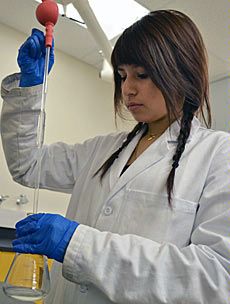
Uniondale High School student intern Katherine De Paz works on her research in a USU lab.
SHARE
Comments and questions regarding this article may be directed to the contact person listed on this page.