USU Earns USDA Grant to Strengthen Vet Tech Workforce, Alleviate 'Veterinary Deserts'
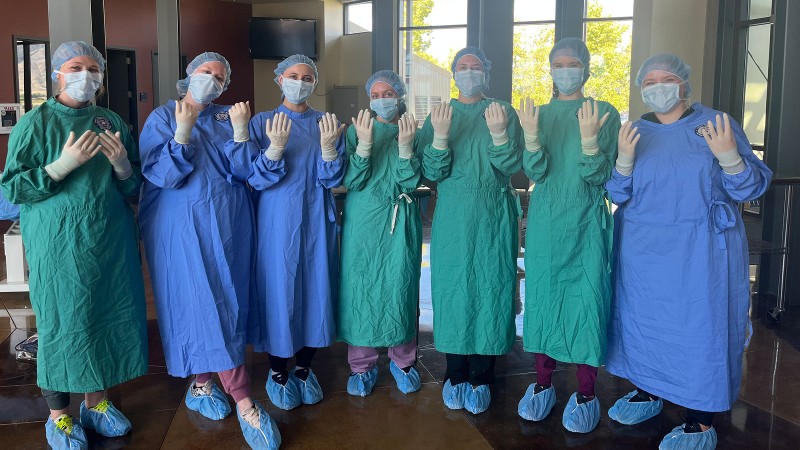
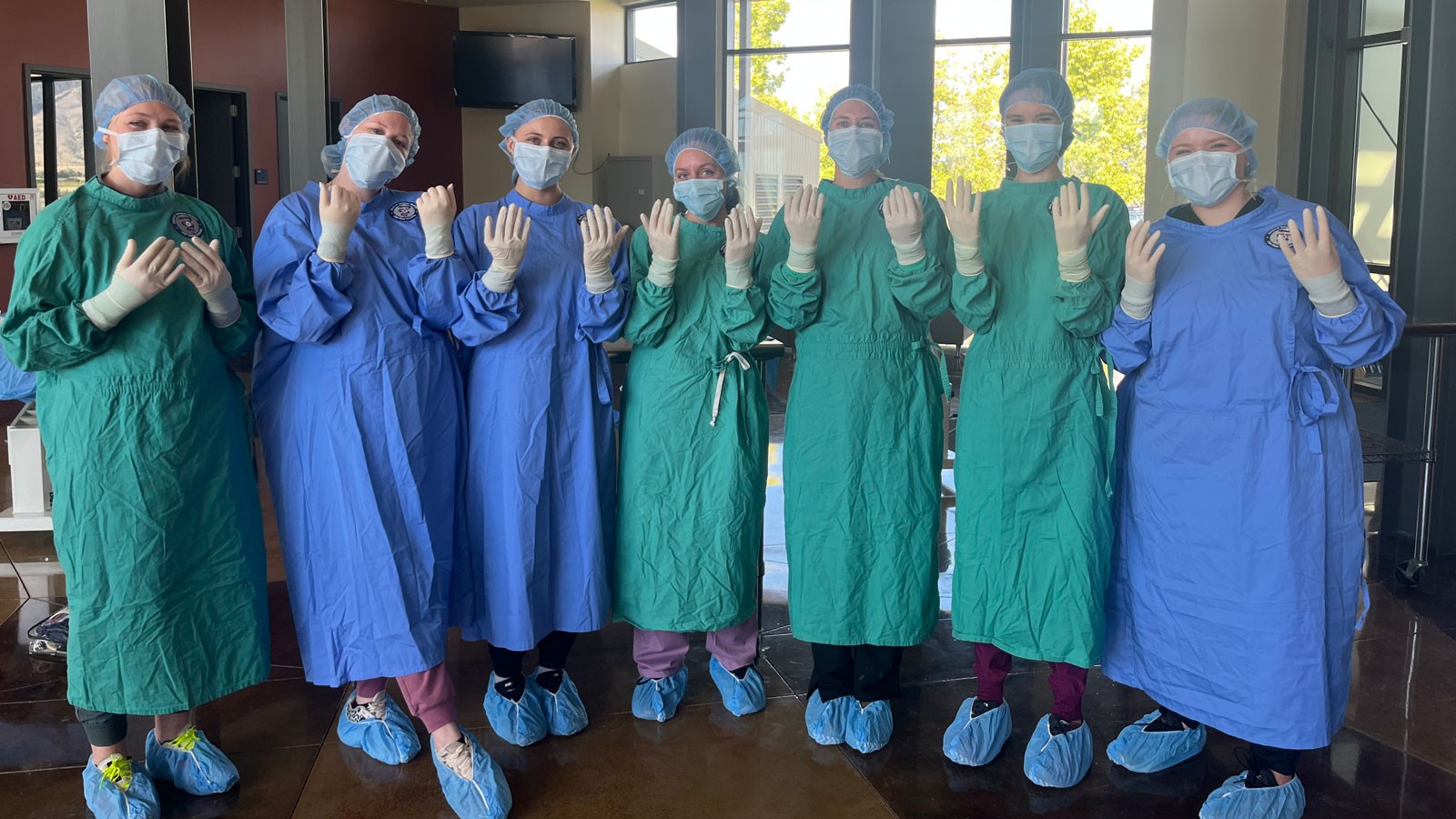
Students in USU's College of Veterinary Medicine pose in this 2025 file photo.
A good veterinary technician, Chloe Stenkamp-Strahm says, is worth their weight in gold.
Stenkamp-Strahm, the Extension Veterinarian for Utah State University’s College of Veterinary Medicine, received a Veterinary Services Grant Program award from the U.S. Department of Agriculture that aims to alleviate the shortage of qualified veterinarians by supporting veterinary technicians in rural practices.
Most discussions about “veterinary deserts” focus on the veterinarians themselves, bolstering certain veterinary training and determining what incentives might lure practitioners to serve far-flung ranches and remote farming operations. But this project tackles the problem from a different angle. It seeks to understand the needs of support staff — the veterinary technicians — and what makes them stay.
This effort, called “Empowering All-Species Veterinary Support Teams to Strengthen Intermountain West Community Care,” is awarded on a competitive basis by the USDA’s National Institute of Food and Agriculture. Three-year Education, Extension, and Training (EET) grants are meant to “develop, implement, and sustain veterinary services through education, training, recruitment, placement, and retention of veterinarians, veterinary technicians, and students of veterinary medicine and veterinary technology,” according to the website nifa.usda.gov.
Stenkamp-Strahm said her team will use a needs-assessment survey to ask practicing, rural veterinarians about their support personnel. What are they good at now? What could they be better at? Is high turnover an issue?
And then, she said, they’ll ask their support staff, “What do you need to do well at your job?”
Better pay is already a well-established need — no survey necessary there. Stenkamp-Strahm said that clinics with well-trained staff can offer better compensation, even in rural communities, because a strong and credentialed support team has been shown to increase practice revenue. Higher revenue should equate to better compensation for veterinary employees, thereby reducing turnover.
But the pathways to get licensed as a veterinary technician aren’t well-paved.
“We have these people with on-the-job training, and they maybe enjoy their jobs,” Stenkamp-Strahm said, “and then they get to a certain point where they sort of hit a ceiling. Maybe they want to get credentialed as veterinary technicians, but they don’t know how to. Or maybe they enjoy what they’re doing, but they’re sort of on an island in this rural area and they don’t have a lot of support, and that may lead to turnover and they may leave their jobs.”
The first hurdle is identifying the population of rural veterinary technicians currently working in the Intermountain West. USU’s team will use data from the USDA, which has mapped veterinary deserts based on county population size and clinic location; research from nonprofit organizations like the Veterinary Care Accessibility Project; and knowledge gleaned from USU’s own Mountainlands Veterinary Summit, a conference that the vet college hosts annually.
Stenkamp-Strahm envisions a platform that working vet techs can access in-person or remotely. If they aren’t licensed but are working under a veterinarian’s supervision at a clinic, USU’s courses will help them train to pass the credentialing test, the Veterinary Technician National Examination, or VTNE. And by grouping interested vet techs into smaller cohorts, they will have the option to learn, study, and ask questions together.
Valeria Hernandez-Madrigal, an academic veterinary technician at USU’s veterinary college, is currently working toward licensure thanks to Utah’s rules that allow an unlicensed vet tech to use hours acquired from supervised work to qualify for taking the VTNE. She can see how the framework proposed through Stenkamp-Strahm and this USDA grant will benefit vet techs in a similar position, who are skilled, competent, and working without a license.
“Most states require that associate’s degree from an [American Association of Veterinary State Boards] -accredited program, in order to take the test,” said Hernandez-Madrigal, who currently works with veterinary students in the college’s labs. “A lot of people can’t afford to do that, especially in this economy.”
Hernandez-Madrigal is taking the VTNE in December 2026 and can be licensed after passing the test and submitting proof that she completed 6,000 hours of supervised practice under a licensed veterinarian.
The test is “incredibly intimidating,” Hernandez-Madrigal said. “Without the resources I could fall back on, and say, ‘OK, I know this is going to give me accurate information,’ I’ve just been left to my own devices trying to figure out where I can learn some of this stuff.”
For veterinary technicians who are licensed and working, USU will offer learning modules that teach competencies in areas they may be unfamiliar with, like poultry medicine, or professional skills like communication or workflow optimization. Responses from the needs assessment will help guide what programs the USU team designs.
The plan includes development of a one-day Intermountain Veterinary Technician Forum to be held at USU each spring for vet techs to come together for lectures, hands-on training sessions, and networking.
The three-year funding period includes ongoing evaluation of these efforts to both improve how the program is delivered and assess its overall impact.
“Hopefully it fosters inclusion,” Stenkamp-Strahm said.
CONTACT
Nadia Pflaum
Public Relations Specialist
College of Veterinary Medicine
nadia.pflaum@usu.edu
SHARE
Comments and questions regarding this article may be directed to the contact person listed on this page.