USU Historian Lawrence Culver captures 2011 Spur Award
On a recent flight back to Utah, Lawrence Culver looked out the window at the cul-de-sacs and swimming pools of the suburbs below and thought, ‘looks like Southern California.’
It’s only natural since Culver, associate professor of history at Utah State University, has had Los Angeles on the brain since publishing The Frontier of Leisure: Southern California and the Shaping of Modern America (Oxford University Press, 2010).The book received a 2011 Spur Award for Best Contemporary Nonfiction Book, which Culver picked up at the Western Writers of America’s conference June 25. (It is a prestige he gladly shares with Joel and Ethan Coen, directors of the film True Grit who captured this year’s best western drama award.)
Culver studies the cultural, environmental and recreational history of the American West. He spent the 2010-11 academic year on sabbatical researching his next book as a fellow at the Rachel Carson Center for Environmental Studies at The University of Munich and at the Huntington Library in San Marino, Calif. After arriving back to campus in June, Culver sat down to discuss his award-winning first book and what he is writing about now.
Q. The Frontier of Leisure began as your dissertation project while a doctoral student at UCLA. How did the idea surface?
A. I have an interest in the history of tourism and the American West. I started looking around and saw that Los Angeles is the most successful tourist attraction in U.S. history. I thought I would write about that.
Q. In the book, you trace the history of Southern California from the late 1800s through the late 20th century and show how its culture influenced the rest of the country from architecture and style to urban planning and education. How did this happen?
A. During the late 1800s one could purchase a train ticket to Los Angeles from the Midwest for as cheap as $1. While many cities were promoting themselves during this era the one thing that Los Angeles had, and still has, is the climate. But the ads were not aimed at everybody — they were for middle class people with money. What attracted people to Southern California was the existence of a cheap labor force, an abundance of land where everyone could own a bungalow and a car, an ideal climate and the idea of living a lifestyle of leisure. Los Angeles had a secret weapon and that was the film industry. Hollywood gave LA this type of global visibility that no other city had. People started emulating the life and style of people they saw in the movies. It really had a transformative effect. Things that began as resort life became something middle class America popularized.
Q. One point you make in The Frontier of Leisure is how Southern California introduced a new way of thinking about nature that sparked the expansion of the suburbs across the Sunbelt and the nation. How was it different from the rest of the country?
A. Southern California rejected the idea of bringing nature into the city; and instead brought the city to nature. But by selling access to nature it devoured it. Everyone had a car, a bungalow and their own little piece of nature far from the city center. It was an ideal merging of the city and the country. It was suburbia — where most people now live. The concept was foreign to those from the East Coast who were used to people building out from a dense, crowded city center. And for a small city it worked pretty well. But no one expected it to grow to 10 million people.
Q. The suburban model you describe relies upon cars and petroleum. With the economic and environmental climate today, do you think we will start seeing a shift?
A. The question we can’t answer is ‘what’s going to happen next.’ In the 1970s we experienced an oil shock, which you would think would have pushed us from continuing with expanding the suburbs. But afterward we continued to sprawl. Part of that may have to do with the culture in America. People want a house. They want a yard. I don’t really see a future where everyone is living in small flats and commuting by rail. But it’s possible.
Q. In The Frontier of Leisure, you also note that not everyone in Southern California experienced a lifestyle of leisure.
A. People are often surprised to learn that the beaches and swimming pools were segregated. Southern California was built as a place for white leisure and dependent upon a labor force of people of color. The mass suburbanizing of America was also the mass segregation of America, the effects of which we are still seeing today. History is not something that happened in the past, it has real consequences for things we are still dealing with now. Personally for me, history is what helps explain the world we live in.
Q. Your first book won the Spur Award for Best Contemporary Nonfiction Book, what are you working on now?
A. I’m delighted about the Spur Award because the Western Writers of America give it to a book that’s accessible and readable and that’s what I wanted to do. When you write a book it’s a chance to reach a broader audience. If you want your research to have an impact on the world, people have to read it.
My next book, Manifest Disaster: Climate and the Making of America, is a departure from Southern California and about environmental history on a larger scale. It focuses more on man’s perception of climate and its impact on policy. One can trace settlement efforts to political conversations about things like weather and locations to plant crops. For instance, in the United States there was the idea that the rain would follow the plow. For a brief time it seemed to work. Then the Dust Bowl happened. Making assumptions about the climate can have really disastrous effects. People in the past and the present see things through their own economic and environmental prisms — they see the climate they want to see. By telling the story I hope to change the way we think about climate.
Related links:
USU College of Humanities and Social Sciences
Writer: Kristen Munson, (435) 797-0267, kristen.munson@usu.edu
Contact: Lawrence Culver, (435) 797-3101, lawrence.culver@usu.edu

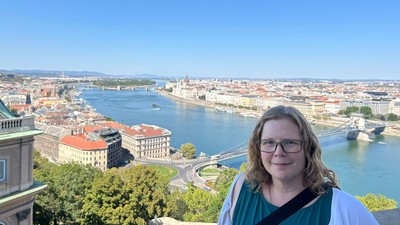
USU history professor Lawrence Culver has been on sabbatical this year, working on a new book project. He received the "Spur Award for Best Contemporary Nonfiction Book for his first book, “The Frontier of Leisure."
TOPICS
Awards 862storiesSHARE
Comments and questions regarding this article may be directed to the contact person listed on this page.