USU Presents Digital Exhibition on I-15's Impact on Salt Lake City's West Side
By Preston Waddoups |
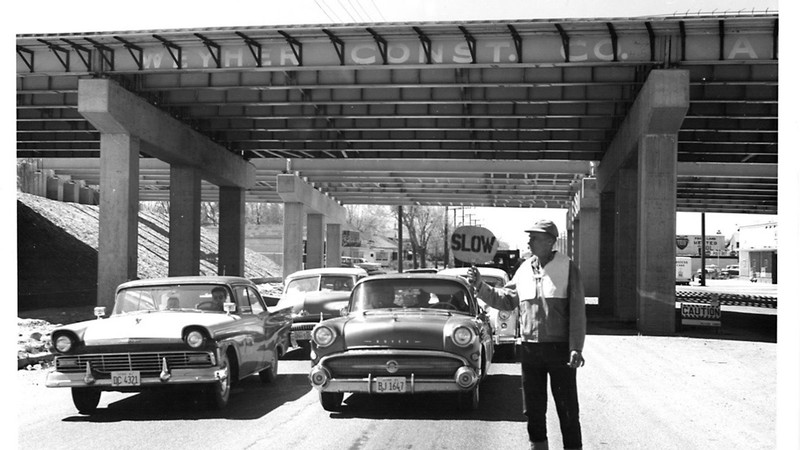
A man guides traffic during interstate construction in Salt Lake City in 1961. (Photo Credit: Utah State Archives)
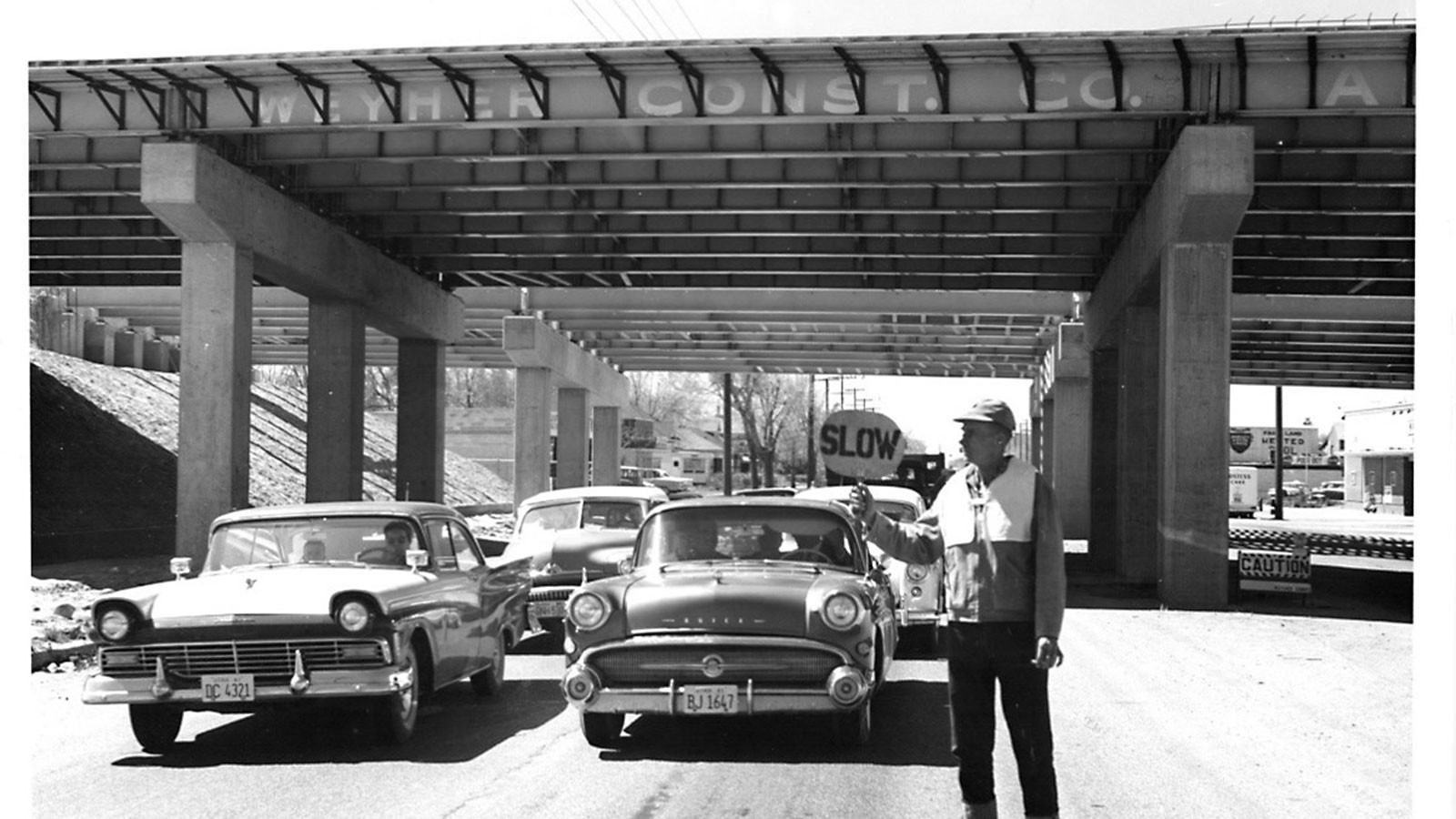
The Libraries and the Department of History at Utah State University collaborated to create a digital exhibition on the construction of Interstate 15 through the west side of Salt Lake City, an under-researched topic in Utah history.
The interstate has become an essential part of Utahns’ lives over the past 60 years, transporting people from their homes to work, leisure and beyond. The interstate was promised as a roadway of the future, but Salt Lake’s west siders fought for over a decade to prevent its construction.
The project “(In) The Road of Progress: The West Side and Interstate 15” first took shape when Rebecca Andersen, a lecturer in Utah and modern U.S. history who oversees the Department of History public history track, was contacted by the Utah Department of Transportation. UDOT approached her with a research inquiry and an interest in collaboration, which she expanded into a public history research project for a graduate course (HIST 6020) in the spring of 2023.
“For this project, we started the semester by reading classic scholarly works on interstate history,” Andersen said. “We then used this literature to help us to both select topics for our exhibit and contextualize Utah's own unique interstate story.”
Andersen partnered with Brittany Bertazon, digital project manager at USU Libraries, to develop a project investigating the history of the construction of I-15 and its impact on Salt Lake City’s west side.
Tameron Fawcett-Williams joined the project as a research assistant to locate, appraise and digitize historical materials through coordination with the Utah State Archives and the Utah Department of Cultural and Community Engagement. Fawcett-Williams also served as a research liaison for the course and worked to synthesize student research and written works into the exhibit, assisting greatly in curatorial direction and authorship.
In the exhibit, the curators explain that what began in Utah as a “super road” running through western Salt Lake became the first piece of the state’s efforts to contribute to the national interstate system.
Home to Salt Lake City’s industrial heart, the west side found itself at the center of a conflict between residential and industrial interests — a conflict it had seen many times since the city’s founding. Although west-siders were ultimately unsuccessful in opposing the initial highway construction, they have continued advocating for their community in the face of transit growth that threatens to disturb and displace them.
“Interstate 15 is Utah's jugular vein. So much of life, especially along the Wasatch Front, happens as we travel up and down the interstate,” Andersen said. “We hope the exhibit helps Utah residents understand the history behind this piece of infrastructure and think critically about its future.”
USU Libraries would like to give special thanks to Heidi Stringham, archivist at the Utah State Archives and Records, for her assistance as well as to Senior Public Historian Brad Westwood from the Utah Department of Culture & Community Engagement, the host of the Speak Your Piece (SYP) podcast and author of Salt Lake West Side Stories who provided support for the course and peer reviewed the digital exhibition.
Research for this project was funded in part by the Utah Department of Transportation.
WRITER
Preston Waddoups
preston.waddoups@usu.edu
CONTACT
Rebecca Andersen
History Lecturer
College of Humanities and Social Sciences
435-797-4159
rebecca.andersen@usu.edu
Brittany Bertazon
Digital Project Manager
University Libraries
(435)797-1389
brittany.bertazon@usu.edu
Tameron Fawcett-Williams
tamerongrfawcett@gmail.com
ADDITIONAL RESOURCES
SHARE
Comments and questions regarding this article may be directed to the contact person listed on this page.