USU Professor Exploring Role of Humanoid Robots in Future of Defense, Society
By Libbie Anderson |
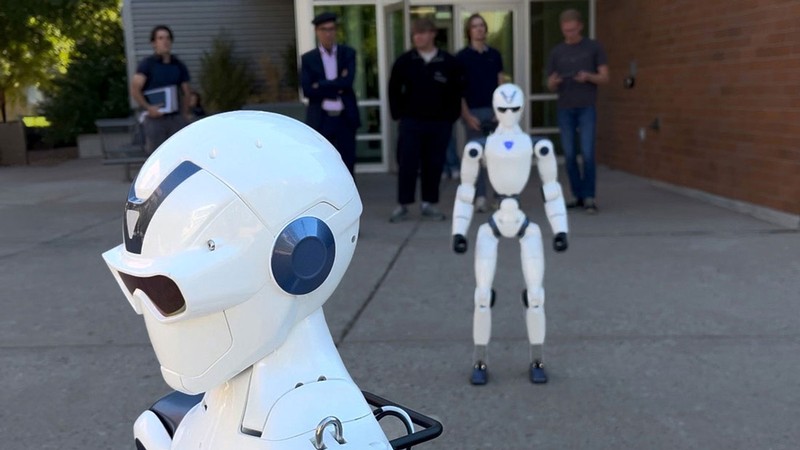
Engineers watching a demonstration of two humanoid robots on USU's Logan campus. Professor Mario Harper will be presenting on the capabilities of humanoid robots at the 2026 Zero Gravity Summit on Oct. 28.
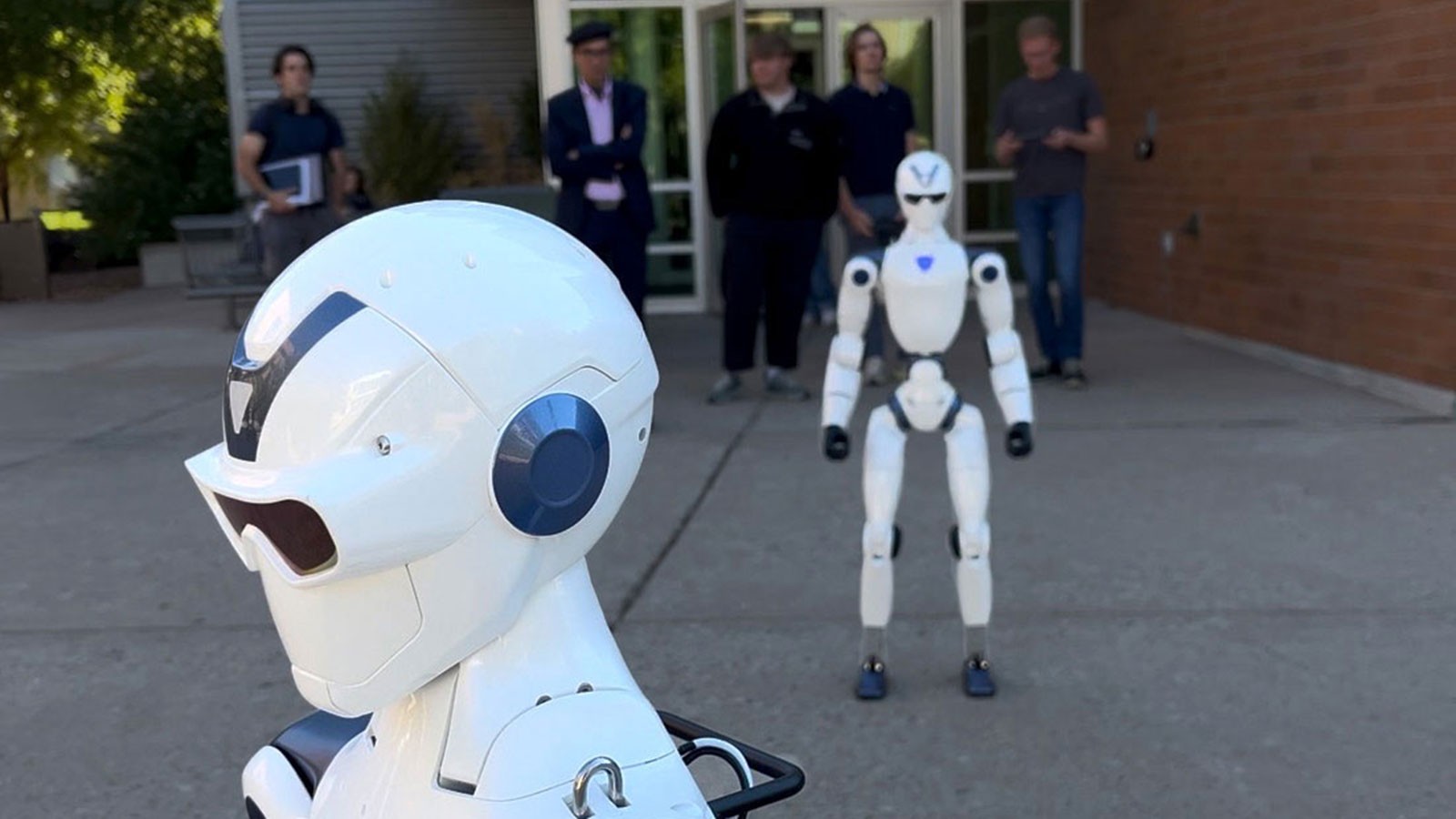
A crowd begins to gather as Dallas and Dallas II are brought outside to dance on Utah State University’s Logan campus, and it’s not hard to see why. The dancers are humanoid robots. While they stand no taller than a few feet, their impact could be huge, and a USU professor is showcasing their potential.
Dallas and Dallas II will be at Utah State University’s booth at the 2026 Zero Gravity Summit, Oct. 28-29. They will be chaperoned by USU’s Mario Harper, who will be presenting on the capabilities of humanoid robots 11 a.m. Oct. 28.
Harper says researchers have primarily worked with four-legged robots and rollers for work on interplanetary surfaces. However, when it comes to working on complex terrain or in human environments, robots need to replicate human abilities.
“Two legs, instead of four or six, allow enough clearance for them to make it around almost any human environment,” said Harper, an assistant professor of electrical and computer engineering.
The other challenge has been the disconnect between robotic versus human perception. With humanoids, Harper says that issue is practically resolved, with their perception of operating space almost identical to that of humans.
These capabilities make it suitable for humanoid robots to be embedded into various industries and military applications.
For operations like tactical insertion, Harper says it would be great to send a robot in first to clear a room, as that tends to be the most dangerous position. Unfortunately, when this exercise was tried with other robots, he said it either slowed the operation down or, if it was hit, would make it more dangerous by giving away the troops’ position, blocking the exit and not providing cover.
Alternatively, humanoid robots collapse, so troops can walk over them or fit them on a stretcher to pull them back. Similarly, if there's an obstacle, these humanoids can jump or climb over it just like their human counterparts.
“It's actually a very real, tactical benefit for the military,” Harper said. “Technical insertion exercises become more compelling when you have a platform that can maneuver well.”
Multidomain defense is another role humanoid robots can serve. Harper says drones provide a lot of cover, but if you want to hold a defense line, you still need somebody on the ground.
“We can start to see that the future of warfare is a place where, ideally, the front is held by these types of humanoid systems in very close coordination with air systems,” he said. “This way, you have a multidomain warfront with autonomous air and ground systems that can secure a city.”
The other industry of interest is robotics in home environments. For at-home care or housecleaning, even a human might have a hard time finding or doing things, but they can use reason and figure it out. Now, humanoid robots can do the same.
“Right now, no other robot has the physical and reasoning capability to do that, and you really need those two abilities,” Harper said. “If we're looking at a future where we want something that can fulfill the day-to-day operations of the home, I don’t think there is another choice.”
The purchase of Dallas and Dallas II has given students a one-of-a-kind experience to work with groundbreaking robotics, but Harper says USU has the capability to begin construction of their own humanoid robots.
“You'll be seeing USU in the next couple of years starting to build our own systems,” he said. “It's time.”
WRITER
Libbie Anderson
Public Relations Specialist
College of Engineering
435-797-8361
libbie.anderson@usu.edu
CONTACT
Mario Harper
Assistant Professor
Computer Science
mario.harper@usu.edu
SHARE
Comments and questions regarding this article may be directed to the contact person listed on this page.