USU to Advance Nuclear Energy Research in Partnership With Idaho National Laboratory
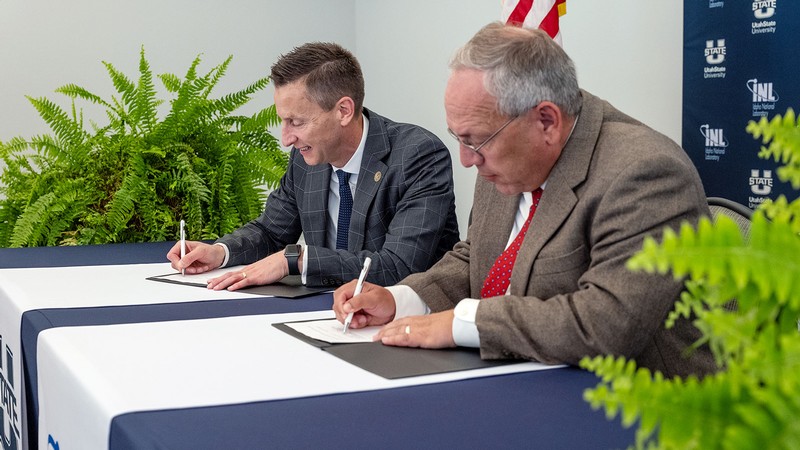
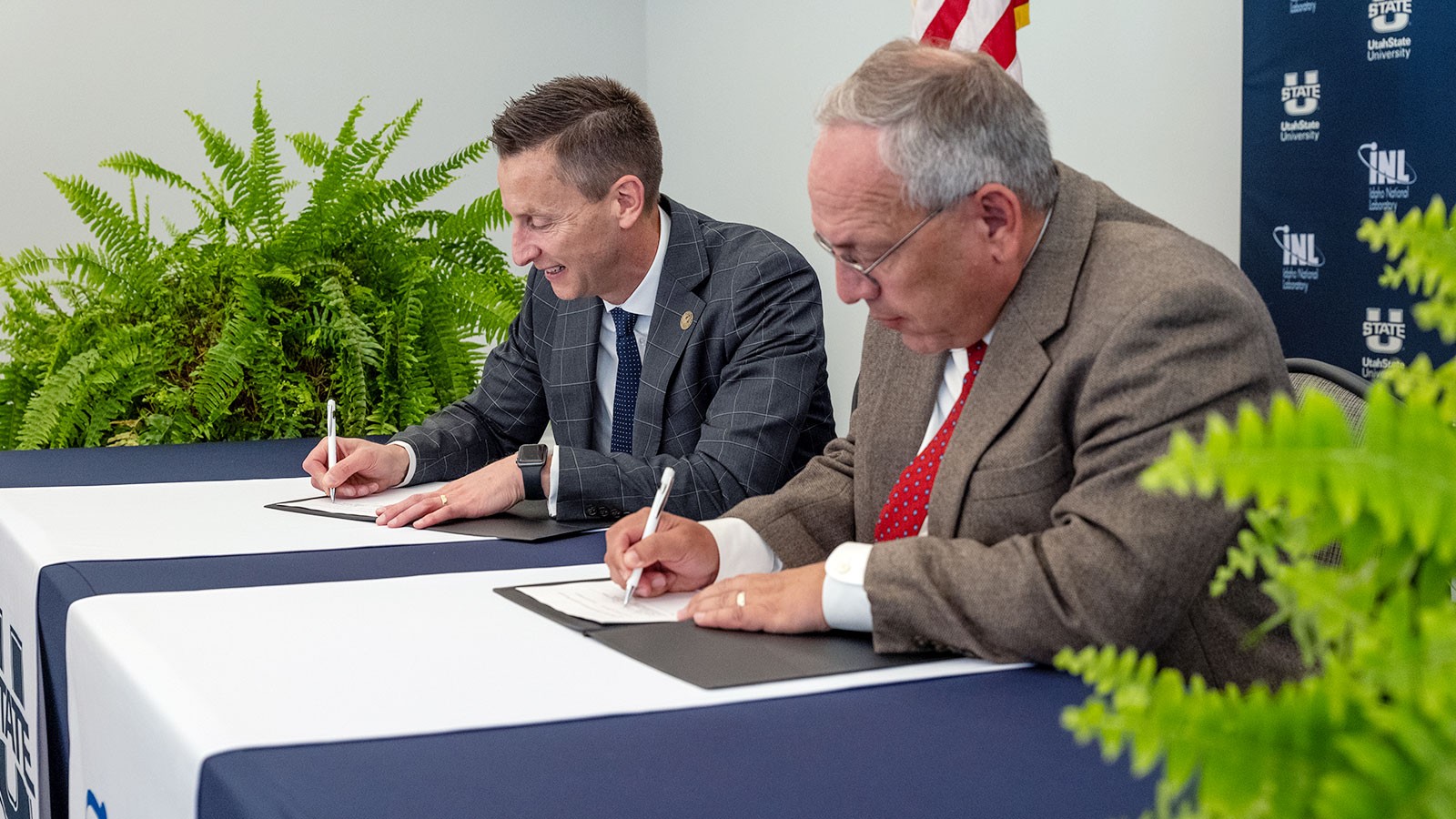
USU President Brad Mortensen and Idaho National Laboratory Deputy Lab Director Todd Combs sign a memorandum of understanding May 11, 2026, in the David B. Haight Center on USU's Logan campus. (Photo credit: USU/Taylor Emerson)
Utah State University to Advance Nuclear Energy Research in Partnership With Idaho National Laboratory
LOGAN — Utah State University has entered into a memorandum of understanding with Idaho National Laboratory contractor Battelle Energy Alliance, LLC, which will lead efforts to discover innovative nuclear energy solutions.
The collaboration between USU and BEA is referred to as the SUPER agreement, or Strategic Understanding for Premier Education and Research. The memorandum, signed in a ceremony on USU’s Logan campus on Monday, formalizes and expands collaboration between USU and INL. It strengthens joint efforts in energy, security technology and research while enhancing opportunities for students and faculty.
“The partnership through SUPER places Utah State at the forefront of discovery for meeting Utah’s energy needs,” said USU President Brad L. Mortensen. “We believe Aggies will find solutions for the energy challenges we face and the goals set in Operation Gigawatt.”
Operation Gigawatt was announced in October 2025 by Gov. Spencer Cox. It’s part of the state’s strategy to double Utah’s energy-generating capacity by 2035 and includes plans for a nuclear facility in northern Utah.
“Idaho National Laboratory is pleased to enter into this agreement as it marks an important step forward in our partnership and creates new opportunities to expand the capacity, efficiency, and impact of critical research initiatives,” said Idaho National Laboratory Deputy Lab Director Todd Combs.
In addition to nuclear, SUPER will allow USU and BEA to research other energy options and critical infrastructure including but not limited to:
- Research and development for upstream and downstream services to support nuclear power, nuclear material recycling, product separation, waste monitoring and radiation detection.
- Environmental engineering and modeling, including water use and efficiency for nuclear systems and fuel cycle uses.
- Developing tools for the extraction and processing of critical minerals, and energy storage systems inclusive of radiation shielding and damage testing.
- Automation, control and cybersecurity of machinery and vehicles.
Both parties see great opportunities through the exchange of academic and research materials and also through cooperative seminars, workshops and conferences. SUPER does allow for further collaboration, research and discovery not specifically mentioned in the agreement.
“INL and USU will collaborate on research, host joint workshops and conferences, and establish a joint appointment program to enhance research and academic collaborations,” Combs added. “We look forward to the critical work INL does with USU as it is of the upmost importance to our region, our nation, and the future of energy and national security.”
CONTACT
Amanda DeRito
Associate VP of Strategic Communications
University Marketing and Communications
435-797-2759
Amanda.derito@usu.edu
SHARE
Comments and questions regarding this article may be directed to the contact person listed on this page.