USU Uintah Basin Professor Ben Burger Digs into own Past in Inaugural Lecture
By Marcus Jensen |
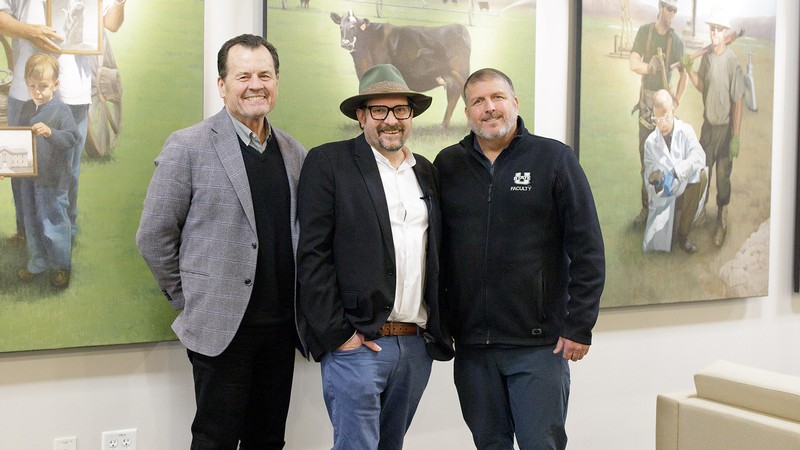
Ben Burger (middle) with Ken White (left), senior vice president for Statewide Enterprise, and James Taylor, vice president for Regional Campuses. Burger gave his inaugural lecture after receiving the promotion to full professor.
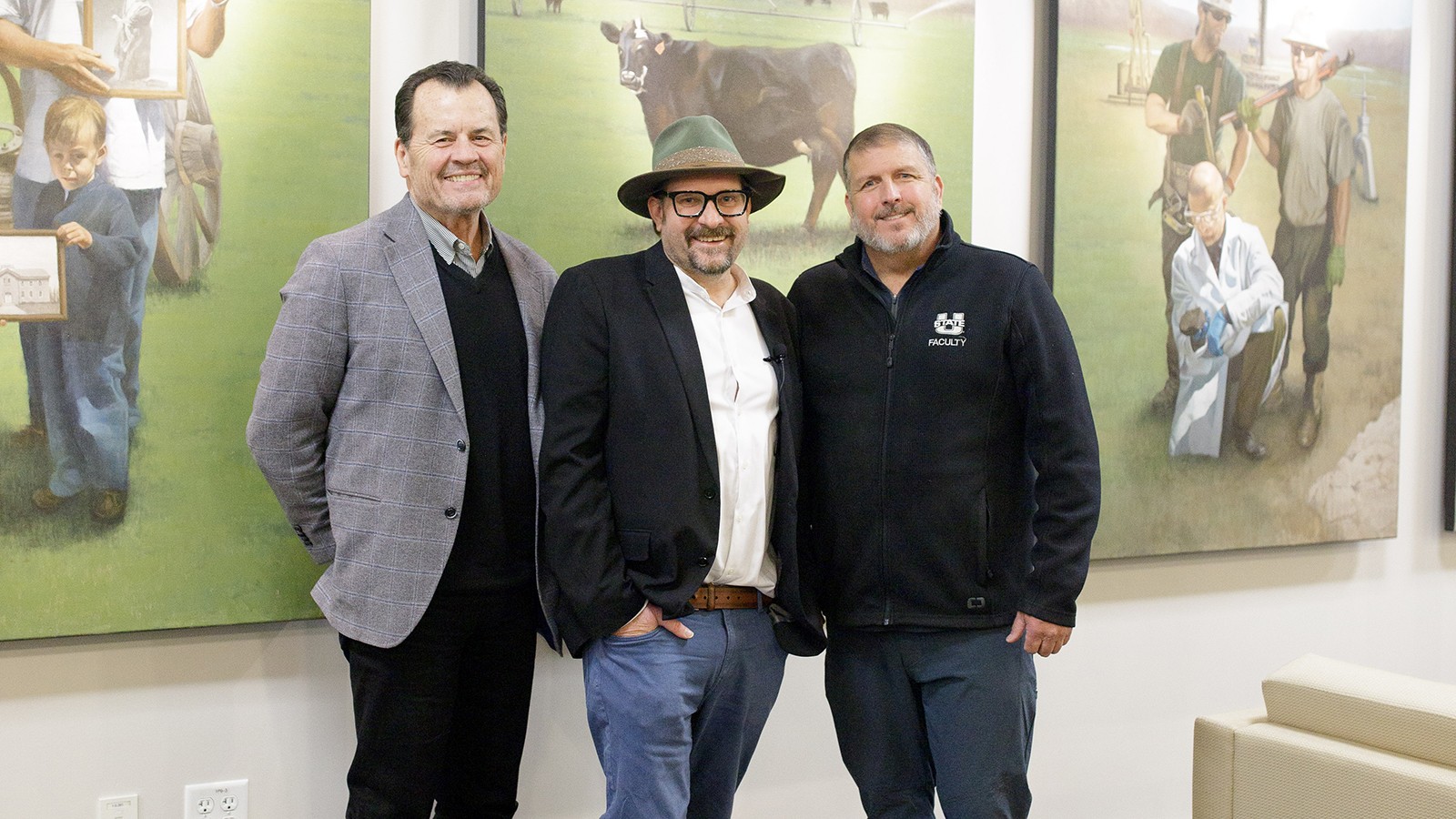
VERNAL, Utah — Utah State University Uintah Basin faculty, staff, and students gathered on Dec. 4 to celebrate the inaugural lecture of Benjamin Burger, newly promoted professor of geology in the S.J. & Jessie E. Quinney College of Agriculture & Natural Resources.
Burger delivered his lecture, titled “In the Company of Ancient Ghosts: Lessons from a Paleontologist's Field Notebook,” highlighting many of the projects and accomplishments he has been involved in throughout his career.
The inaugural lecture series honors USU faculty who have completed the promotion and tenure process and advanced to the rank of professor within the past year. Earning the title of full professor is one of the highest distinctions a faculty member can achieve. It recognizes years of excellence in instruction, research, and service to both the university and the community. USU marks this achievement with an inaugural lecture—a tradition in which newly promoted professors share moments and insights from their academic journey, their research, and their hopes for the future.
“The USU Uintah Basin campus is fortunate to have renowned paleontologist Ben Burger as a local faculty member,” said David Law, associate vice president of USU Uintah Basin. “We celebrate Ben's promotion to professor with his inaugural lecture.
“In addition to his scientific contributions, Ben is known for being a passionate teacher who successfully mentors students and helps them become thriving scientists. His educational outreach also reaches budding scientists around the world through his paleontology videos available on YouTube.”
During his lecture, Burger shared examples from his field notebooks, which contain notes, drawings, and artwork.
“I'm an avid journaler, writer, and artist,” Burger said. “Over the years I’ve amassed a large collection filled with notes and sketches from my adventures. I thought I would simply open pages from my field notebooks and talk about some of the projects I’ve worked on over the years.”
He began with his first project as a student at the University of Colorado, geologically mapping parts of southern Wyoming. He later worked with crews from the American Museum of Natural History (AMNH) surveying and correlating fossil quarries in the Eocene Bridger Formation. This work led to his honors thesis on a small mammal fossil called Hyopsodus.
While working with the AMNH during graduate school, Burger described finding what he called “the coolest” fossil he has ever discovered—a primate fossil of Omomys, an animal resembling modern tarsiers. After completing graduate school at Stony Brook University in New York, he went on to work full time at the AMNH, cataloging and photographing dinosaur and other fossil collections. His supervisor instructed him to start with the largest dinosaur specimens, which proved both fun and challenging given their size and abundance.
“We had to use forklifts to move the dinosaurs off the shelves, photograph all the bones, and enter everything into a database,” Burger said. “At the same time, we were also cataloging small fossils like shells and mammal teeth. The museum has six floors and more than five million specimens. It was an incredible task.”
Burger eventually felt drawn back to research and spent his vacation time visiting various field sites, including locations in Egypt and Colorado. He later left the museum to return to Colorado to pursue his doctorate. Much of his lecture focused on his work in the Uinta Basin and surrounding regions in Colorado and Wyoming, and the fossils he and others have discovered and studied there.
Burger concluded by offering an invitation similar to one he often gives his students: start keeping a journal, as it can be rewarding to revisit years later.
“Grab a journal and write down your observations,” he said. “Record your ideas and the things you want to work on. Some of these notes might become important later. You can always go back to them. You’ll discover amazing things if you do, and you’ll remember details about your past.”
After earning his doctoral degree in 2009, Burger came to the Uinta Basin, first as a paleontology specialist for an environmental consulting agency. He joined the USU Uintah Basin faculty in 2011 as an assistant professor and was promoted to associate professor in 2017. He leads ongoing field studies across eastern Utah, western Colorado, and southwest Wyoming. He also teaches courses in geology, paleontology, stratigraphy, and sedimentary geology across the state and mentors graduate students in field-based research.
Operating campuses in Vernal and Roosevelt for more than 50 years, Utah State University Uintah Basin gives students the personalized attention and small class sizes of a small-town college with the resources of a large university, all in the backdrop of the outdoor oasis that is the Uinta Mountains and Ashley National Forest. With degree options ranging from associate to doctorate degrees and more than 125 programs available, as well as access to the renowned Bingham Research Center, USU Uintah Basin offers programs that help fuel local economies and empower individuals and their communities. Learn more at uintahbasin.usu.edu.
WRITER
Marcus Jensen
News Coordinator
University Marketing and Communications
marcus.jensen@usu.edu
CONTACT
David Law
Associate Vice President
USU Uintah Basin
435-722-1716
david.law@usu.edu
TOPICS
Inaugural Lecture 130storiesSHARE
Comments and questions regarding this article may be directed to the contact person listed on this page.