USU Undergrad Physics Researcher Connor Waite Contributes to NASA-Funded Space Mission
Named a Scholar of the Year by the College of Arts and Sciences, Waite helped USU scientists and Space Dynamics Laboratory engineers solve a geolocation challenge with an atmospheric waves image collection instrument aboard the International Space Station.
By Mary-Ann Muffoletto |

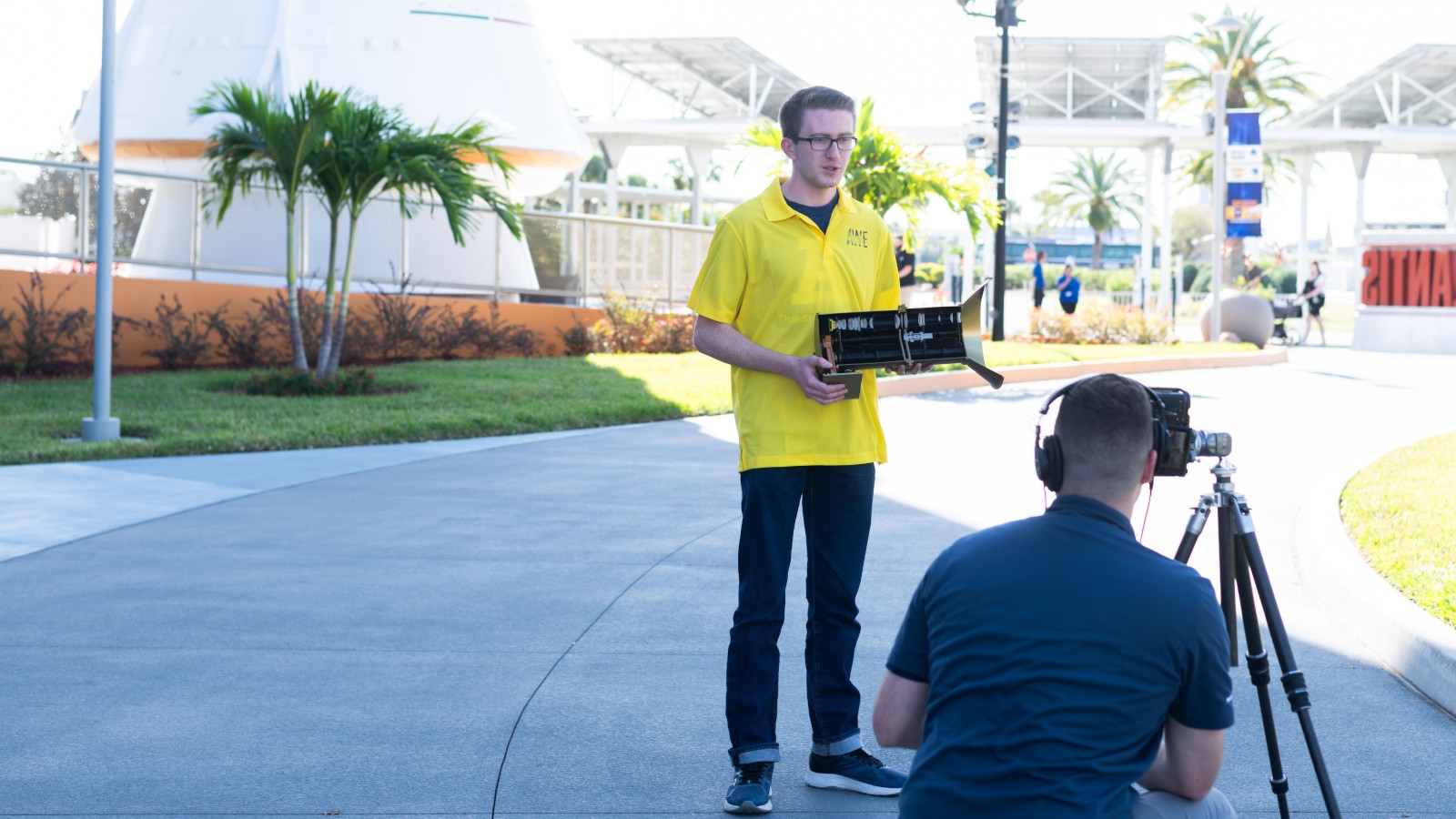
Undergraduate physics researcher and ArtSci Scholar of the Year Connor Waite, holding a model of a Space Dynamics Laboratory-built instrument ready for launch to the International Space Station, is interviewed at Florida's Kennedy Space Center in November 2023. (Photo credit: SDL/Allison Bills)
If you trace the orbit of the International Space Station around the Earth, you’ll see a path resembling yarn wound into a ball. That’s because the spacecraft orbits at a 51.6-degree inclination and as the planet rotates, the path covers a new swath from north to south and south to north as the ISS cruises along at roughly 17,500 miles per hour.
Each trip around the planet takes 90-93 minutes. With each pass, the ISS gradually drops due to the Earth’s gravitational pull and atmospheric drag. Periodic reboosts right the spacecraft’s orbit, which is affected by pitch, roll and yaw — three fundamental axes of motion: vertical (nodding up and down), longitudinal (tilting side-to-side) and lateral (like a person shaking their head “no.”)
Utah State University researcher Connor Waite has spent the past three years of his undergraduate career considering the station’s changing movements and orientation as he’s studied a novel instrument attached to the underbelly of the station since November 2023.
Waite, who is the College of Arts and Sciences’ 2026 Scholar of the Year, joined the USU Department of Physics AWE (Atmospheric Waves Experiment) science team about two years into his college studies.
“I wanted to get involved in research and my physics advisor Karalee Ransom thought the AWE team might be a great fit — she was right,” he says. “After meeting with Research Associate Professor Dominique Pautet, I was ready to get started.”
The NASA-funded AWE mission, the largest joint endeavor undertaken by USU and Space Dynamics Laboratory, features an SDL-built Advanced Mesospheric Temperature Mapper, or AMTM, equipped with four telescopes actively capturing images of atmospheric gravity waves emanating from the Earth’s lower atmosphere. The AMTM, launched to the ISS aboard a SpaceX Falcon 9 rocket from Cape Canaveral, Florida, in November 2023, is capturing millions of images and set to accede its coveted slot on the ISS this May.
Waite, who graduates from USU this spring with a bachelor’s degree in physics, was among USU and SDL researchers who traveled to Florida for the launch.
“It was so inspiring and exciting to be in a place with so much space history,” says Waite, who was enlisted to speak at the launch event. “I was honored to be part of the team teaching the public about the importance of this scientific mission. It was a once-in-a-lifetime experience.”
After the AMTM was mounted by a robotic arm on the outside, Earth-facing part of the ISS, teams at SDL and USU, including Waite and his mentors, worked at calibrating and analyzing AWE’s geolocation estimates.
“As we examined the images, we needed to know their geolocation — where they were located,” he says. “We noticed an offset. That is, the locations in our data were not as accurate as we needed them to be.”
Waite was assigned to work with SDL engineer and USU alum Eric McKinney, who worked with Waite and other USU students on the AWE Science Team for several months to resolve geolocation challenges.
“I was an undergraduate researcher myself, so I know the value of gaining experience working on real-world problems,” McKinney says. “Connor and his teammates have made important contributions to our efforts.”
Waite was tasked with locating “tie points;” that is, finding points where the team knew an image should be and identifying displacements.
“After spending several months examining these displacements, we were able to discern some patterns,” he says. “We determined two main causes, which guided us to changes we needed to make to our geolocation algorithms.”
Waite presented his findings to SDL engineers and scientists.
“It was a little intimidating, as I’m an undergraduate and I was describing my findings to people with much more expertise and experience,” he says. “But everyone was supportive and helpful.”
Russ Kirkham, SDL program manager and AWE project manager, praised the combined team’s success in refining geolocation accuracy.
“These efforts are key to fully satisfying AWE mission requirements,” Kirkham says. “NASA scientists have emphasized the challenges of doing this and have been impressed with our results. Connor’s contributions directly helped to enable this success, both individually and as part of a large, multi-organizational team.”
The AMTM’s ISS tenure draws to a close in May, but Waite’s research career is just beginning.
“I’m grateful for the opportunities I’ve had, which have shown me how fulfilling research can be,” he says. “My next step is graduate school.”
Waite says mentorship by Pautet and McKinney, along with AWE Mission Principal Investigator and USU Physics Professor Ludger Scherliess and Research Associate Professor Yucheng Zhao, has been invaluable.
“They’ve been amazing mentors in teaching me how to do research and encouraging me to push forward and take extra steps,” he says. “Most of all, they’ve put their trust in me, allowing me to contribute to the project in a meaningful way.”
Waite says he’s proud to be part of Utah State University.
“I love the sense of community at USU,” he says. “I often wear Utah State merch when I travel and people often catch my eye and say ‘Go, Aggies!’”
WRITER
Mary-Ann Muffoletto
Communications Specialist
College of Arts & Sciences
435-797-3517
maryann.muffoletto@usu.edu
CONTACT
Ludger Scherliess
AWE Mission Principal Investigator
Department of Physics
435-797-7189
ludger.scherliess@usu.edu
SHARE
Comments and questions regarding this article may be directed to the contact person listed on this page.