Utah Water Research Laboratory Director to Step Down From Administrative Role
By Madeline Buskirk |
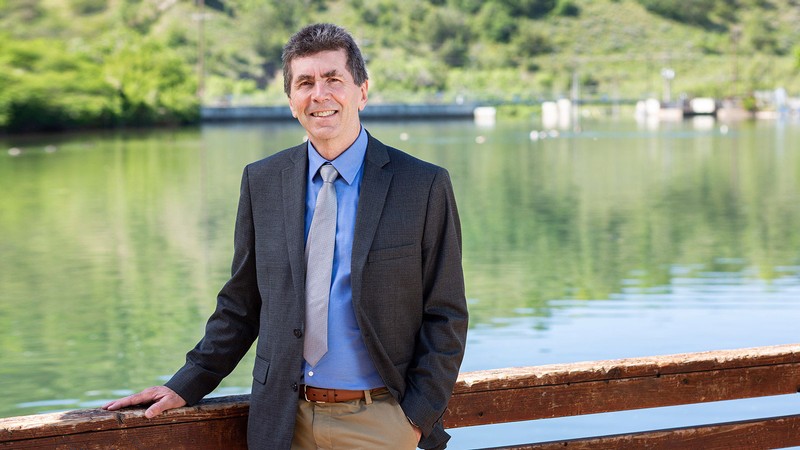
David Tarboton will step down as director of the Utah Water Research Laboratory. He will continue teaching and scholarly research in his faculty role at the lab.

After nearly six years of service as director of the Utah Water Research Laboratory, David Tarboton has announced his decision to step down from this administrative role.
“David’s leadership has been instrumental in shaping the UWRL into what it is today,” said David Jones, dean of the College of Engineering. “His resilience, vision and ability to steer the laboratory through both calm and turbulent times have left a lasting impact on all of us. We are incredibly grateful for his contributions and leadership, and his legacy will continue to inspire us in the years ahead.”
Tarboton will continue teaching and scholarly research as he returns to his faculty role at the lab. He will stay on as director while a search for his replacement is underway.
The UWRL is one of the country’s leading institutions for water resources engineering and environmental quality research, a reputation shaped by Tarboton’s leadership and contributions. It is among the first and largest university-based water research facilities in the United States and employs around 200 faculty, staff and students. The lab consists of 113,000 square feet of research and office space, housing two world-class hydraulics modeling facilities and an environmental quality lab.
Under Tarboton’s leadership, the UWRL navigated challenges and reached impressive milestones. He steered the UWRL through the COVID-19 pandemic. He also facilitated several major remodeling projects, improving key areas like the mezzanine student workspace, third floor student area, reception area and second floor remodel, as well as repurposing the greenhouse for extra storage and overseeing the successful reconstruction of the lab’s main parking lot.
Tarboton helped strengthen UWRL programs by hiring seven new faculty members. He also invested UWRL Mineral Lease funds into equipment, seed grants and collaborative research, including exciting partnerships with the Institute for Land, Water & Air and support for graduate research. He recently coordinated the 2025 Spring Runoff Conference, which coincided with the UWRL’s 60th anniversary celebration.
Tarboton holds a master’s and a doctorate from the Massachusetts Institute of Technology and undergraduate degrees from the University of Natal and the University of South Africa. He joined USU in 1990 and was named the Sant Endowed Professor of Water Resources Engineering in 2022.
Tarboton worked during sabbatical leaves from USU as a visiting professor and scholar at the University of North Carolina at Chapel Hill, and the National Institute for Water and Atmospheric Research in Christchurch, New Zealand. Having mentored 37 graduate students, he is helping to guide and inspire future leaders in the field.
Tarboton is a highly experienced water resources engineer and renowned hydrologist with over 80 research publications to his name. As a fellow of the American Geophysical Union, his contributions to the field have been recognized with several awards, including
- The 2023 D. Wynne Thorne Career Research Award from Utah State University.
- The 2020 David R. Maidment Award for Exemplary Contributions to Water Resources Data and Information Systems from the American Water Resources Association.
- The 2019 Outstanding Graduate Mentor Award from USU's Department of Civil and Environmental Engineering.
While serving as UWRL director, Tarboton has remained actively engaged in research. He serves on the Great Salt Lake Strike Team, providing timely research support to help leaders make data-driven decisions about the Great Salt Lake.
Tarboton led the development of HydroShare, a platform established using funding from two NSF grants (2012-2022). Now operated by the Consortium of Universities for the Advancement of Hydrologic Science, HydroShare serves as a repository for sharing data and models, supporting collaboration among hydrologists globally.
His work on HydroShare continues with support from the Cooperative Institute for Research to Operations in Hydrology to advance the modeling capability of computing platforms linked to HydroShare.
Additionally, Tarboton has published research on plausible future streamflow scenarios being used by the U.S. Bureau of Reclamation in Colorado River Post 2026 operations planning.
WRITER
Madeline Buskirk
Public Relations Specialist
College of Engineering
madeline.buskirk@usu.edu
CONTACT
David Tarboton
Director
Utah Water Research Laboratory
435-797-3172
david.tarboton@usu.edu
SHARE
Comments and questions regarding this article may be directed to the contact person listed on this page.