What's in Utah's Air? USU Researcher Explores Dust's Effects Beyond What We Breathe
By Tabitha Wagner |
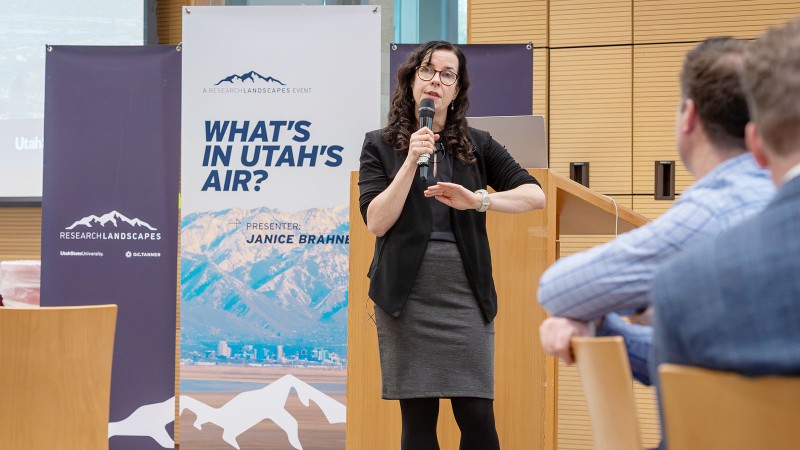
Janice Brahney speaks about airborne dust at a Research Landscapes presentation Nov. 11 in Salt Lake City.
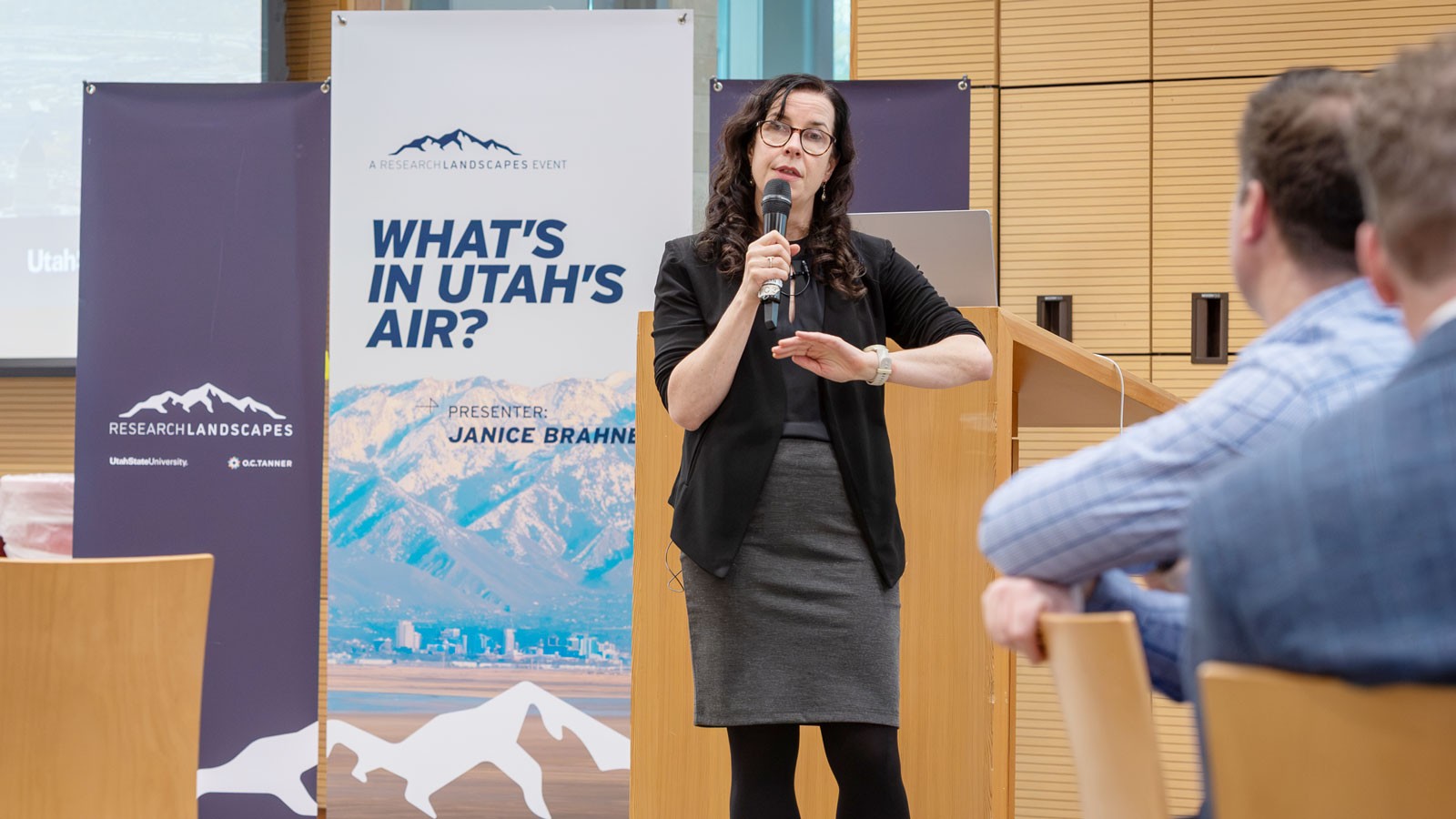
What’s in Utah’s air matters long after the dust settles. At Utah State University’s latest Research Landscapes event, Janice Brahney explored how airborne particles can affect not only the air people breathe, but also water supplies, plants, animals, and ecosystems.
The event was Nov. 11 at O.C. Tanner headquarters in Salt Lake City.
During the presentation, titled “What’s in Utah’s Air?” Brahney drew on eight years of atmospheric deposition research at 30 locations across the Midwest and West. She examined the substances traveling through the atmosphere and their consequences for people and the environment.
“Not all dust is equivalent,” Brahney said. “Composition matters.”
Her research has identified toxins, nutrients, heavy metals, caffeine, and microplastics in airborne dust.
An award-winning associate professor in USU’s S.J. & Jessie E. Quinney College of Agriculture & Natural Resources, Brahney studies the connections among environmental change, nutrient cycles, and freshwater ecosystems. Four locations in her atmospheric deposition study are in Utah, including one focused on the Great Salt Lake.
Air quality discussions often emphasize particles smaller than 10 microns because of concerns about inhalation. Brahney’s work examines why that size threshold does not capture the full range of potential effects. Larger particles can settle onto land and water, creating pathways for contaminants to reach ecosystems and people beyond direct breathing exposure.
“The composition of particles in the atmosphere is changing faster than we realize, influencing human exposure to contaminants,” Brahney said.
At the Great Salt Lake, dust from the exposed lakebed can carry both naturally occurring materials and pollutants associated with human activity in the basin. Those particles may affect human and ecosystem health, as well as snowpack and mountain watersheds. Understanding their composition is essential to understanding their effects.
Her message emphasized the need to consider both what remains suspended in the air and what eventually settles into the surrounding environment.
“We need to monitor the full spectrum of what is in the atmosphere,” Brahney said.
USU Research Landscapes is hosted by the Utah State University Office of Research and sponsored by O.C. Tanner. The series connects community and state decision-makers with researchers investigating Utah’s land, water, and air challenges through presentations and question-and-answer sessions. Learn more about the series and future events at researchlandscapes.usu.edu.
WRITER
Tabitha Wagner
Office of Research Communications
tabitha.wagner@usu.edu
CONTACT
Janice Brahney
Associate Professor
Department of Water, Earth, & Environmental Sciences
435-797-4479
janice.brahney@usu.edu
SHARE
Comments and questions regarding this article may be directed to the contact person listed on this page.