Logan Wellbeing Survey Findings 2024

By Dr. Courtney Flint and Team

utah wellbeing survey logo

Contact Information

Summary

Logan is one of 51 cities participating in the Utah Wellbeing Survey Project in 2024. This project is designed to assess the wellbeing and local perspectives of city residents and to provide information to city leaders to inform general planning processes. Additional analysis is underway and this report may be updated over time.

We are grateful to all those who took the survey and to our city partners who helped to make this possible. We are grateful to a number of entities for funding: the Utah League of Cities and Towns, USU Extension, USU’s Institute for Land Water and Air, the Wasatch Front Regional Council, Utah Department of Transportation, the Utah Agricultural Experiment Station, and the cities of Alpine, Cedar Hills, Draper, Millcreek, Nephi, North Salt Lake, Ogden, Orem, Pleasant Grove, Providence, Springdale, Tremonton, West Bountiful, and West Valley City.

This report describes findings from the 2024 Logan survey and comparative information with other project cities. In March, April, and May 2024, Logan City advertised the survey for residents largely through flyers, neighborhood meetings, social media, and the city website. All city residents age 18+ were encouraged to take the online Qualtrics survey.

How many people responded?

  • 757 viable surveys were recorded in this 2024 survey effort.
  • The Logan 2022 survey had 476 responses and the Logan 2021 survey had 563 responses.
  • The adult population of Logan was estimated at 41,034, based on the American Community Survey by the U.S. Census. The 757 survey responses in 2024 represent 1.8% of the adult population and have a conservative margin of error of 3.53%.

Survey Respondent Characteristics

Resident Statistics
Full Time Residents of Logan 95.9%
Part Time Residents of Logan 4.1%
Length of Residency — Range 0.2-71 years
Length of Residency — Average 14.6 years
Length of Residency — Median 10 years
Length of Residency 5 Years or less 30.9%
ZIP Code Percent
84321 73.4%
84322 0.9%
84323 0.1%
84339 0.7%
84341 24.9%
City Area Percent
Adams 17.1%
Bridger 19.4%
Ellis 11.0%
Hillcrest 8.7%
Wilson 18.8%
Woodruff 24.9%

A Map of Logan City Areas

Demographic characteristics of the survey respondents were compared below with U.S. Census information from the 2018-2022 American Community Survey. In the graph below, gray bars indicate differences between the American Community Survey estimates and the Utah Wellbeing Project surveys. The wider the gray bars, the larger the differences. Also note that estimates for religious affiliation, adult non-conforming or non-binary gender, disability, and chronic conditions are unavailable from the census data. There can also be a variable margin of error in the American Community Survey estimates, and caution should be used when comparing estimates. Not all respondents provided demographic information. As the graph shows, 2024 survey respondents were not fully representative of Logan. People who are age 30-39, have at least a 4-year college degree, and are married were overrepresented while those who are age 18-29, are adult males, and do not have a college degree were underrepresented.
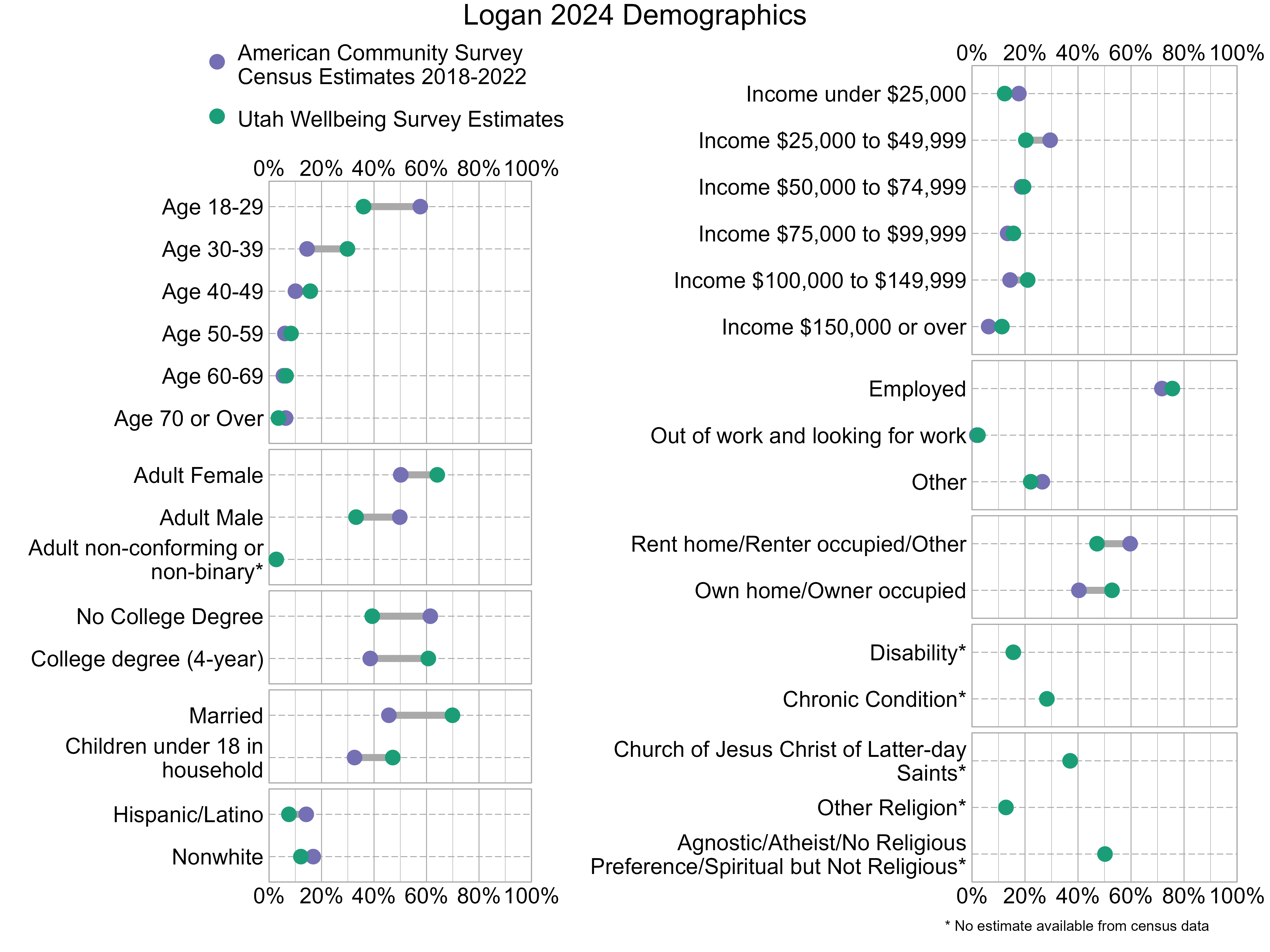
Dot Plot. Title: Logan 2024 Demographics. Data — Age 18-29: American Community Survey Estimate: 58%, Utah Wellbeing Survey Estimate: 36%; Age 30-39: American Community Survey Estimate: 14%, Utah Wellbeing Survey Estimate: 30%; Age 40-49: American Community Survey Estimate: 10%, Utah Wellbeing Survey Estimate: 16%; Age 50-59: American Community Survey Estimate: 6%, Utah Wellbeing Survey Estimate: 8%; Age 60-69: American Community Survey Estimate: 5%, Utah Wellbeing Survey Estimate: 6%; Age 70 or Over: American Community Survey Estimate: 6%, Utah Wellbeing Survey Estimate: 4%; Income under $25,000: American Community Survey Estimate: 18%, Utah Wellbeing Survey Estimate: 12%; Income $25,000 to $49,999: American Community Survey Estimate: 29%, Utah Wellbeing Survey Estimate: 20%; Income $50,000 to $74,999: American Community Survey Estimate: 19%, Utah Wellbeing Survey Estimate: 19%; Income $75,000 to $99,999: American Community Survey Estimate: 13%, Utah Wellbeing Survey Estimate: 16%; Income $100,000 to $149,999: American Community Survey Estimate: 14%, Utah Wellbeing Survey Estimate: 21%; Income $150,000 or over: American Community Survey Estimate: 6%, Utah Wellbeing Survey Estimate: 11%; Adult Female: American Community Survey Estimate: 50%, Utah Wellbeing Survey Estimate: 64%; Adult Male: American Community Survey Estimate: 50%, Utah Wellbeing Survey Estimate: 33%; Adult non-conforming or non-binary*: American Community Survey Estimate: NA%, Utah Wellbeing Survey Estimate: 3%; Employed: American Community Survey Estimate: 72%, Utah Wellbeing Survey Estimate: 76%; Out of work and looking for work: American Community Survey Estimate: 2%, Utah Wellbeing Survey Estimate: 2%; Other: American Community Survey Estimate: 27%, Utah Wellbeing Survey Estimate: 22%; No College Degree: American Community Survey Estimate: 61%, Utah Wellbeing Survey Estimate: 39%; College degree (4-year): American Community Survey Estimate: 39%, Utah Wellbeing Survey Estimate: 61%; Rent home/Renter occupied/Other: American Community Survey Estimate: 60%, Utah Wellbeing Survey Estimate: 47%; Own home/Owner occupied: American Community Survey Estimate: 40%, Utah Wellbeing Survey Estimate: 53%; Married: American Community Survey Estimate: 46%, Utah Wellbeing Survey Estimate: 70%; Children under 18 in household: American Community Survey Estimate: 33%, Utah Wellbeing Survey Estimate: 47%; Disability*: American Community Survey Estimate: NA%, Utah Wellbeing Survey Estimate: 16%; Chronic Condition*: American Community Survey Estimate: NA%, Utah Wellbeing Survey Estimate: 28%; Hispanic/Latino: American Community Survey Estimate: 14%, Utah Wellbeing Survey Estimate: 8%; Nonwhite: American Community Survey Estimate: 17%, Utah Wellbeing Survey Estimate: 12%; Church of Jesus Christ of Latter-day Saints*: American Community Survey Estimate: NA%, Utah Wellbeing Survey Estimate: 37%; Other Religion*: American Community Survey Estimate: NA%, Utah Wellbeing Survey Estimate: 13%; Agnostic/Atheist/No Religious Preference/Spiritual but Not Religious*: American Community Survey Estimate: NA%, Utah Wellbeing Survey Estimate: 50%

Overall Personal Wellbeing and Overall Wellbeing in Logan

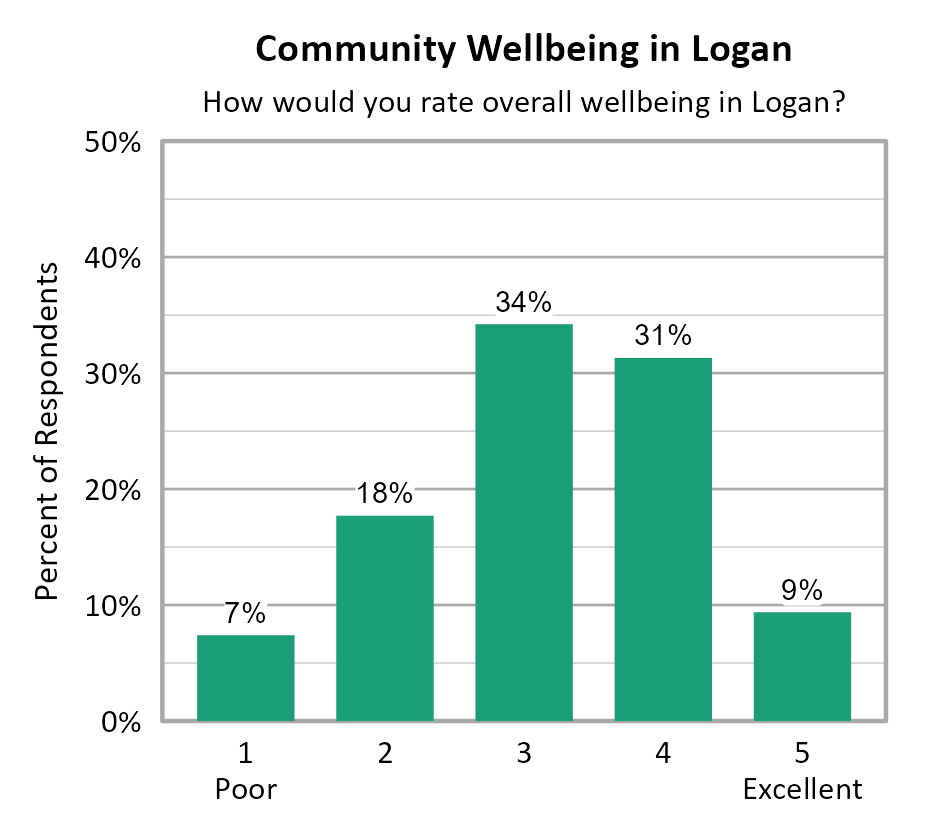
Survey participants were asked about their overall personal wellbeing and overall community wellbeing in Logan. These wellbeing indicators were both measured on a 5-point scale from poor (1) to excellent (5). The average personal wellbeing score in Logan was 3.66 with 62% of respondents indicating their wellbeing at a 4 or 5 on the 5-point scale. The average score for community wellbeing in Logan was 3.18 with 41% of respondents indicating community wellbeing at a 4 or 5 on the 5-point scale. There was no statistically significant difference in personal wellbeing scores among the city districts. However, Adams and Hillcrest districts were both significantly higher than the Bridger district in terms of community wellbeing.
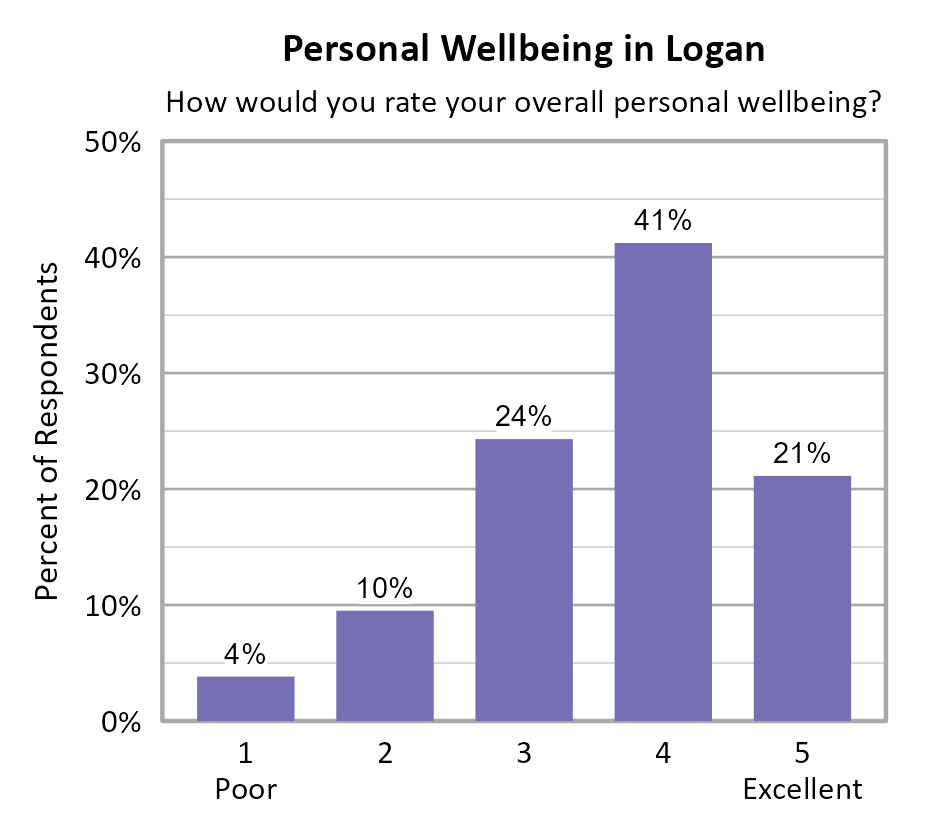
Bar Chart. Title: Personal Wellbeing in Logan. Subtitle: How would you rate your overall personal wellbeing? Data — 1 Poor: 4% of respondents; 2: 10% of respondents; 3: 24% of respondents; 4: 41% of respondents; 5 Excellent: 21% of respondents

Bar Chart. Title: Community Wellbeing in Logan. Subtitle: How would you rate overall wellbeing in Logan? Data — 1 Poor: 7% of respondents; 2: 18% of respondents; 3: 34% of respondents; 4: 31% of respondents; 5 Excellent: 9% of respondents

When comparing survey data from Logan over the years as shown in the information below, we can see that the average personal wellbeing score improved between 2021 and 2022, and declined between 2022 and 2024. The average community wellbeing score remained nearly the same between 2021 and 2022, and declined between 2022 and 2024. Note that the number of respondents differed between years, there is no tracking of individuals from one year to the next, and the low end of the scale was "Poor" in 2024 but "Very Poor" in prior years which may account for differences in scores over time.

Dot Plot. Title: Average Rating of Personal and Community Wellbeing Over Time in Logan. Subtitle: (Wellbeing is rated on a scale from 1=Very Poor to 5=Excellent) Data — Community Wellbeing 2021: 3.46; Community Wellbeing 2022: 3.46; Community Wellbeing 2024: 3.18; Personal Wellbeing 2021: 3.81; Personal Wellbeing 2022: 3.89; Personal Wellbeing 2024: 3.66

Comparing Wellbeing Across Utah Cities

The Utah League of Cities and Towns clusters cities and towns into five different categories based on size and growth rates. We utilize these clusters in our analysis. Logan is classified as an Established/Mid-sized City. Some cities may fit within more than one cluster.

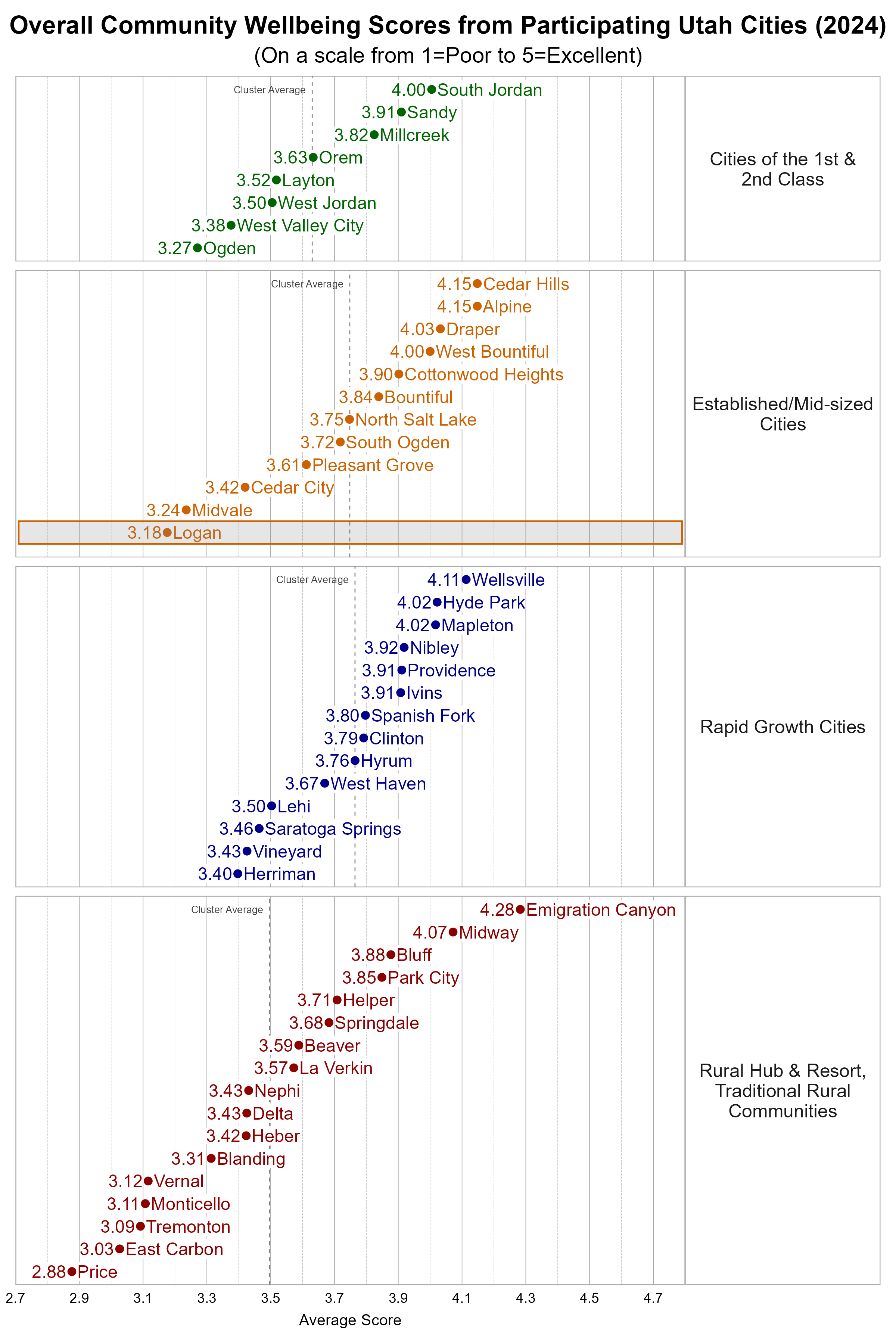
Within the more Urban city cluster, Logan was below the average overall personal wellbeing score and below the average overall community wellbeing score.
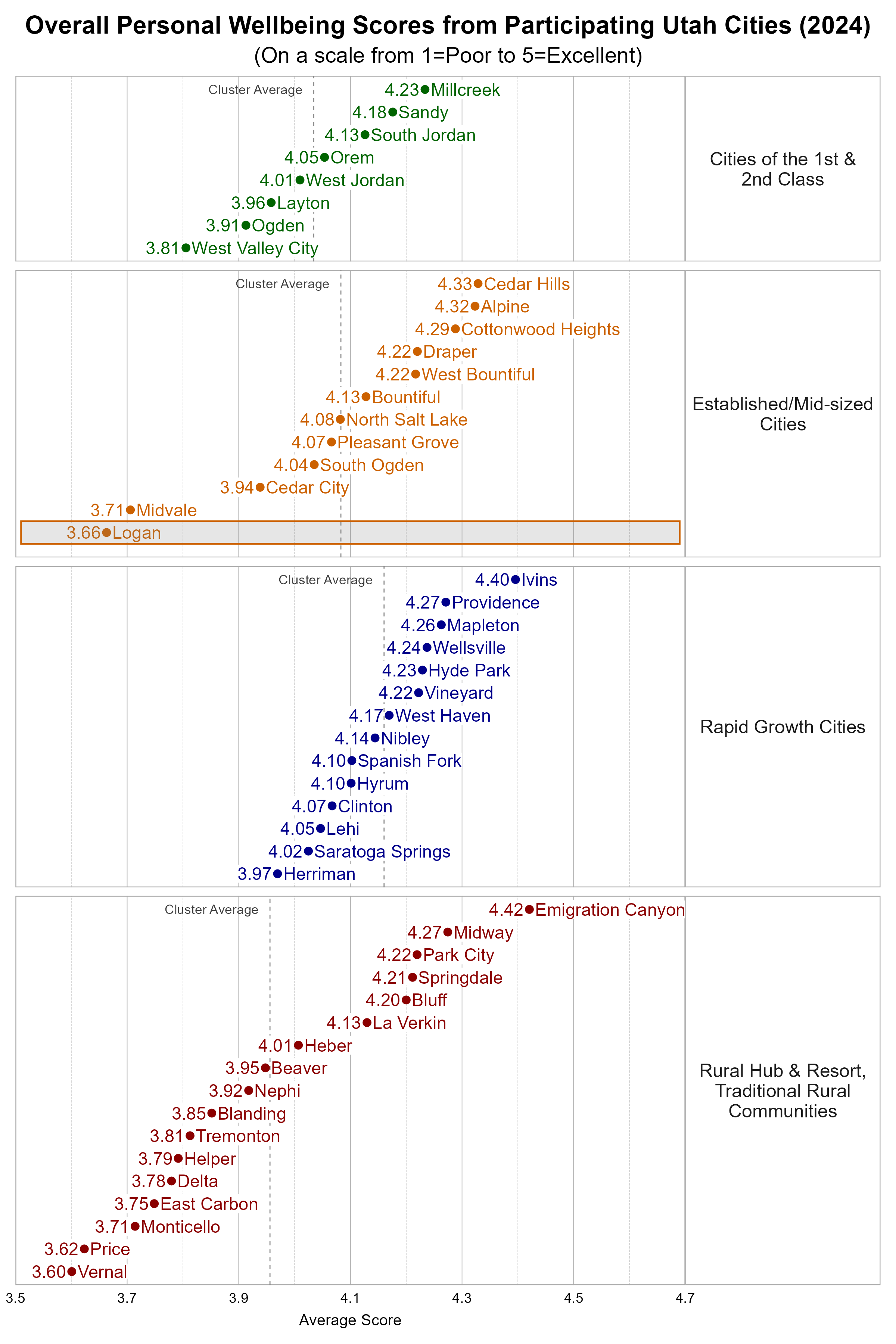
Dot Plot. Title: Overall Personal Wellbeing Scores from Participating Utah Cities (2024). Subtitle: (On a scale from 1=Poor to 5=Excellent). Data — Group: Cities of the 1st & 2nd Class — West Valley City Average Score 3.81; Ogden Average Score 3.91; Layton Average Score 3.96; West Jordan Average Score 4.01; Orem Average Score 4.05; South Jordan Average Score 4.13; Sandy Average Score 4.18; Millcreek Average Score 4.23; Group: Established/Mid-sized Cities — Logan Average Score 3.66; Midvale Average Score 3.71; Cedar City Average Score 3.94; South Ogden Average Score 4.04; Pleasant Grove Average Score 4.07; North Salt Lake Average Score 4.08; Bountiful Average Score 4.13; Draper Average Score 4.22; West Bountiful Average Score 4.22; Cottonwood Heights Average Score 4.29; Alpine Average Score 4.32; Cedar Hills Average Score 4.33; Group: Rapid Growth Cities — Herriman Average Score 3.97; Saratoga Springs Average Score 4.02; Lehi Average Score 4.05; Clinton Average Score 4.07; Hyrum Average Score 4.10; Spanish Fork Average Score 4.10; Nibley Average Score 4.14; West Haven Average Score 4.17; Vineyard Average Score 4.22; Hyde Park Average Score 4.23; Wellsville Average Score 4.24; Mapleton Average Score 4.26; Providence Average Score 4.27; Ivins Average Score 4.40; Group: Rural Hub & Resort, Traditional Rural Communities — Vernal Average Score 3.60; Price Average Score 3.62; Monticello Average Score 3.71; East Carbon Average Score 3.75; Delta Average Score 3.78; Helper Average Score 3.79; Tremonton Average Score 3.81; Blanding Average Score 3.85; Nephi Average Score 3.92; Beaver Average Score 3.95; Heber Average Score 4.01; La Verkin Average Score 4.13; Bluff Average Score 4.20; Springdale Average Score 4.21; Park City Average Score 4.22; Midway Average Score 4.27; Emigration Canyon Average Score 4.42

Dot Plot. Title: Overall Community Wellbeing Scores from Participating Utah Cities (2024). Subtitle: (On a scale from 1=Poor to 5=Excellent). Data — Group: Cities of the 1st & 2nd Class — Ogden Average Score 3.27; West Valley City Average Score 3.38; West Jordan Average Score 3.50; Layton Average Score 3.52; Orem Average Score 3.63; Millcreek Average Score 3.82; Sandy Average Score 3.91; South Jordan Average Score 4.00; Group: Established/Mid-sized Cities — Logan Average Score 3.18; Midvale Average Score 3.24; Cedar City Average Score 3.42; Pleasant Grove Average Score 3.61; South Ogden Average Score 3.72; North Salt Lake Average Score 3.75; Bountiful Average Score 3.84; Cottonwood Heights Average Score 3.90; West Bountiful Average Score 4.00; Draper Average Score 4.03; Alpine Average Score 4.15; Cedar Hills Average Score 4.15; Group: Rapid Growth Cities — Herriman Average Score 3.40; Vineyard Average Score 3.43; Saratoga Springs Average Score 3.46; Lehi Average Score 3.50; West Haven Average Score 3.67; Hyrum Average Score 3.76; Clinton Average Score 3.79; Spanish Fork Average Score 3.80; Ivins Average Score 3.91; Providence Average Score 3.91; Nibley Average Score 3.92; Hyde Park Average Score 4.02; Mapleton Average Score 4.02; Wellsville Average Score 4.11; Group: Rural Hub & Resort, Traditional Rural Communities — Price Average Score 2.88; East Carbon Average Score 3.03; Tremonton Average Score 3.09; Monticello Average Score 3.11; Vernal Average Score 3.12; Blanding Average Score 3.31; Heber Average Score 3.42; Delta Average Score 3.43; Nephi Average Score 3.43; La Verkin Average Score 3.57; Beaver Average Score 3.59; Springdale Average Score 3.68; Helper Average Score 3.71; Park City Average Score 3.85; Bluff Average Score 3.88; Midway Average Score 4.07; Emigration Canyon Average Score 4.28

Wellbeing Domains in Logan

According to national and international entities that track wellbeing, there are a number of common dimensions or domains of wellbeing. Survey respondents rated twelve domains on a 5-point scale from poor to excellent. They were also asked to indicate the importance of each domain to their overall personal wellbeing on a 5-point scale from not at all important to very important. The highest rated wellbeing domains for respondents in Logan were Safety and Security (68%), Family Life (63%), and Connection with Nature (58%). The most important wellbeing domains were Mental Health (96%), Safety and Security (94%), Living Standards (91%), and Physical Health (90%).
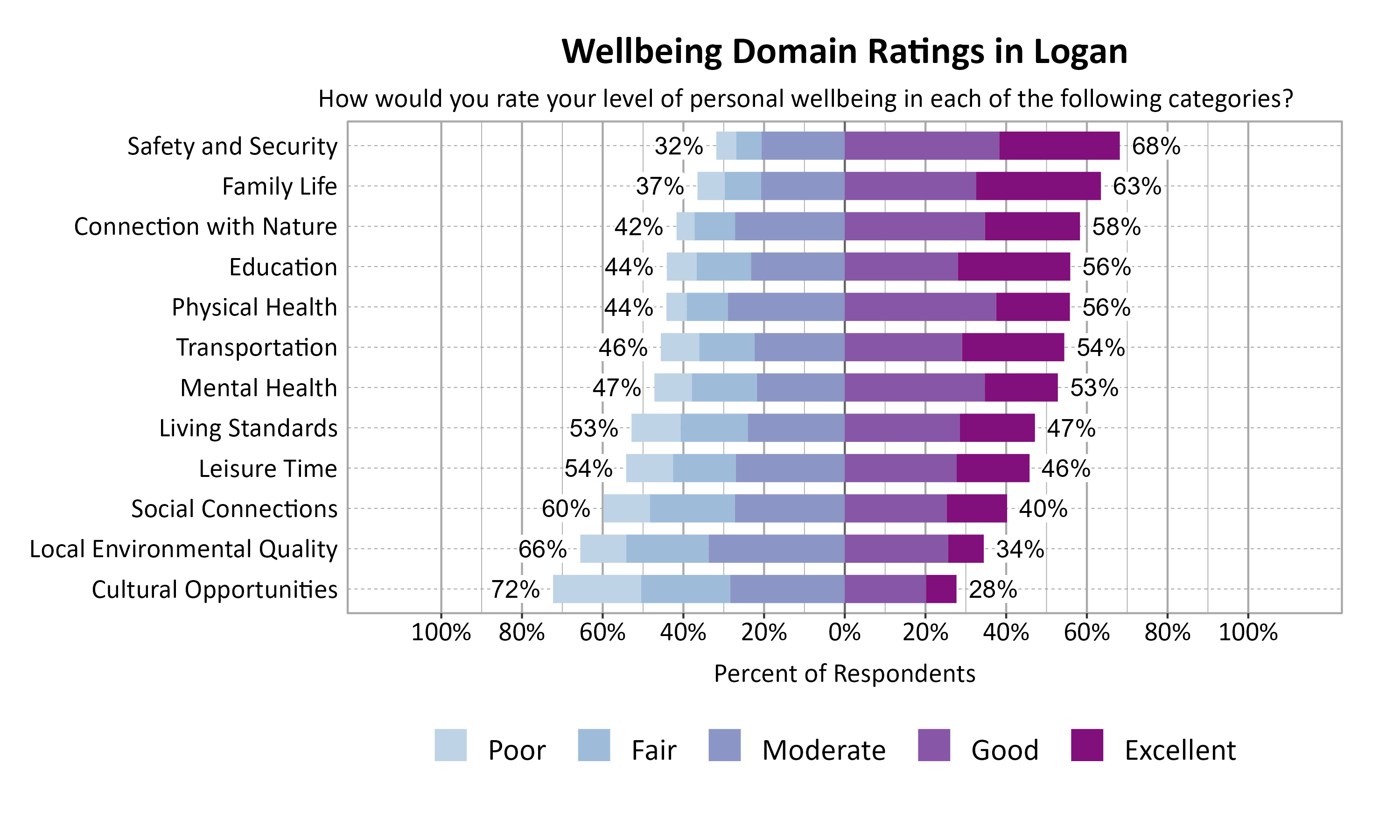
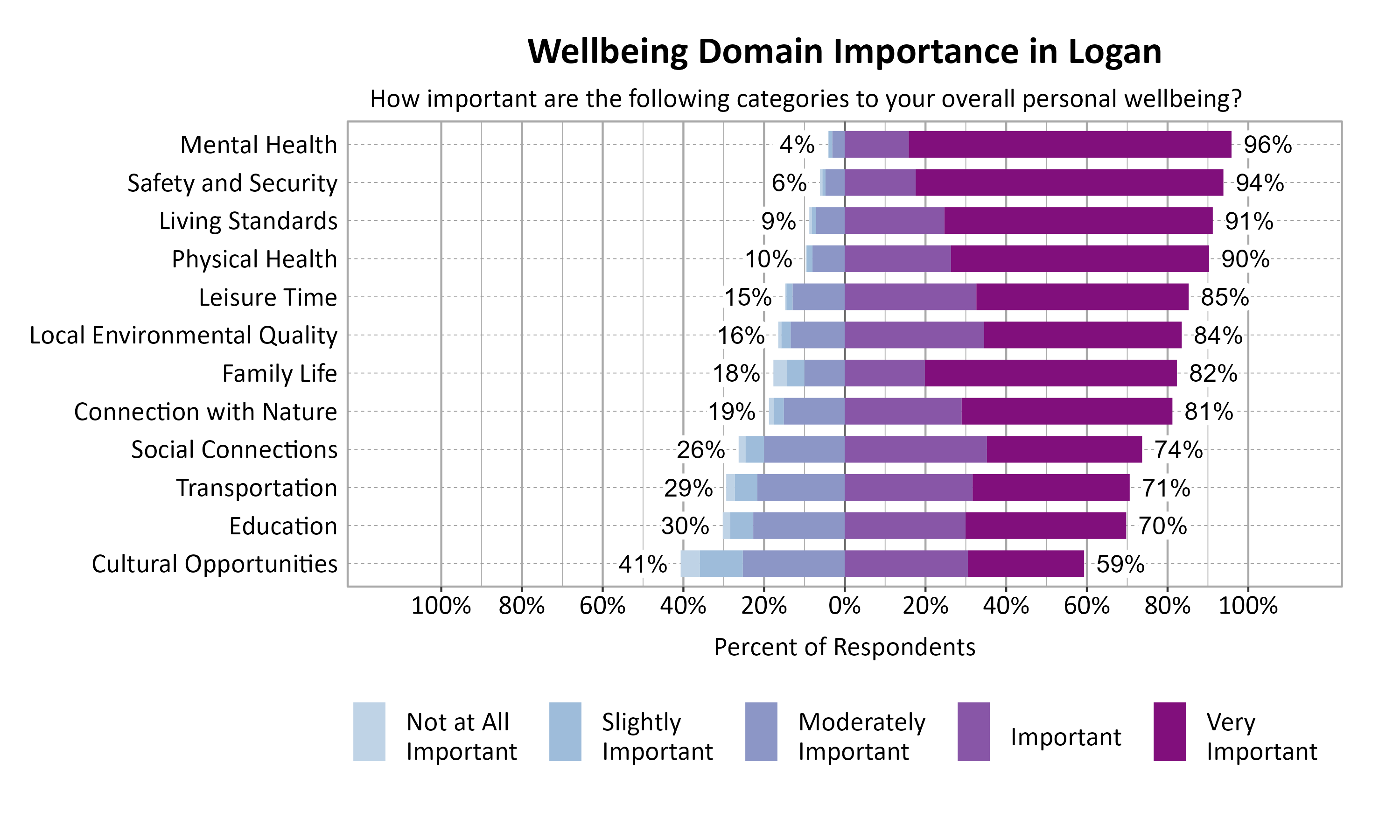
Likert Graph. Title: Wellbeing Domain Ratings in Logan. Subtitle: How would you rate your level of personal wellbeing in each of the following categories? Data — Category: Safety and Security - 32% of respondents rated as poor, fair, or moderate while  68% rated as good or excellent; Category: Family Life - 37% of respondents rated as poor, fair, or moderate while  63% rated as good or excellent; Category: Connection with Nature - 42% of respondents rated as poor, fair, or moderate while  58% rated as good or excellent; Category: Education - 44% of respondents rated as poor, fair, or moderate while  56% rated as good or excellent; Category: Physical Health - 44% of respondents rated as poor, fair, or moderate while  56% rated as good or excellent; Category: Transportation - 46% of respondents rated as poor, fair, or moderate while  54% rated as good or excellent; Category: Mental Health - 47% of respondents rated as poor, fair, or moderate while  53% rated as good or excellent; Category: Living Standards - 53% of respondents rated as poor, fair, or moderate while  47% rated as good or excellent; Category: Leisure Time - 54% of respondents rated as poor, fair, or moderate while  46% rated as good or excellent; Category: Social Connections - 60% of respondents rated as poor, fair, or moderate while  40% rated as good or excellent; Category: Local Environmental Quality - 66% of respondents rated as poor, fair, or moderate while  34% rated as good or excellent; Category: Cultural Opportunities - 72% of respondents rated as poor, fair, or moderate while  28% rated as good or excellent Likert Graph. Title: Wellbeing Domain Importance in Logan. Subtitle: How important are the following categories to your overall personal wellbeing? Data — Category: Mental Health - 4% of respondents rated as not at all important, slightly important, or moderately important while 96% rated as important or very important; Category: Safety and Security - 6% of respondents rated as not at all important, slightly important, or moderately important while 94% rated as important or very important; Category: Living Standards - 9% of respondents rated as not at all important, slightly important, or moderately important while 91% rated as important or very important; Category: Physical Health -10% of respondents rated as not at all important, slightly important, or moderately important while 90% rated as important or very important; Category: Leisure Time -15% of respondents rated as not at all important, slightly important, or moderately important while 85% rated as important or very important; Category: Local Environmental Quality -16% of respondents rated as not at all important, slightly important, or moderately important while 84% rated as important or very important; Category: Family Life -18% of respondents rated as not at all important, slightly important, or moderately important while 82% rated as important or very important; Category: Connection with Nature -19% of respondents rated as not at all important, slightly important, or moderately important while 81% rated as important or very important; Category: Social Connections -26% of respondents rated as not at all important, slightly important, or moderately important while 74% rated as important or very important; Category: Transportation -29% of respondents rated as not at all important, slightly important, or moderately important while 71% rated as important or very important; Category: Education -30% of respondents rated as not at all important, slightly important, or moderately important while 70% rated as important or very important; Category: Cultural Opportunities -41% of respondents rated as not at all important, slightly important, or moderately important while 59% rated as important or very important

Wellbeing Matrix for Logan

The graph below illustrates the relationship between the average rating and the average importance of wellbeing domains for survey respondents from Logan. Family Life, Physical Health, and Safety and Security were highly important and rated above average among the domains. Leisure Time, Living Standards, and Mental Health fell in the “red zone” of higher importance and lower ratings.
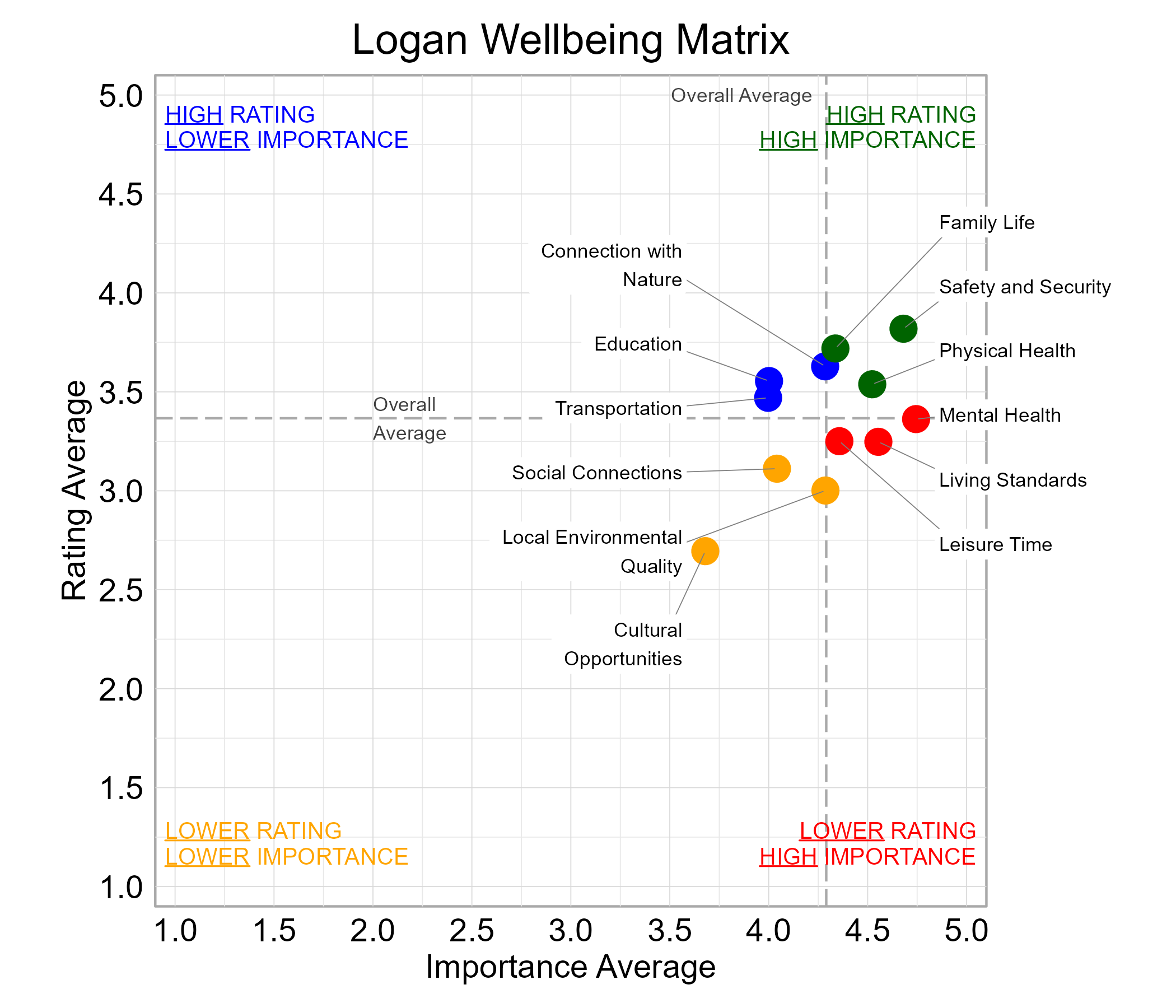
Scatterplot. Title: Logan Wellbeing Matrix. Subtitle: Domains are classified into four quadrants depending on their average rating and average importance as compared to the average of all the average domain ratings and the average domain importance ratings. Data — High rating, high importance (green quadrant) domains include: Family Life, Physical Health, and Safety and Security; High rating, lower importance (blue quadrant) domains include: Connection with Nature, Education, and Transportation; Lower rating, lower importance (yellow quadrant) domains include: Cultural Opportunities, Local Environmental Quality, and Social Connections; Lower rating, high importance (red quadrant) domains include: Leisure Time, Living Standards, and Mental Health

Wellbeing Domains Over Time in Logan

The graphs below show how the domains were rated over the years by Logan residents. The number of respondents changed over time. Note that the two domains Family Life and Transportation were new categories in the 2024 survey and were not measured in previous years. All the domains saw a small drop in ratings from 2022 to 2024. Safety and Security and Connection with Nature were consistently among the top rated domains each survey year, while Cultural Opportunities was among the lowest.

Dot Plot. Title: Wellbeing Domain Ratings Over Time in Logan. Subtitle: (Wellbeing is rated on a scale from 1=Very Poor to 5=Excellent) Data — Connection with Nature 2021: 3.72; Connection with Nature 2022: 3.85; Connection with Nature 2024: 3.63; Cultural Opportunities 2021: 2.66; Cultural Opportunities 2022: 3.09; Cultural Opportunities 2024: 2.70; Education 2021: 3.73; Education 2022: 3.95; Education 2024: 3.55; Family Life 2024: 3.72; Leisure Time 2021: 3.39; Leisure Time 2022: 3.53; Leisure Time 2024: 3.25; Living Standards 2021: 3.66; Living Standards 2022: 3.61; Living Standards 2024: 3.25; Local Environmental Quality 2021: 3.18; Local Environmental Quality 2022: 3.20; Local Environmental Quality 2024: 3.00; Mental Health 2021: 3.37; Mental Health 2022: 3.62; Mental Health 2024: 3.36; Physical Health 2021: 3.44; Physical Health 2022: 3.67; Physical Health 2024: 3.54; Safety and Security 2021: 3.98; Safety and Security 2022: 4.04; Safety and Security 2024: 3.82; Social Connections 2021: 3.11; Social Connections 2022: 3.35; Social Connections 2024: 3.11; Transportation 2024: 3.47

Community Connection in Logan

Survey participants were asked about how connected they feel to Logan on a 5-point scale from not at all (1) to a great deal (5), and the average score of all respondents was 2.58. The Hillcrest and Wilson city districts were both significantly higher than the Bridger and Woodruff city districts in terms of community connection scores.
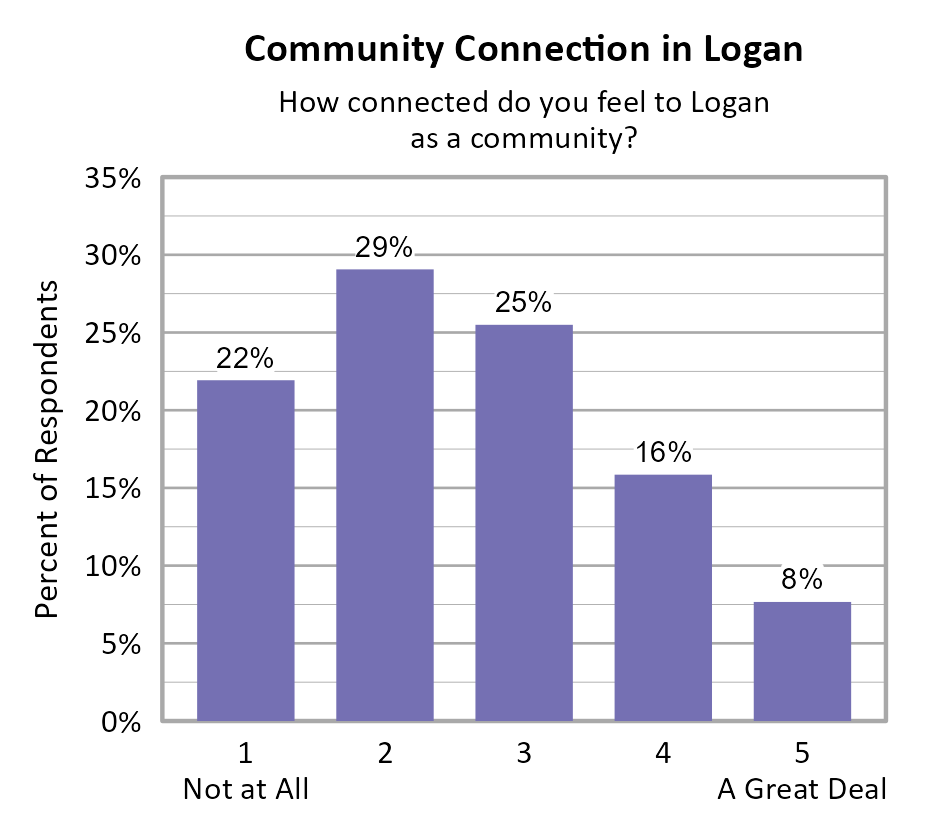
Bar Chart. Title: Community Connection in Logan. Subtitle: How connected do you feel to Logan as a community? Data — 1 Not at All: 22% of respondents; 2: 29% of respondents; 3: 25% of respondents; 4: 16% of respondents; 5 A Great Deal: 8% of respondents

When comparing survey data from Logan over the years as shown in the information below, we can see that the average community connection score improved between 2021 and 2022, and declined between 2022 and 2024.
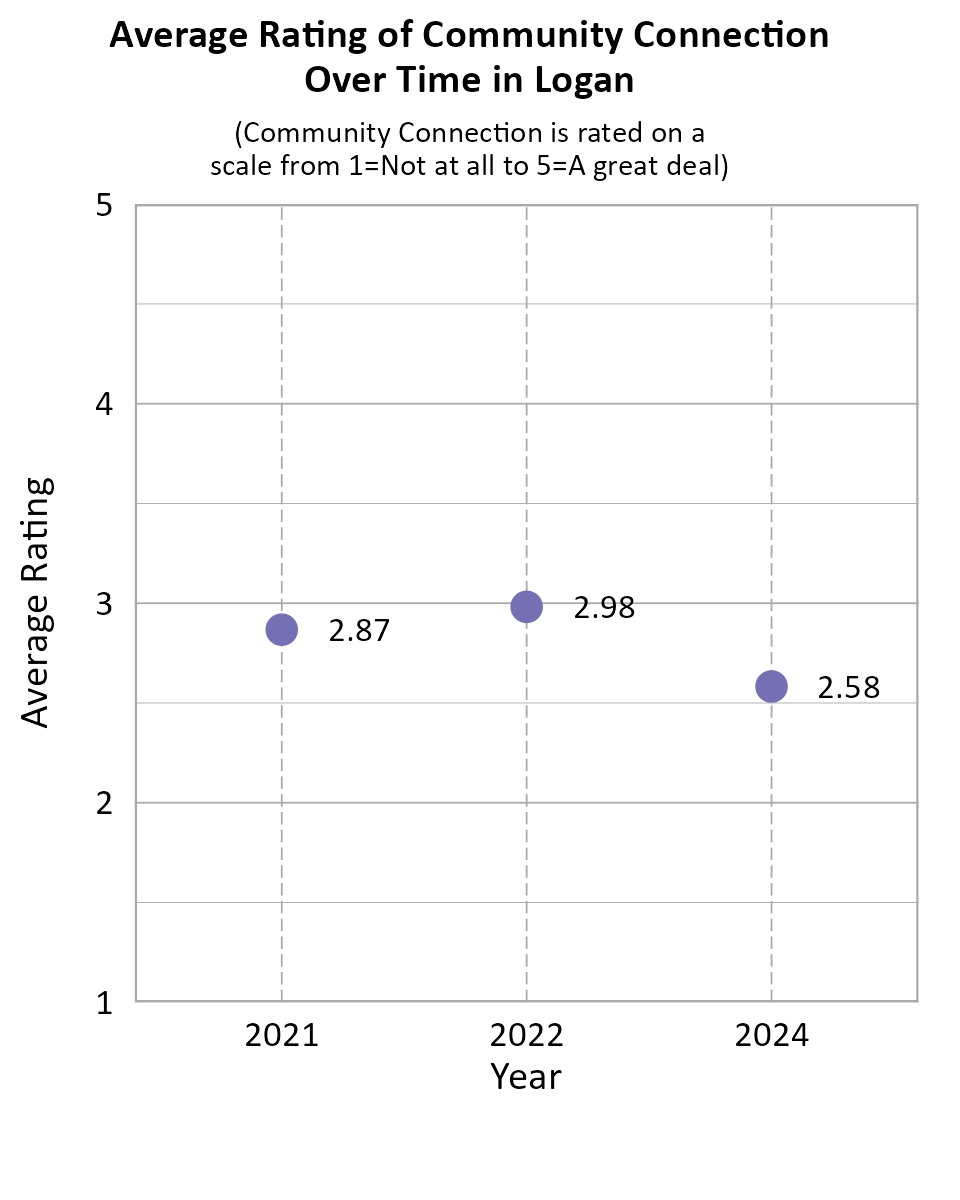
Dot Plot. Title: Average Rating of Community Connection Over Time in Logan. Subtitle: (Community Connection is rated on a scale from 1=Not at all to 5=A great deal) Data — 2021: 2.87; 2022: 2.98; 2024: 2.58

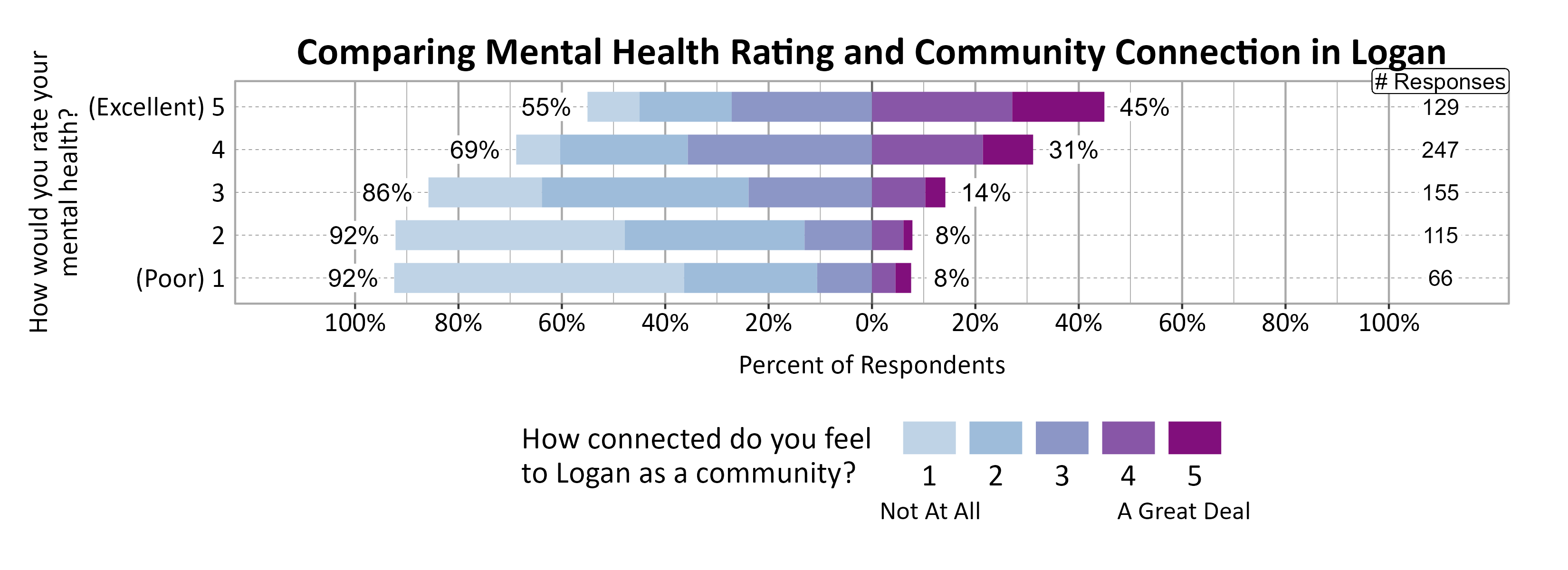
A positive relationship was found between individuals’ community connection and overall personal wellbeing as well as mental health.
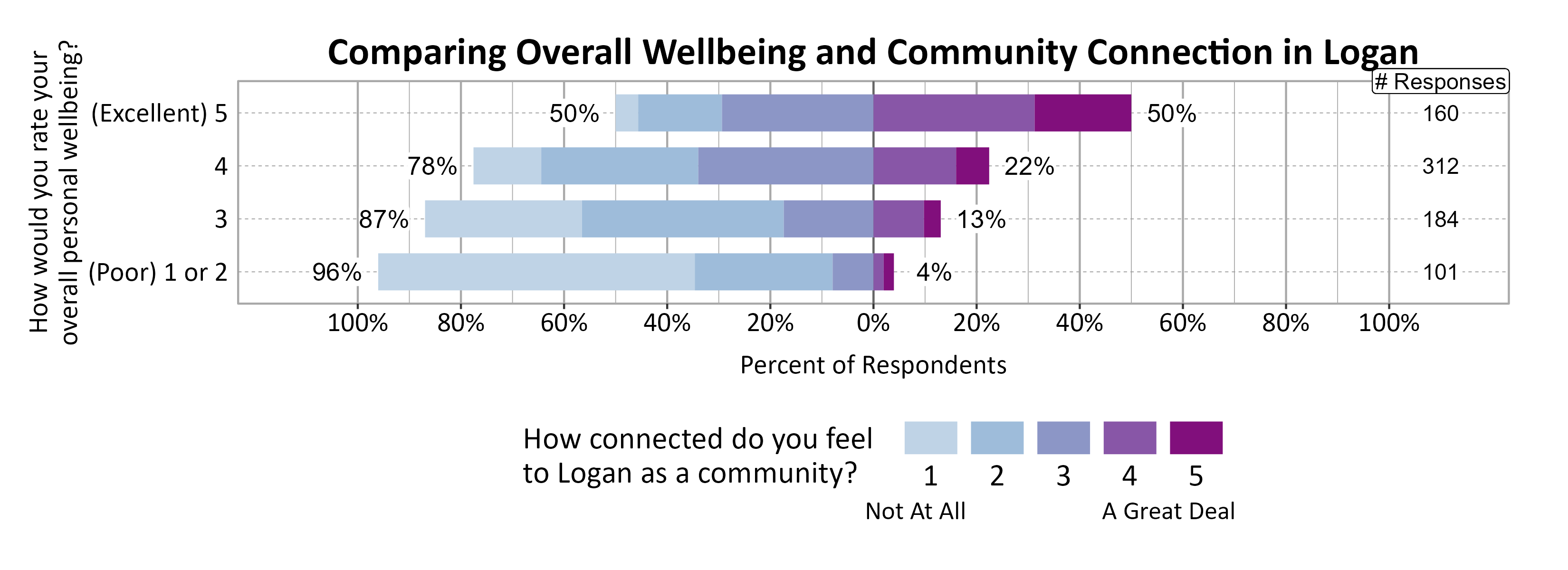
Likert Graph. Title: Comparing Overall Wellbeing and Community Connection in Logan. Data — Of the 101 respondents that rate their overall personal wellbeing as a (Poor) 1 or 2, 96% indicate a community connection score of 1, 2, or 3 while  4% indicate a community connection score of 4 or 5; Of the 184 respondents that rate their overall personal wellbeing as a 3, 87% indicate a community connection score of 1, 2, or 3 while 13% indicate a community connection score of 4 or 5; Of the 312 respondents that rate their overall personal wellbeing as a 4, 78% indicate a community connection score of 1, 2, or 3 while 22% indicate a community connection score of 4 or 5; Of the 160 respondents that rate their overall personal wellbeing as a (Excellent) 5, 50% indicate a community connection score of 1, 2, or 3 while 50% indicate a community connection score of 4 or 5

Likert Graph. Title: Comparing Mental Health Rating and Community Connection in Logan. Data — Of the 66 respondents that rate their mental health rating as a (Poor) 1, 92% indicate a community connection score of 1, 2, or 3 while  8% indicate a community connection score of 4 or 5; Of the 115 respondents that rate their mental health rating as a 2, 92% indicate a community connection score of 1, 2, or 3 while  8% indicate a community connection score of 4 or 5; Of the 155 respondents that rate their mental health rating as a 3, 86% indicate a community connection score of 1, 2, or 3 while 14% indicate a community connection score of 4 or 5; Of the 247 respondents that rate their mental health rating as a 4, 69% indicate a community connection score of 1, 2, or 3 while 31% indicate a community connection score of 4 or 5; Of the 129 respondents that rate their mental health rating as a (Excellent) 5, 55% indicate a community connection score of 1, 2, or 3 while 45% indicate a community connection score of 4 or 5

The graph below shows how Wellbeing Project cities and towns compare on feelings of community connection based on the percentage of respondents who answered 4 or a 5 on a 5-point scale from “not at all” to “a great deal” connected to their city or town. Logan ranked 49 out of the 51 cities that participated.
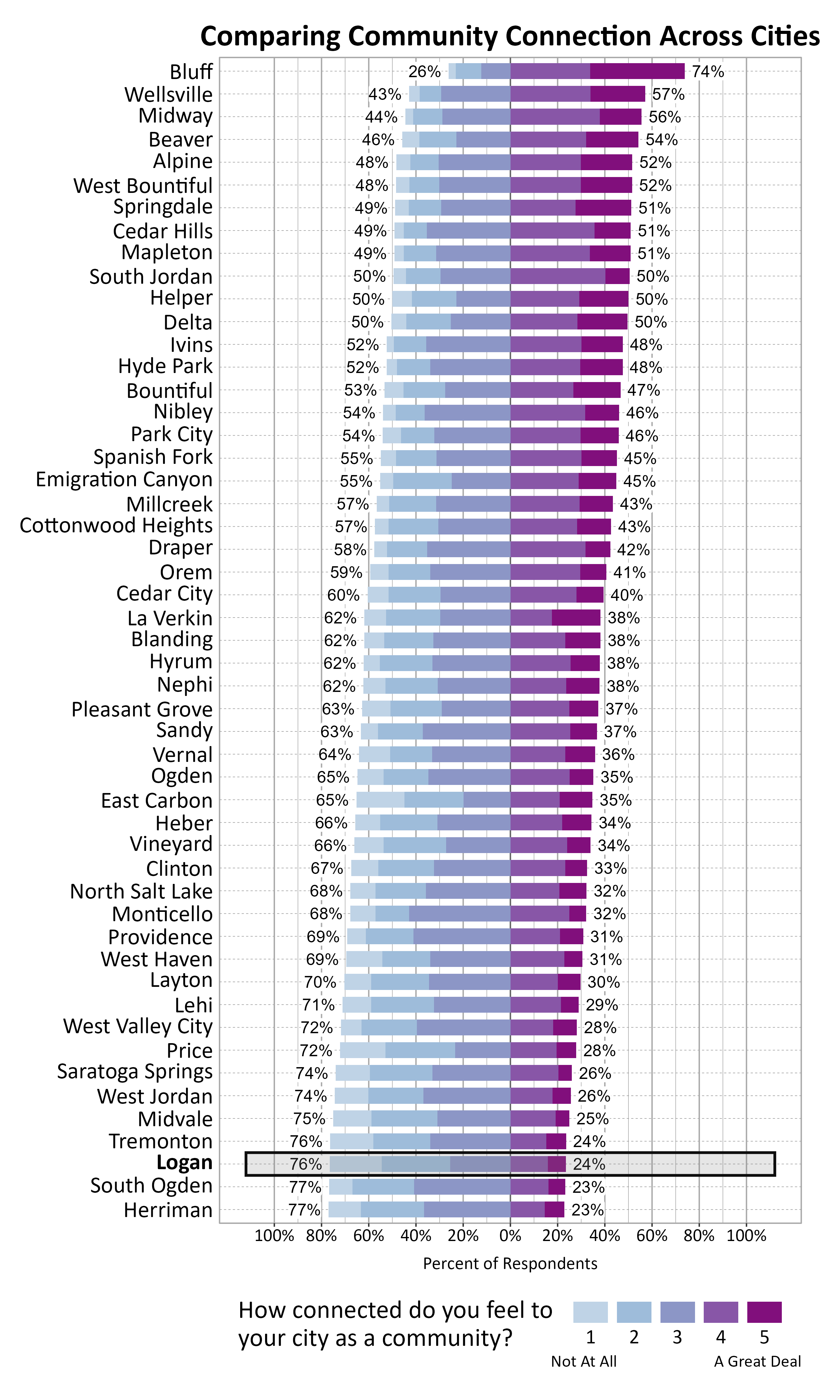
Likert Graph. Title: Comparing Community Connection Across Cities. Subtitle: How connected do you feel to your city as a community? 1 being not at all and 5 being a great deal. Data — City: Bluff 26% of respondents indicated a community connection score of 1, 2, or 3 while 74% of respondents indicated a community connection score of 4 or 5; City: Wellsville 43% of respondents indicated a community connection score of 1, 2, or 3 while 57% of respondents indicated a community connection score of 4 or 5; City: Midway 44% of respondents indicated a community connection score of 1, 2, or 3 while 56% of respondents indicated a community connection score of 4 or 5; City: Beaver 46% of respondents indicated a community connection score of 1, 2, or 3 while 54% of respondents indicated a community connection score of 4 or 5; City: Alpine 48% of respondents indicated a community connection score of 1, 2, or 3 while 52% of respondents indicated a community connection score of 4 or 5; City: West Bountiful 48% of respondents indicated a community connection score of 1, 2, or 3 while 52% of respondents indicated a community connection score of 4 or 5; City: Springdale 49% of respondents indicated a community connection score of 1, 2, or 3 while 51% of respondents indicated a community connection score of 4 or 5; City: Cedar Hills 49% of respondents indicated a community connection score of 1, 2, or 3 while 51% of respondents indicated a community connection score of 4 or 5; City: Mapleton 49% of respondents indicated a community connection score of 1, 2, or 3 while 51% of respondents indicated a community connection score of 4 or 5; City: South Jordan 50% of respondents indicated a community connection score of 1, 2, or 3 while 50% of respondents indicated a community connection score of 4 or 5; City: Helper 50% of respondents indicated a community connection score of 1, 2, or 3 while 50% of respondents indicated a community connection score of 4 or 5; City: Delta 50% of respondents indicated a community connection score of 1, 2, or 3 while 50% of respondents indicated a community connection score of 4 or 5; City: Ivins 52% of respondents indicated a community connection score of 1, 2, or 3 while 48% of respondents indicated a community connection score of 4 or 5; City: Hyde Park 52% of respondents indicated a community connection score of 1, 2, or 3 while 48% of respondents indicated a community connection score of 4 or 5; City: Bountiful 53% of respondents indicated a community connection score of 1, 2, or 3 while 47% of respondents indicated a community connection score of 4 or 5; City: Nibley 54% of respondents indicated a community connection score of 1, 2, or 3 while 46% of respondents indicated a community connection score of 4 or 5; City: Park City 54% of respondents indicated a community connection score of 1, 2, or 3 while 46% of respondents indicated a community connection score of 4 or 5; City: Spanish Fork 55% of respondents indicated a community connection score of 1, 2, or 3 while 45% of respondents indicated a community connection score of 4 or 5; City: Emigration Canyon 55% of respondents indicated a community connection score of 1, 2, or 3 while 45% of respondents indicated a community connection score of 4 or 5; City: Millcreek 57% of respondents indicated a community connection score of 1, 2, or 3 while 43% of respondents indicated a community connection score of 4 or 5; City: Cottonwood Heights 57% of respondents indicated a community connection score of 1, 2, or 3 while 43% of respondents indicated a community connection score of 4 or 5; City: Draper 58% of respondents indicated a community connection score of 1, 2, or 3 while 42% of respondents indicated a community connection score of 4 or 5; City: Orem 59% of respondents indicated a community connection score of 1, 2, or 3 while 41% of respondents indicated a community connection score of 4 or 5; City: Cedar City 60% of respondents indicated a community connection score of 1, 2, or 3 while 40% of respondents indicated a community connection score of 4 or 5; City: La Verkin 62% of respondents indicated a community connection score of 1, 2, or 3 while 38% of respondents indicated a community connection score of 4 or 5; City: Blanding 62% of respondents indicated a community connection score of 1, 2, or 3 while 38% of respondents indicated a community connection score of 4 or 5; City: Hyrum 62% of respondents indicated a community connection score of 1, 2, or 3 while 38% of respondents indicated a community connection score of 4 or 5; City: Nephi 62% of respondents indicated a community connection score of 1, 2, or 3 while 38% of respondents indicated a community connection score of 4 or 5; City: Pleasant Grove 63% of respondents indicated a community connection score of 1, 2, or 3 while 37% of respondents indicated a community connection score of 4 or 5; City: Sandy 63% of respondents indicated a community connection score of 1, 2, or 3 while 37% of respondents indicated a community connection score of 4 or 5; City: Vernal 64% of respondents indicated a community connection score of 1, 2, or 3 while 36% of respondents indicated a community connection score of 4 or 5; City: Ogden 65% of respondents indicated a community connection score of 1, 2, or 3 while 35% of respondents indicated a community connection score of 4 or 5; City: East Carbon 65% of respondents indicated a community connection score of 1, 2, or 3 while 35% of respondents indicated a community connection score of 4 or 5; City: Heber 66% of respondents indicated a community connection score of 1, 2, or 3 while 34% of respondents indicated a community connection score of 4 or 5; City: Vineyard 66% of respondents indicated a community connection score of 1, 2, or 3 while 34% of respondents indicated a community connection score of 4 or 5; City: Clinton 67% of respondents indicated a community connection score of 1, 2, or 3 while 33% of respondents indicated a community connection score of 4 or 5; City: North Salt Lake 68% of respondents indicated a community connection score of 1, 2, or 3 while 32% of respondents indicated a community connection score of 4 or 5; City: Monticello 68% of respondents indicated a community connection score of 1, 2, or 3 while 32% of respondents indicated a community connection score of 4 or 5; City: Providence 69% of respondents indicated a community connection score of 1, 2, or 3 while 31% of respondents indicated a community connection score of 4 or 5; City: West Haven 69% of respondents indicated a community connection score of 1, 2, or 3 while 31% of respondents indicated a community connection score of 4 or 5; City: Layton 70% of respondents indicated a community connection score of 1, 2, or 3 while 30% of respondents indicated a community connection score of 4 or 5; City: Lehi 71% of respondents indicated a community connection score of 1, 2, or 3 while 29% of respondents indicated a community connection score of 4 or 5; City: West Valley City 72% of respondents indicated a community connection score of 1, 2, or 3 while 28% of respondents indicated a community connection score of 4 or 5; City: Price 72% of respondents indicated a community connection score of 1, 2, or 3 while 28% of respondents indicated a community connection score of 4 or 5; City: Saratoga Springs 74% of respondents indicated a community connection score of 1, 2, or 3 while 26% of respondents indicated a community connection score of 4 or 5; City: West Jordan 74% of respondents indicated a community connection score of 1, 2, or 3 while 26% of respondents indicated a community connection score of 4 or 5; City: Midvale 75% of respondents indicated a community connection score of 1, 2, or 3 while 25% of respondents indicated a community connection score of 4 or 5; City: Tremonton 76% of respondents indicated a community connection score of 1, 2, or 3 while 24% of respondents indicated a community connection score of 4 or 5; City: Logan 76% of respondents indicated a community connection score of 1, 2, or 3 while 24% of respondents indicated a community connection score of 4 or 5; City: South Ogden 77% of respondents indicated a community connection score of 1, 2, or 3 while 23% of respondents indicated a community connection score of 4 or 5; City: Herriman 77% of respondents indicated a community connection score of 1, 2, or 3 while 23% of respondents indicated a community connection score of 4 or 5

Participation in Recreation and Nature-Related Activities

Respondents were asked to indicate whether or not they participated in various activities in the last 12 months. The most popular activities were walking or biking in your neighborhood or city (94%), using trails in or near your city (86%), recreating in parks in your city (84%), and community events (82%).
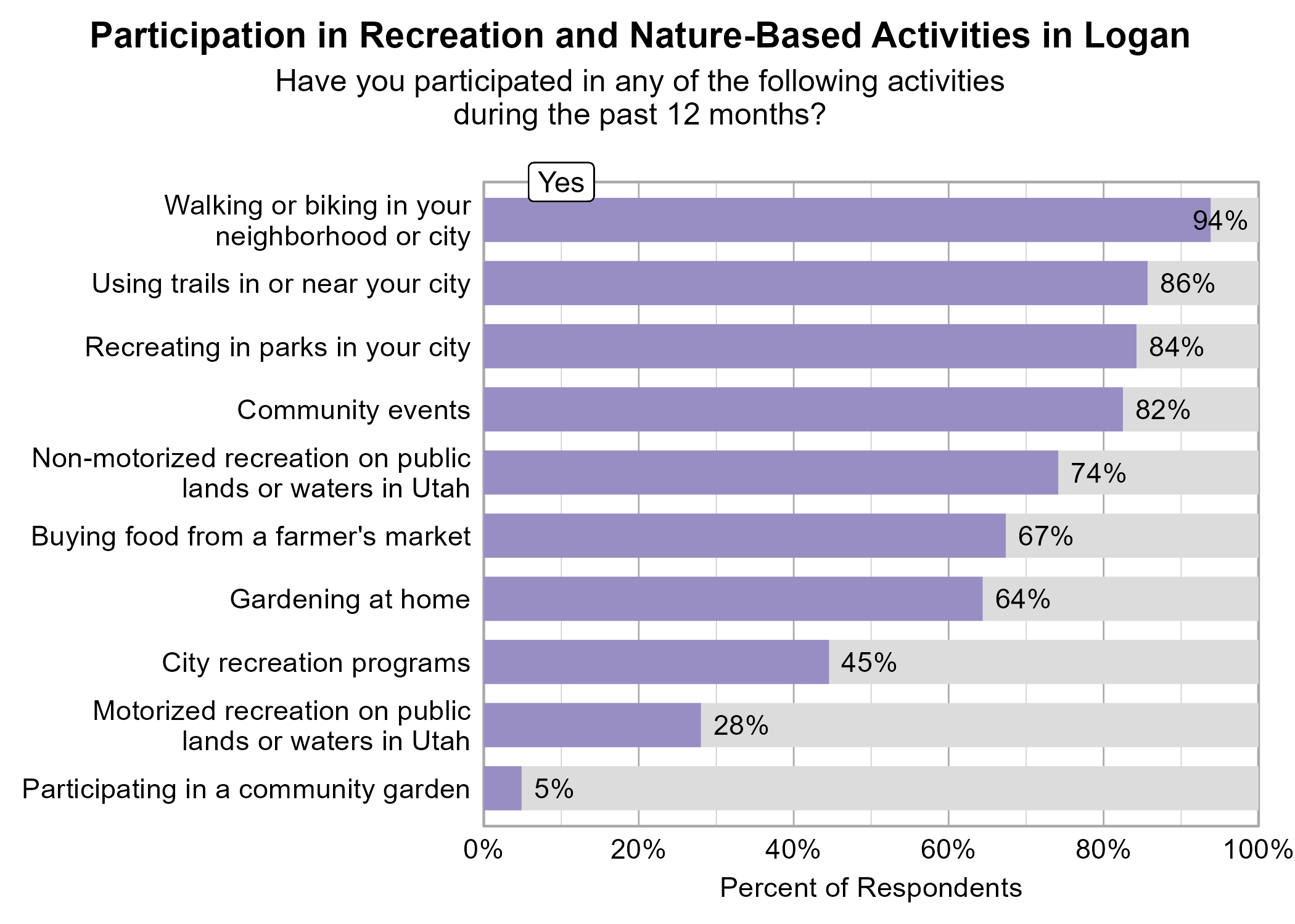
Bar Graph. Title: Participation in Recreation and Nature-Based Activities in Logan. Subtitle: Have you participated in any of the following activities during the past 12 months? Data — 94% of respondents indicated yes to Walking or biking in your neighborhood or city; 86% of respondents indicated yes to Using trails in or near your city; 84% of respondents indicated yes to Recreating in parks in your city; 82% of respondents indicated yes to Community events; 74% of respondents indicated yes to Non-motorized recreation on public lands or waters in Utah; 67% of respondents indicated yes to Buying food from a farmer's market; 64% of respondents indicated yes to Gardening at home; 45% of respondents indicated yes to City recreation programs; 28% of respondents indicated yes to Motorized recreation on public lands or waters in Utah; 5% of respondents indicated yes to Participating in a community garden

All of the recreation activities above, except for participating in a community garden, were significantly related to higher ratings of personal wellbeing.

Participating in city recreation programs, participating in community events, non-motorized recreation on public lands or waters in Utah, recreating in parks in your city, and walking or biking in your neighborhood or city were significantly related to higher ratings of community wellbeing.

All of the recreation activites above, except for participating in a community garden and motorized recreation on public lands or waters in Utah, were significantly related to higher ratings of community connection.

Perspectives on Population Growth and Economic Development

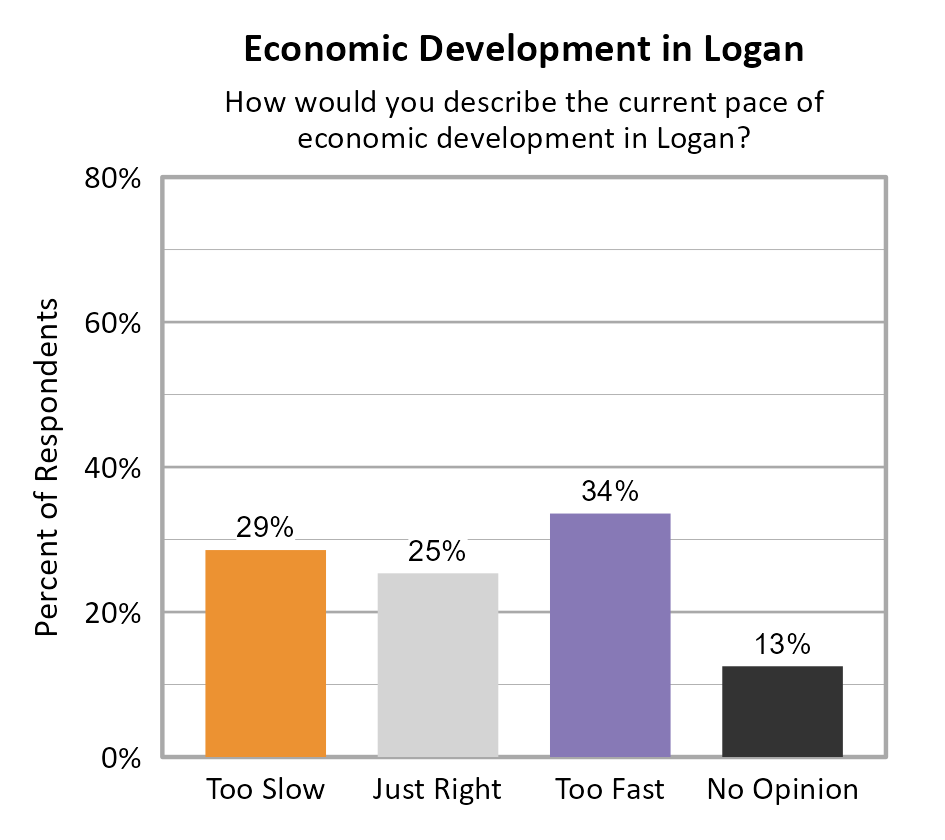
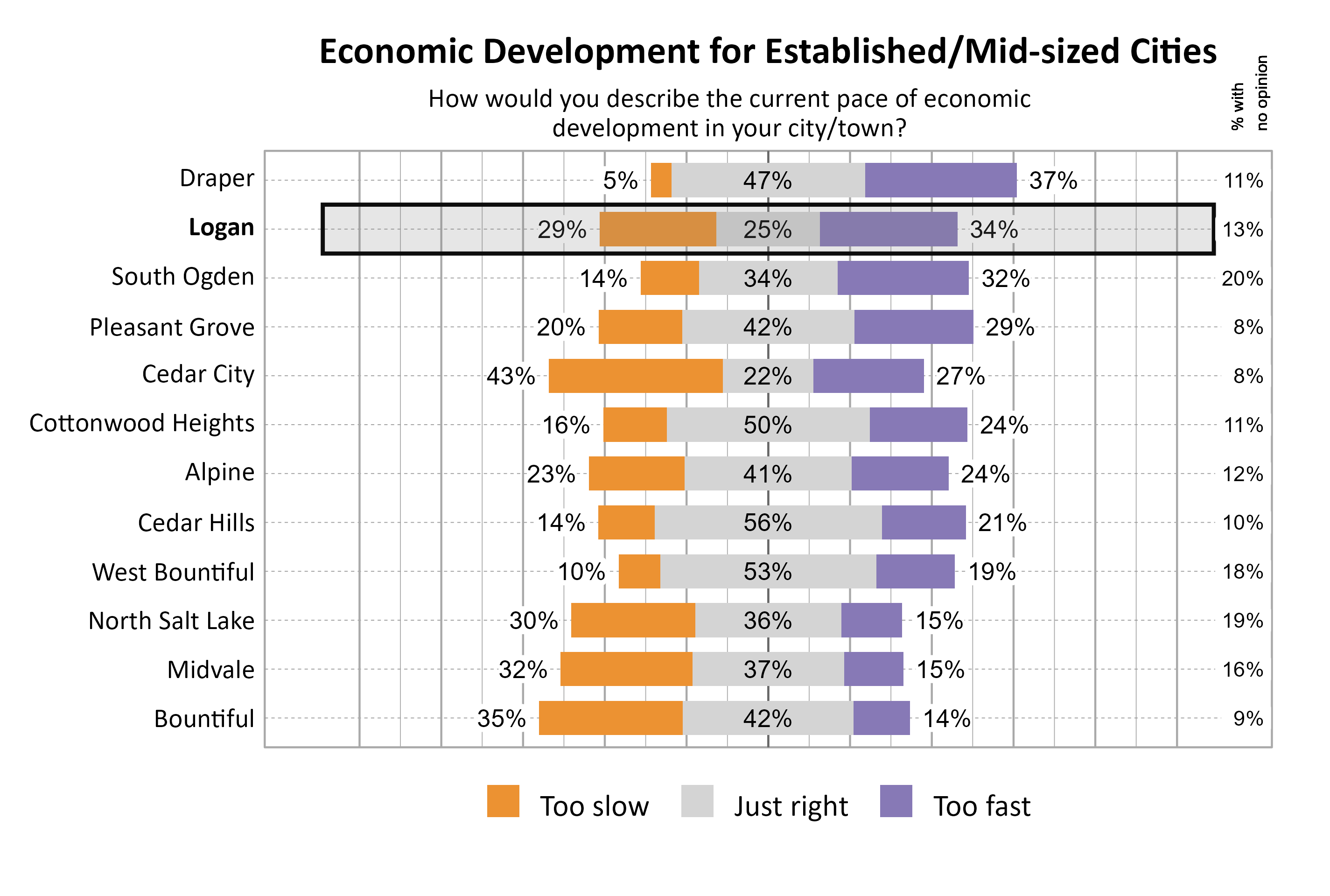
The majority of respondents in Logan indicated that they felt the population growth was too fast (70%). For the pace of economic development, respondents were split between opinions that it was too fast (34%), too slow (29%), and just right (25%).
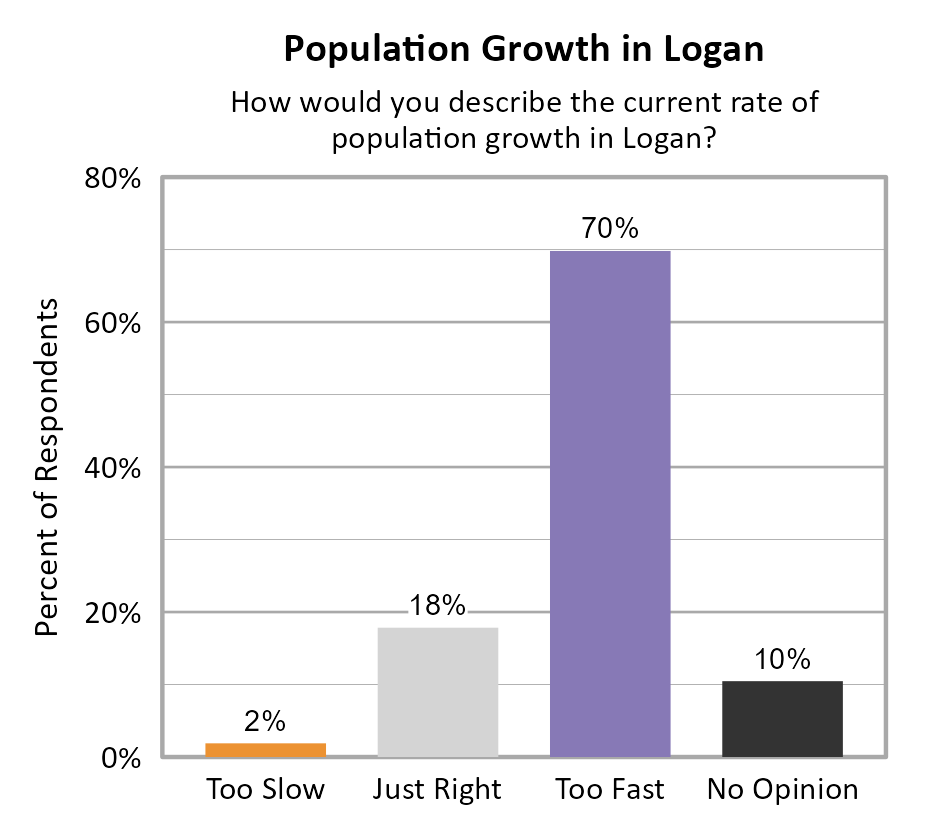
Bar Chart. Title: Population Growth in Logan. Subtitle: How would you describe the current rate of population growth in Logan? Data — Too Slow: 2% of respondents; Just Right: 18% of respondents; Too Fast: 70% of respondents; No Opinion: 10% of respondents

Bar Chart. Title: Economic Development in Logan. Subtitle: How would you describe the current pace of economic development in Logan? Data — Too Slow: 29% of respondents; Just Right: 25% of respondents; Too Fast: 34% of respondents; No Opinion: 13% of respondents

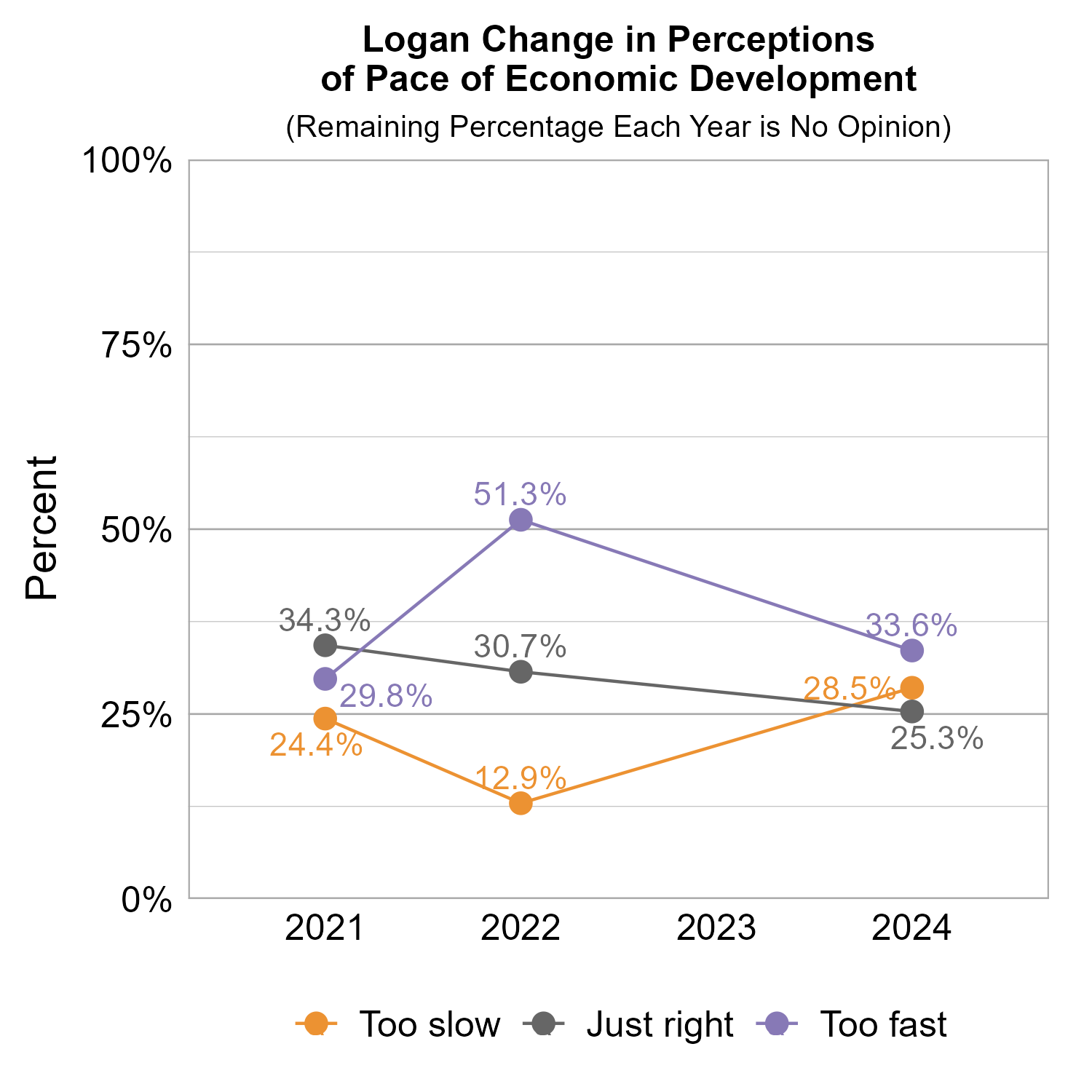
The graphs below show how perceptions of population growth and economic development in Logan have varied across recent years of Wellbeing Surveys. The majority of respondents have consistently indicated that the rate of population growth is too fast over the survey years, while the perception that economic development is too fast dropped from 2022 to 2024 and the perception that it is too slow increased from 2022 to 2024.
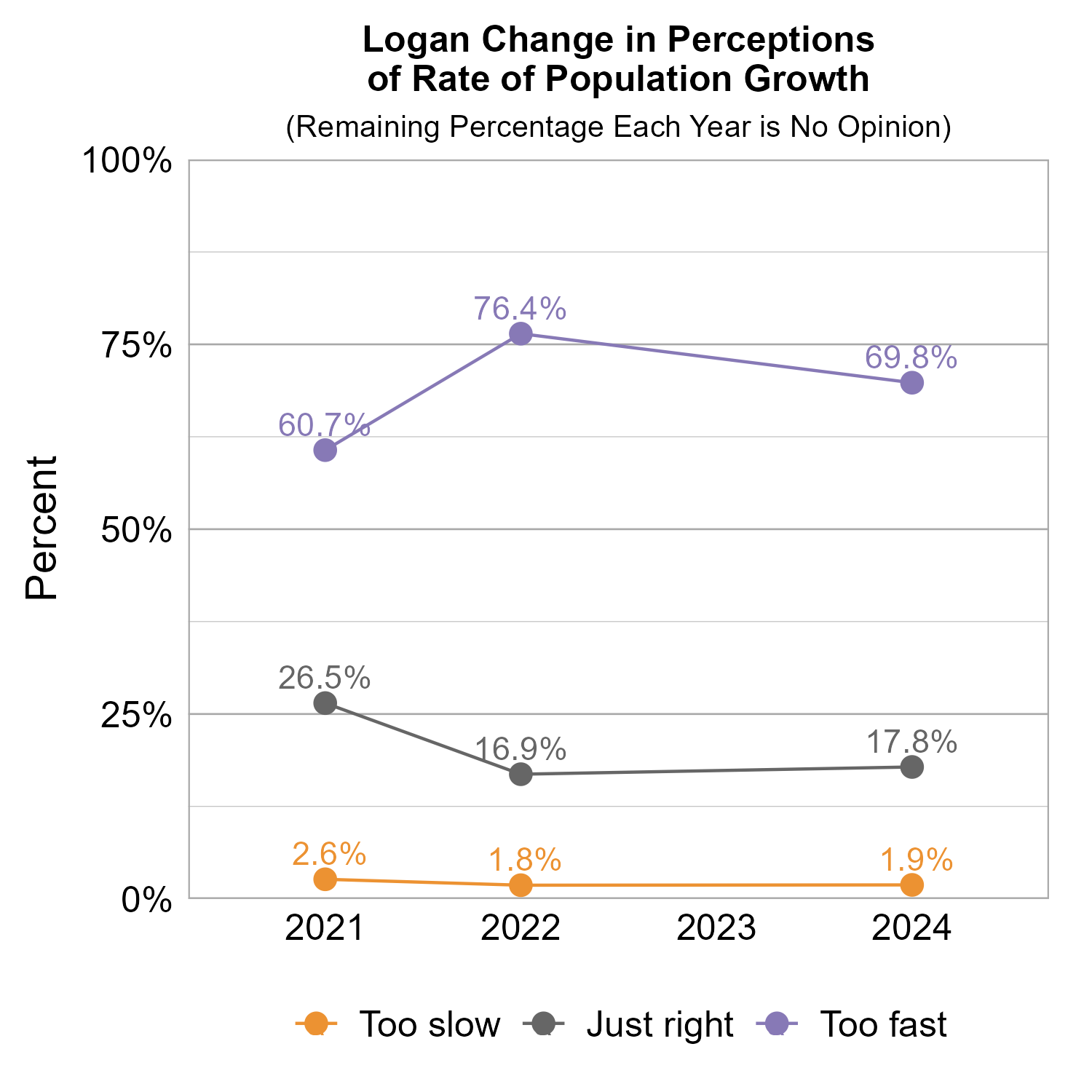
Line Graph. Title: Logan Change in Perceptions of Rate of Population Growth. Subtitle: (Remaining Percentage Each Year is No Opinion) Data — 2021:  2.6% rated too slow, 26.5% rated just right, 60.7% rated too fast; 2022:  1.8% rated too slow, 16.9% rated just right, 76.4% rated too fast; 2024:  1.9% rated too slow, 17.8% rated just right, 69.8% rated too fast

Line Graph. Title: Logan Change in Perceptions of Pace of Economic Development. Subtitle: (Remaining Percentage Each Year is No Opinion) Data — 2021: 24.4% rated too slow, 34.3% rated just right, 29.8% rated too fast; 2022: 12.9% rated too slow, 30.7% rated just right, 51.3% rated too fast; 2024: 28.5% rated too slow, 25.3% rated just right, 33.6% rated too fast

The graphs below show perceptions of population growth and economic development for Logan compared to other participating cities and towns in the Established/Mid-sized Cities cluster.
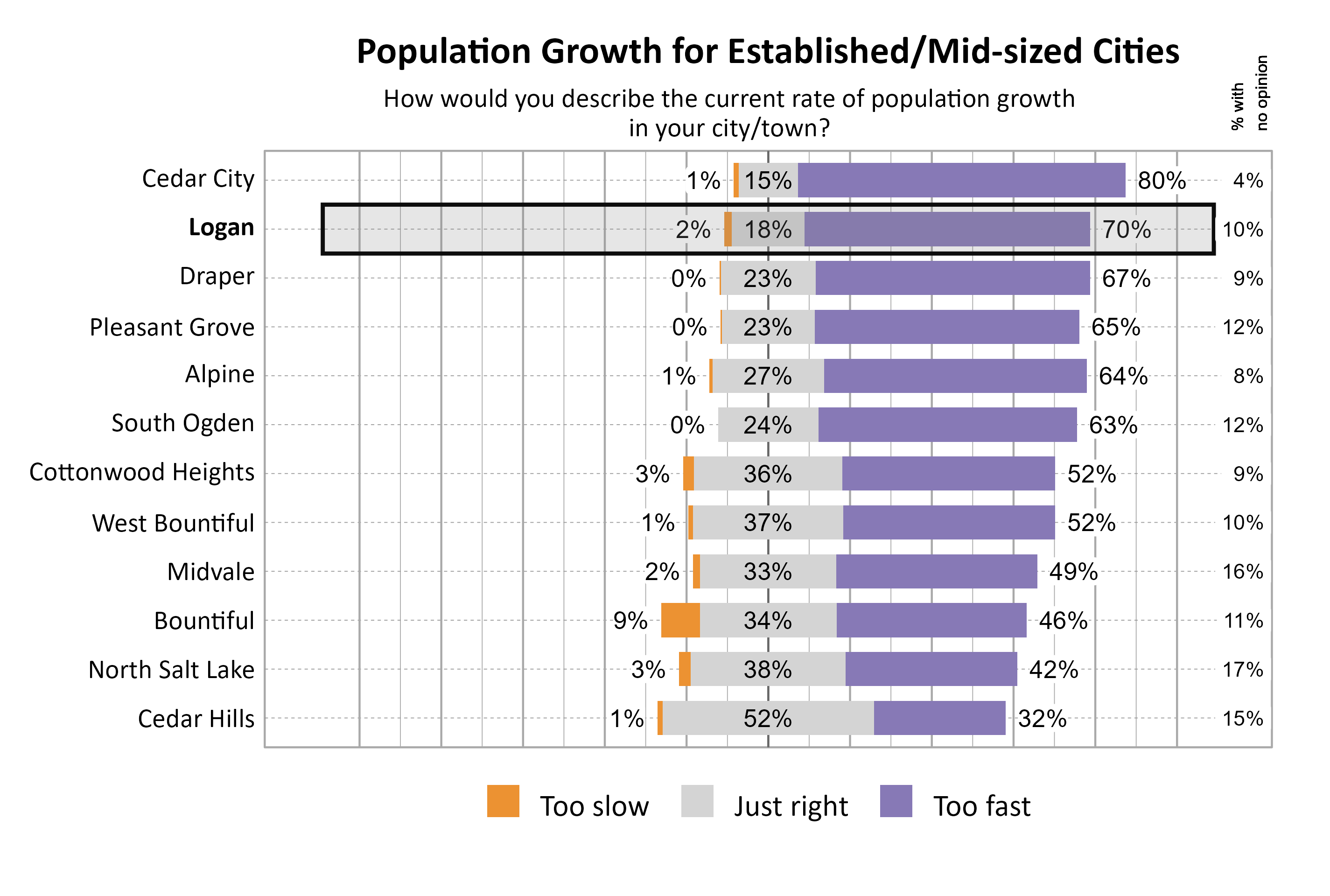
Likert Graph. Title: Population Growth for Established/Mid-sized Cities. Subtitle: How would you describe the current rate of population growth in your city/town? Data — City: Cedar City 1% of respondents indicated that it was too slow, 15% indicated that it was just right, 80% indicated that it was too fast, and  4% had no opinion; City: Logan 2% of respondents indicated that it was too slow, 18% indicated that it was just right, 70% indicated that it was too fast, and 10% had no opinion; City: Draper 0% of respondents indicated that it was too slow, 23% indicated that it was just right, 67% indicated that it was too fast, and  9% had no opinion; City: Pleasant Grove 0% of respondents indicated that it was too slow, 23% indicated that it was just right, 65% indicated that it was too fast, and 12% had no opinion; City: Alpine 1% of respondents indicated that it was too slow, 27% indicated that it was just right, 64% indicated that it was too fast, and  8% had no opinion; City: South Ogden 0% of respondents indicated that it was too slow, 24% indicated that it was just right, 63% indicated that it was too fast, and 12% had no opinion; City: Cottonwood Heights 3% of respondents indicated that it was too slow, 36% indicated that it was just right, 52% indicated that it was too fast, and  9% had no opinion; City: West Bountiful 1% of respondents indicated that it was too slow, 37% indicated that it was just right, 52% indicated that it was too fast, and 10% had no opinion; City: Midvale 2% of respondents indicated that it was too slow, 33% indicated that it was just right, 49% indicated that it was too fast, and 16% had no opinion; City: Bountiful 9% of respondents indicated that it was too slow, 34% indicated that it was just right, 46% indicated that it was too fast, and 11% had no opinion; City: North Salt Lake 3% of respondents indicated that it was too slow, 38% indicated that it was just right, 42% indicated that it was too fast, and 17% had no opinion; City: Cedar Hills 1% of respondents indicated that it was too slow, 52% indicated that it was just right, 32% indicated that it was too fast, and 15% had no opinion

Likert Graph. Title: Economic Development for Established/Mid-sized Cities. Subtitle: How would you describe the current pace of economic development in your city/town? Data — City: Draper  5% of respondents indicated that it was too slow, 47% indicated that it was just right, 37% indicated that it was too fast, and 11% had no opinion; City: Logan 29% of respondents indicated that it was too slow, 25% indicated that it was just right, 34% indicated that it was too fast, and 13% had no opinion; City: South Ogden 14% of respondents indicated that it was too slow, 34% indicated that it was just right, 32% indicated that it was too fast, and 20% had no opinion; City: Pleasant Grove 20% of respondents indicated that it was too slow, 42% indicated that it was just right, 29% indicated that it was too fast, and  8% had no opinion; City: Cedar City 43% of respondents indicated that it was too slow, 22% indicated that it was just right, 27% indicated that it was too fast, and  8% had no opinion; City: Cottonwood Heights 16% of respondents indicated that it was too slow, 50% indicated that it was just right, 24% indicated that it was too fast, and 11% had no opinion; City: Alpine 23% of respondents indicated that it was too slow, 41% indicated that it was just right, 24% indicated that it was too fast, and 12% had no opinion; City: Cedar Hills 14% of respondents indicated that it was too slow, 56% indicated that it was just right, 21% indicated that it was too fast, and 10% had no opinion; City: West Bountiful 10% of respondents indicated that it was too slow, 53% indicated that it was just right, 19% indicated that it was too fast, and 18% had no opinion; City: North Salt Lake 30% of respondents indicated that it was too slow, 36% indicated that it was just right, 15% indicated that it was too fast, and 19% had no opinion; City: Midvale 32% of respondents indicated that it was too slow, 37% indicated that it was just right, 15% indicated that it was too fast, and 16% had no opinion; City: Bountiful 35% of respondents indicated that it was too slow, 42% indicated that it was just right, 14% indicated that it was too fast, and  9% had no opinion

The graph below illustrates how many respondents perceived the pace of economic development as too slow, just right, too fast, or had no opinion, with additional breakdowns for the number of respondents who provided comments.
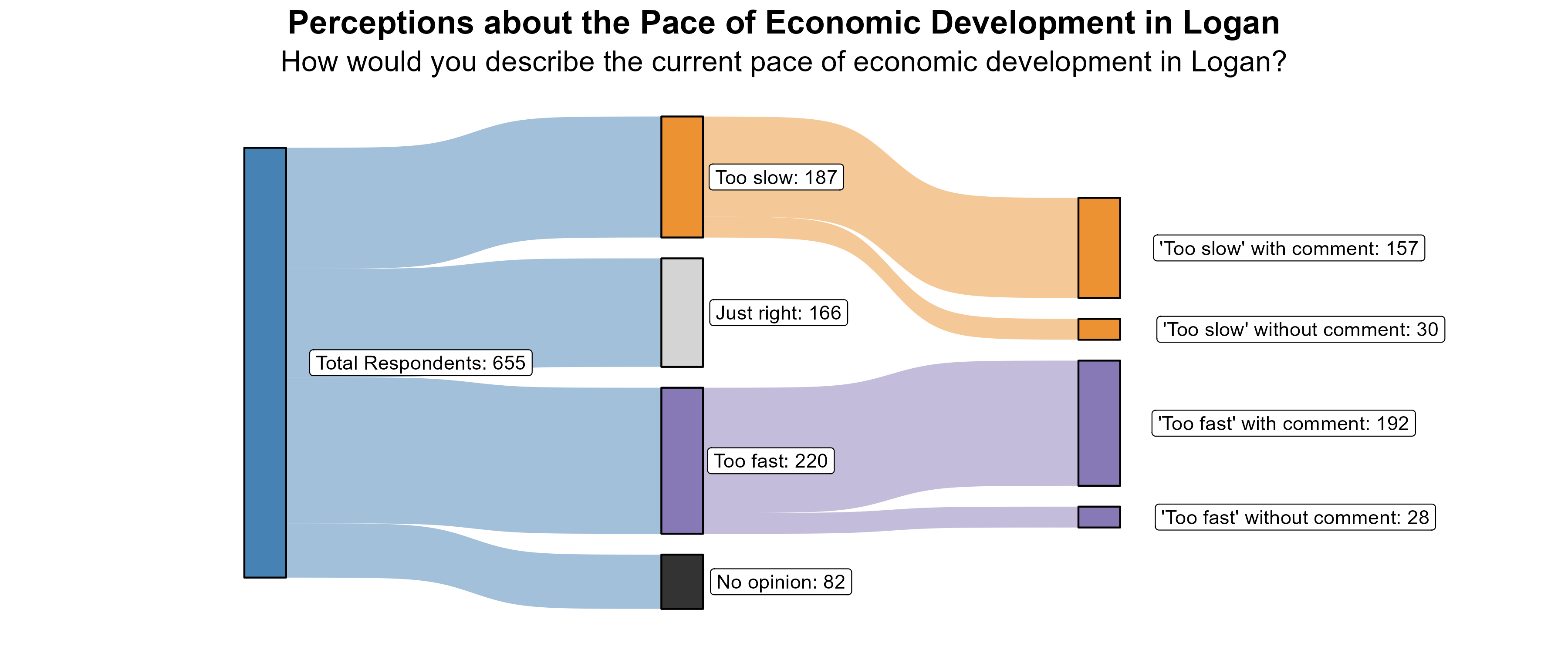
Sankey Graph. Title: Perceptions about the Pace of Economic Development in Logan. Subtitle: How would you describe the current pace of economic development in Logan? (In Number of Respondents). Data — Total Respondents: 655; No opinion: 82; Too fast: 220; Just right: 166; Too slow: 187; 'Too fast' without comment: 28; 'Too fast' with comment: 192; 'Too slow' without comment: 30; 'Too slow' with comment: 157

The 29% of respondents who rated the pace of economic growth as “too slow” were further asked what aspects of the local economy they would like to see more of in Logan. Comments focused on the need for better job opportunities and wages. Affordability was an issue for many, particularly housing. There were calls for additional retail and business opportunities, particularly support for local businesses.

Additionally, the 34% of respondents who rated the pace of economic growth as “too fast” were further asked what aspects of the local economy they feel are growing too quickly in Logan. Comments generally focused on housing development that is unaffordable and retail and business development in the form of fast food, chains, and warehouses. There were concerns about infrastructure, particularly related to roads and traffic. There were some concerns about resources and the loss of green space and open space. There were also mentions of the need for better job opportunities and the lack of affordability.

Transportation in Logan

Respondents were asked to indicate all of their primary modes of transportation on a regular basis in Logan. The most popular modes of transportation were personal car (95%) and walking (53%).
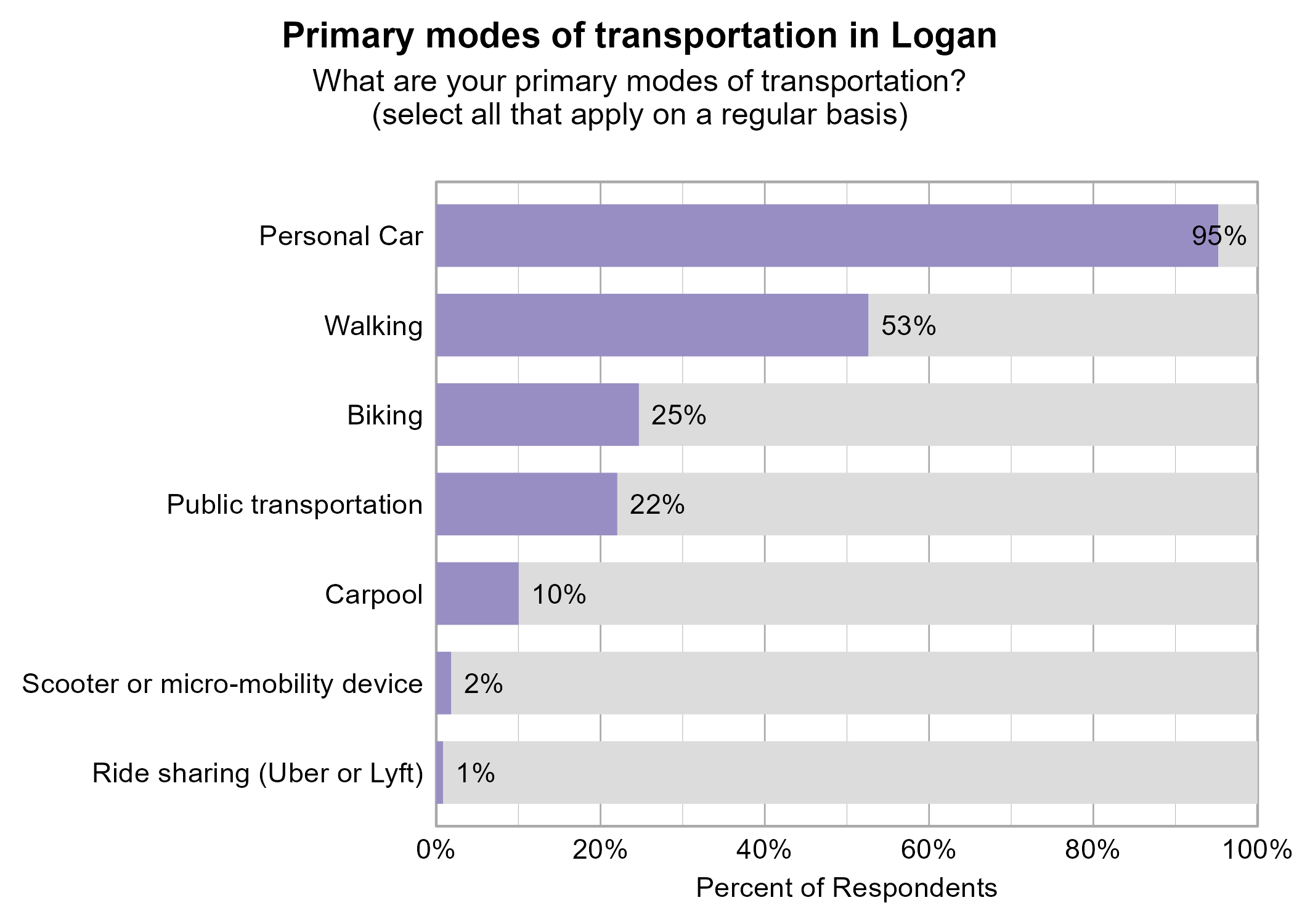
Bar Graph. Title: Primary modes of transportation in Logan. Subtitle: What are your primary modes of transportation? (select all that apply on a regular basis) Data — 95% of respondents indicated yes to Personal Car; 53% of respondents indicated yes to Walking; 25% of respondents indicated yes to Biking; 22% of respondents indicated yes to Public transportation; 10% of respondents indicated yes to Carpool; 2% of respondents indicated yes to Scooter or micro-mobility device; 1% of respondents indicated yes to Ride sharing (Uber or Lyft)

Respondents were asked to indicate the most common barriers to transportation in Logan. The most problematic barriers were Travel time (52%) and Lack of routes (41%).
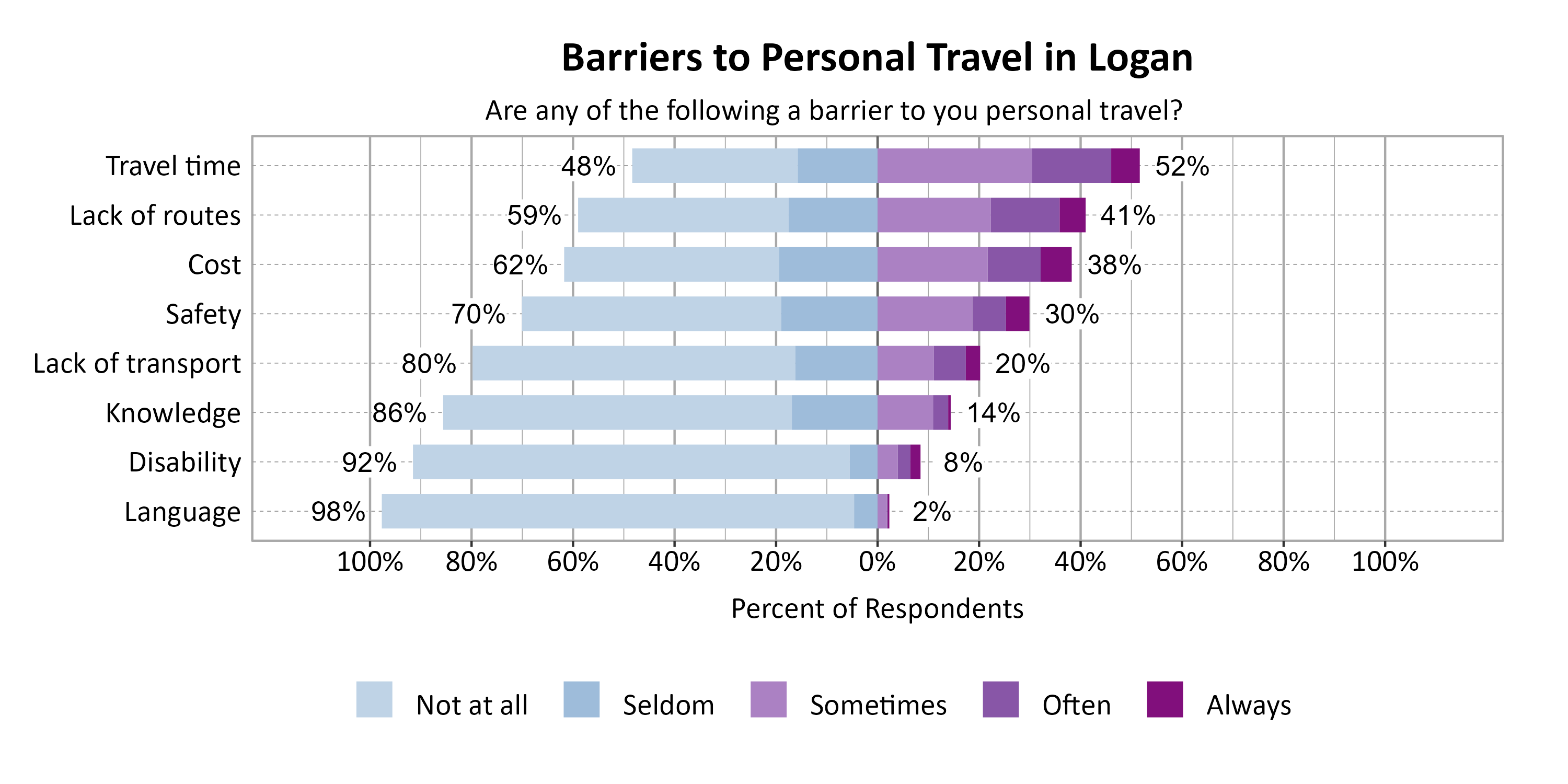
Likert Graph. Title: Barriers to Personal Travel in Logan. Subtitle: Are any of the following a barrier to you personal travel? Data — Category: Travel time - 48% of respondents indicated it was not a barrier or seldom a barrier, while 52% of respondents indicated it was sometimes, often, or always a barrier; Category: Lack of routes - 59% of respondents indicated it was not a barrier or seldom a barrier, while 41% of respondents indicated it was sometimes, often, or always a barrier; Category: Cost - 62% of respondents indicated it was not a barrier or seldom a barrier, while 38% of respondents indicated it was sometimes, often, or always a barrier; Category: Safety - 70% of respondents indicated it was not a barrier or seldom a barrier, while 30% of respondents indicated it was sometimes, often, or always a barrier; Category: Lack of transport - 80% of respondents indicated it was not a barrier or seldom a barrier, while 20% of respondents indicated it was sometimes, often, or always a barrier; Category: Knowledge - 86% of respondents indicated it was not a barrier or seldom a barrier, while 14% of respondents indicated it was sometimes, often, or always a barrier; Category: Disability - 92% of respondents indicated it was not a barrier or seldom a barrier, while  8% of respondents indicated it was sometimes, often, or always a barrier; Category: Language - 98% of respondents indicated it was not a barrier or seldom a barrier, while  2% of respondents indicated it was sometimes, often, or always a barrier

Respondents were asked to indicate the importance of a set of possible transportation developments in Logan. The most important development to respondents were Improving walkability (74%), More trails (70%), and Enhancing safety (68%).
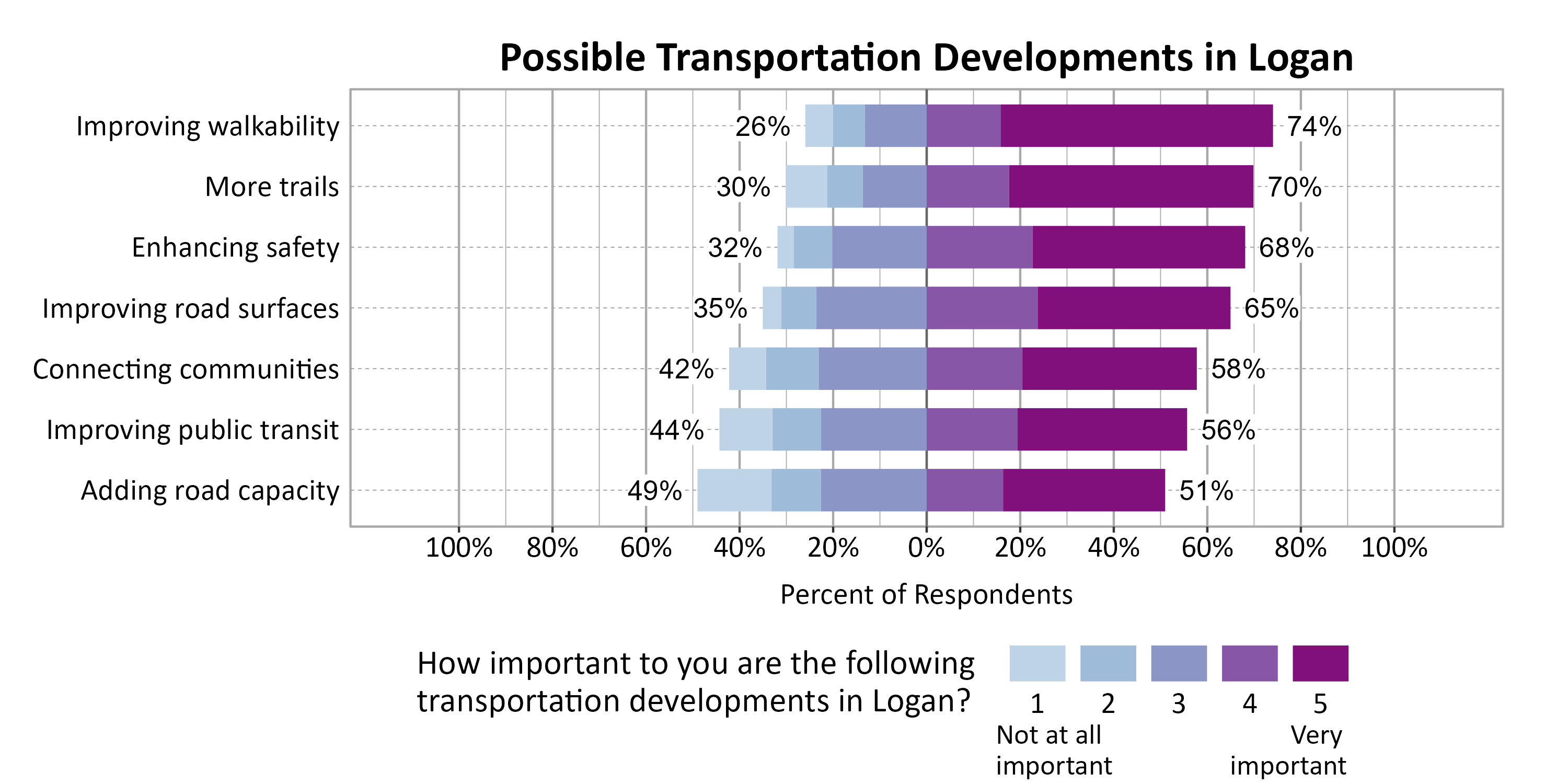
Likert Graph. Title: Possible Transportation Developments in Logan. Subtitle: On a scale of 1 - Not at all important to 5 - Very important, please rate the importance of the following developments to you. Data — Category: Improving walkability - 26% of respondents indicated it 1, 2, or 3, while 74% of respondents rated it a 4 or 5.; Category: More trails - 30% of respondents indicated it 1, 2, or 3, while 70% of respondents rated it a 4 or 5.; Category: Enhancing safety - 32% of respondents indicated it 1, 2, or 3, while 68% of respondents rated it a 4 or 5.; Category: Improving road surfaces - 35% of respondents indicated it 1, 2, or 3, while 65% of respondents rated it a 4 or 5.; Category: Connecting communities - 42% of respondents indicated it 1, 2, or 3, while 58% of respondents rated it a 4 or 5.; Category: Improving public transit - 44% of respondents indicated it 1, 2, or 3, while 56% of respondents rated it a 4 or 5.; Category: Adding road capacity - 49% of respondents indicated it 1, 2, or 3, while 51% of respondents rated it a 4 or 5.

Respondents were asked to indicate how frequently various activities take them out of Logan to another city or town. The most commonly indicated reasons for traveling to another city or town at least sometimes or once a month were Friends and Family (74%), Eating Out (53%), Other Services (51%), and Recreation/Sports (50%).
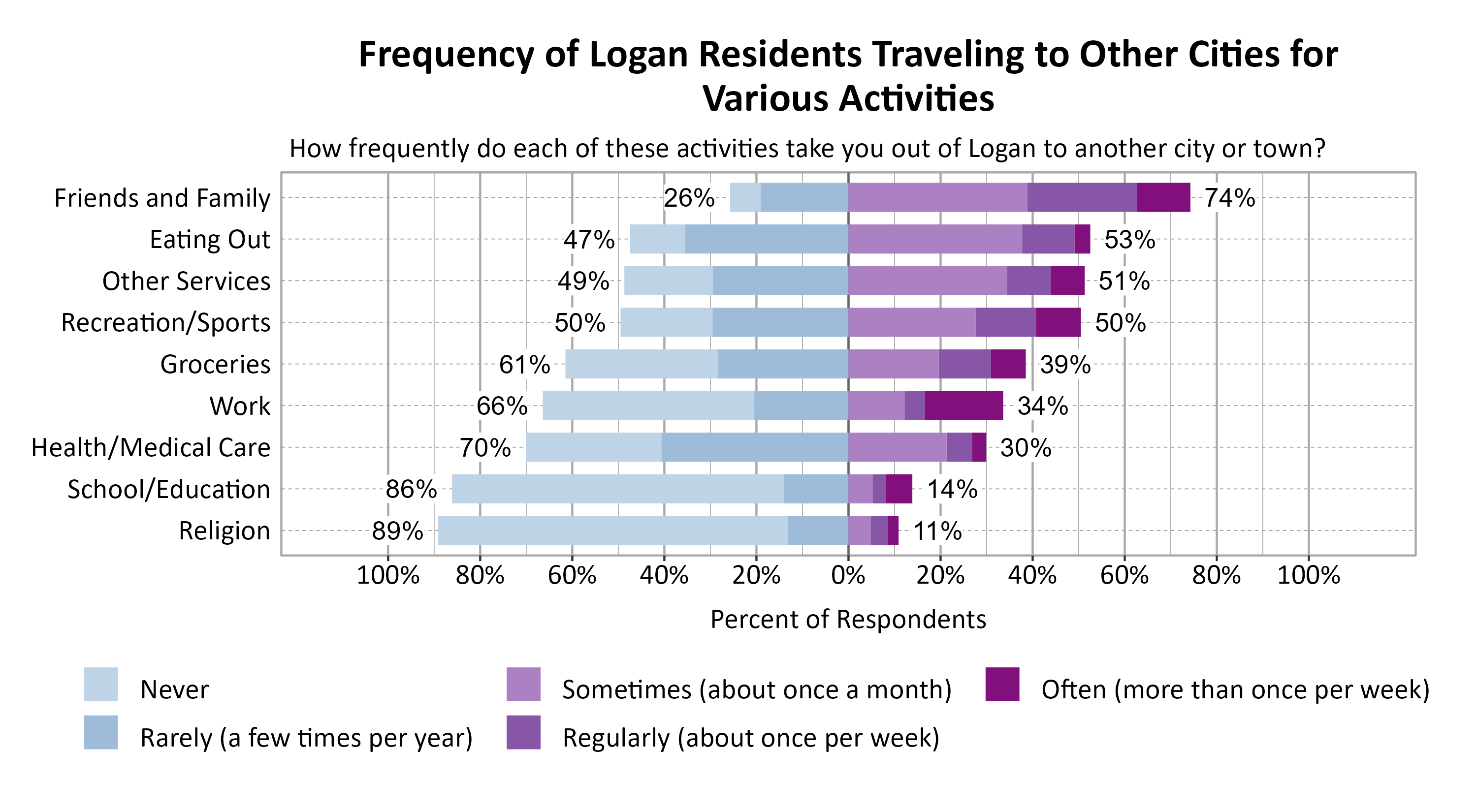
Likert Graph. Title: Frequency of Logan Residents Traveling to Other Cities for Various Activities. Subtitle: How frequently do each of these activities take you out of Logan to another city or town? Data — Category: Friends and Family - 26% of respondents indicated it was never or rarely and 74% of respondents indicated it was sometimes, regularly, often; Category: Eating Out - 47% of respondents indicated it was never or rarely and 53% of respondents indicated it was sometimes, regularly, often; Category: Other Services - 49% of respondents indicated it was never or rarely and 51% of respondents indicated it was sometimes, regularly, often; Category: Recreation/Sports - 50% of respondents indicated it was never or rarely and 50% of respondents indicated it was sometimes, regularly, often; Category: Groceries - 61% of respondents indicated it was never or rarely and 39% of respondents indicated it was sometimes, regularly, often; Category: Work - 66% of respondents indicated it was never or rarely and 34% of respondents indicated it was sometimes, regularly, often; Category: Health/Medical Care - 70% of respondents indicated it was never or rarely and 30% of respondents indicated it was sometimes, regularly, often; Category: School/Education - 86% of respondents indicated it was never or rarely and 14% of respondents indicated it was sometimes, regularly, often; Category: Religion - 89% of respondents indicated it was never or rarely and 11% of respondents indicated it was sometimes, regularly, often

Concerns in Logan

Survey respondents indicated the degree to which a number of possible local issues were a concern as they look to the future of Logan. Affordable Housing (88%), Air Quality (86%), and Traffic (85%) were the top concerns. Since 2022, moderate or major concern about employment opportunities (+10%) notably increased, while concern about water supply (-10%) notably decreased.
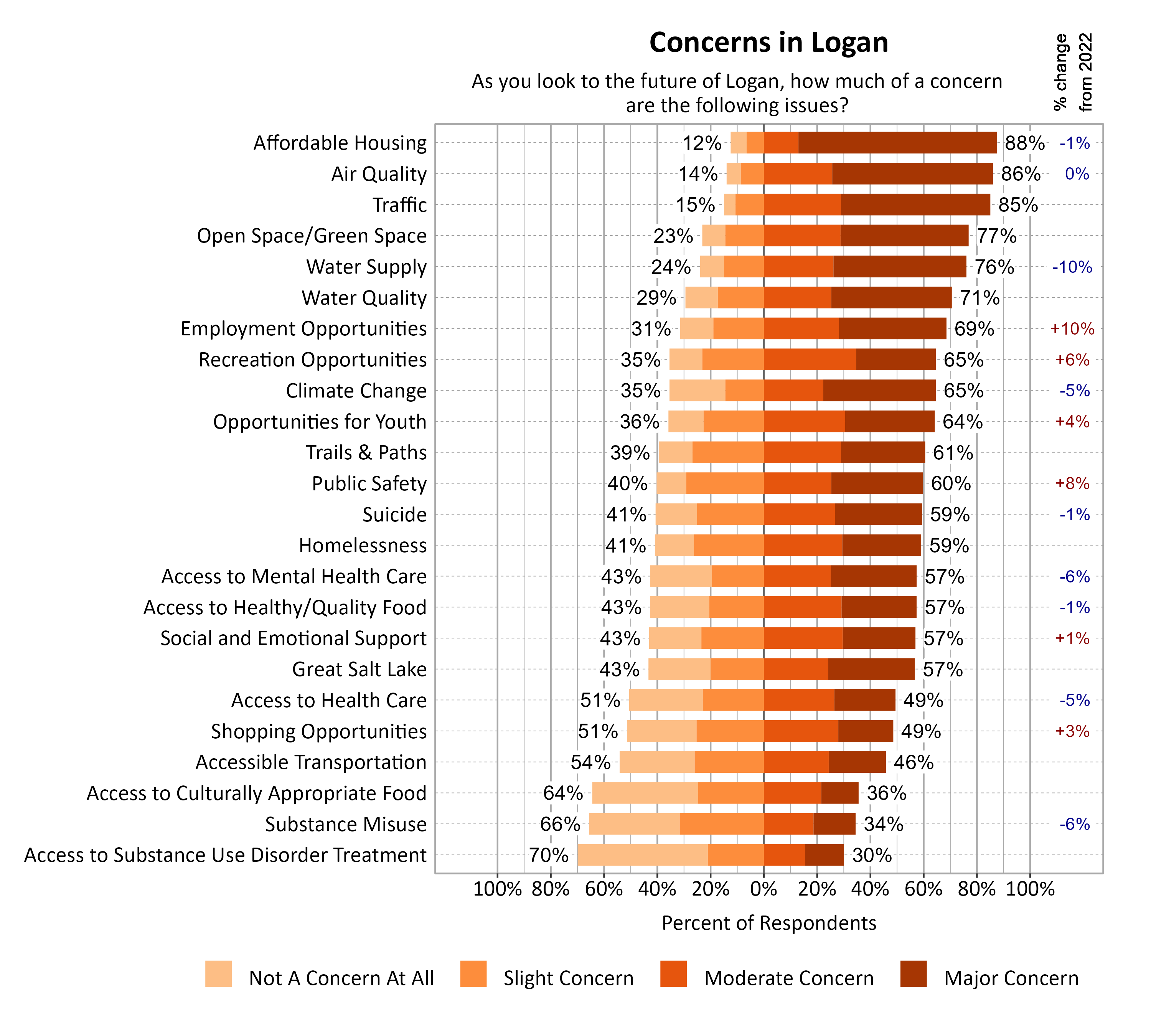
Likert Graph. Title: Concerns in Logan. Subtitle: As you look to the future of Logan, how much of a concern are the following issues? Data — Category: Affordable Housing - 12% of respondents indicated not a concern at all or slight concern while 88% of respondents indicated a moderate or major concern; Category: Air Quality - 14% of respondents indicated not a concern at all or slight concern while 86% of respondents indicated a moderate or major concern; Category: Traffic - 15% of respondents indicated not a concern at all or slight concern while 85% of respondents indicated a moderate or major concern; Category: Open Space/Green Space - 23% of respondents indicated not a concern at all or slight concern while 77% of respondents indicated a moderate or major concern; Category: Water Supply - 24% of respondents indicated not a concern at all or slight concern while 76% of respondents indicated a moderate or major concern; Category: Water Quality - 29% of respondents indicated not a concern at all or slight concern while 71% of respondents indicated a moderate or major concern; Category: Employment Opportunities - 31% of respondents indicated not a concern at all or slight concern while 69% of respondents indicated a moderate or major concern; Category: Climate Change - 35% of respondents indicated not a concern at all or slight concern while 65% of respondents indicated a moderate or major concern; Category: Recreation Opportunities - 35% of respondents indicated not a concern at all or slight concern while 65% of respondents indicated a moderate or major concern; Category: Opportunities for Youth - 36% of respondents indicated not a concern at all or slight concern while 64% of respondents indicated a moderate or major concern; Category: Trails & Paths - 39% of respondents indicated not a concern at all or slight concern while 61% of respondents indicated a moderate or major concern; Category: Public Safety - 40% of respondents indicated not a concern at all or slight concern while 60% of respondents indicated a moderate or major concern; Category: Homelessness - 41% of respondents indicated not a concern at all or slight concern while 59% of respondents indicated a moderate or major concern; Category: Suicide - 41% of respondents indicated not a concern at all or slight concern while 59% of respondents indicated a moderate or major concern; Category: Access to Healthy/Quality Food - 43% of respondents indicated not a concern at all or slight concern while 57% of respondents indicated a moderate or major concern; Category: Access to Mental Health Care - 43% of respondents indicated not a concern at all or slight concern while 57% of respondents indicated a moderate or major concern; Category: Great Salt Lake - 43% of respondents indicated not a concern at all or slight concern while 57% of respondents indicated a moderate or major concern; Category: Social and Emotional Support - 43% of respondents indicated not a concern at all or slight concern while 57% of respondents indicated a moderate or major concern; Category: Access to Health Care - 51% of respondents indicated not a concern at all or slight concern while 49% of respondents indicated a moderate or major concern; Category: Shopping Opportunities - 51% of respondents indicated not a concern at all or slight concern while 49% of respondents indicated a moderate or major concern; Category: Accessible Transportation - 54% of respondents indicated not a concern at all or slight concern while 46% of respondents indicated a moderate or major concern; Category: Access to Culturally Appropriate Food - 64% of respondents indicated not a concern at all or slight concern while 36% of respondents indicated a moderate or major concern; Category: Substance Misuse - 66% of respondents indicated not a concern at all or slight concern while 34% of respondents indicated a moderate or major concern; Category: Access to Substance Use Disorder Treatment - 70% of respondents indicated not a concern at all or slight concern while 30% of respondents indicated a moderate or major concern

Open Comments

All open comments collected in the survey were shared with city leaders. General observations and themes are shared here.

What Respondents Value Most in Logan

Survey respondents were asked to comment on what they value most about Logan. The most common words and phrases from all city comments are included in the word cloud below. It is possible that negative or unrelated words may appear since these words have been taken out of context, and they may not indicate the respondent’s intended meaning. Many respondents indicated that they value the nature and beauty in and around Logan, as well as the ease of accessing recreational activities in nature. Many expressed valuing the small town feel of Logan that is accompanied by bigger city amenities, such as retail opportunities, arts, community events, and public transportation. Many said they value the nice people, family, community, and friends they have in Logan. Several values the safety in Logan, both due to lower crime rates and the nature of the community. Some comments addressed accessibility and location, mentioning how easy it is to access amenities due to proximity and ease of transportation.
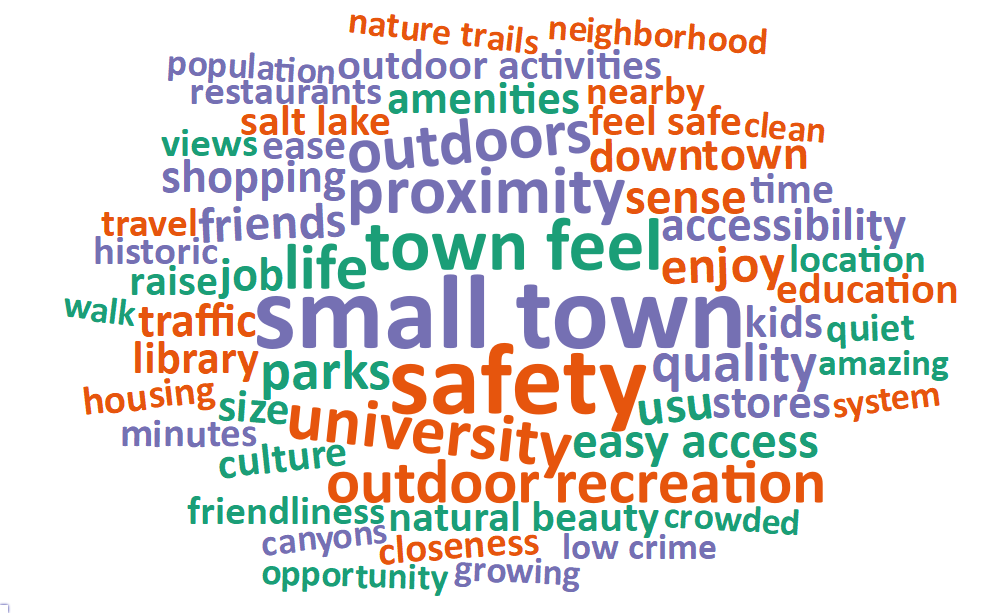
A word cloud of most common words about what respondents value most in their city

Local Environmental Quality in Logan

The 66% of respondents who rated the Local Environmental Quality domain as 1, 2, or 3 (Poor, Fair, or Moderate) were further asked if there are specific aspects of local environmental quality that they feel are problematic. Air Quality was a major concern, particularly related to inversions and idling cars. Water scarcity and quality were mentioned. Some residents described the taste of water as poor while others were concerned about water supply. Congestion and traffic were major concerns, and lack of bike lines or walk lanes frustrated respondents. There were a notable number of comments on recycling. Residents want a more productive recycling system and an easier way to dispose of glass. Trash and the lack of cleanliness of Logan were concerns as well. Green space was seen as important and diminishing as parks are de-emphasized for other developments or not well maintained.

Improving Wellbeing in Logan

Survey respondents were asked if there is anything that could be done to improve wellbeing in Logan. Many comments addressed concerns about transportation, particularly traffic, walkability, bike infrastructure, buses, and how these things relate to safety. Many requested restructuring road infrastructure to create more high traffic roads to relieve traffic burdens, especially on roads with businesses and housing, and to improve sidewalks, bike paths, bike lanes, and add more public transportation options (both within Logan and to other cities, such as Brigham City). Many brought up concerns about growth, development, and economic opportunities, especially in context of the housing crisis. There were concerns about traffic, housing affordability, and general cost of living. There were also many comments about recreation and local opportunities, particularly requests for a new recreation and/or community center, more community activities, and improving trails and parks. A few comments addressed concerns about diversity, inclusion, and community building, particularly in relation to local opportunities.

Additional Comments

Respondents were also asked if they had any additional comments on wellbeing in Logan. Transportation and growth and development were common themes in additional comments from Logan, particularly related to traffic and walkability. Many comments also mentioned housing issues, particularly issues with finding affordable housing. Issues were raised related to government, including complaints about corruption, growth and development choices, and the need for politicians or city officials to listen to the needs of the community. Several comments asked for more local opportunities, such as community events, a new rec center, and more winter time recreation options. A few comments addressed social climate, such as requests for more opportunities for non-LDS community members to find community and more acceptance for LGBTQ+ individuals.