
Midway Wellbeing Survey Findings 2024
By Dr. Courtney Flint and Team
Contact Information
Dr. Courtney Flint
courtney.flint@usu.edu
435-797-8635
Summary
Midway is one of 51 cities participating in the Utah Wellbeing Survey Project in 2024. This project is designed to assess the wellbeing and local perspectives of city residents and to provide information to city leaders to inform general planning processes. Additional analysis is underway and this report may be updated over time.
We are grateful to all those who took the survey and to our city partners who helped to make this possible. We are grateful to a number of entities for funding: the Utah League of Cities and Towns, USU Extension, USU’s Institute for Land Water and Air, the Wasatch Front Regional Council, Utah Department of Transportation, the Utah Agricultural Experiment Station, and the cities of Alpine, Cedar Hills, Draper, Millcreek, Nephi, North Salt Lake, Ogden, Orem, Pleasant Grove, Providence, Springdale, Tremonton, West Bountiful, and West Valley City.
This report describes findings from the 2024 Midway survey and comparative information with other project cities. In April and May 2024, Midway City advertised the survey for residents largely through social media, banners, the city website, City App notifications, and flyers. All city residents age 18+ were encouraged to take the online Qualtrics survey.
How many people responded?
- 153 viable surveys were recorded in this 2024 survey effort.
- The adult population of Midway was estimated at 4,264, based on the American Community Survey by the U.S. Census. The 153 survey responses in 2024 represent 3.6% of the adult population and have a conservative margin of error of 7.78%.
Survey Respondent Characteristics
| Resident Statistics | |
|---|---|
| Full Time Residents of Midway | 84.3% |
| Part Time Residents of Midway | 15.7% |
| Length of Residency — Range | 0.1-68 years |
| Length of Residency — Average | 12.5 years |
| Length of Residency — Median | 8 years |
| Length of Residency 5 Years or less | 42.4% |
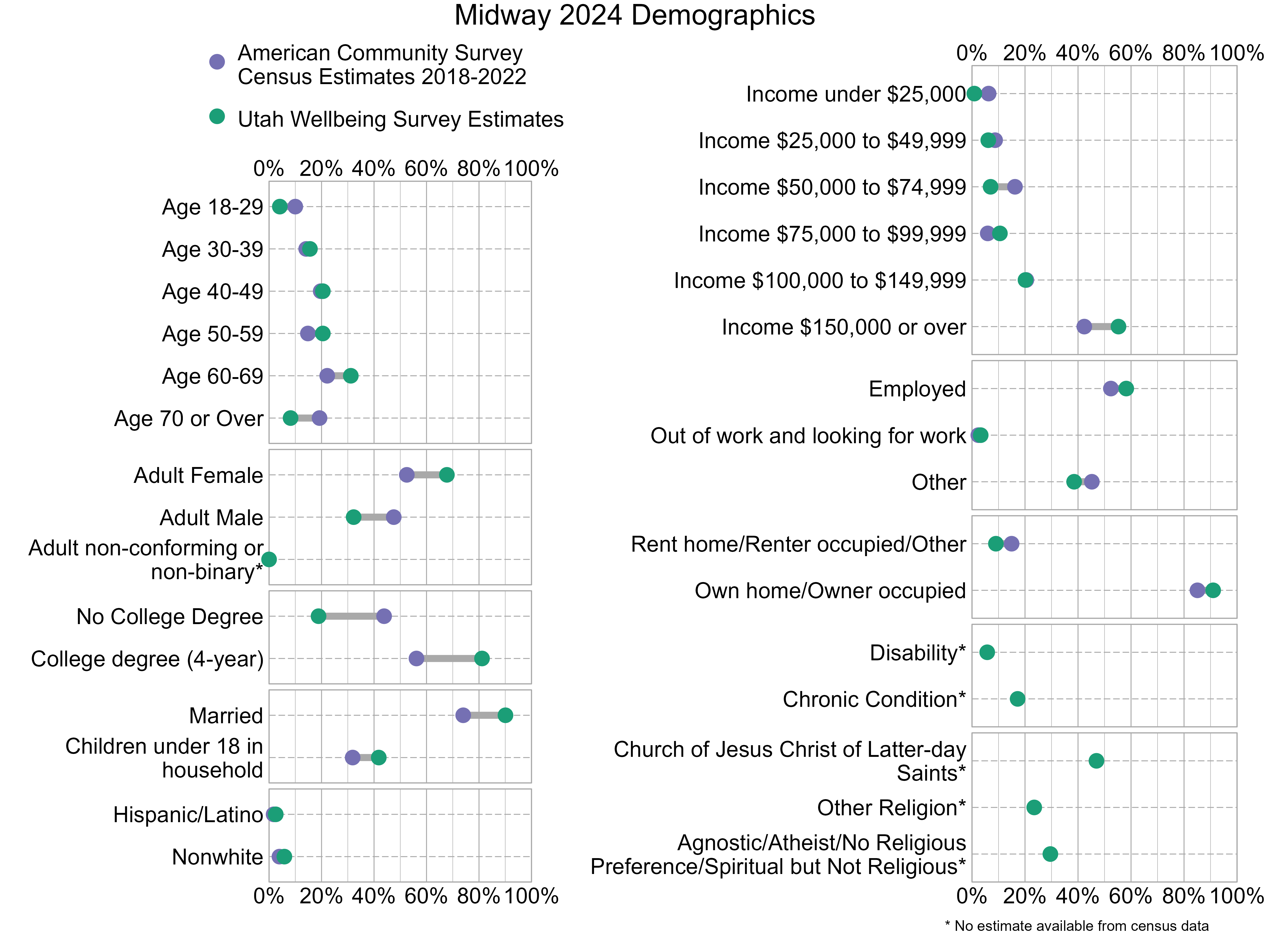
Demographic characteristics of the survey respondents were compared below with U.S. Census information from the 2018-2022 American Community Survey. In the graph below, gray bars indicate differences between the American Community Survey estimates and the Utah Wellbeing Project surveys. The wider the gray bars, the larger the differences. Also note that estimates for religious affiliation, adult non-conforming or non-binary gender, disability, and chronic conditions are unavailable from the census data. There can also be a variable margin of error in the American Community Survey estimates, and caution should be used when comparing estimates. Not all respondents provided demographic information. As the graph shows, 2024 survey respondents were not fully representative of Midway. People who are adult females, have at least a 4-year college degree, and are married were overrepresented while those who are adult males and do not have a college degree were underrepresented.
Overall Personal Wellbeing and Overall Wellbeing in Midway
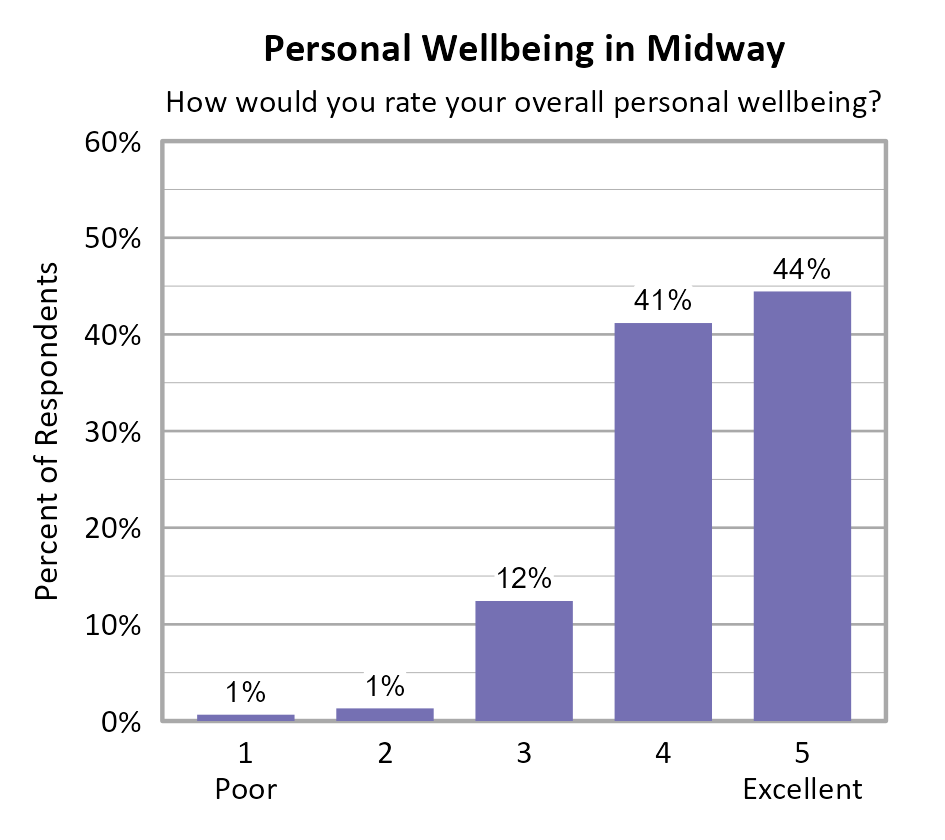
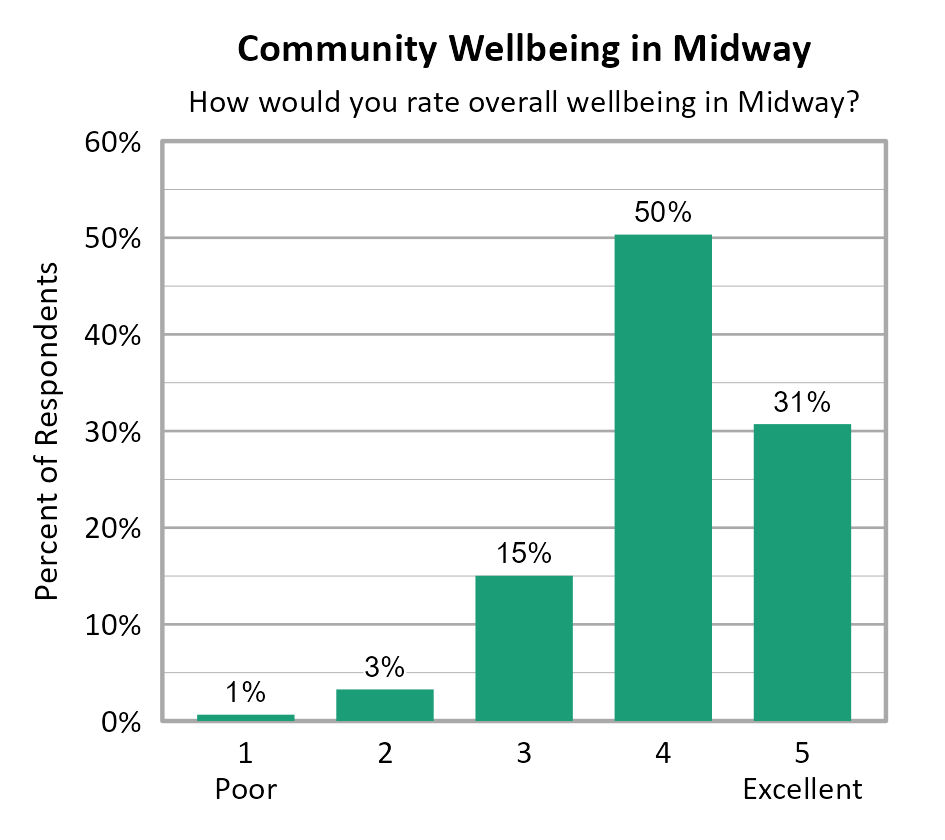
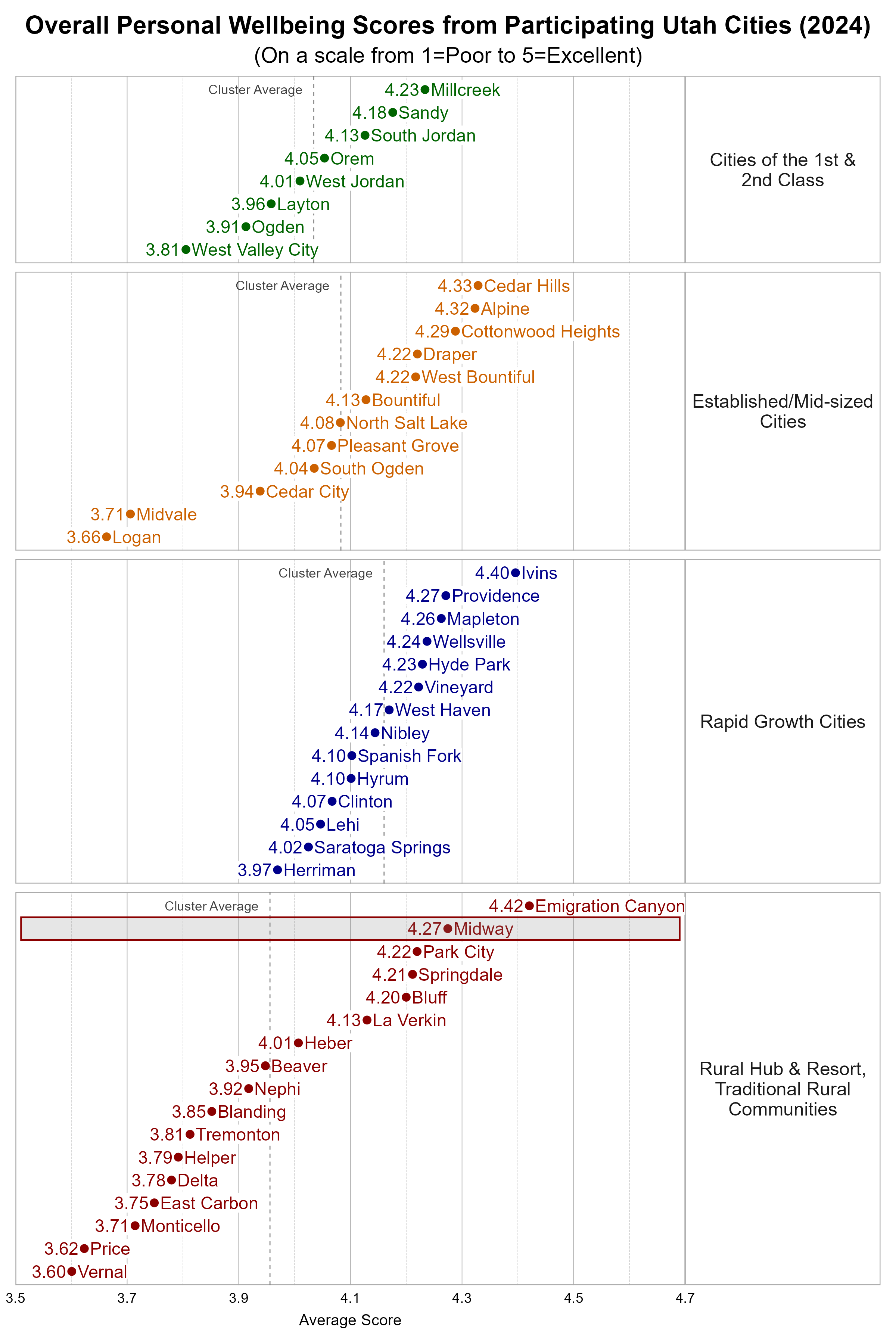
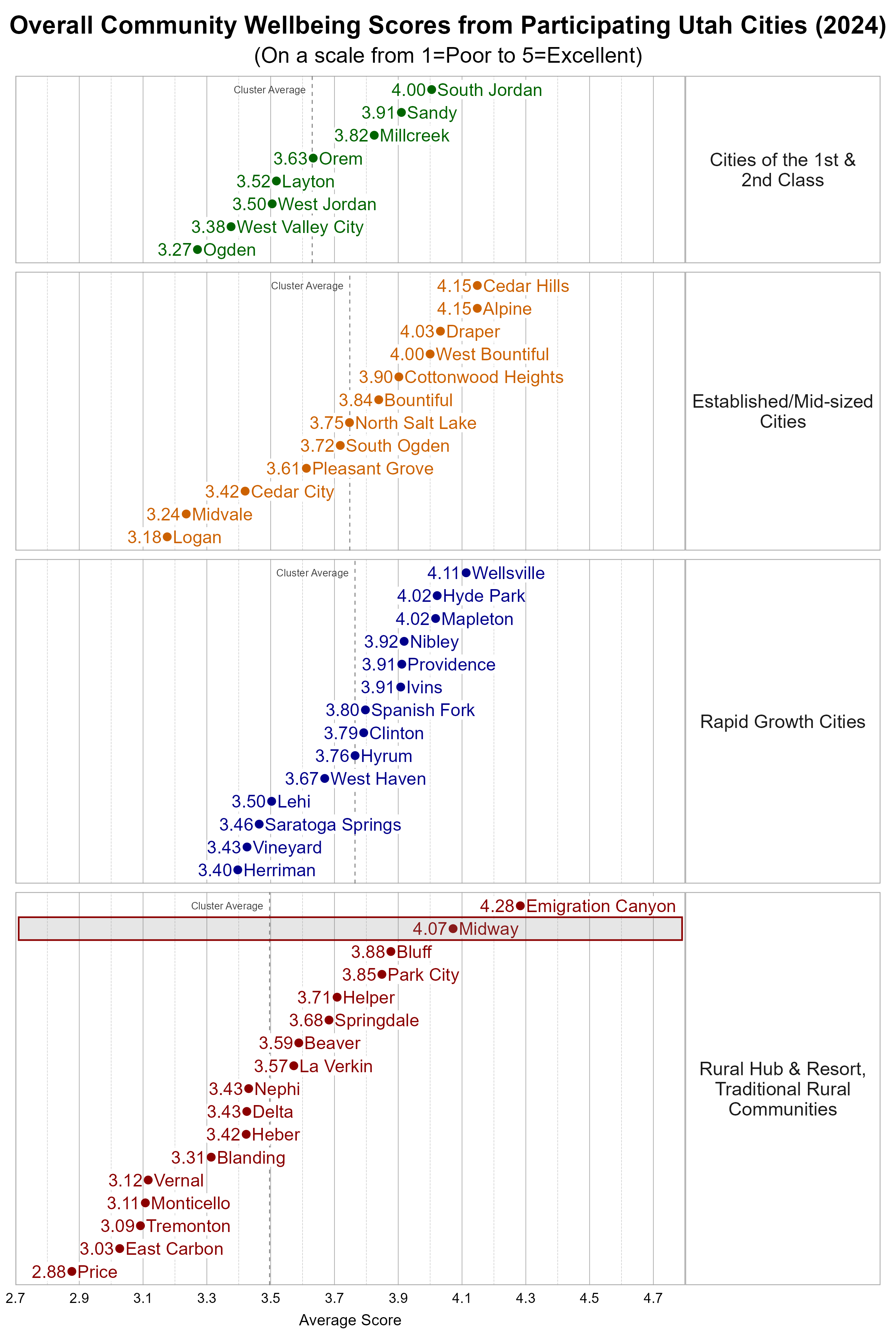
Survey participants were asked about their overall personal wellbeing and overall community wellbeing in Midway. These wellbeing indicators were both measured on a 5-point scale from poor (1) to excellent (5). The average personal wellbeing score in Midway was 4.27 with 86% of respondents indicating their wellbeing at a 4 or 5 on the 5-point scale. The average score for community wellbeing in Midway was 4.07 with 81% of respondents indicating community wellbeing at a 4 or 5 on the 5-point scale.
Comparing Wellbeing Across Utah Cities
The Utah League of Cities and Towns clusters cities and towns into five different categories based on size and growth rates. We utilize these clusters in our analysis. Midway is classified as a Rural Hub/Resort Community (and we have combined these with the Traditional Rural Communities). Some cities may fit within more than one cluster.
Within the Rural city cluster, Midway was well above the average overall personal wellbeing score and well above the average overall community wellbeing score.
Wellbeing Domains in Midway
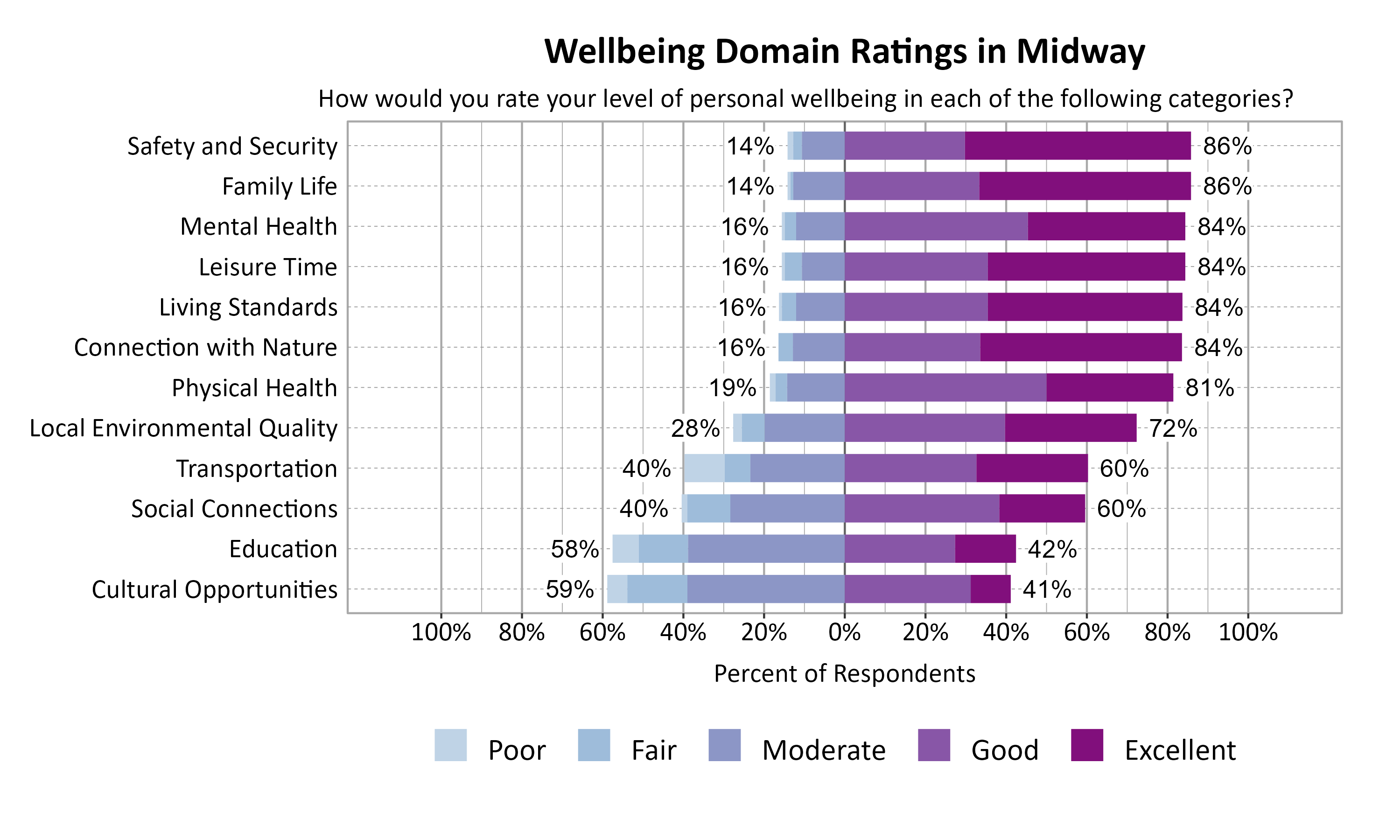
According to national and international entities that track wellbeing, there are a number of common dimensions or domains of wellbeing. Survey respondents rated twelve domains on a 5-point scale from poor to excellent. They were also asked to indicate the importance of each domain to their overall personal wellbeing on a 5-point scale from not at all important to very important. The highest rated wellbeing domains for respondents in Midway were Family Life (86%), Safety and Security (86%), Leisure Time (84%), Mental Health (84%), Living Standards (84%), and Connection with Nature (84%). The most important wellbeing domains were Mental Health (99%), Physical Health (99%), Safety and Security (97%), and Living Standards (96%).

Wellbeing Matrix for Midway
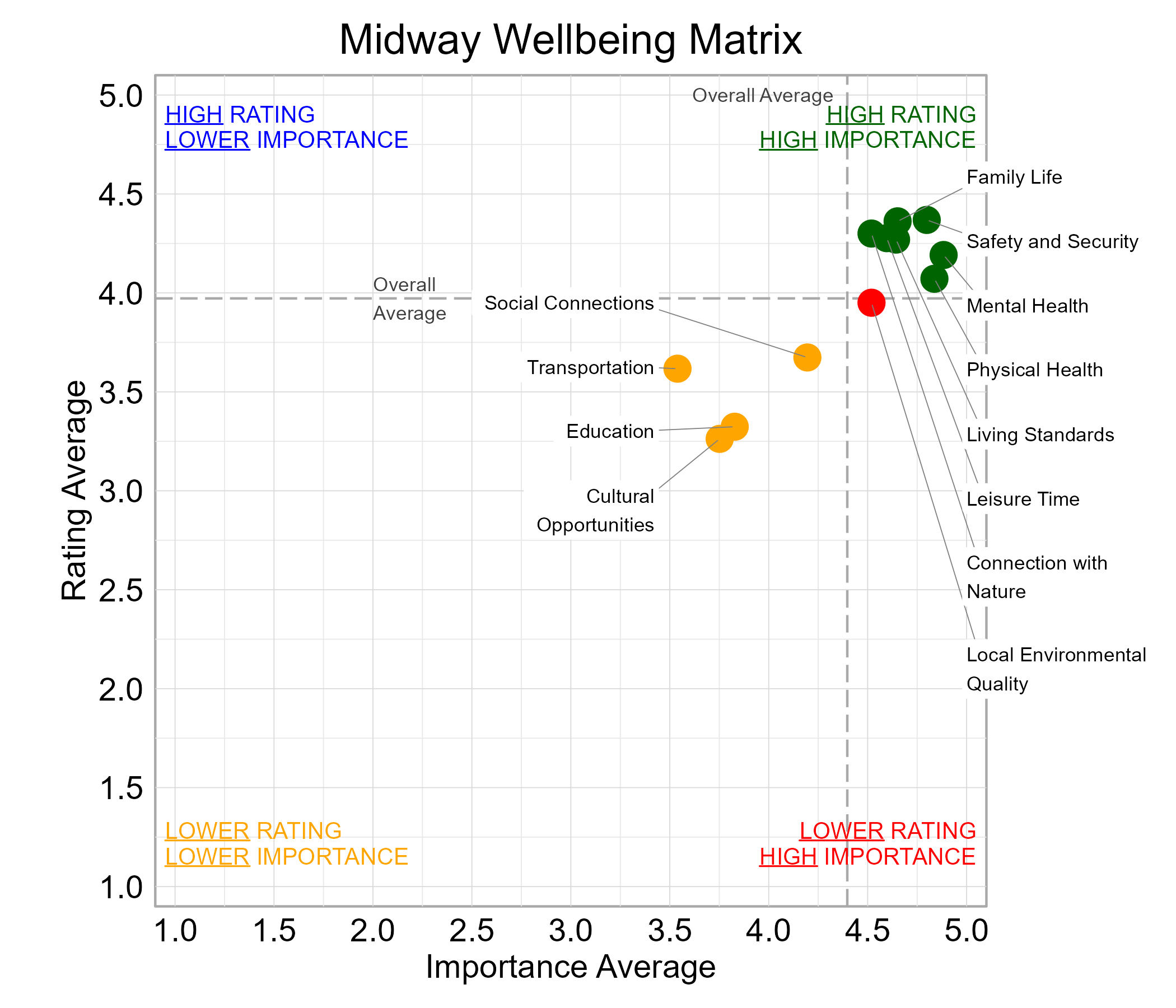
The graph below illustrates the relationship between the average rating and the average importance of wellbeing domains for survey respondents from Midway. Connection with Nature, Family Life, Leisure Time, Living Standards, Mental Health, Physical Health, and Safety and Security were highly important and rated above average among the domains. Local Environmental Quality fell in the “red zone” of higher importance and lower ratings.
Community Connection in Midway
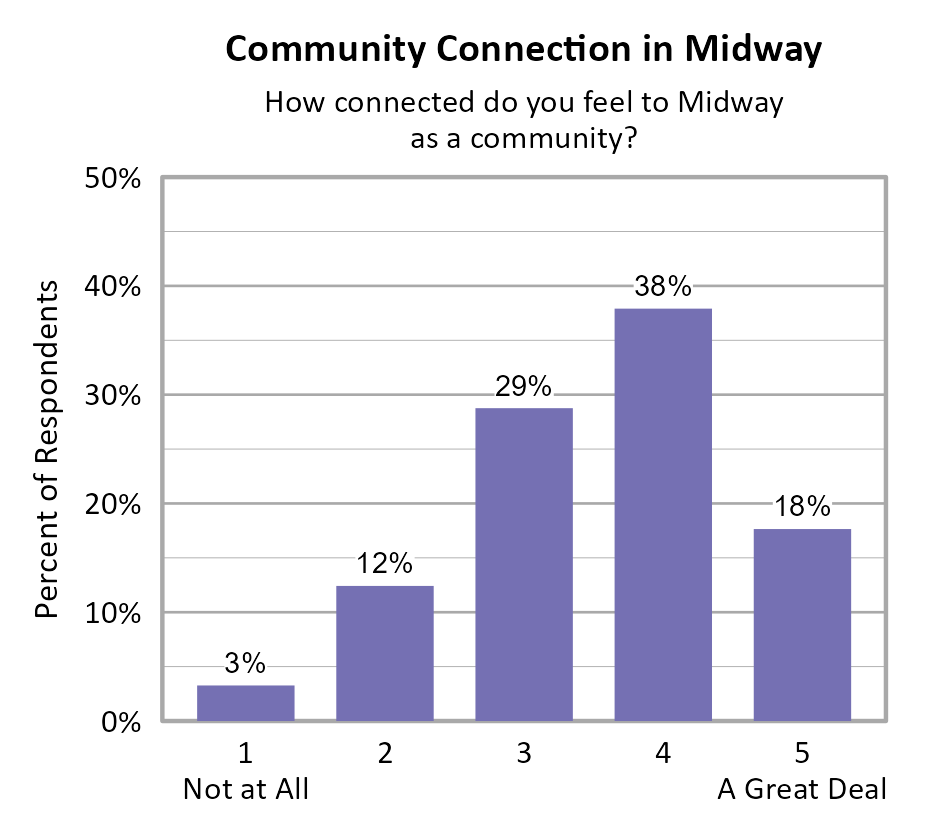
Survey participants were asked about how connected they feel to Midway on a 5-point scale from not at all (1) to a great deal (5), and the average score of all respondents was 3.54.
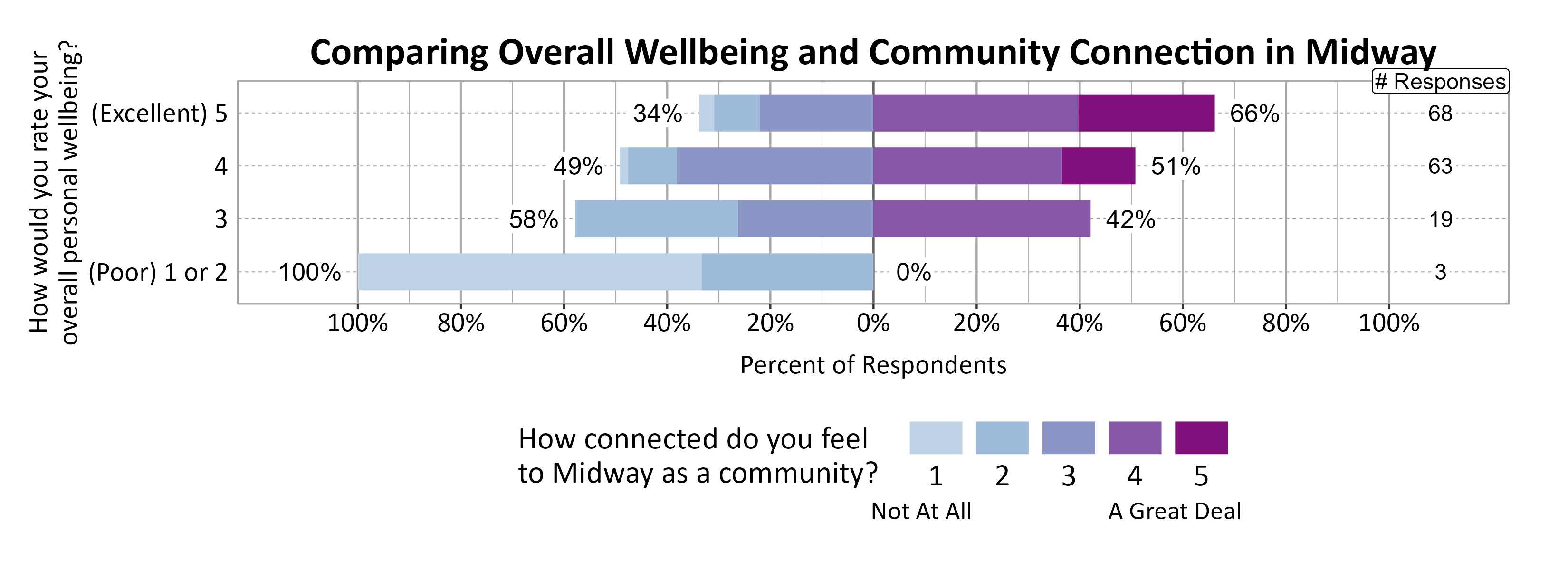
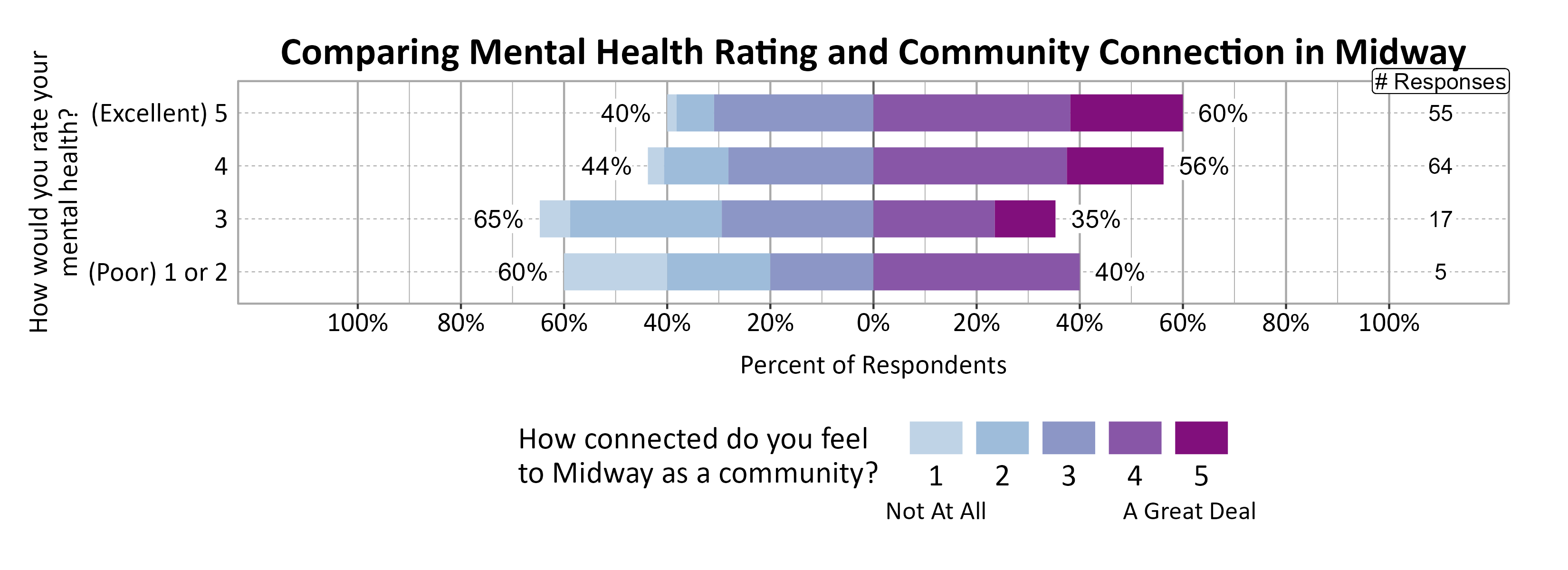
A positive relationship was found between individuals’ community connection and overall personal wellbeing, but to a lesser degree between community connection and mental health.
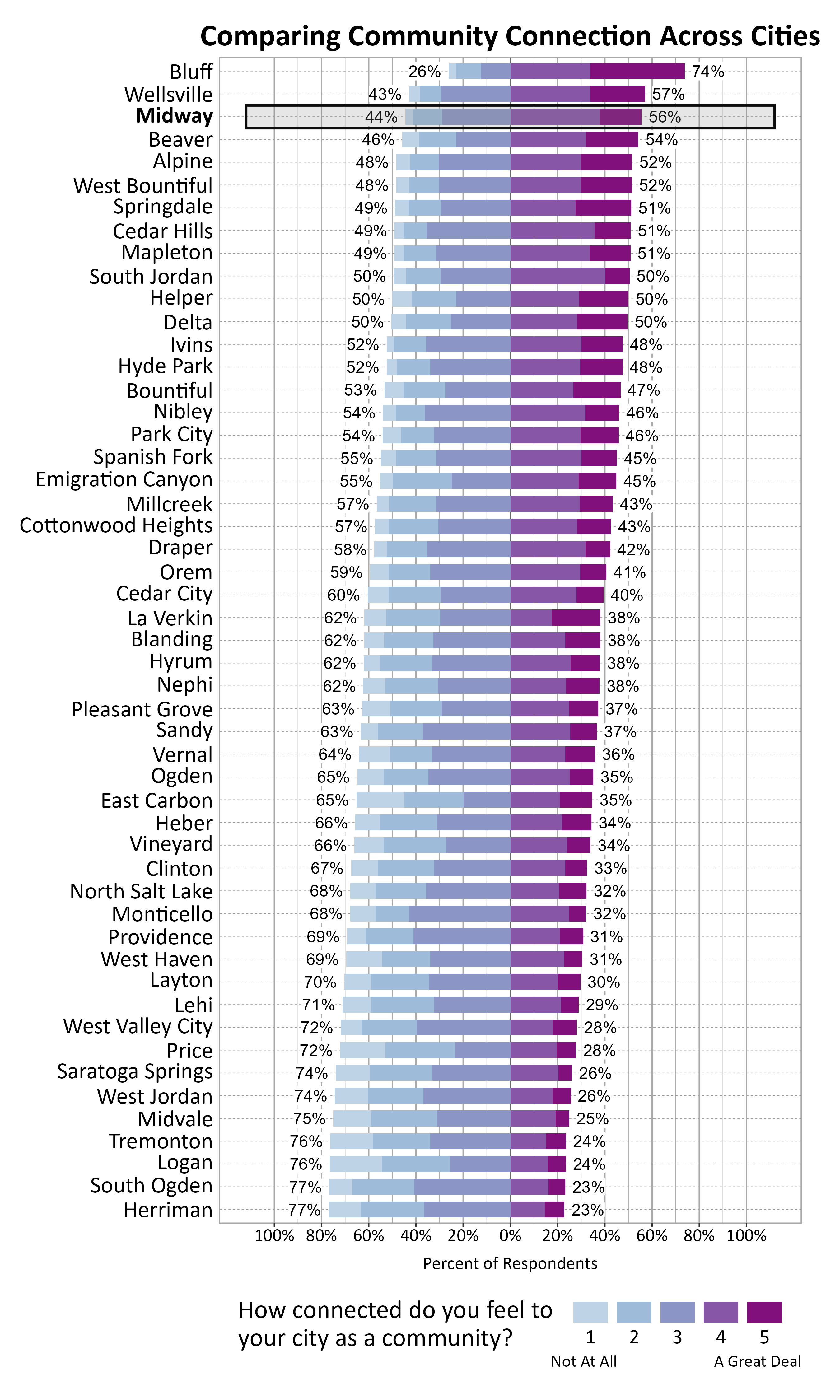
The graph below shows how Wellbeing Project cities and towns compare on feelings of community connection based on the percentage of respondents who answered 4 or a 5 on a 5-point scale from “not at all” to “a great deal” connected to their city or town. Midway ranked 3 out of the 51 cities that participated.
Participation in Recreation and Nature-Related Activities
Respondents were asked to indicate whether or not they participated in various activities in the last 12 months. The most popular activities were walking or biking in your neighborhood or city (98%), using trails in or near your city (91%), and community events (86%).
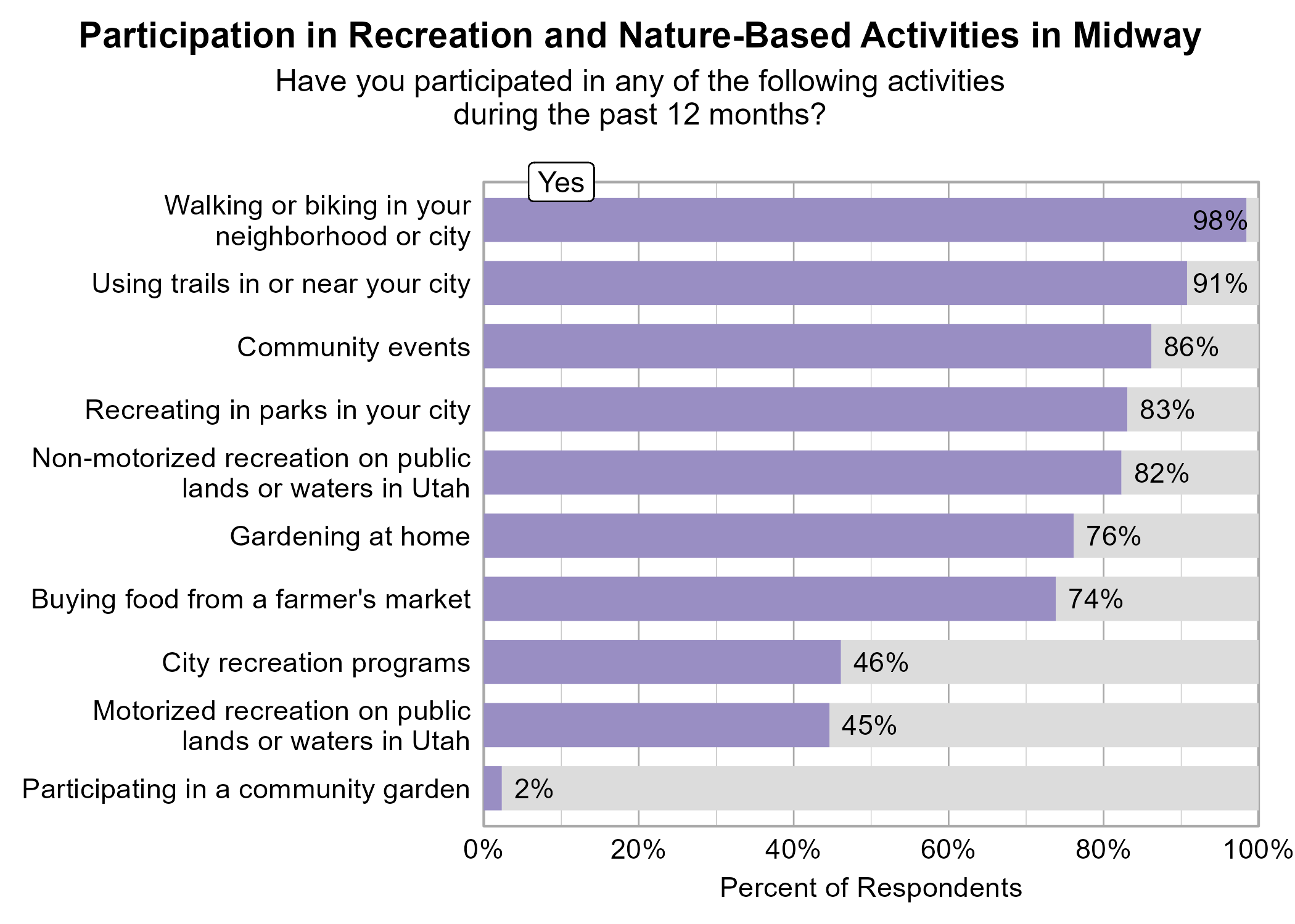
None of the recreation activities above were significantly related to higher ratings of personal wellbeing and community wellbeing. This is likely due to the very high numbers of respondents who participate in most of these activities.
Participation in city recreation programs was significantly related to higher ratings of community connection.
Perspectives on Population Growth and Economic Development
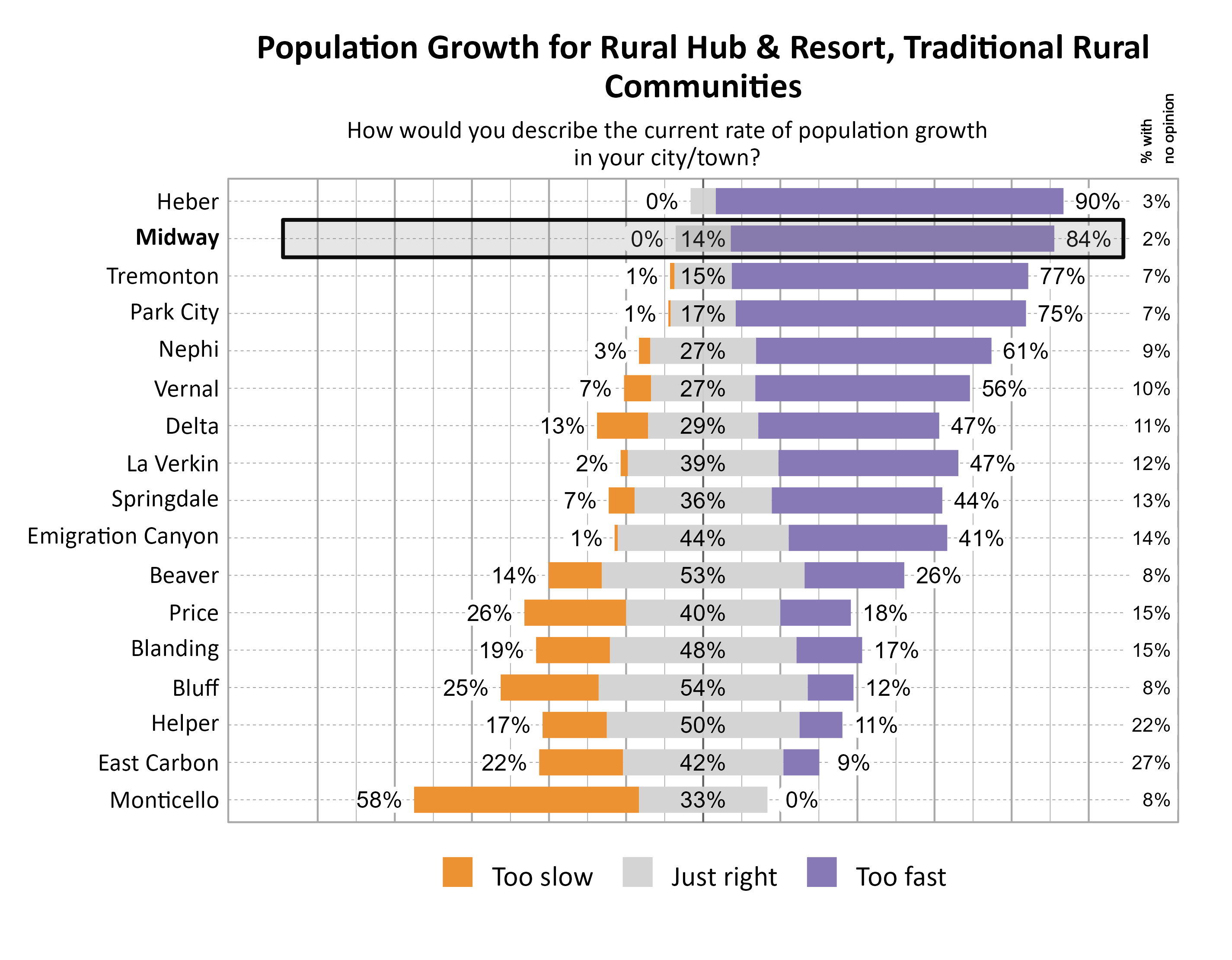
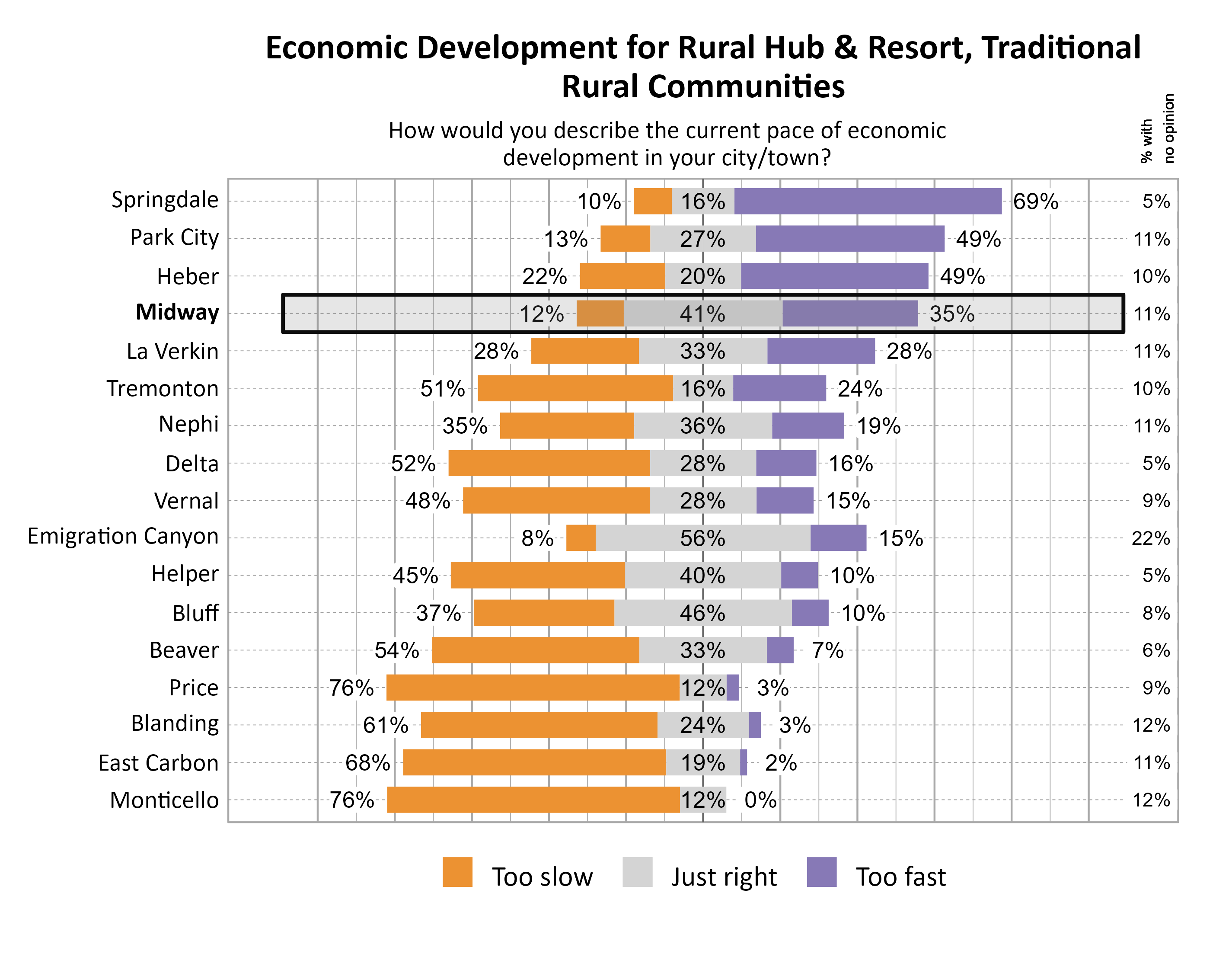
The majority of respondents in Midway indicated that they felt the population growth was too fast (84%). For the pace of economic development, respondents were split between opinions that it was just right (41%) and too fast (35%).


The graphs below show perceptions of population growth and economic development for Midway compared to other participating cities and towns in the Rural cluster.
The graph below illustrates how many respondents perceived the pace of economic development as too slow, just right, too fast, or had no opinion, with additional breakdowns for the number of respondents who provided comments.
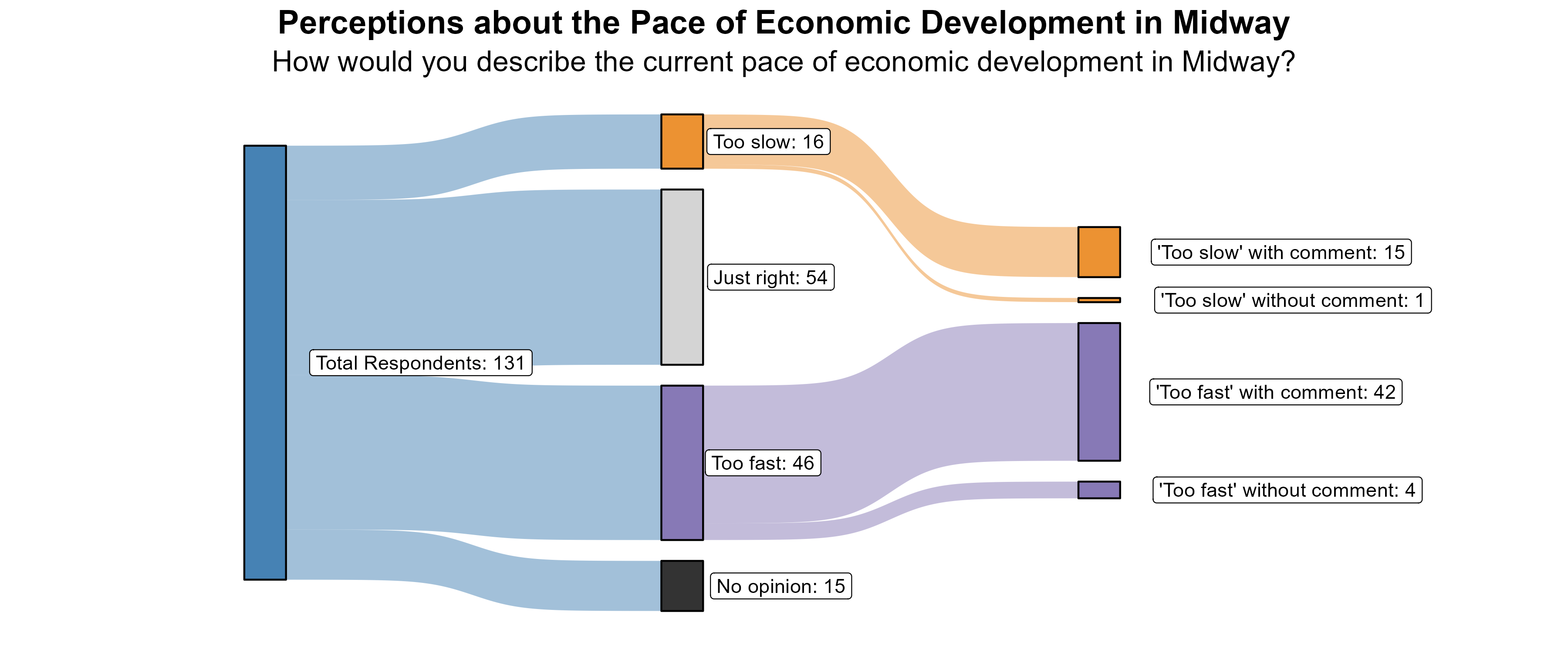
The 12% of respondents who rated the pace of economic growth as “too slow” were further asked what aspects of the local economy they would like to see more of in Midway. Almost all comments revolved around wanting more shops, restaurants, and things to do.
Additionally, the 35% of respondents who rated the pace of economic growth as “too fast” were further asked what aspects of the local economy they feel are growing too quickly in Midway. Respondents commonly expressed feeling that development is happening too fast, particularly housing. Many said they feel the pace of development contributes to traffic, crowding, loss of open space, and a loss of small town feel.
Transportation in Midway
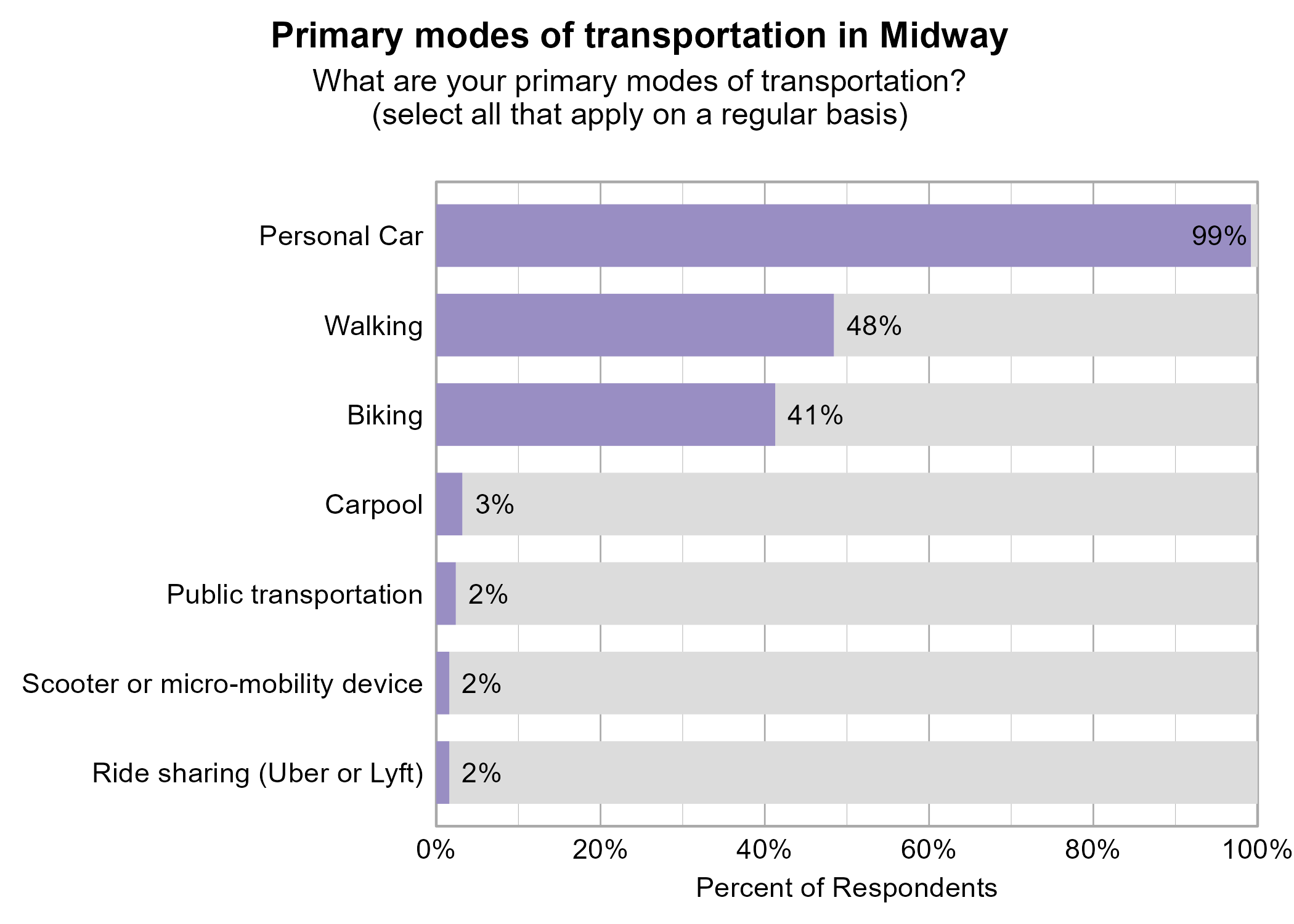
Respondents were asked to indicate all of their primary modes of transportation on a regular basis in Midway. The most popular modes of transportation were personal car (99%) and walking (48%).
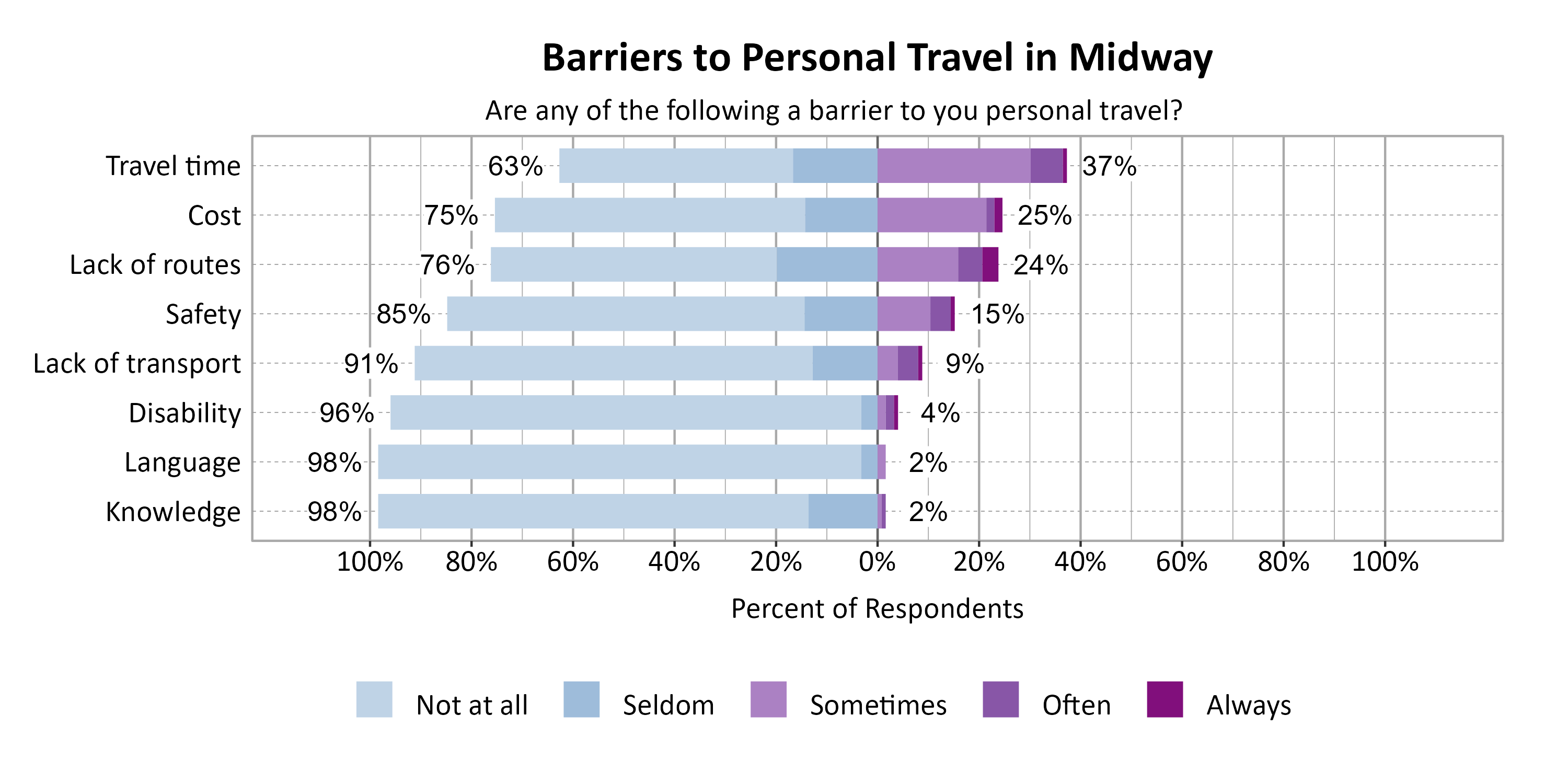
Respondents were asked to indicate the most common barriers to transportation in Midway. The most problematic barriers were Travel time (37%), Cost (25%), and Lack of routes (24%).
Respondents were asked to indicate the importance of a set of possible transportation developments in Midway. The most important development to respondents were More trails (71%), Improving walkability (62%), and Enhancing safety (53%).

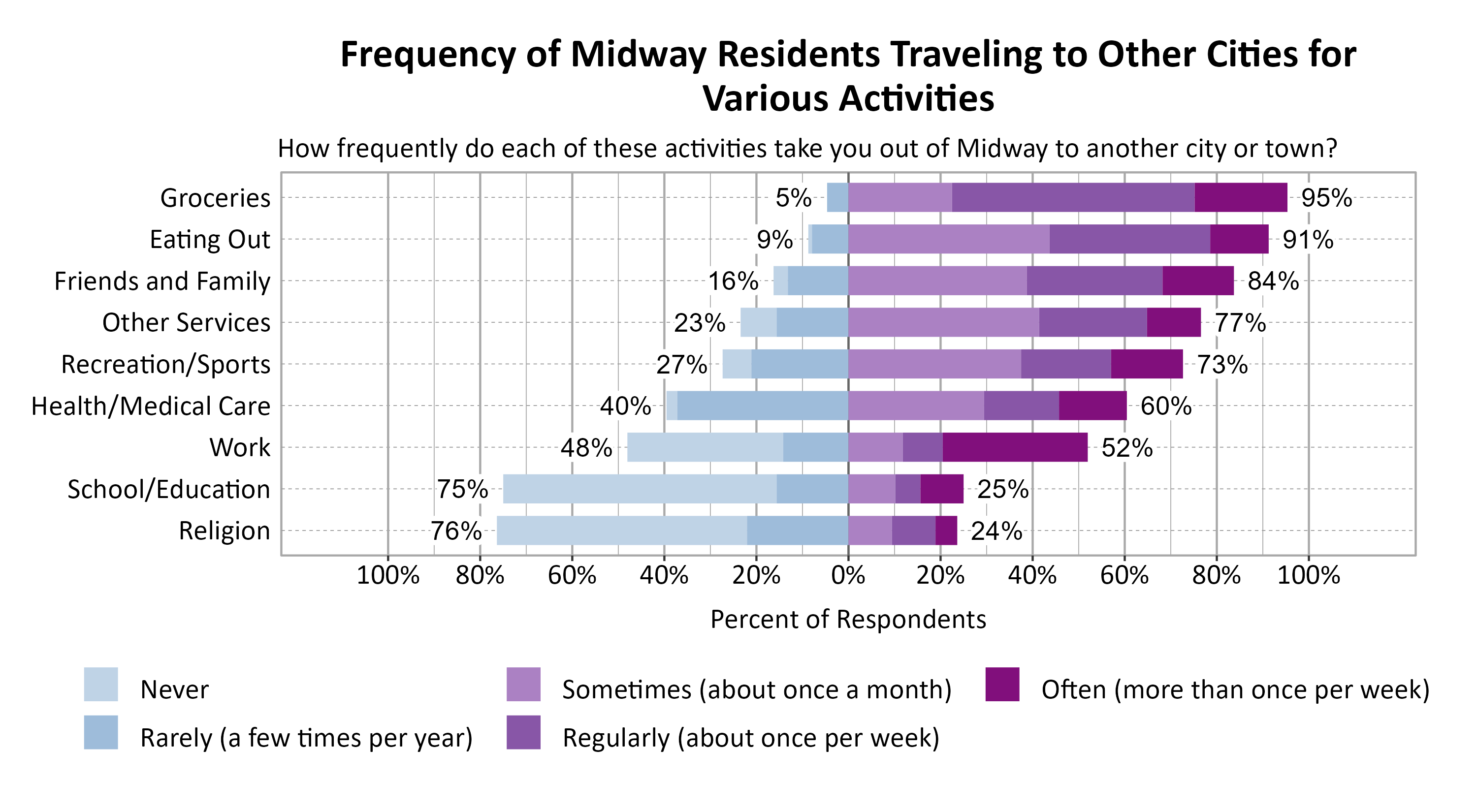
Respondents were asked to indicate how frequently various activities take them out of Midway to another city or town. The most commonly indicated reasons for traveling to another city or town at least sometimes or once a month were Groceries (95%), Eating Out (91%), and Friends and Family (84%).
Concerns in Midway
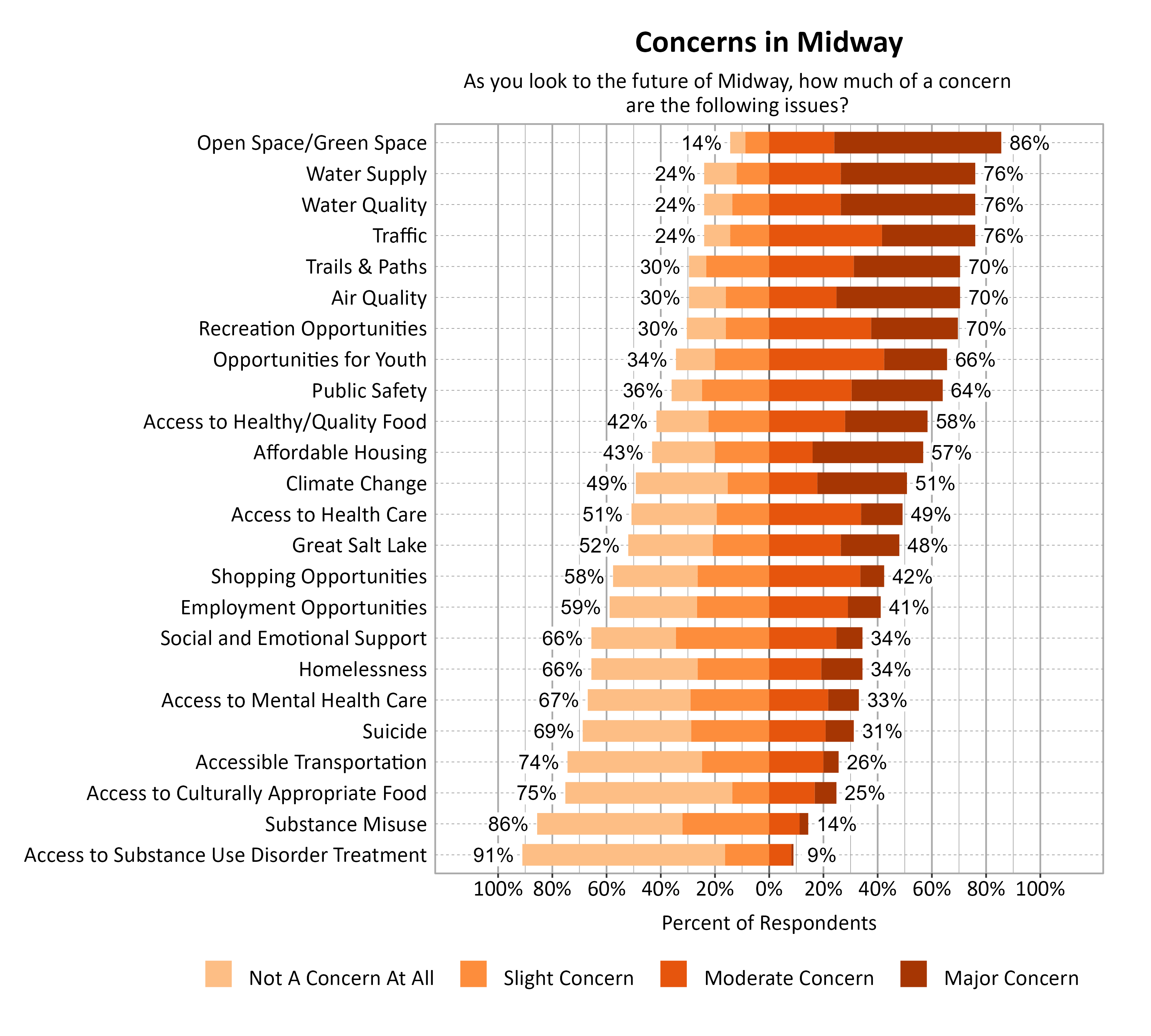
Survey respondents indicated the degree to which a number of possible local issues were a concern as they look to the future of Midway. Open Space/Green Space (86%), Traffic (76%), Water Quality (76%), and Water Supply (76%) were the top concerns.
Open Comments
All open comments collected in the survey were shared with city leaders. General observations and themes are shared here.
What Respondents Value Most in Midway
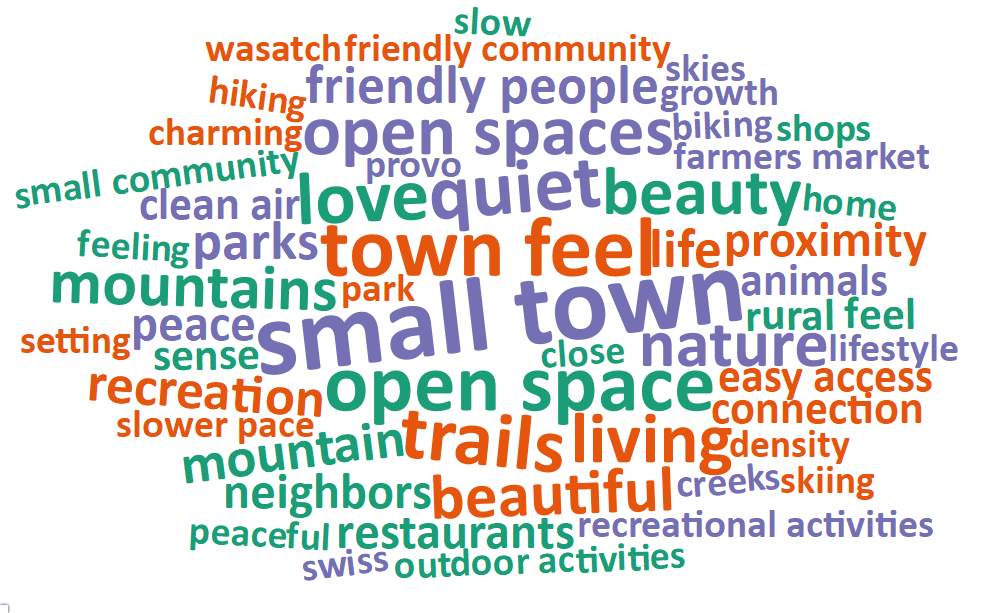
Survey respondents were asked to comment on what they value most about Midway. The most common words and phrases from all city comments are included in the word cloud below. It is possible that negative or unrelated words may appear since these words have been taken out of context, and they may not indicate the respondent’s intended meaning. The majority of comments expressed their appreciation of the small-town agricultural feel of the town as well as the beautiful scenery and environment. There are also many comments of praise about Midway’s social climate and open spaces.
Local Environmental Quality in Midway
The 28% of respondents who rated the Local Environmental Quality domain as 1, 2, or 3 (Poor, Fair, or Moderate) were further asked if there are specific aspects of local environmental quality that they feel are problematic. Sewer treatment and water quality management were major concerns in Midway comments. The sewer ponds were said to contribute to poor air quality, water quality, and some residents mentioned that think this correlates with health issues arising in the area. Another notable concern was the lack of open space or green space in the area, due to growth and increased traffic. Overall, the smell from sewer ponds was the greatest environmental concern mentioned.
Improving Wellbeing in Midway
Survey respondents were asked if there is anything that could be done to improve wellbeing in Midway. Many comments expressed concerns with regards to growth and development in Midway with many correlating it with traffic and developers who do not have their interests at heart. Road maintenance, speed limits, and a lack of police patrols were also a common theme among the issues with transportation as well.
Additional Comments
Respondents were also asked if they had any additional comments on wellbeing in Midway. Many people were critical of Midway’s rapid growth and development, low pay and high prices, and transit as a whole. A sizable number of comments about development mentioned the possibility of losing the small-town feel. Many comments suggest prices are too high. Comments also indicated that some do not feel heard by their leaders.