Salt Lake County Wellbeing Survey Report

By Dr. Courtney Flint and Team

utah wellbeing survey logo

Contact Information

Summary

The Utah Wellbeing Survey project is designed to assess the wellbeing and local perspectives of city residents and to provide information to city leaders to inform their general planning processes. Over the years, we have found that each city and town has a unique experience and the Utah Wellbeing Survey allows for focused analysis at the community level. Survey questions include rating and importance of twelve different domains or categories of wellbeing, participation in recreation and nature-related activities, perspectives on local population growth and economic development, transportation perspectives, concerns for the future, and an array of demographic characteristic questions. Some cities added additional questions to their survey.

In early 2024, participating cities in Salt Lake County advertised the survey via social media, email lists, newsletters, and other ways of reaching out to local residents. All city residents age 18+ were encouraged to take the online Qualtrics survey.

What is in this report?

This report summarizes findings from the 2024 survey from ten cities in Salt Lake County (Cottonwood Heights, Draper, Emigration Canyon, Herriman, Midvale, Millcreek, Sandy, South Jordan, West Jordan, and West Valley City). Please see the individual city reports on the Utah Wellbeing Project website for more details. This information may help cities and other regional entities refine their messaging with residents on key issues, affirm existing plans, support future planning, and have practical implications for spending and providing services.

Utah League of Cities and Towns Cluster Classifications and Response Numbers

From Salt Lake County, 3,251 viable surveys were recorded in this 2024 survey effort. It should be noted that responses for Midvale were particularly low and caution should be taken when interpreting these results. 

This project benefits from the partnership with, and funding from, the Utah League of Cities and Towns, which is helping cities envision ways to use the findings from the wellbeing survey to inform their general planning processes. The Utah League of Cities and Towns clusters cities and towns into five different categories based on size and growth rates. We utilize these clusters in our analysis and have combined Rural Hub & Resort communities with Traditional Rural Communities. Some cities may fit within more than one cluster. The Salt Lake County cities with their cluster classification and number of responses are listed below:

Cities of the 1st & 2nd Class


Millcreek (291)
Sandy (955)
South Jordan (206)
West Jordan (309)
West Valley City (149)

Established/Mid-sized Cities


Cottonwood Heights (347)
Draper (650)
Midvale (68)

Rapid Growth Cities


Herriman (131)

Rural Hub & Resort, Traditional Rural Communities


Emigration Canyon (145)

Overall Personal Wellbeing and Community Wellbeing

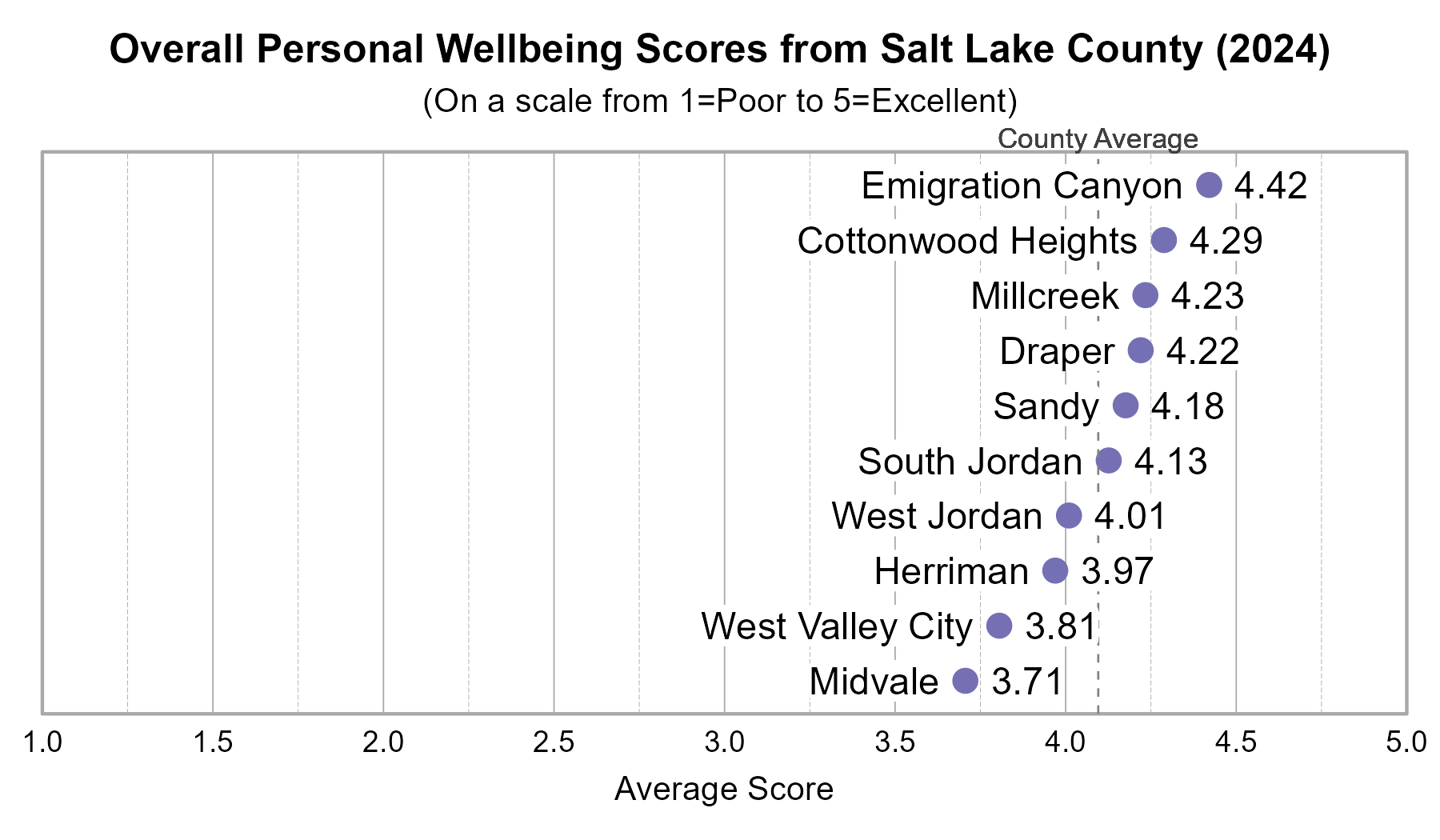
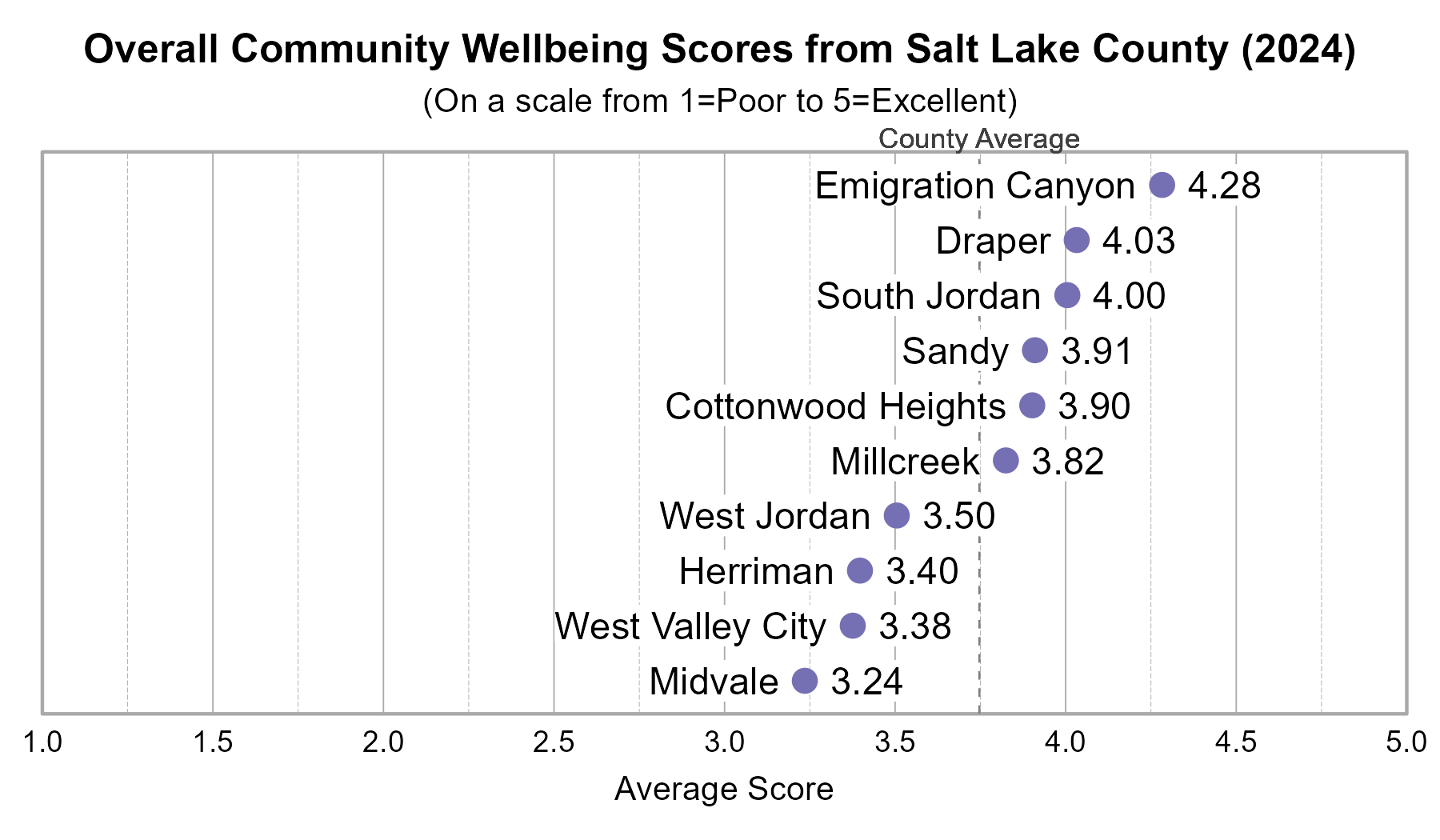
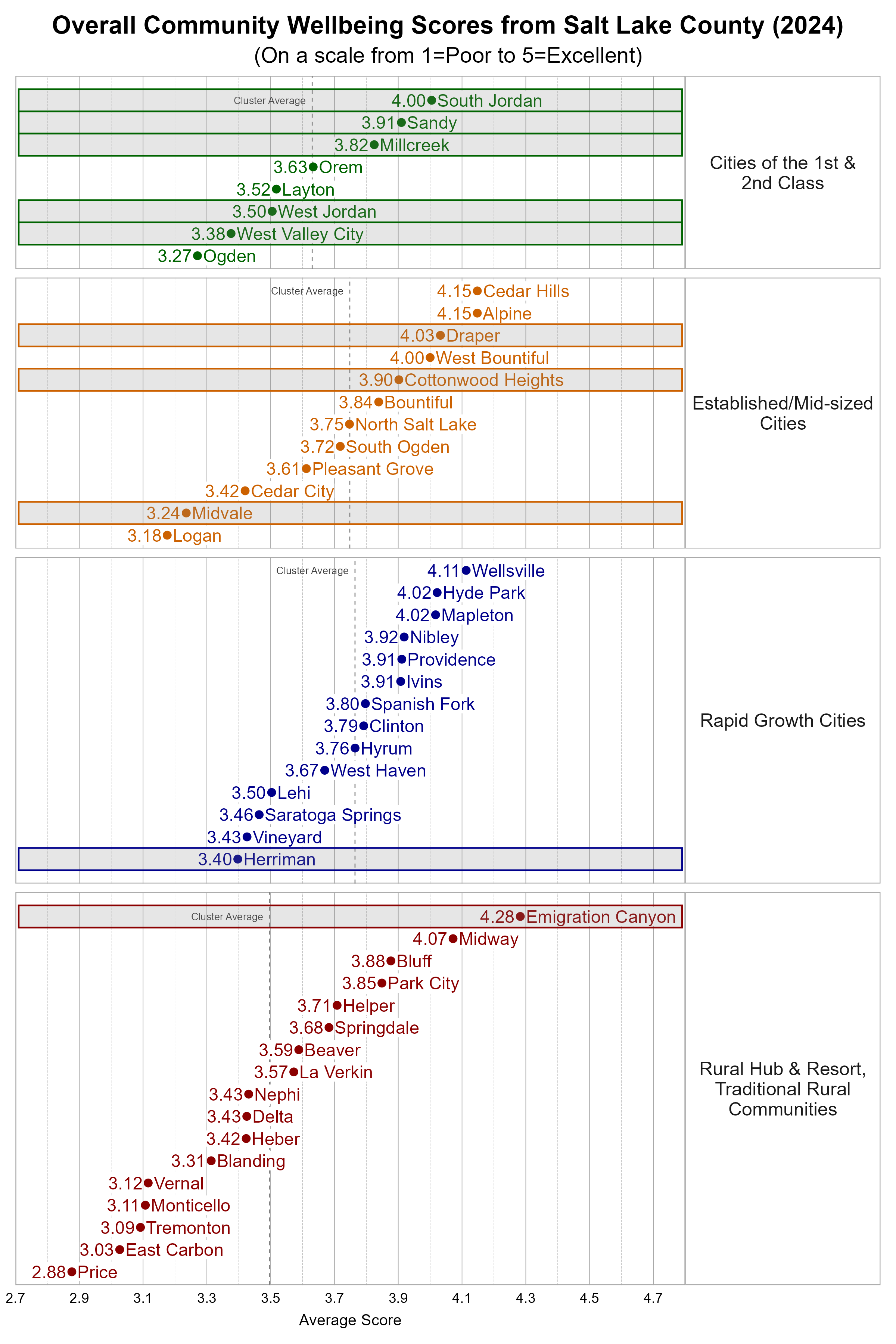
Survey participants were asked about their overall personal wellbeing and overall community wellbeing in their respective cities or towns. The Salt Lake County cities are highlighted in the graph below. wellbeing indicators were both measured on a 5-point scale from poor (1) to excellent (5). The average of the city average personal wellbeing scores in Salt Lake County was 4.10 with 83% of respondents indicating their wellbeing at a 4 or 5 on the 5-point scale. The average of the city average scores for community wellbeing in Salt Lake County was 3.75 with 70% of respondents indicating community wellbeing at a 4 or 5 on the 5-point scale. As the graphs below show, scores vary across the ten participating cities.
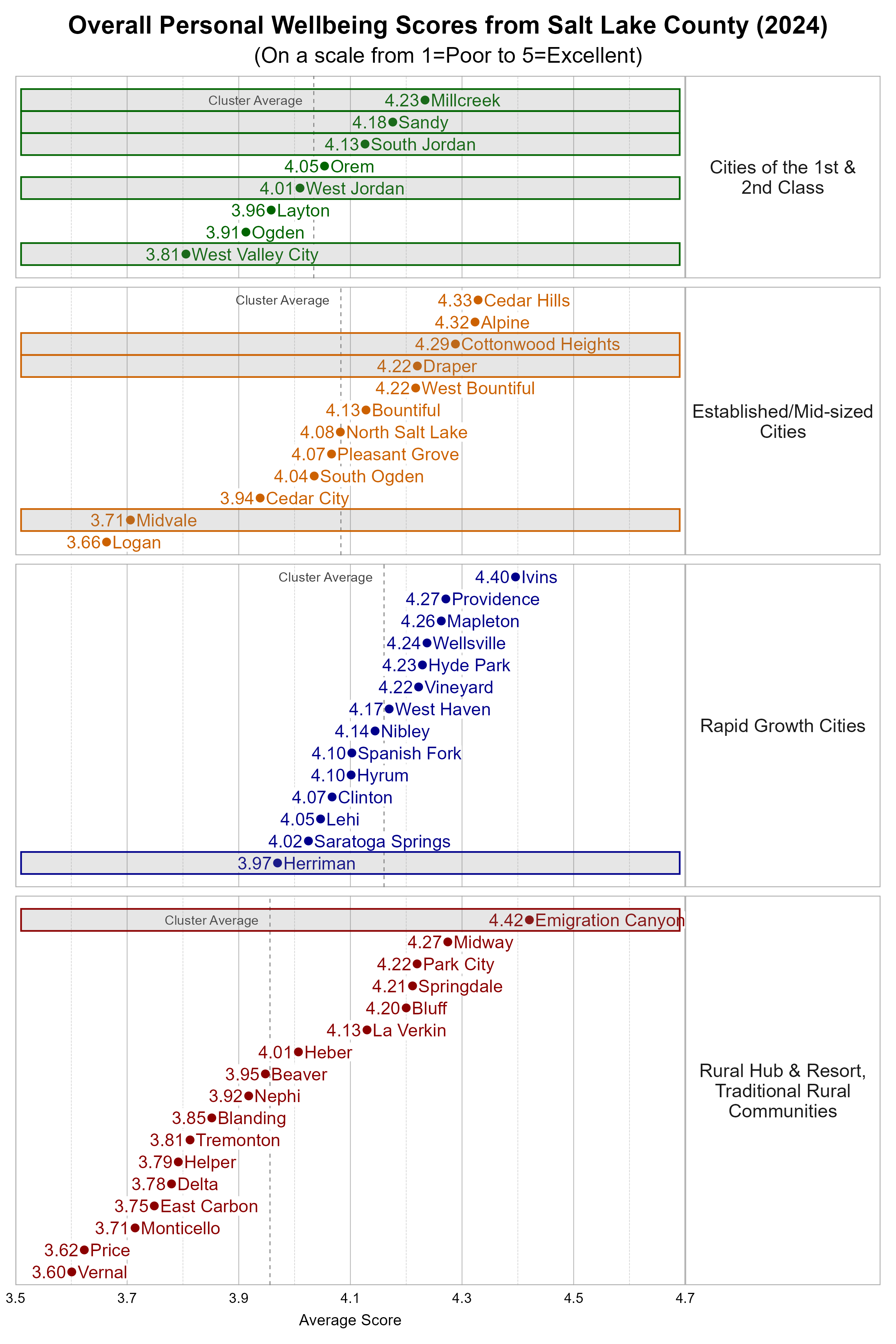
 Dot Plot. Title: Overall Personal Wellbeing Scores from Participating Utah Cities (2024). Subtitle: (On a scale from 1=Poor to 5=Excellent). Data — Group: Cities of the 1st & 2nd Class — West Valley City Average Score 3.81; Ogden Average Score 3.91; Layton Average Score 3.96; West Jordan Average Score 4.01; Orem Average Score 4.05; South Jordan Average Score 4.13; Sandy Average Score 4.18; Millcreek Average Score 4.23; Group: Established/Mid-sized Cities — Logan Average Score 3.66; Midvale Average Score 3.71; Cedar City Average Score 3.94; South Ogden Average Score 4.04; Pleasant Grove Average Score 4.07; North Salt Lake Average Score 4.08; Bountiful Average Score 4.13; Draper Average Score 4.22; West Bountiful Average Score 4.22; Cottonwood Heights Average Score 4.29; Alpine Average Score 4.32; Cedar Hills Average Score 4.33; Group: Rapid Growth Cities — Herriman Average Score 3.97; Saratoga Springs Average Score 4.02; Lehi Average Score 4.05; Clinton Average Score 4.07; Hyrum Average Score 4.10; Spanish Fork Average Score 4.10; Nibley Average Score 4.14; West Haven Average Score 4.17; Vineyard Average Score 4.22; Hyde Park Average Score 4.23; Wellsville Average Score 4.24; Mapleton Average Score 4.26; Providence Average Score 4.27; Ivins Average Score 4.40; Group: Rural Hub & Resort, Traditional Rural Communities — Vernal Average Score 3.60; Price Average Score 3.62; Monticello Average Score 3.71; East Carbon Average Score 3.75; Delta Average Score 3.78; Helper Average Score 3.79; Tremonton Average Score 3.81; Blanding Average Score 3.85; Nephi Average Score 3.92; Beaver Average Score 3.95; Heber Average Score 4.01; La Verkin Average Score 4.13; Bluff Average Score 4.20; Springdale Average Score 4.21; Park City Average Score 4.22; Midway Average Score 4.27; Emigration Canyon Average Score 4.42

 Dot Plot. Title: Overall Community Wellbeing Scores from Participating Utah Cities (2024). Subtitle: (On a scale from 1=Poor to 5=Excellent). Data — Group: Cities of the 1st & 2nd Class — Ogden Average Score 3.27; West Valley City Average Score 3.38; West Jordan Average Score 3.50; Layton Average Score 3.52; Orem Average Score 3.63; Millcreek Average Score 3.82; Sandy Average Score 3.91; South Jordan Average Score 4.00; Group: Established/Mid-sized Cities — Logan Average Score 3.18; Midvale Average Score 3.24; Cedar City Average Score 3.42; Pleasant Grove Average Score 3.61; South Ogden Average Score 3.72; North Salt Lake Average Score 3.75; Bountiful Average Score 3.84; Cottonwood Heights Average Score 3.90; West Bountiful Average Score 4.00; Draper Average Score 4.03; Alpine Average Score 4.15; Cedar Hills Average Score 4.15; Group: Rapid Growth Cities — Herriman Average Score 3.40; Vineyard Average Score 3.43; Saratoga Springs Average Score 3.46; Lehi Average Score 3.50; West Haven Average Score 3.67; Hyrum Average Score 3.76; Clinton Average Score 3.79; Spanish Fork Average Score 3.80; Ivins Average Score 3.91; Providence Average Score 3.91; Nibley Average Score 3.92; Hyde Park Average Score 4.02; Mapleton Average Score 4.02; Wellsville Average Score 4.11; Group: Rural Hub & Resort, Traditional Rural Communities — Price Average Score 2.88; East Carbon Average Score 3.03; Tremonton Average Score 3.09; Monticello Average Score 3.11; Vernal Average Score 3.12; Blanding Average Score 3.31; Heber Average Score 3.42; Delta Average Score 3.43; Nephi Average Score 3.43; La Verkin Average Score 3.57; Beaver Average Score 3.59; Springdale Average Score 3.68; Helper Average Score 3.71; Park City Average Score 3.85; Bluff Average Score 3.88; Midway Average Score 4.07; Emigration Canyon Average Score 4.28

Dot Plot. Title: Overall Personal Wellbeing Scores from Salt Lake County (2024). Subtitle: (On a scale from 1=Poor to 5=Excellent) Data — Emigration Canyon: 4.42; Cottonwood Heights: 4.29; Millcreek: 4.23; Draper: 4.22; Sandy: 4.18; South Jordan: 4.13; West Jordan: 4.01; Herriman: 3.97; West Valley City: 3.81; Midvale: 3.71

Dot Plot. Title: Overall Community Wellbeing Scores from Salt Lake County (2024). Subtitle: (On a scale from 1=Poor to 5=Excellent) Data — Emigration Canyon: 4.28; Draper: 4.03; South Jordan: 4.00; Sandy: 3.91; Cottonwood Heights: 3.90; Millcreek: 3.82; West Jordan: 3.50; Herriman: 3.40; West Valley City: 3.38; Midvale: 3.24

Wellbeing Domains

According to national and international entities that track wellbeing, there are a number of common dimensions or domains of wellbeing. Survey respondents rated twelve domains on a 5-point scale from poor to excellent. They were also asked to indicate the importance of each domain to their overall personal wellbeing on a 5-point scale from not at all important to very important.

The highest rated wellbeing domains for the ten Salt Lake County study cities were:

  • Living Standards (all 10 cities)
  • Family Life (Cottonwood Heights, Draper, Herriman, Midvale, Millcreek, Sandy, South Jordan, West Jordan, West Valley City)
  • Mental Health (Cottonwood Heights, Midvale, Millcreek, Sandy, West Jordan, West Valley City)
  • Safety and Security (Draper, Emigration Canyon, Herriman, South Jordan)
  • Connection with Nature (Cottonwood Heights, Emigration Canyon)
  • Physical Health (Cottonwood Heights)

The most important wellbeing domains for the ten Salt Lake County study cities were:

  • Mental Health (all 10 cities)
  • Safety and Security (Cottonwood Heights, Draper, Herriman, Midvale, Millcreek, Sandy, South Jordan, West Jordan, West Valley City)
  • Physical Health (Cottonwood Heights, Draper, Emigration Canyon, Millcreek, Sandy, South Jordan)
  • Living Standards (Midvale, Millcreek, West Jordan, West Valley City)
  • Connection with Nature (Emigration Canyon)
  • Family Life (Herriman)

The “Red Zone” Domains (higher importance, lower quality) for the ten Salt Lake County study cities were:

  • Cottonwood Heights — Local Environmental Quality
  • Draper — Local Environmental Quality
  • Midvale — Local Environmental Quality, Safety and Security
  • Millcreek — Local Environmental Quality
  • Sandy — Local Environmental Quality
  • South Jordan — Local Environmental Quality, Physical Health
  • West Valley City — Local Environmental Quality, Safety and Security

Community Connection

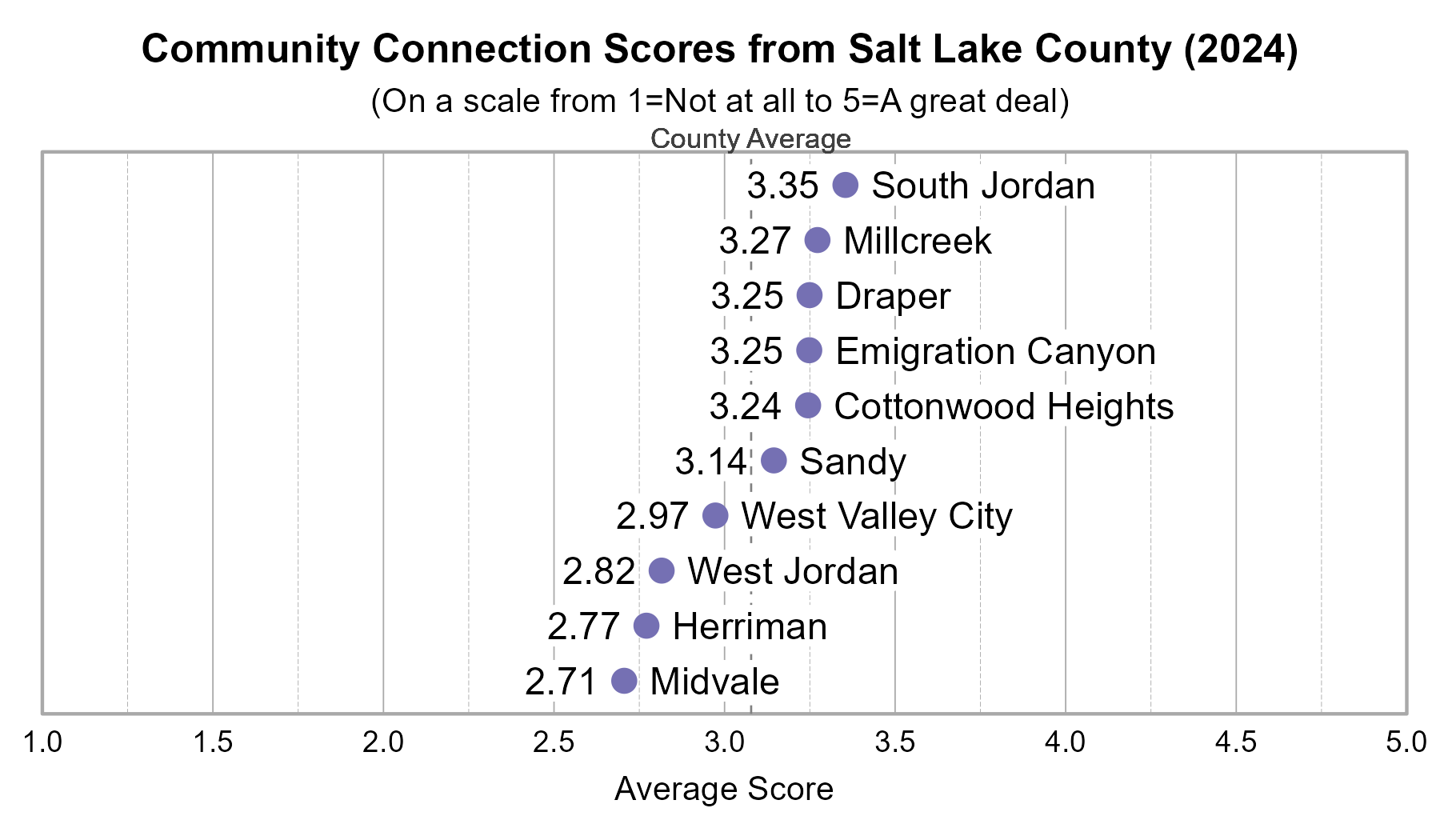
Survey participants were asked about how connected they feel to their city on a 5-point scale from not at all (1) to a great deal (5). Community Connection was highest for South Jordan and lowest for Midvale and Herriman.
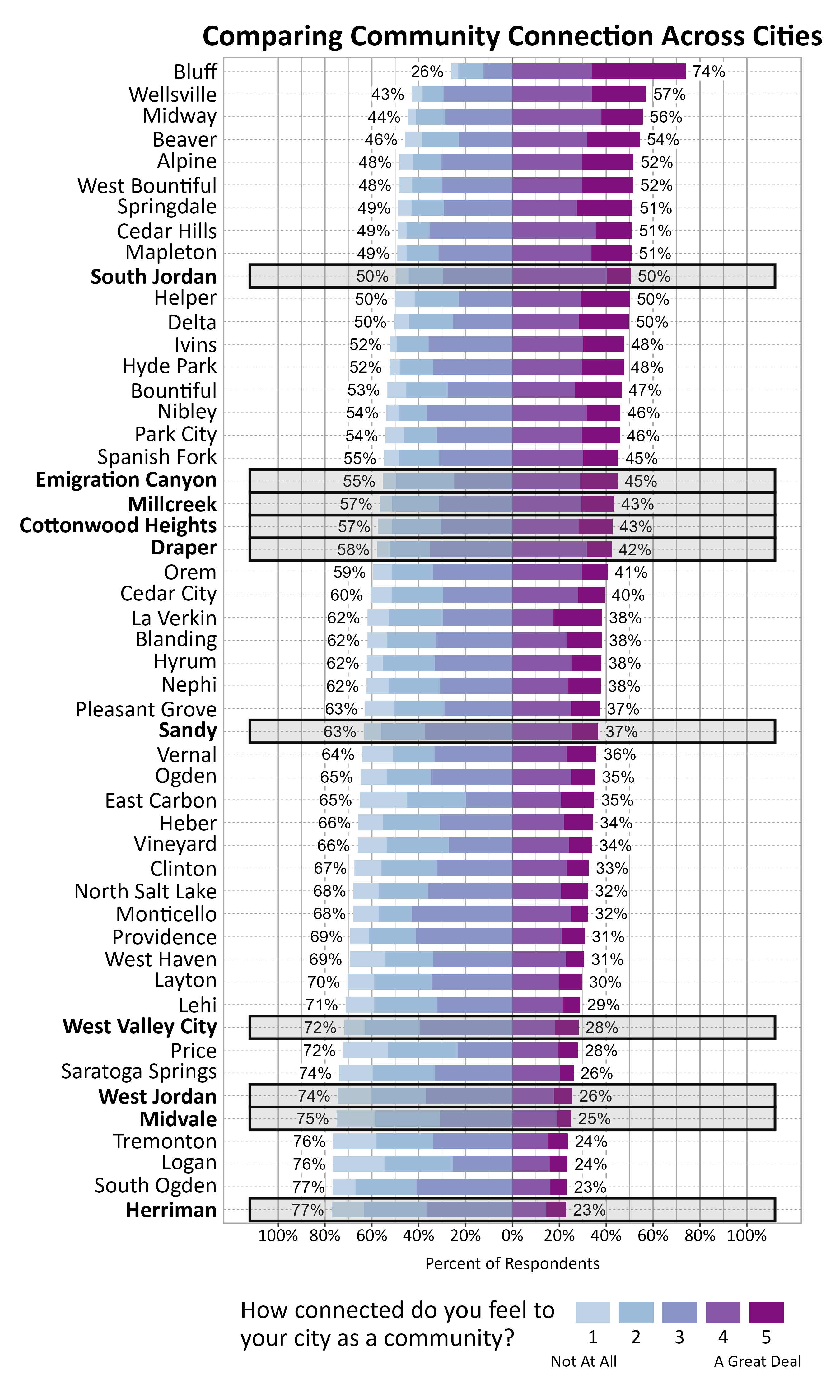
 Likert Graph. Title: Comparing Community Connection Across Cities. Subtitle: How connected do you feel to your city as a community? 1 being not at all and 5 being a great deal. Data — City: Bluff 26% of respondents indicated a community connection score of 1, 2, or 3 while 74% of respondents indicated a community connection score of 4 or 5; City: Wellsville 43% of respondents indicated a community connection score of 1, 2, or 3 while 57% of respondents indicated a community connection score of 4 or 5; City: Midway 44% of respondents indicated a community connection score of 1, 2, or 3 while 56% of respondents indicated a community connection score of 4 or 5; City: Beaver 46% of respondents indicated a community connection score of 1, 2, or 3 while 54% of respondents indicated a community connection score of 4 or 5; City: Alpine 48% of respondents indicated a community connection score of 1, 2, or 3 while 52% of respondents indicated a community connection score of 4 or 5; City: West Bountiful 48% of respondents indicated a community connection score of 1, 2, or 3 while 52% of respondents indicated a community connection score of 4 or 5; City: Springdale 49% of respondents indicated a community connection score of 1, 2, or 3 while 51% of respondents indicated a community connection score of 4 or 5; City: Cedar Hills 49% of respondents indicated a community connection score of 1, 2, or 3 while 51% of respondents indicated a community connection score of 4 or 5; City: Mapleton 49% of respondents indicated a community connection score of 1, 2, or 3 while 51% of respondents indicated a community connection score of 4 or 5; City: South Jordan 50% of respondents indicated a community connection score of 1, 2, or 3 while 50% of respondents indicated a community connection score of 4 or 5; City: Helper 50% of respondents indicated a community connection score of 1, 2, or 3 while 50% of respondents indicated a community connection score of 4 or 5; City: Delta 50% of respondents indicated a community connection score of 1, 2, or 3 while 50% of respondents indicated a community connection score of 4 or 5; City: Ivins 52% of respondents indicated a community connection score of 1, 2, or 3 while 48% of respondents indicated a community connection score of 4 or 5; City: Hyde Park 52% of respondents indicated a community connection score of 1, 2, or 3 while 48% of respondents indicated a community connection score of 4 or 5; City: Bountiful 53% of respondents indicated a community connection score of 1, 2, or 3 while 47% of respondents indicated a community connection score of 4 or 5; City: Nibley 54% of respondents indicated a community connection score of 1, 2, or 3 while 46% of respondents indicated a community connection score of 4 or 5; City: Park City 54% of respondents indicated a community connection score of 1, 2, or 3 while 46% of respondents indicated a community connection score of 4 or 5; City: Spanish Fork 55% of respondents indicated a community connection score of 1, 2, or 3 while 45% of respondents indicated a community connection score of 4 or 5; City: Emigration Canyon 55% of respondents indicated a community connection score of 1, 2, or 3 while 45% of respondents indicated a community connection score of 4 or 5; City: Millcreek 57% of respondents indicated a community connection score of 1, 2, or 3 while 43% of respondents indicated a community connection score of 4 or 5; City: Cottonwood Heights 57% of respondents indicated a community connection score of 1, 2, or 3 while 43% of respondents indicated a community connection score of 4 or 5; City: Draper 58% of respondents indicated a community connection score of 1, 2, or 3 while 42% of respondents indicated a community connection score of 4 or 5; City: Orem 59% of respondents indicated a community connection score of 1, 2, or 3 while 41% of respondents indicated a community connection score of 4 or 5; City: Cedar City 60% of respondents indicated a community connection score of 1, 2, or 3 while 40% of respondents indicated a community connection score of 4 or 5; City: La Verkin 62% of respondents indicated a community connection score of 1, 2, or 3 while 38% of respondents indicated a community connection score of 4 or 5; City: Blanding 62% of respondents indicated a community connection score of 1, 2, or 3 while 38% of respondents indicated a community connection score of 4 or 5; City: Hyrum 62% of respondents indicated a community connection score of 1, 2, or 3 while 38% of respondents indicated a community connection score of 4 or 5; City: Nephi 62% of respondents indicated a community connection score of 1, 2, or 3 while 38% of respondents indicated a community connection score of 4 or 5; City: Pleasant Grove 63% of respondents indicated a community connection score of 1, 2, or 3 while 37% of respondents indicated a community connection score of 4 or 5; City: Sandy 63% of respondents indicated a community connection score of 1, 2, or 3 while 37% of respondents indicated a community connection score of 4 or 5; City: Vernal 64% of respondents indicated a community connection score of 1, 2, or 3 while 36% of respondents indicated a community connection score of 4 or 5; City: Ogden 65% of respondents indicated a community connection score of 1, 2, or 3 while 35% of respondents indicated a community connection score of 4 or 5; City: East Carbon 65% of respondents indicated a community connection score of 1, 2, or 3 while 35% of respondents indicated a community connection score of 4 or 5; City: Heber 66% of respondents indicated a community connection score of 1, 2, or 3 while 34% of respondents indicated a community connection score of 4 or 5; City: Vineyard 66% of respondents indicated a community connection score of 1, 2, or 3 while 34% of respondents indicated a community connection score of 4 or 5; City: Clinton 67% of respondents indicated a community connection score of 1, 2, or 3 while 33% of respondents indicated a community connection score of 4 or 5; City: North Salt Lake 68% of respondents indicated a community connection score of 1, 2, or 3 while 32% of respondents indicated a community connection score of 4 or 5; City: Monticello 68% of respondents indicated a community connection score of 1, 2, or 3 while 32% of respondents indicated a community connection score of 4 or 5; City: Providence 69% of respondents indicated a community connection score of 1, 2, or 3 while 31% of respondents indicated a community connection score of 4 or 5; City: West Haven 69% of respondents indicated a community connection score of 1, 2, or 3 while 31% of respondents indicated a community connection score of 4 or 5; City: Layton 70% of respondents indicated a community connection score of 1, 2, or 3 while 30% of respondents indicated a community connection score of 4 or 5; City: Lehi 71% of respondents indicated a community connection score of 1, 2, or 3 while 29% of respondents indicated a community connection score of 4 or 5; City: West Valley City 72% of respondents indicated a community connection score of 1, 2, or 3 while 28% of respondents indicated a community connection score of 4 or 5; City: Price 72% of respondents indicated a community connection score of 1, 2, or 3 while 28% of respondents indicated a community connection score of 4 or 5; City: Saratoga Springs 74% of respondents indicated a community connection score of 1, 2, or 3 while 26% of respondents indicated a community connection score of 4 or 5; City: West Jordan 74% of respondents indicated a community connection score of 1, 2, or 3 while 26% of respondents indicated a community connection score of 4 or 5; City: Midvale 75% of respondents indicated a community connection score of 1, 2, or 3 while 25% of respondents indicated a community connection score of 4 or 5; City: Tremonton 76% of respondents indicated a community connection score of 1, 2, or 3 while 24% of respondents indicated a community connection score of 4 or 5; City: Logan 76% of respondents indicated a community connection score of 1, 2, or 3 while 24% of respondents indicated a community connection score of 4 or 5; City: South Ogden 77% of respondents indicated a community connection score of 1, 2, or 3 while 23% of respondents indicated a community connection score of 4 or 5; City: Herriman 77% of respondents indicated a community connection score of 1, 2, or 3 while 23% of respondents indicated a community connection score of 4 or 5

Dot Plot. Title: Community Connetion Scores from Salt Lake County (2024). Subtitle: (On a scale from 1=Not at all to 5=A great deal) Data — South Jordan: 3.35; Millcreek: 3.27; Draper: 3.25; Emigration Canyon: 3.25; Cottonwood Heights: 3.24; Sandy: 3.14; West Valley City: 2.97; West Jordan: 2.82; Herriman: 2.77; Midvale: 2.71

Participation in Recreation and Nature-Related Activities

Respondents were asked to indicate whether or not they participated in various activities in the last 12 months. The most popular activities in Salt Lake County were walking or biking in your neighborhood or city (94%), gardening at home (84%), and recreating in parks in your city (83%).
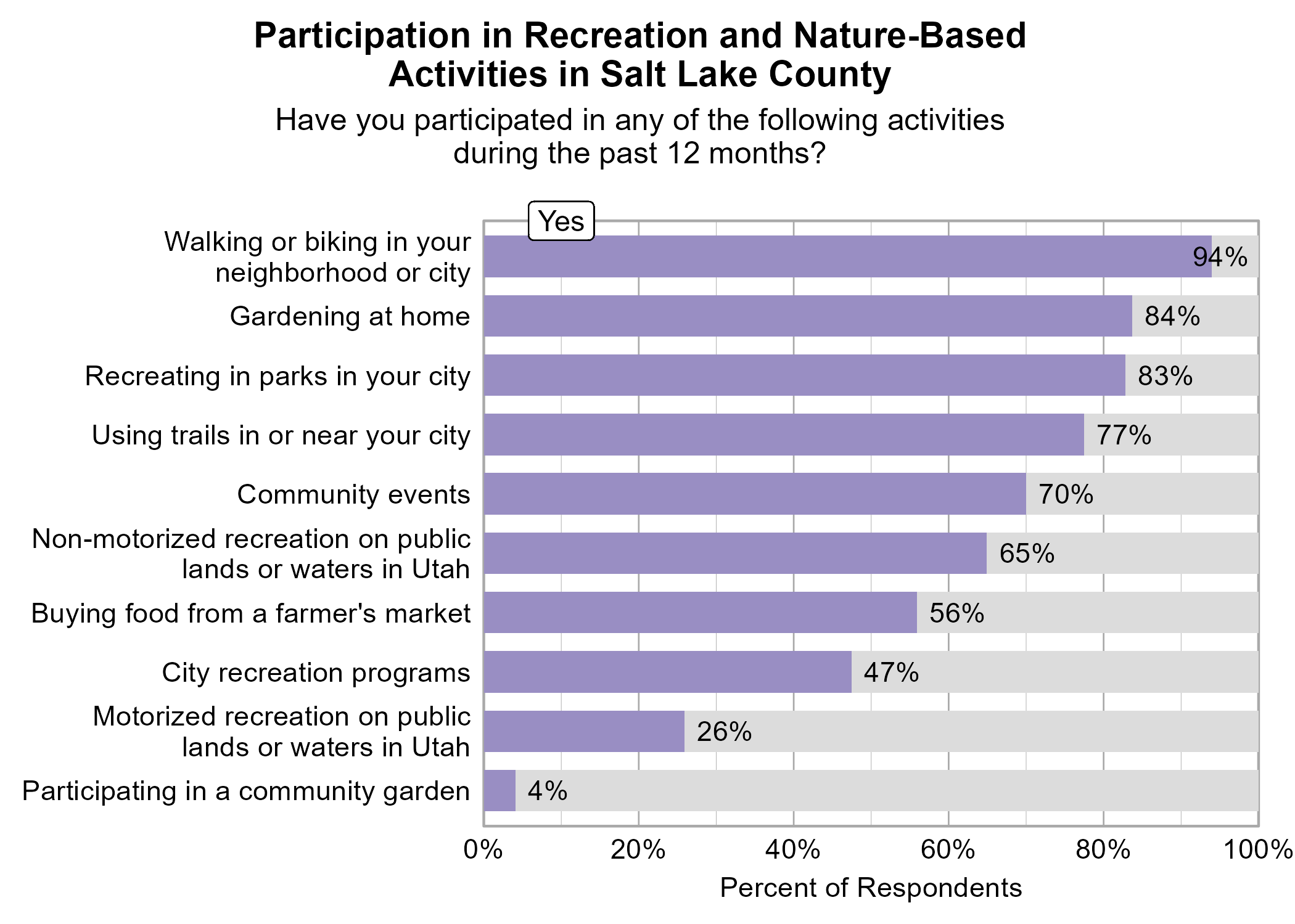
Bar Graph. Title: Participation in Recreation and Nature-Based Activities in Salt Lake County. Subtitle: Have you participated in any of the following activities during the past 12 months? Data — 94% of respondents indicated yes to Walking or biking in your neighborhood or city; 84% of respondents indicated yes to Gardening at home; 83% of respondents indicated yes to Recreating in parks in your city; 77% of respondents indicated yes to Using trails in or near your city; 70% of respondents indicated yes to Community events; 65% of respondents indicated yes to Non-motorized recreation on public lands or waters in Utah; 56% of respondents indicated yes to Buying food from a farmer's market; 47% of respondents indicated yes to City recreation programs; 26% of respondents indicated yes to Motorized recreation on public lands or waters in Utah; 4% of respondents indicated yes to Participating in a community garden

Activities for each city that were found to be significantly correlated with higher levels of wellbeing, community connection, mental health or physical health are shown below in the table.

  Personal Wellbeing Community Wellbeing Community Connection Mental Health Physical Health
Cottonwood Heights
  • City Rec Programs
  • Non-Motorized Recreation
 
  • City Rec Programs
  • Community Events
  • Recreating in Parks
  • Gardening at Home
  • Non-Motorized Recreation
  • Using Trails
Draper
  • Community Events
  • Gardening at Home
  • Non-Motorized Recreation
  • Using Trails
  • Community Events
  • Using Trails
  • City Rec Programs
  • Community Events
  • Gardening at Home
  • Recreating in Parks
  • Gardening at Home
  • Community Events
  • Gardening at Home
  • Non-Motorized Recreation
  • Using Trails
Emigration Canyon    
  • Community Events
   
Herriman
  • Non-Motorized Recreation
 
  • City Rec Programs
  • Community Events
  • Non-Motorized Recreation
 
  • Motorized Recreation
  • Non-Motorized Recreation
  • Using Trails
Millcreek
  • Community Events
  • Non-Motorized Recreation
  • Recreating in Parks
  • City Rec Programs
  • Community Events
  • Non-Motorized Recreation
  • Recreating in Parks
  • Using Trails
 
  • Community Events
  • Non-Motorized Recreation
  • Using Trails
Sandy
  • Community Events
  • Recreating in Parks
  • Using Trails
  • Walking or Biking
  • Community Events
  • Walking or Biking
  • City Rec Programs
  • Community Events
  • Gardening at Home
  • Recreating in Parks
  • Community Events
  • City Rec Programs
  • Community Events
  • Non-Motorized Recreation
  • Recreating in Parks
  • Using Trails
  • Walking or Biking
South Jordan
  • City Rec Programs
  • Gardening at Home
 
  • City Rec Programs
  • Community Events
  • Motorized Recreation
  • Gardening at Home
 
West Jordan
  • City Rec Programs
  • Community Events
  • Community Events
  • Recreating in Parks
  • City Rec Programs
  • Community Events
  • Recreating in Parks
  • Community Events
  • Gardening at Home
  • City Rec Programs
  • Community Events
West Valley City
  • City Rec Programs
  • Non-Motorized Recreation
  • Recreating in Parks
  • Non-Motorized Recreation
  • Recreating in Parks
  • City Rec Programs
  • Community Events
  • Recreating in Parks
  • City Rec Programs
  • Using Trails

Perspectives on Population Growth and Economic Development

The largest proportion of respondents felt the Rate of Population Growth was just right in Emigration Canyon and too fast in West Valley City, Midvale, Millcreek, Cottonwood Heights, Sandy, Draper, South Jordan, West Jordan, and Herriman.

The largest proportion of respondents felt the Pace of Economic Growth was too slow in Herriman and just right in Emigration Canyon, Midvale, West Valley City, West Jordan, Cottonwood Heights, Sandy, Millcreek, South Jordan, and Draper.
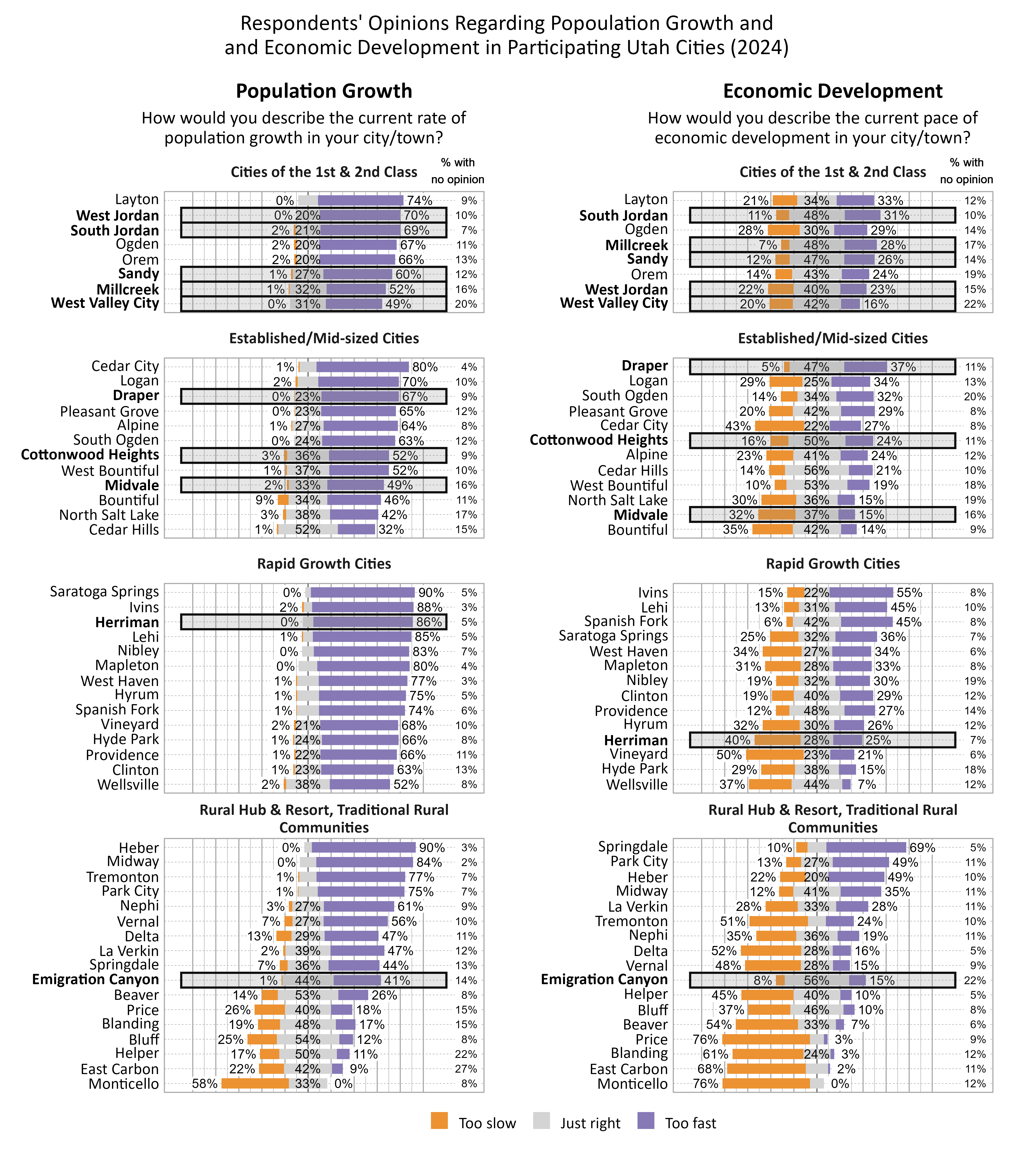
Respondents' Opinions Regarding Population Growth and and Economic Development in Participating Utah Cities (2024). Left Likert Graph Column. Title: Population Growth. Subtitle: How would you describe the current rate of population growth in your city/town? Data — Cluster Cities of the 1st & 2nd Class: City: West Valley City,  0% of respondents indicated that the rate of population growth was too slow, 31% indicated that it was just right, 49% indicated that it was too fast, and 20% had no opinion. City: Millcreek,  1% of respondents indicated that the rate of population growth was too slow, 32% indicated that it was just right, 52% indicated that it was too fast, and 16% had no opinion. City: Sandy,  1% of respondents indicated that the rate of population growth was too slow, 27% indicated that it was just right, 60% indicated that it was too fast, and 12% had no opinion. City: Orem,  2% of respondents indicated that the rate of population growth was too slow, 20% indicated that it was just right, 66% indicated that it was too fast, and 13% had no opinion. City: Ogden,  2% of respondents indicated that the rate of population growth was too slow, 20% indicated that it was just right, 67% indicated that it was too fast, and 11% had no opinion. City: West Jordan,  0% of respondents indicated that the rate of population growth was too slow, 20% indicated that it was just right, 70% indicated that it was too fast, and 10% had no opinion. City: South Jordan,  2% of respondents indicated that the rate of population growth was too slow, 21% indicated that it was just right, 69% indicated that it was too fast, and  7% had no opinion. City: Layton,  0% of respondents indicated that the rate of population growth was too slow, 17% indicated that it was just right, 74% indicated that it was too fast, and  9% had no opinion; Cluster Established/Mid-sized Cities: City: Cedar Hills,  1% of respondents indicated that the rate of population growth was too slow, 52% indicated that it was just right, 32% indicated that it was too fast, and 15% had no opinion. City: North Salt Lake,  3% of respondents indicated that the rate of population growth was too slow, 38% indicated that it was just right, 42% indicated that it was too fast, and 17% had no opinion. City: Bountiful,  9% of respondents indicated that the rate of population growth was too slow, 34% indicated that it was just right, 46% indicated that it was too fast, and 11% had no opinion. City: Midvale,  2% of respondents indicated that the rate of population growth was too slow, 33% indicated that it was just right, 49% indicated that it was too fast, and 16% had no opinion. City: West Bountiful,  1% of respondents indicated that the rate of population growth was too slow, 37% indicated that it was just right, 52% indicated that it was too fast, and 10% had no opinion. City: Cottonwood Heights,  3% of respondents indicated that the rate of population growth was too slow, 36% indicated that it was just right, 52% indicated that it was too fast, and  9% had no opinion. City: South Ogden,  0% of respondents indicated that the rate of population growth was too slow, 24% indicated that it was just right, 63% indicated that it was too fast, and 12% had no opinion. City: Pleasant Grove,  0% of respondents indicated that the rate of population growth was too slow, 23% indicated that it was just right, 65% indicated that it was too fast, and 12% had no opinion. City: Alpine,  1% of respondents indicated that the rate of population growth was too slow, 27% indicated that it was just right, 64% indicated that it was too fast, and  8% had no opinion. City: Draper,  0% of respondents indicated that the rate of population growth was too slow, 23% indicated that it was just right, 67% indicated that it was too fast, and  9% had no opinion. City: Logan,  2% of respondents indicated that the rate of population growth was too slow, 18% indicated that it was just right, 70% indicated that it was too fast, and 10% had no opinion. City: Cedar City,  1% of respondents indicated that the rate of population growth was too slow, 15% indicated that it was just right, 80% indicated that it was too fast, and  4% had no opinion; Cluster Rapid Growth Cities: City: Wellsville,  2% of respondents indicated that the rate of population growth was too slow, 38% indicated that it was just right, 52% indicated that it was too fast, and  8% had no opinion. City: Clinton,  1% of respondents indicated that the rate of population growth was too slow, 23% indicated that it was just right, 63% indicated that it was too fast, and 13% had no opinion. City: Providence,  1% of respondents indicated that the rate of population growth was too slow, 22% indicated that it was just right, 66% indicated that it was too fast, and 11% had no opinion. City: Vineyard,  2% of respondents indicated that the rate of population growth was too slow, 21% indicated that it was just right, 68% indicated that it was too fast, and 10% had no opinion. City: Hyde Park,  1% of respondents indicated that the rate of population growth was too slow, 24% indicated that it was just right, 66% indicated that it was too fast, and  8% had no opinion. City: Spanish Fork,  1% of respondents indicated that the rate of population growth was too slow, 19% indicated that it was just right, 74% indicated that it was too fast, and  6% had no opinion. City: Hyrum,  1% of respondents indicated that the rate of population growth was too slow, 19% indicated that it was just right, 75% indicated that it was too fast, and  5% had no opinion. City: West Haven,  1% of respondents indicated that the rate of population growth was too slow, 19% indicated that it was just right, 77% indicated that it was too fast, and  3% had no opinion. City: Nibley,  0% of respondents indicated that the rate of population growth was too slow, 10% indicated that it was just right, 83% indicated that it was too fast, and  7% had no opinion. City: Mapleton,  0% of respondents indicated that the rate of population growth was too slow, 16% indicated that it was just right, 80% indicated that it was too fast, and  4% had no opinion. City: Lehi,  1% of respondents indicated that the rate of population growth was too slow,  8% indicated that it was just right, 85% indicated that it was too fast, and  5% had no opinion. City: Herriman,  0% of respondents indicated that the rate of population growth was too slow,  9% indicated that it was just right, 86% indicated that it was too fast, and  5% had no opinion. City: Ivins,  2% of respondents indicated that the rate of population growth was too slow,  7% indicated that it was just right, 88% indicated that it was too fast, and  3% had no opinion. City: Saratoga Springs,  0% of respondents indicated that the rate of population growth was too slow,  5% indicated that it was just right, 90% indicated that it was too fast, and  5% had no opinion; Cluster Rural Hub & Resort, Traditional Rural Communities: City: Monticello, 58% of respondents indicated that the rate of population growth was too slow, 33% indicated that it was just right,  0% indicated that it was too fast, and  8% had no opinion. City: East Carbon, 22% of respondents indicated that the rate of population growth was too slow, 42% indicated that it was just right,  9% indicated that it was too fast, and 27% had no opinion. City: Helper, 17% of respondents indicated that the rate of population growth was too slow, 50% indicated that it was just right, 11% indicated that it was too fast, and 22% had no opinion. City: Price, 26% of respondents indicated that the rate of population growth was too slow, 40% indicated that it was just right, 18% indicated that it was too fast, and 15% had no opinion. City: Bluff, 25% of respondents indicated that the rate of population growth was too slow, 54% indicated that it was just right, 12% indicated that it was too fast, and  8% had no opinion. City: Blanding, 19% of respondents indicated that the rate of population growth was too slow, 48% indicated that it was just right, 17% indicated that it was too fast, and 15% had no opinion. City: Beaver, 14% of respondents indicated that the rate of population growth was too slow, 53% indicated that it was just right, 26% indicated that it was too fast, and  8% had no opinion. City: Delta, 13% of respondents indicated that the rate of population growth was too slow, 29% indicated that it was just right, 47% indicated that it was too fast, and 11% had no opinion. City: Springdale,  7% of respondents indicated that the rate of population growth was too slow, 36% indicated that it was just right, 44% indicated that it was too fast, and 13% had no opinion. City: Emigration Canyon,  1% of respondents indicated that the rate of population growth was too slow, 44% indicated that it was just right, 41% indicated that it was too fast, and 14% had no opinion. City: La Verkin,  2% of respondents indicated that the rate of population growth was too slow, 39% indicated that it was just right, 47% indicated that it was too fast, and 12% had no opinion. City: Vernal,  7% of respondents indicated that the rate of population growth was too slow, 27% indicated that it was just right, 56% indicated that it was too fast, and 10% had no opinion. City: Nephi,  3% of respondents indicated that the rate of population growth was too slow, 27% indicated that it was just right, 61% indicated that it was too fast, and  9% had no opinion. City: Park City,  1% of respondents indicated that the rate of population growth was too slow, 17% indicated that it was just right, 75% indicated that it was too fast, and  7% had no opinion. City: Tremonton,  1% of respondents indicated that the rate of population growth was too slow, 15% indicated that it was just right, 77% indicated that it was too fast, and  7% had no opinion. City: Midway,  0% of respondents indicated that the rate of population growth was too slow, 14% indicated that it was just right, 84% indicated that it was too fast, and  2% had no opinion. City: Heber,  0% of respondents indicated that the rate of population growth was too slow,  7% indicated that it was just right, 90% indicated that it was too fast, and  3% had no opinion. Right Likert Graph Column. Title: Economic Development. Subtitle: How would you describe the current pace of economic development in your city/town? Data — Cluster Cities of the 1st & 2nd Class: City: West Valley City, 20% of respondents indicated that the pace of economic development was too slow, 42% indicated that it was just right, 16% indicated that it was too fast, and 22% had no opinion. City: West Jordan, 22% of respondents indicated that the pace of economic development was too slow, 40% indicated that it was just right, 23% indicated that it was too fast, and 15% had no opinion. City: Ogden, 28% of respondents indicated that the pace of economic development was too slow, 30% indicated that it was just right, 29% indicated that it was too fast, and 14% had no opinion. City: Orem, 14% of respondents indicated that the pace of economic development was too slow, 43% indicated that it was just right, 24% indicated that it was too fast, and 19% had no opinion. City: Layton, 21% of respondents indicated that the pace of economic development was too slow, 34% indicated that it was just right, 33% indicated that it was too fast, and 12% had no opinion. City: Sandy, 12% of respondents indicated that the pace of economic development was too slow, 47% indicated that it was just right, 26% indicated that it was too fast, and 14% had no opinion. City: Millcreek,  7% of respondents indicated that the pace of economic development was too slow, 48% indicated that it was just right, 28% indicated that it was too fast, and 17% had no opinion. City: South Jordan, 11% of respondents indicated that the pace of economic development was too slow, 48% indicated that it was just right, 31% indicated that it was too fast, and 10% had no opinion; Cluster Established/Mid-sized Cities: City: North Salt Lake, 30% of respondents indicated that the pace of economic development was too slow, 36% indicated that it was just right, 15% indicated that it was too fast, and 19% had no opinion. City: Midvale, 32% of respondents indicated that the pace of economic development was too slow, 37% indicated that it was just right, 15% indicated that it was too fast, and 16% had no opinion. City: Bountiful, 35% of respondents indicated that the pace of economic development was too slow, 42% indicated that it was just right, 14% indicated that it was too fast, and  9% had no opinion. City: Cedar City, 43% of respondents indicated that the pace of economic development was too slow, 22% indicated that it was just right, 27% indicated that it was too fast, and  8% had no opinion. City: Alpine, 23% of respondents indicated that the pace of economic development was too slow, 41% indicated that it was just right, 24% indicated that it was too fast, and 12% had no opinion. City: West Bountiful, 10% of respondents indicated that the pace of economic development was too slow, 53% indicated that it was just right, 19% indicated that it was too fast, and 18% had no opinion. City: Logan, 29% of respondents indicated that the pace of economic development was too slow, 25% indicated that it was just right, 34% indicated that it was too fast, and 13% had no opinion. City: Cedar Hills, 14% of respondents indicated that the pace of economic development was too slow, 56% indicated that it was just right, 21% indicated that it was too fast, and 10% had no opinion. City: Cottonwood Heights, 16% of respondents indicated that the pace of economic development was too slow, 50% indicated that it was just right, 24% indicated that it was too fast, and 11% had no opinion. City: South Ogden, 14% of respondents indicated that the pace of economic development was too slow, 34% indicated that it was just right, 32% indicated that it was too fast, and 20% had no opinion. City: Pleasant Grove, 20% of respondents indicated that the pace of economic development was too slow, 42% indicated that it was just right, 29% indicated that it was too fast, and  8% had no opinion. City: Draper,  5% of respondents indicated that the pace of economic development was too slow, 47% indicated that it was just right, 37% indicated that it was too fast, and 11% had no opinion; Cluster Rapid Growth Cities: City: Wellsville, 37% of respondents indicated that the pace of economic development was too slow, 44% indicated that it was just right,  7% indicated that it was too fast, and 12% had no opinion. City: Vineyard, 50% of respondents indicated that the pace of economic development was too slow, 23% indicated that it was just right, 21% indicated that it was too fast, and  6% had no opinion. City: Hyde Park, 29% of respondents indicated that the pace of economic development was too slow, 38% indicated that it was just right, 15% indicated that it was too fast, and 18% had no opinion. City: Herriman, 40% of respondents indicated that the pace of economic development was too slow, 28% indicated that it was just right, 25% indicated that it was too fast, and  7% had no opinion. City: Hyrum, 32% of respondents indicated that the pace of economic development was too slow, 30% indicated that it was just right, 26% indicated that it was too fast, and 12% had no opinion. City: Nibley, 19% of respondents indicated that the pace of economic development was too slow, 32% indicated that it was just right, 30% indicated that it was too fast, and 19% had no opinion. City: West Haven, 34% of respondents indicated that the pace of economic development was too slow, 27% indicated that it was just right, 34% indicated that it was too fast, and  6% had no opinion. City: Mapleton, 31% of respondents indicated that the pace of economic development was too slow, 28% indicated that it was just right, 33% indicated that it was too fast, and  8% had no opinion. City: Clinton, 19% of respondents indicated that the pace of economic development was too slow, 40% indicated that it was just right, 29% indicated that it was too fast, and 12% had no opinion. City: Providence, 12% of respondents indicated that the pace of economic development was too slow, 48% indicated that it was just right, 27% indicated that it was too fast, and 14% had no opinion. City: Saratoga Springs, 25% of respondents indicated that the pace of economic development was too slow, 32% indicated that it was just right, 36% indicated that it was too fast, and  7% had no opinion. City: Lehi, 13% of respondents indicated that the pace of economic development was too slow, 31% indicated that it was just right, 45% indicated that it was too fast, and 10% had no opinion. City: Spanish Fork,  6% of respondents indicated that the pace of economic development was too slow, 42% indicated that it was just right, 45% indicated that it was too fast, and  8% had no opinion. City: Ivins, 15% of respondents indicated that the pace of economic development was too slow, 22% indicated that it was just right, 55% indicated that it was too fast, and  8% had no opinion; Cluster Rural Hub & Resort, Traditional Rural Communities: City: Monticello, 76% of respondents indicated that the pace of economic development was too slow, 12% indicated that it was just right,  0% indicated that it was too fast, and 12% had no opinion. City: Price, 76% of respondents indicated that the pace of economic development was too slow, 12% indicated that it was just right,  3% indicated that it was too fast, and  9% had no opinion. City: East Carbon, 68% of respondents indicated that the pace of economic development was too slow, 19% indicated that it was just right,  2% indicated that it was too fast, and 11% had no opinion. City: Blanding, 61% of respondents indicated that the pace of economic development was too slow, 24% indicated that it was just right,  3% indicated that it was too fast, and 12% had no opinion. City: Beaver, 54% of respondents indicated that the pace of economic development was too slow, 33% indicated that it was just right,  7% indicated that it was too fast, and  6% had no opinion. City: Vernal, 48% of respondents indicated that the pace of economic development was too slow, 28% indicated that it was just right, 15% indicated that it was too fast, and  9% had no opinion. City: Delta, 52% of respondents indicated that the pace of economic development was too slow, 28% indicated that it was just right, 16% indicated that it was too fast, and  5% had no opinion. City: Helper, 45% of respondents indicated that the pace of economic development was too slow, 40% indicated that it was just right, 10% indicated that it was too fast, and  5% had no opinion. City: Tremonton, 51% of respondents indicated that the pace of economic development was too slow, 16% indicated that it was just right, 24% indicated that it was too fast, and 10% had no opinion. City: Bluff, 37% of respondents indicated that the pace of economic development was too slow, 46% indicated that it was just right, 10% indicated that it was too fast, and  8% had no opinion. City: Nephi, 35% of respondents indicated that the pace of economic development was too slow, 36% indicated that it was just right, 19% indicated that it was too fast, and 11% had no opinion. City: Emigration Canyon,  8% of respondents indicated that the pace of economic development was too slow, 56% indicated that it was just right, 15% indicated that it was too fast, and 22% had no opinion. City: La Verkin, 28% of respondents indicated that the pace of economic development was too slow, 33% indicated that it was just right, 28% indicated that it was too fast, and 11% had no opinion. City: Midway, 12% of respondents indicated that the pace of economic development was too slow, 41% indicated that it was just right, 35% indicated that it was too fast, and 11% had no opinion. City: Heber, 22% of respondents indicated that the pace of economic development was too slow, 20% indicated that it was just right, 49% indicated that it was too fast, and 10% had no opinion. City: Park City, 13% of respondents indicated that the pace of economic development was too slow, 27% indicated that it was just right, 49% indicated that it was too fast, and 11% had no opinion. City: Springdale, 10% of respondents indicated that the pace of economic development was too slow, 16% indicated that it was just right, 69% indicated that it was too fast, and  5% had no opinion

Transportation in Salt Lake County

Respondents were asked to indicate all of their primary modes of transportation on a regular basis in their city. The most popular modes of transportation across Salt Lake County were personal car (99%) and walking (37%).
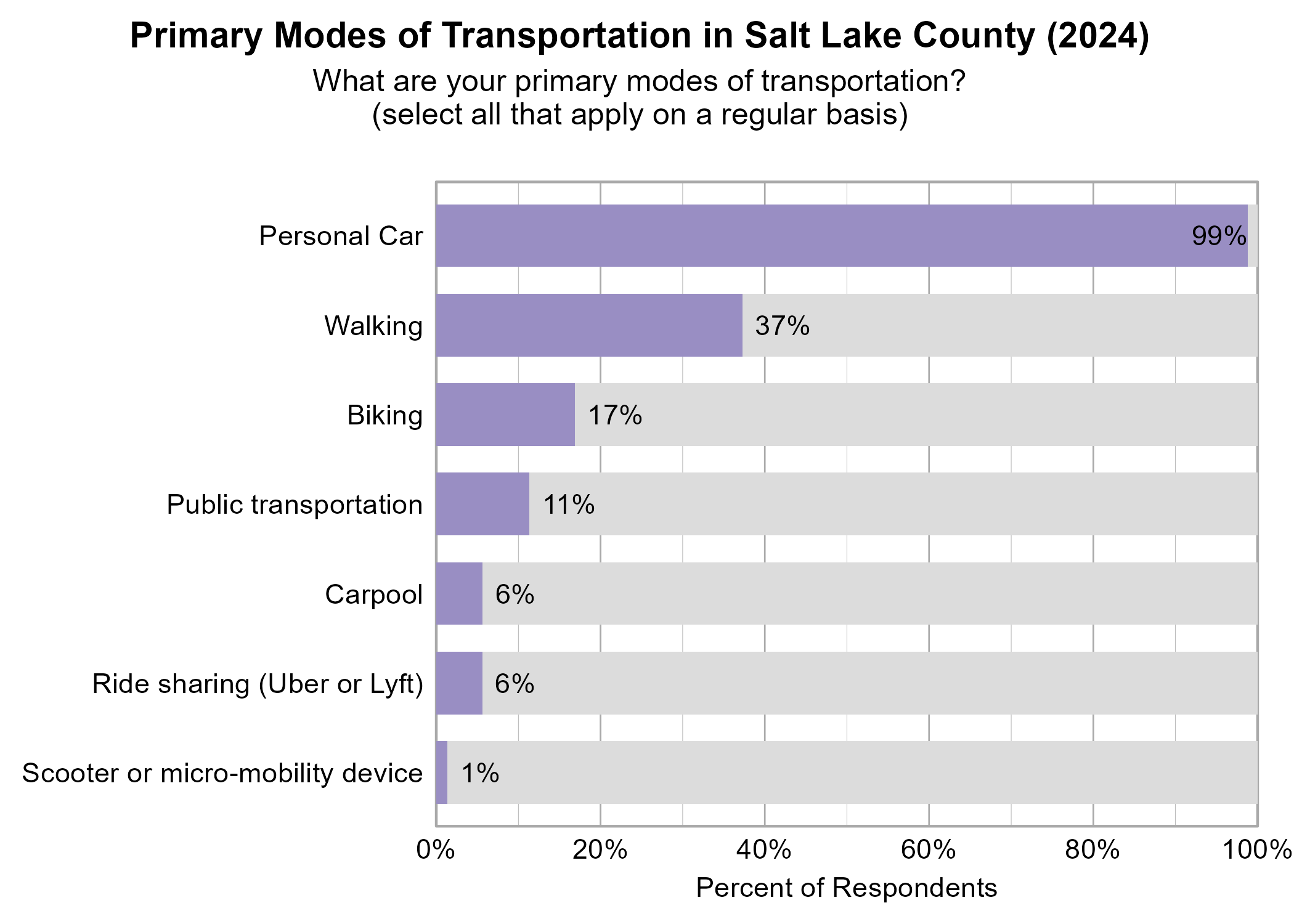
Bar Graph. Title: Primary Modes of Transportation in Salt Lake County (2024). Subtitle: What are your primary modes of transportation? (select all that apply on a regular basis) Data — 99% of respondents indicated yes to Personal Car; 37% of respondents indicated yes to Walking; 17% of respondents indicated yes to Biking; 11% of respondents indicated yes to Public transportation; 6% of respondents indicated yes to Carpool; 6% of respondents indicated yes to Ride sharing (Uber or Lyft); 1% of respondents indicated yes to Scooter or micro-mobility device

Respondents were asked to indicate the most common barriers to transportation in their city. The most problematic barriers across Salt Lake County were Travel time (46%) and Lack of routes (32%).
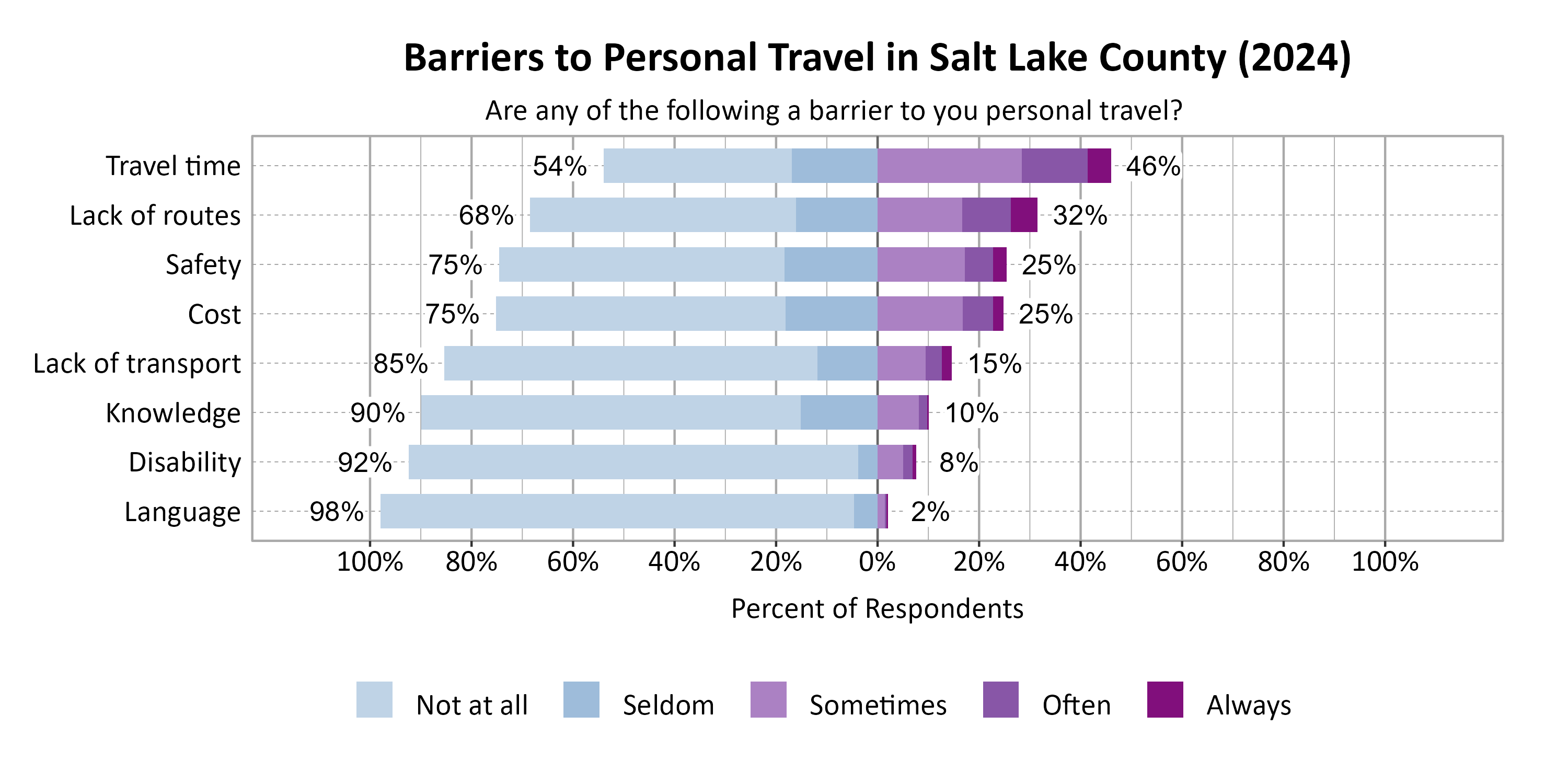
Likert Graph. Title: Barriers to Personal Travel in Salt Lake County (2024). Subtitle: Are any of the following a barrier to you personal travel? Data — Category: Travel time - 54% of respondents indicated it was not a barrier or seldom a barrier, while 46% of respondents indicated it was sometimes, often, or always a barrier; Category: Lack of routes - 68% of respondents indicated it was not a barrier or seldom a barrier, while 32% of respondents indicated it was sometimes, often, or always a barrier; Category: Cost - 75% of respondents indicated it was not a barrier or seldom a barrier, while 25% of respondents indicated it was sometimes, often, or always a barrier; Category: Safety - 75% of respondents indicated it was not a barrier or seldom a barrier, while 25% of respondents indicated it was sometimes, often, or always a barrier; Category: Lack of transport - 85% of respondents indicated it was not a barrier or seldom a barrier, while 15% of respondents indicated it was sometimes, often, or always a barrier; Category: Knowledge - 90% of respondents indicated it was not a barrier or seldom a barrier, while 10% of respondents indicated it was sometimes, often, or always a barrier; Category: Disability - 92% of respondents indicated it was not a barrier or seldom a barrier, while  8% of respondents indicated it was sometimes, often, or always a barrier; Category: Language - 98% of respondents indicated it was not a barrier or seldom a barrier, while  2% of respondents indicated it was sometimes, often, or always a barrier

Respondents were asked to indicate the importance of a set of possible transportation developments in their city. The most important developments to respondents in Salt Lake County were Improving road surfaces (74%), Enhancing safety (72%), and Improving walkability (62%).
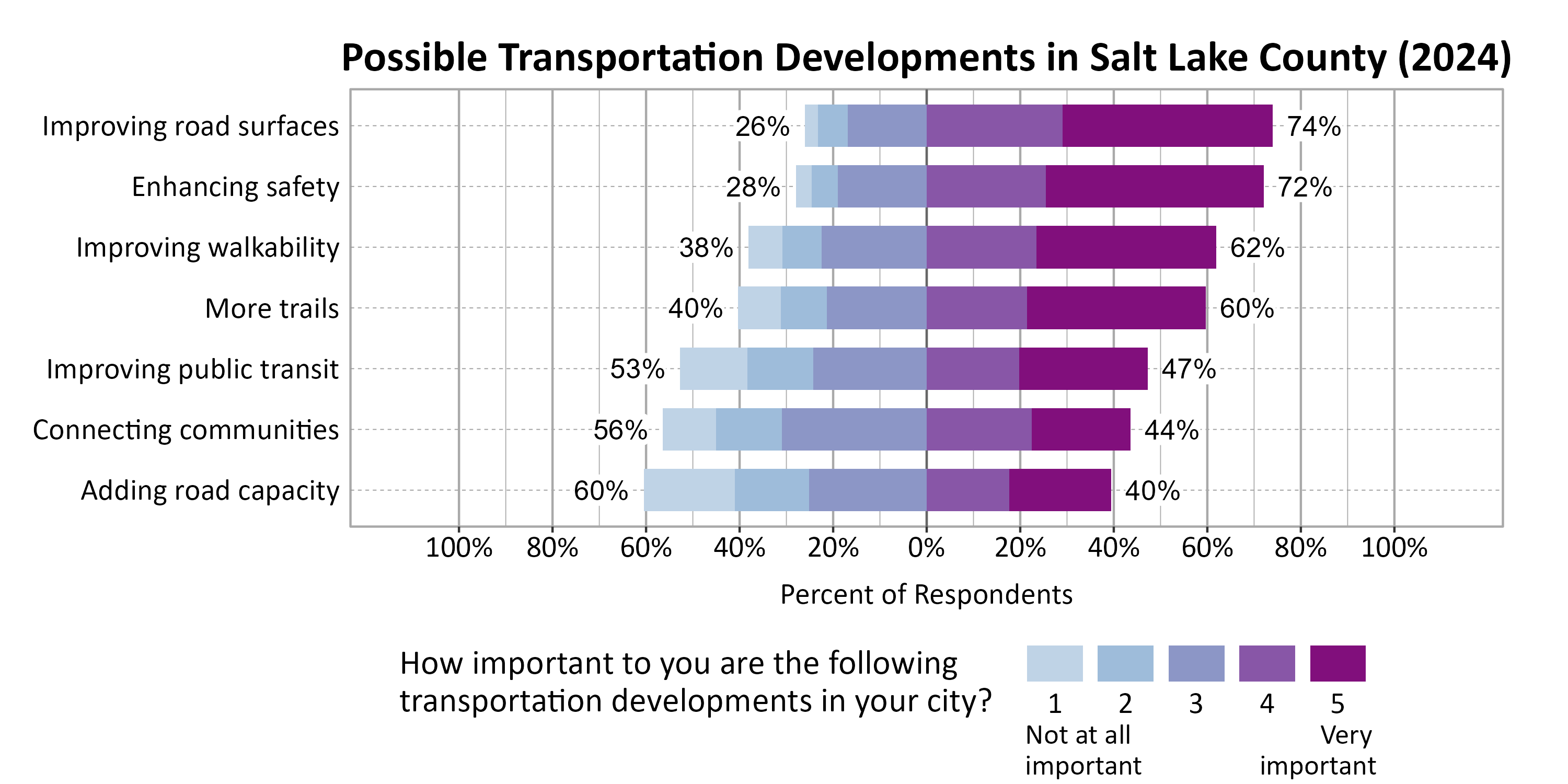
Likert Graph. Title: Possible Transportation Developments in Salt Lake County (2024). Subtitle: On a scale of 1 - Not at all important to 5 - Very important, please rate the importance of the following developments to you. Data — Category: Improving road surfaces - 26% of respondents indicated it 1, 2, or 3, while 74% of respondents rated it a 4 or 5.; Category: Enhancing safety - 28% of respondents indicated it 1, 2, or 3, while 72% of respondents rated it a 4 or 5.; Category: Improving walkability - 38% of respondents indicated it 1, 2, or 3, while 62% of respondents rated it a 4 or 5.; Category: More trails - 40% of respondents indicated it 1, 2, or 3, while 60% of respondents rated it a 4 or 5.; Category: Improving public transit - 53% of respondents indicated it 1, 2, or 3, while 47% of respondents rated it a 4 or 5.; Category: Connecting communities - 56% of respondents indicated it 1, 2, or 3, while 44% of respondents rated it a 4 or 5.; Category: Adding road capacity - 60% of respondents indicated it 1, 2, or 3, while 40% of respondents rated it a 4 or 5.

Respondents were asked to indicate how frequently various activities take them out of your city to another city or town. The most commonly indicated reasons for traveling to another city or town at least sometimes or once a month in Salt Lake County were Eating Out (87%), Friends and Family (87%), Other Services (74%), and Recreation/Sports (73%).
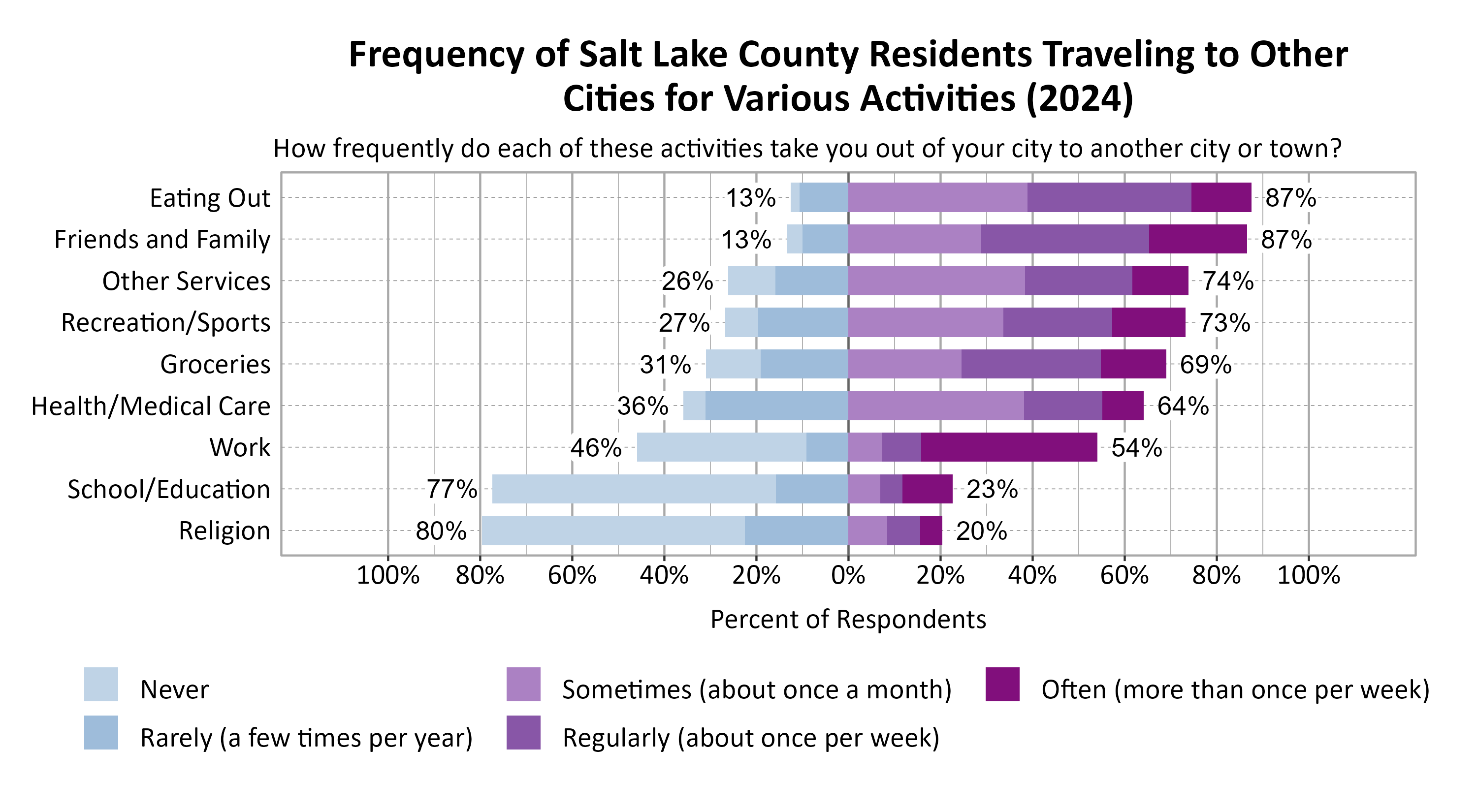
Likert Graph. Title: Frequency of Salt Lake County Residents Traveling to Other Cities for Various Activities (2024). Subtitle: How frequently do each of these activities take you out of your city to another city or town? Data — Category: Eating Out - 13% of respondents indicated it was never or rarely and 87% of respondents indicated it was sometimes, regularly, often; Category: Friends and Family - 13% of respondents indicated it was never or rarely and 87% of respondents indicated it was sometimes, regularly, often; Category: Other Services - 26% of respondents indicated it was never or rarely and 74% of respondents indicated it was sometimes, regularly, often; Category: Recreation/Sports - 27% of respondents indicated it was never or rarely and 73% of respondents indicated it was sometimes, regularly, often; Category: Groceries - 31% of respondents indicated it was never or rarely and 69% of respondents indicated it was sometimes, regularly, often; Category: Health/Medical Care - 36% of respondents indicated it was never or rarely and 64% of respondents indicated it was sometimes, regularly, often; Category: Work - 46% of respondents indicated it was never or rarely and 54% of respondents indicated it was sometimes, regularly, often; Category: School/Education - 77% of respondents indicated it was never or rarely and 23% of respondents indicated it was sometimes, regularly, often; Category: Religion - 80% of respondents indicated it was never or rarely and 20% of respondents indicated it was sometimes, regularly, often

Concerns for the Future of Salt Lake County Cities

Survey respondents indicated the degree to which a number of possible local issues were a concern as they look to the future of their city. Across Salt Lake County, Air Quality (87%), Water Supply (84%), Open Space/Green Space (80%), Traffic (79%), and Water Quality (79%) were the top concerns.

Likert Graph. Title: Concerns for Salt Lake County Survey Respondents. Subtitle: As you look to the future of your city, how much of a concern are the following issues? Data — Category: Air Quality - 13% of respondents indicated not a concern at all or slight concern while 87% of respondents indicated a moderate or major concern; Category: Water Supply - 16% of respondents indicated not a concern at all or slight concern while 84% of respondents indicated a moderate or major concern; Category: Open Space/Green Space - 20% of respondents indicated not a concern at all or slight concern while 80% of respondents indicated a moderate or major concern; Category: Traffic - 21% of respondents indicated not a concern at all or slight concern while 79% of respondents indicated a moderate or major concern; Category: Water Quality - 21% of respondents indicated not a concern at all or slight concern while 79% of respondents indicated a moderate or major concern; Category: Public Safety - 22% of respondents indicated not a concern at all or slight concern while 78% of respondents indicated a moderate or major concern; Category: Homelessness - 30% of respondents indicated not a concern at all or slight concern while 70% of respondents indicated a moderate or major concern; Category: Great Salt Lake - 33% of respondents indicated not a concern at all or slight concern while 67% of respondents indicated a moderate or major concern; Category: Affordable Housing - 35% of respondents indicated not a concern at all or slight concern while 65% of respondents indicated a moderate or major concern; Category: Climate Change - 35% of respondents indicated not a concern at all or slight concern while 65% of respondents indicated a moderate or major concern; Category: Opportunities for Youth - 35% of respondents indicated not a concern at all or slight concern while 65% of respondents indicated a moderate or major concern; Category: Recreation Opportunities - 35% of respondents indicated not a concern at all or slight concern while 65% of respondents indicated a moderate or major concern; Category: Trails & Paths - 39% of respondents indicated not a concern at all or slight concern while 61% of respondents indicated a moderate or major concern; Category: Access to Healthy/Quality Food - 47% of respondents indicated not a concern at all or slight concern while 53% of respondents indicated a moderate or major concern; Category: Shopping Opportunities - 56% of respondents indicated not a concern at all or slight concern while 44% of respondents indicated a moderate or major concern; Category: Suicide - 56% of respondents indicated not a concern at all or slight concern while 44% of respondents indicated a moderate or major concern; Category: Accessible Transportation - 60% of respondents indicated not a concern at all or slight concern while 40% of respondents indicated a moderate or major concern; Category: Employment Opportunities - 61% of respondents indicated not a concern at all or slight concern while 39% of respondents indicated a moderate or major concern; Category: Social and Emotional Support - 62% of respondents indicated not a concern at all or slight concern while 38% of respondents indicated a moderate or major concern; Category: Access to Health Care - 63% of respondents indicated not a concern at all or slight concern while 37% of respondents indicated a moderate or major concern; Category: Access to Mental Health Care - 65% of respondents indicated not a concern at all or slight concern while 35% of respondents indicated a moderate or major concern; Category: Substance Misuse - 68% of respondents indicated not a concern at all or slight concern while 32% of respondents indicated a moderate or major concern; Category: Access to Culturally Appropriate Food - 75% of respondents indicated not a concern at all or slight concern while 25% of respondents indicated a moderate or major concern; Category: Access to Substance Use Disorder Treatment - 82% of respondents indicated not a concern at all or slight concern while 18% of respondents indicated a moderate or major concern

Top concerns also varied across cities. The top five concerns for each city are highlighted in the graph below.
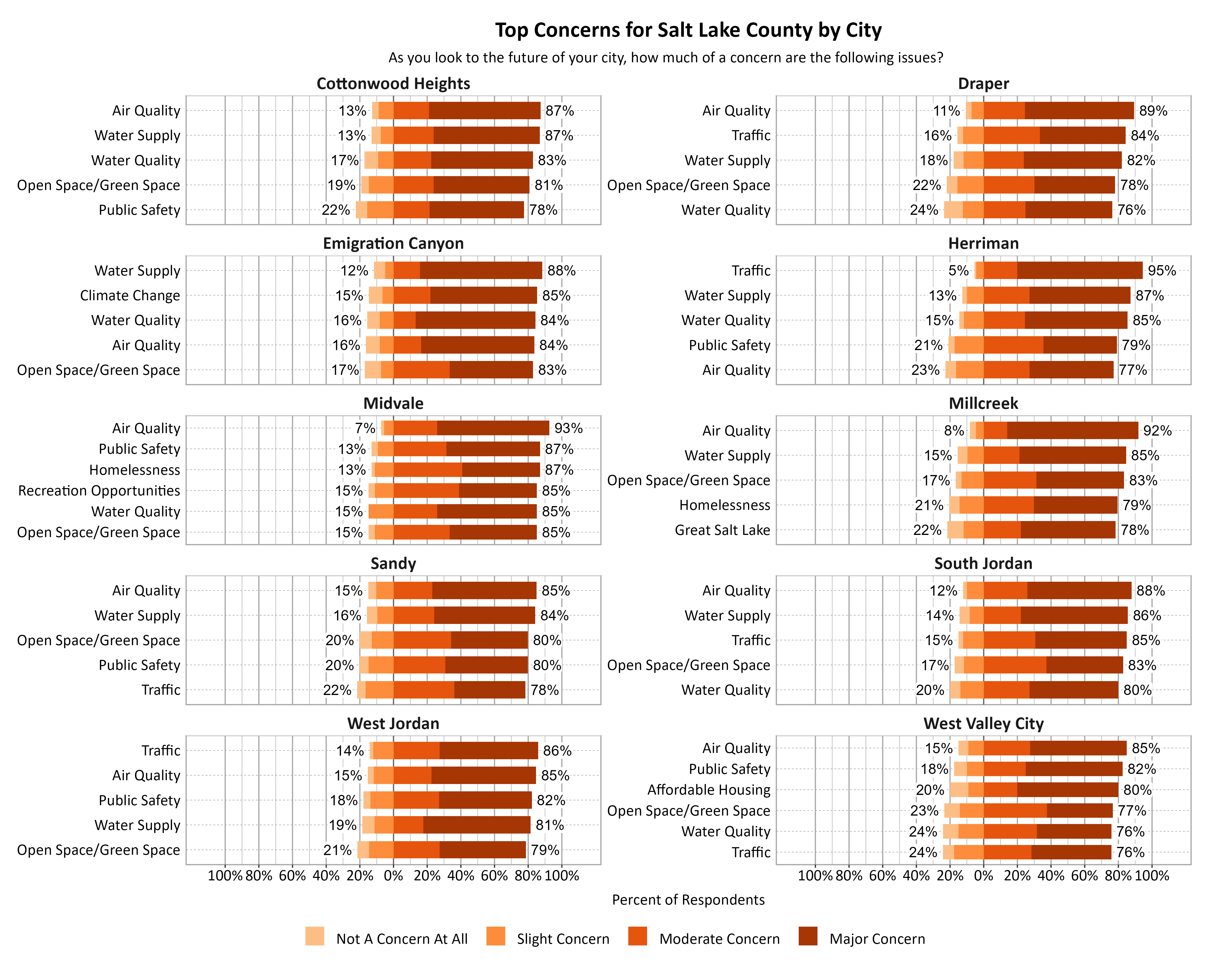
Likert Graph. Title: Top Concerns for Salt Lake County by City. Subtitle: As you look to the future of your city, how much of a concern are the following issues? Data — Cottonwood Heights: Air Quality - 13% of respondents indicated not a concern at all or slight concern while 87% of respondents indicated a moderate or major concern, Open Space/Green Space - 19% of respondents indicated not a concern at all or slight concern while 81% of respondents indicated a moderate or major concern, Public Safety - 22% of respondents indicated not a concern at all or slight concern while 78% of respondents indicated a moderate or major concern, Water Quality - 17% of respondents indicated not a concern at all or slight concern while 83% of respondents indicated a moderate or major concern, Water Supply - 13% of respondents indicated not a concern at all or slight concern while 87% of respondents indicated a moderate or major concern; Draper: Air Quality - 11% of respondents indicated not a concern at all or slight concern while 89% of respondents indicated a moderate or major concern, Open Space/Green Space - 22% of respondents indicated not a concern at all or slight concern while 78% of respondents indicated a moderate or major concern, Traffic - 16% of respondents indicated not a concern at all or slight concern while 84% of respondents indicated a moderate or major concern, Water Quality - 24% of respondents indicated not a concern at all or slight concern while 76% of respondents indicated a moderate or major concern, Water Supply - 18% of respondents indicated not a concern at all or slight concern while 82% of respondents indicated a moderate or major concern; Emigration Canyon: Air Quality - 16% of respondents indicated not a concern at all or slight concern while 84% of respondents indicated a moderate or major concern, Climate Change - 15% of respondents indicated not a concern at all or slight concern while 85% of respondents indicated a moderate or major concern, Open Space/Green Space - 17% of respondents indicated not a concern at all or slight concern while 83% of respondents indicated a moderate or major concern, Water Quality - 16% of respondents indicated not a concern at all or slight concern while 84% of respondents indicated a moderate or major concern, Water Supply - 12% of respondents indicated not a concern at all or slight concern while 88% of respondents indicated a moderate or major concern; Herriman: Air Quality - 23% of respondents indicated not a concern at all or slight concern while 77% of respondents indicated a moderate or major concern, Public Safety - 21% of respondents indicated not a concern at all or slight concern while 79% of respondents indicated a moderate or major concern, Traffic -  5% of respondents indicated not a concern at all or slight concern while 95% of respondents indicated a moderate or major concern, Water Quality - 15% of respondents indicated not a concern at all or slight concern while 85% of respondents indicated a moderate or major concern, Water Supply - 13% of respondents indicated not a concern at all or slight concern while 87% of respondents indicated a moderate or major concern; Midvale: Air Quality -  7% of respondents indicated not a concern at all or slight concern while 93% of respondents indicated a moderate or major concern, Homelessness - 13% of respondents indicated not a concern at all or slight concern while 87% of respondents indicated a moderate or major concern, Open Space/Green Space - 15% of respondents indicated not a concern at all or slight concern while 85% of respondents indicated a moderate or major concern, Public Safety - 13% of respondents indicated not a concern at all or slight concern while 87% of respondents indicated a moderate or major concern, Recreation Opportunities - 15% of respondents indicated not a concern at all or slight concern while 85% of respondents indicated a moderate or major concern, Water Quality - 15% of respondents indicated not a concern at all or slight concern while 85% of respondents indicated a moderate or major concern; Millcreek: Air Quality -  8% of respondents indicated not a concern at all or slight concern while 92% of respondents indicated a moderate or major concern, Great Salt Lake - 22% of respondents indicated not a concern at all or slight concern while 78% of respondents indicated a moderate or major concern, Homelessness - 21% of respondents indicated not a concern at all or slight concern while 79% of respondents indicated a moderate or major concern, Open Space/Green Space - 17% of respondents indicated not a concern at all or slight concern while 83% of respondents indicated a moderate or major concern, Water Supply - 15% of respondents indicated not a concern at all or slight concern while 85% of respondents indicated a moderate or major concern; Sandy: Air Quality - 15% of respondents indicated not a concern at all or slight concern while 85% of respondents indicated a moderate or major concern, Open Space/Green Space - 20% of respondents indicated not a concern at all or slight concern while 80% of respondents indicated a moderate or major concern, Public Safety - 20% of respondents indicated not a concern at all or slight concern while 80% of respondents indicated a moderate or major concern, Traffic - 22% of respondents indicated not a concern at all or slight concern while 78% of respondents indicated a moderate or major concern, Water Supply - 16% of respondents indicated not a concern at all or slight concern while 84% of respondents indicated a moderate or major concern; South Jordan: Air Quality - 12% of respondents indicated not a concern at all or slight concern while 88% of respondents indicated a moderate or major concern, Open Space/Green Space - 17% of respondents indicated not a concern at all or slight concern while 83% of respondents indicated a moderate or major concern, Traffic - 15% of respondents indicated not a concern at all or slight concern while 85% of respondents indicated a moderate or major concern, Water Quality - 20% of respondents indicated not a concern at all or slight concern while 80% of respondents indicated a moderate or major concern, Water Supply - 14% of respondents indicated not a concern at all or slight concern while 86% of respondents indicated a moderate or major concern; West Jordan: Air Quality - 15% of respondents indicated not a concern at all or slight concern while 85% of respondents indicated a moderate or major concern, Open Space/Green Space - 21% of respondents indicated not a concern at all or slight concern while 79% of respondents indicated a moderate or major concern, Public Safety - 18% of respondents indicated not a concern at all or slight concern while 82% of respondents indicated a moderate or major concern, Traffic - 14% of respondents indicated not a concern at all or slight concern while 86% of respondents indicated a moderate or major concern, Water Supply - 19% of respondents indicated not a concern at all or slight concern while 81% of respondents indicated a moderate or major concern; West Valley City: Affordable Housing - 20% of respondents indicated not a concern at all or slight concern while 80% of respondents indicated a moderate or major concern, Air Quality - 15% of respondents indicated not a concern at all or slight concern while 85% of respondents indicated a moderate or major concern, Open Space/Green Space - 23% of respondents indicated not a concern at all or slight concern while 77% of respondents indicated a moderate or major concern, Public Safety - 18% of respondents indicated not a concern at all or slight concern while 82% of respondents indicated a moderate or major concern, Traffic - 24% of respondents indicated not a concern at all or slight concern while 76% of respondents indicated a moderate or major concern, Water Quality - 24% of respondents indicated not a concern at all or slight concern while 76% of respondents indicated a moderate or major concern