
Q&A with GEAR UP Project Director Jim Dorward
With a career spanning from teaching math and science to getting the first USU STARS! GEAR UP grant funded, Jim Dorward has focused on STEM-education throughout his career. As the first USU GEAR UP grant comes to a close this summer, we wanted to talk with Jim about what the program does for students and families, especially in rural communities.

Program Director Jim Dorward has seen how the program has improved the lives of the students it serves
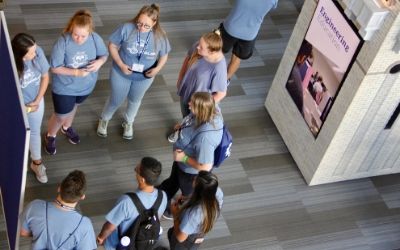
Teams of high school students presented their findings after a weeklong GEAR UP Engineering camp at USU
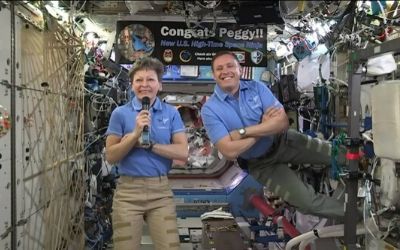
Students from GEAR UP schools talked to scientists aboard the ISS in May 2017
Credit NASA
The Utah State University STARS! program received its first federal funding of $15 million from the Department of Education’s Gaining Early Awareness and Readiness for Undergraduate Programs (GEAR UP) in 2012. These funds targeted nearly 3,000 students who started the program in middle school and continued through high school and into college. The program focused on academic preparation and the creation of a college-attending culture in the schools it served.
As of this month, USU GEAR UP completed eight years of student and family support through grant one. The program has improved high school graduation rates for underprivileged students, as well as seen an improvement in students going to college after high school. As Project Director, Jim Dorward has seen how the program has improved the lives of the students and families that it serves. We asked him to share his final thoughts as grant one comes to a close.
What were you doing in education before GEAR UP and USU and how long have you been working with the USU GEAR UP program?
I started my career as a math and science teacher in Jackson, WY and Vail, CO for four years.That was followed by a move to USU where I served as a Professor of Mathematics Education and Program Evaluation for 27 years. In spring of 2010, I started working on the initial USU STARS! GEAR UP project. USU submitted a proposal in 2011, and it was funded in June 2012.
What schools and students have been served through the GEAR UP grant in Utah?
We started serving 2,900 4-7 grade students in fall of 2012. Students were at Mt. Logan Middle School, Eagle View Elementary, North Sanpete Middle School, Ephraim Middle School, Gunnison Middle School, Dual Immersion Academy, American Preparatory Academy, Wendover High School, West Wendover Middle School, and North Davis Junior High School.
Students transitioned into Logan High School, Uintah Middle School, Uintah High School, North Sanpete High School, Manti High School, Gunnison High School, Clearfield High School, and Innovations High School. At the end of the project, we had served approximately 6,000 individual students at these participating schools.
How important are the roles of families in this process?
Family participation in college and career activities, financial aid workshops, summer programming, and more recently in promoting remote educational services has been critical to enabling and sustaining college enrollment.
What need does the grant fill in the communities it serves and how does the GEAR UP model work in the schools that it serves?
GEAR UP provides an additional stimulus for helping students realize life aspirations. The model seeks an authentic partnership between the university, local schools and communities, businesses, and governmental agencies.The schools determine what they will do on an annual basis to increase college awareness and readiness.With guidance from the GEAR UP staff, these plans are enacted and data is collected on student participation.The plans vary from year-to-year as the cohort of students moves toward high school graduation and college enrollment.
What do you think that the programs greatest strengths are?
The focus on STEM (Science, Technology, Engineering, and Mathematics) education has enabled our project to address some noticeable gaps in schooling and awareness of opportunities, particularly in rural areas. Having students interact with professionals and be involved in unique and relevant science, technology, engineering, and mathematics activities has been incredible.
What sorts of changes have you seen in the schools and students that GEAR UP partners with over the years?
We have seen a remarkable increase in the percentage of students enrolling in advanced math and science courses, Free Application for Federal Student Aid (FAFSA) completion, and awareness of other financial aid opportunities, such as scholarships.
Is there some advice that you would like to give other GEAR UP programs that are just starting out?
I would say to partner with local academic, business, or government ventures that are innovating and who are willing to share their excitement, challenges, and successes with those of the next generation.
Can you tell us about your favorite project or event over the years and why you think it helps students?
I’ve always enjoyed exploring, so seeing our students talk to scientists aboard the an electric car describe how she wants to continue that work in college, are experiences that have also given me shiver bumps.
Is there anything else that you would like to share about the GEAR UP program and how it changes students' lives?
GEAR UP is a program where half of the funding comes from the federal government and the other half comes from state and local governments, businesses, and non-governmental organizations. It is very rewarding, when these groups can come together and create experiences for students that changes lives for the better.
What are you going to do with all of your extra free time now that the project is done?
Explore more.
We thank Jim for taking the time to talk with us about his work with the USU GEAR UP program these past eight years. Grant one has impacted the lives of the many students and families in the communities that it has served. The good news is that the program has three additional GEAR UP grants still serving participating schools throughout the state. Grants two, three, and four will continue supporting students through their first year of college during the 2024-2025 school year.