
Summer 2020 Newsletter
Thank you for reading our summer newsletter. In this issue, we share news about changes in winter ozone that have occurred over the past few years, provide updates about how we are improving photochemical models, and show a comparison of methane concentrations during winters 2019 and 2020. And we congratulate Tyler Elgiar, who was named the USU-Uinta Basin Undergraduate Researcher of the Year!
Winter Ozone Production is Decreasing Over Time
Ambient ozone precursor concentrations have decreased over time in the Uinta Basin, especially in the eastern Basin, and a new analysis has shown that ozone production has slowed, also. This means that, for a given set of meteorological conditions, winter ozone concentrations are now lower than they would have been in the past. The annual ozone reduction has been about 4 ppb per year from 2011 through 2020, with a total drop of more than 30 ppb, and the number of ozone exceedance days per year has also decreased. Evidence indicates that the decline in wintertime ozone is driven by changes in emissions, not meteorology.
Some of the reduction in ozone precursor emissions has been due to a decrease in natural gas production, and some has been due to new regulations and voluntary emissions reductions by industry. We are not currently able to quantify the fraction of emissions reductions caused by production declines versus changes to industry practices, and we have limited ability to predict whether these declines will continue.
Because of this reduction in ozone, the Uinta Basin is more likely to be able to achieve the EPA ozone standard than it was in the past, though ozone exceedances are certainly still possible. Additional information is available in our 2019 Annual Report and in a manuscript in preparation by Marc Mansfield.
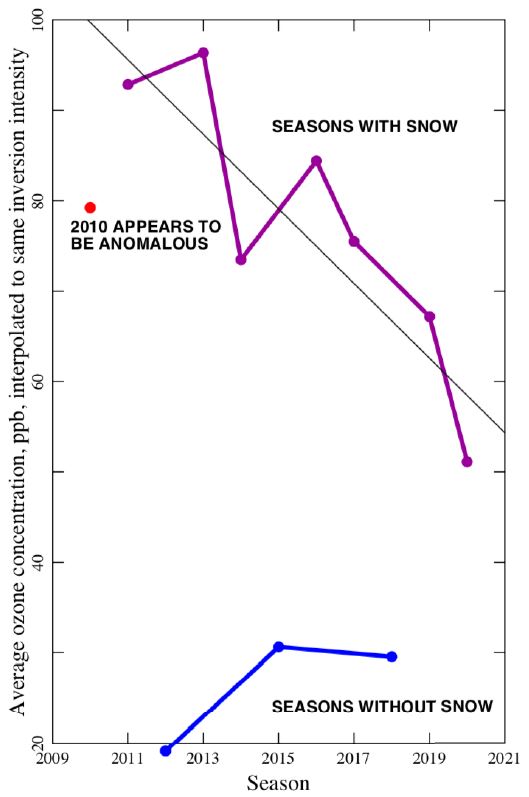
Seasonal estimate of average ozone concentrations at the Ouray monitoring station, given the same inversion intensity for each year (derived from a linear regression analysis). The figure shows that winter ozone was much lower in 2019-2020 than in 2011-2013 for a given meteorology.
Team News
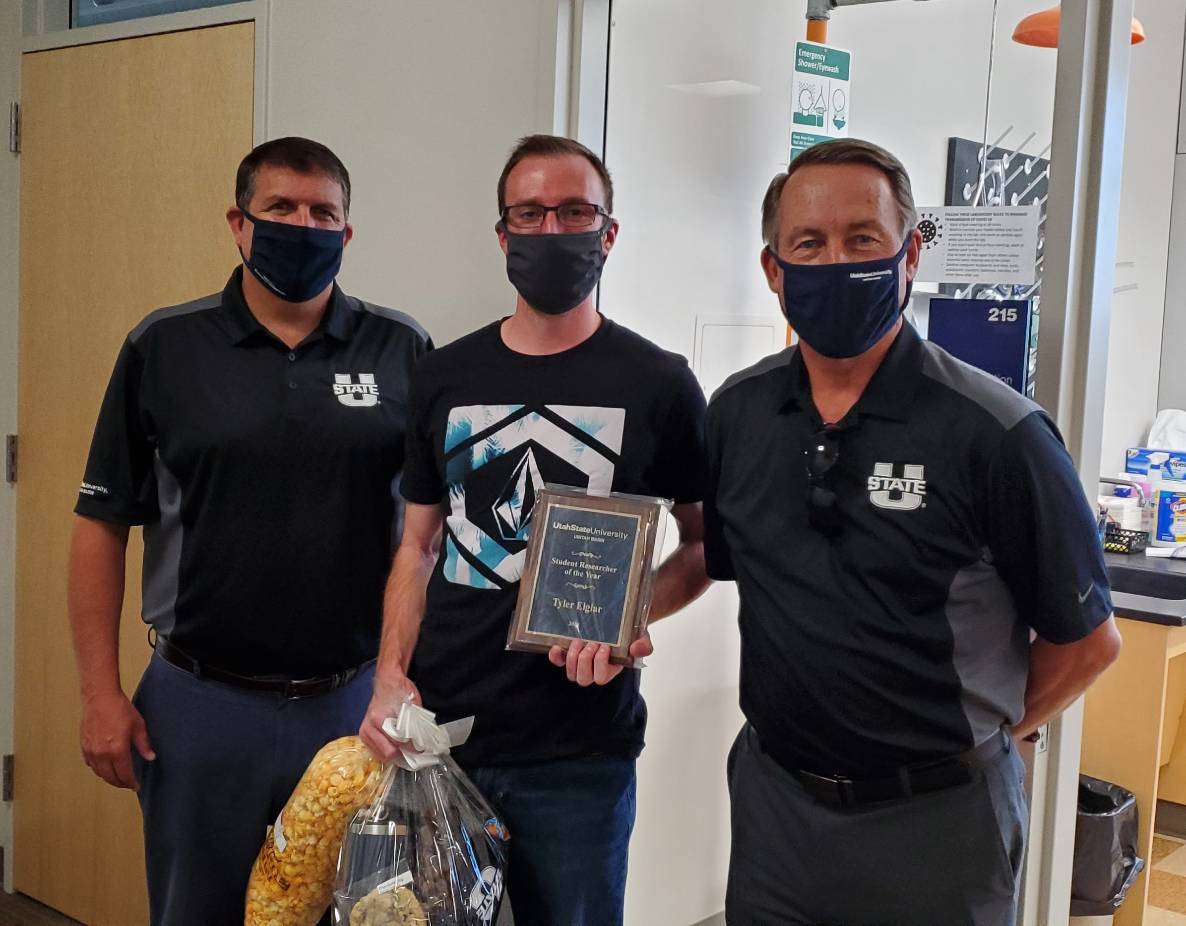
- Tyler Elgiar receives USU-Uinta Basin Student Researcher of the Year Award: Tyler Elgiar, a student researcher in our team, received the 2020 Student Researcher of the Year Award. Tyler has worked with us for about 1.5 years and recently completed a degree in Wildlife Management. Tyler has worked on projects to measure the composition of oil and gas emissions, measure ambient chemistry and meteorology at sites throughout the Uinta Basin, and design and deploy new instruments to detect atmospheric mercury at ultra-low levels. Tyler will continue his student career with our team as he pursues a master's degree in toxicology. Hooray for Tyler!
- Meteorological model development for Utah Division of Air Quality: We recently began a project funded by Utah DAQ to develop a meteorological model of a Uinta Basin winter inversion episode. DAQ will use the model as part of their regulatory SIP modeling efforts.
- New project to characterize emissions from oilfield engines: We received funding from the Utah DAQ Science for Solutions grant program to measure organic compound emissions from artificial lift (a.k.a. pumpjack) engines in the Uinta Basin. We will characterize
 emissions from these engines in real field conditions during the 2020-21 winter season. We will measure emissions of more than 75 different ozone-forming compounds from several dozen engines.
 - Team participates in Air Quality: Science for Solutions Conference: Our team recently helped organize and participated in the fourth annual Air Quality: Science for Solutions conference, as Utah-centric air quality research conference. The following is a list of the presentations we gave. Ask us if you'd like a copy of any of them.
- Organic compound concentrations and composition in ambient air across the Uinta Basin (Makenzie Holmes)
- Improving WRF/CAMx Model Performance using Satellite Data Assimilation Technique for the Uinta Basin (Huy Tran)
- Composition of organic compound emissions from oil and gas wells (Seth Lyman)
- Comparison of Meteorological-Chemistry Coupled Online Versus Offline Models in
Simulating High Winter Ozone Episode in the Uinta Basin – Utah, USA. (Trang Tran) - Evidence against oxidation of elemental mercury by ozone (Seth Lyman)
- Transport of Reacting Molecules Across the Air-Water Interface (Marc Mansfield)
Satellite Measurements Aid Uinta Basin Air Quality Research
Lower Methane in Uinta Basin Oilfield During Winter 2020
We examined data from the TROPOspheric Monitoring Instrument (TROPOMI) instruments onboard the Sentinel – 5P satellite platform for the distribution of methane total atmospheric column concentration over the Uinta Basin in winters 2019 and 2020. As shown in the figure, during January through March, methane concentration over the oil field (west of Ouray – OU) was lower in 2020 than in 2019, but methane over the gas field (east of OU) was higher in 2020 than in 2019. The reason for these differences is not yet entirely clear. Oil production declined during winter 2020, but meteorological conditions were different also. Persistent inversion conditions in 2019 led to elevated winter ozone, while 2020 inversions were accompanied by cloud cover and lower ozone. While methane's contribution to wintertime ozone is low, methane is a reasonable surrogate for ozone-producing organic compound concentrations in the atmosphere.
TROPOMI data products include methane, carbon monoxide, formaldehyde, and nitrogen dioxide. These data are providing insights into meteorological and chemical changes in the Uinta Basin atmosphere and will be used to validate photochemical model outputs. Furthermore, in combination with measurements of the atmospheric boundary layer using instruments such as met towers, SODAR, and LiDAR that will be carried out over the next two winters by BLM, these TROPOMI data products can be used to deduce Basin-wide emission rates, leading to improvements to emissions inventories.
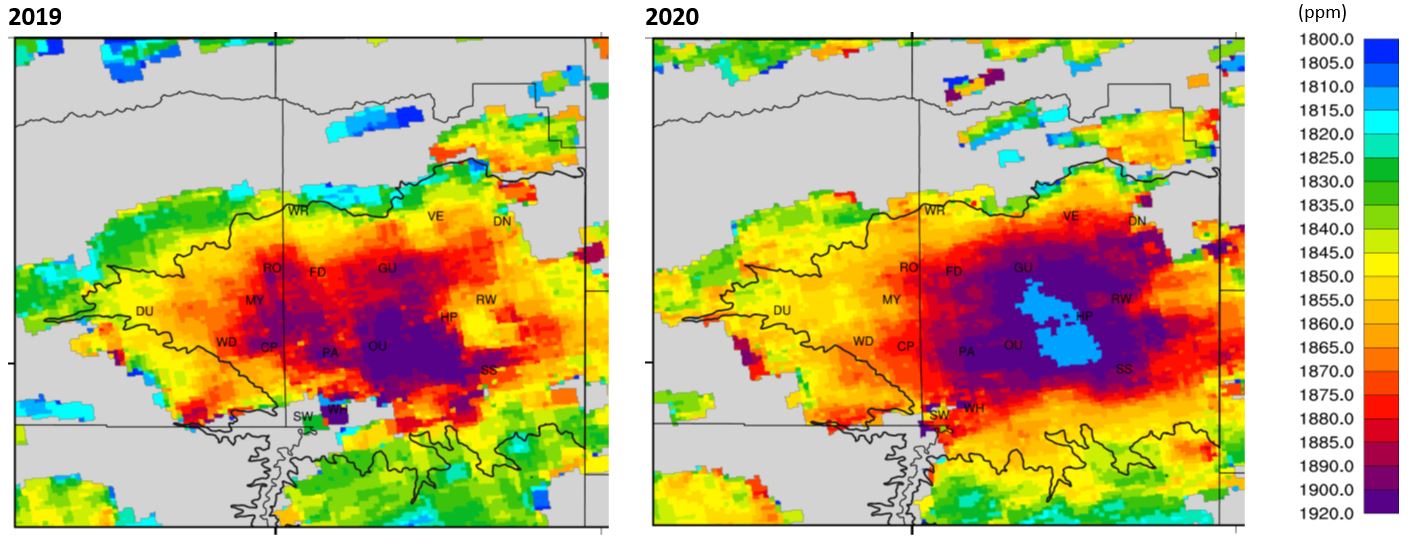
Atmospheric total column of methane concentration (in ppb) over the Uinta Basin on average over the period January – March 2019 and 2020, as observed from SENTINEl-5P satellite (TROPOMI). The blob in cyan south of Gusher (GU) and east of Ouray (OU) in 2020 is caused by insufficient TROPOMI data and should be disregarded.
Incorporation of Satellite Data Improves Snow Cover in Photochemical Models
We have completed work to improve meteorological (WRF) and photochemical (CAMx) model performance in simulating surface albedo and snow cover using a novel MODIS satellite data assimilation technique. The main finding for a model episode in winter 2011 is that assimilation of MODIS data to WRF greatly improves WRF’s accuracy in simulating snow characteristics, not only in the Basin, but in all areas of the model domain, including the Wasatch Front. Decay of snow depth and snow cover in WRF is also less with MODIS data assimilation in comparison with a regular simulation. However, no significant improvements in WRF performance were found for other quantities, such as mixing height or wind fields. Furthermore, higher snow albedo in WRF as obtained from the MODIS data assimilation did not, in general, result in higher photolysis rates in CAMx, due to how the model calculates snow albedo and its assumption on snow age. Nevertheless, from this study we have developed a methodological approach to improve WRF performance in simulating snow characteristics which, prior to this study, required manual corrections and best guesses from modelers. This study was financially supported by Utah DAQ.
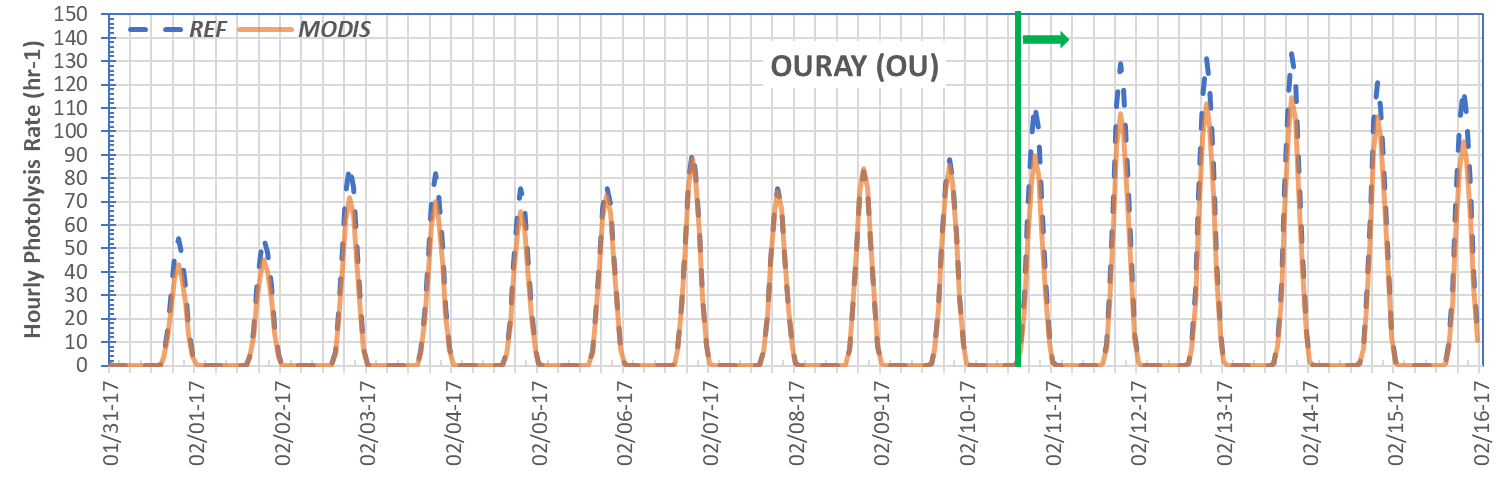
Comparison of ozone photolysis rates simulated by CAMx at Ouray (OU) in a standard simulation (REF) and with snow albedo assimilated from MODIS. Ozone photolysis rates are higher in MODIS than in REF if snow is left aging over an extended period, but becomes lower when there is fresh snow in the model, which is indicated by the green vertical bar.
Chemical Mechanisms Strongly Impact Winter Ozone Production in Photochemical Models
We have been working to understand the impact of different chemical mechanisms on photochemical model outputs. Chemical mechanisms are the lists of chemical reactions used by three-dimensional photochemical models to simulate atmospheric chemistry. Models used to make regulatory decisions rely on these mechanisms, and we are finding that the choice of mechanism can have a big impact on model outcomes.
We compared two mechanisms that have been used in previous air quality modeling studies of the Uinta Basin: the Carbon-bond Mechanism (CB05) and the Regional Atmospheric Chemistry Mechanism (RACM), using the WRF-Chem photochemical model. The two sensitivity runs shared the same model cores, emissions, snow/albedo modifications and only differed in the chemical mechanisms. Our results thus far indicate that the RACM mechanism resulted in more ozone-reactive organic compounds (especially carbonyls), leading to much higher simulated ozone concentrations than the CB05 mechanism. We are working now to investigate the particular reactions that lead to this difference and to explore other chemical mechanisms to determine how they behave in models of winter ozone. In the past, we assumed that errors in meteorological simulations and emissions inventories were the only two important factors that limited the effectiveness of simulations of winter ozone in the Uinta Basin. These new results show that chemical mechanisms are also very important, and that the widely-used carbon-bond mechanism might be deficient for simulations of winter ozone chemistry.
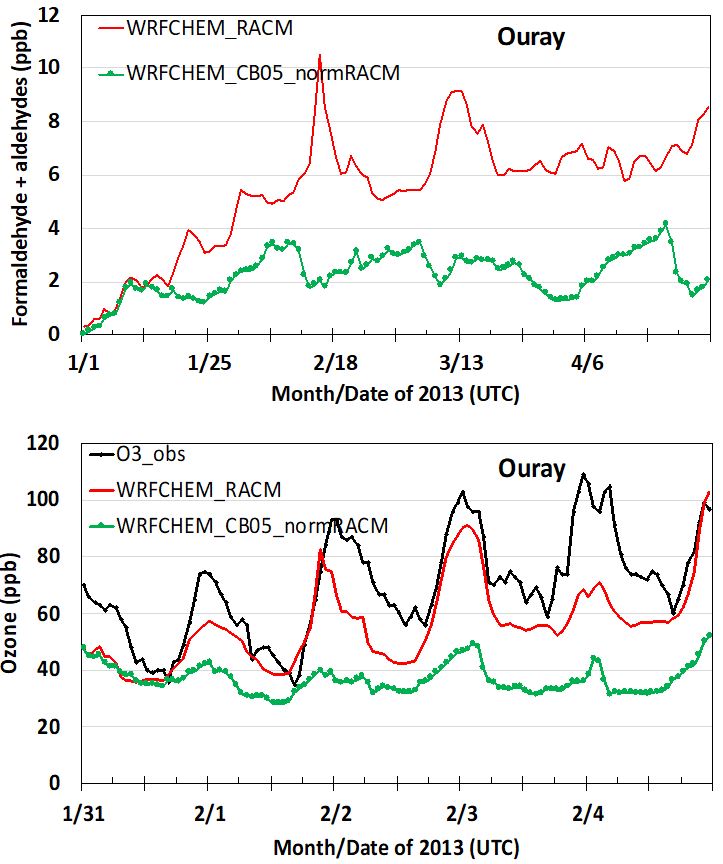
Simulated (red-RACM and green-CB05) and observed (black) carbonyls and ozone concentrations at Ouray.
Modeling Formaldehyde and Acetaldehyde at the Air-Water Interface
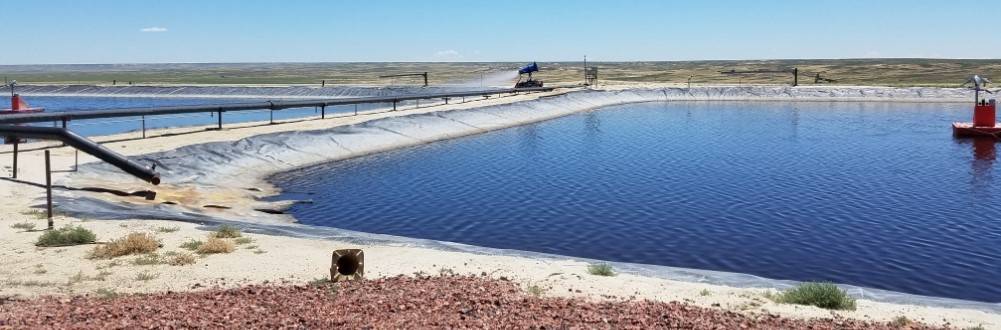
Aldehydes, which are very reactive with respect to ozone production, are emitted from produced water ponds and snowpacks. Models that treat the transport of pollutant molecules from water (or snow) to air, or vice versa, are important when we consider emissions from these sources. Water-soluble aldehyde molecules, such as formaldehyde and acetaldehyde, react reversibly with water molecules to form gem-diols. In fact, about 99.95% of the formaldehyde molecules that have entered water bodies from the atmosphere are actually found in the gem-diol form. In the past, it has always been assumed that the gem-diol molecule cannot cross the air-water interface, and that it must convert back to the aldehyde before it can return to the atmosphere. This assumption is based on the belief, in spite of much evidence to the contrary, that the gem-diol form does not exist in the vapor phase. We have been working to generalize transport models to allow for both molecular forms in both phases and for both forms to cross the air-water interface. These improved models for formaldehyde and acetaldehyde have been developed and are now being applied. This work will improve our ability to estimate emissions of aldehydes from water and snow sources.
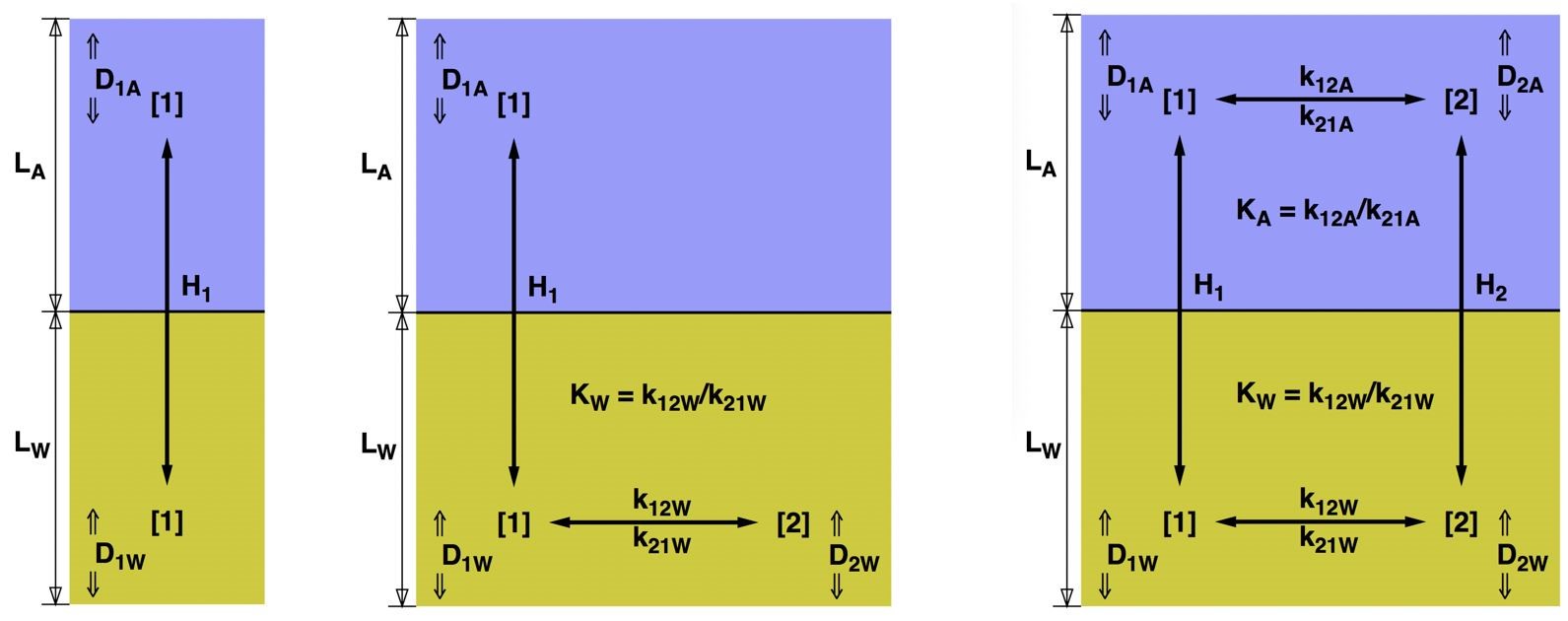
The left panel represents models of transport across the air-water interface of molecules that exist in only one form. Net flow occurs from water to air when water concentrations are in excess and vice versa. The central panel represents the current modeling paradigm for molecules such as aldehydes that allows for the interconversion between two different forms in the water phase, but not in the air. The right panel represents models that we have been developing, with both forms existing in both phases and both forms able to cross the air-water boundary.
Coming Up Next
- Bingham Center scientists are wrapping up BLM ARMS modeling, including projections of the impact of future oil and gas development on Utah air quality. The final report of that work will be available later this summer.
- All data collected during winter 2020 is now finalized and available. Contact us to obtain meteorological and chemical data for the 2020 winter.
- The final report for the Uinta Basin Composition Study, which was led by Utah DAQ, is now available. This study, in which the Bingham Center team participated, provided new measurements of the organic compound composition of emissions from oil and natural gas wells in the Uinta Basin.
- Our 2020 Annual Report will be released in November.