
Ambient Air Monitoring Stations
We operate four air quality monitoring stations from December through March each year to track key air pollutants that contribute to winter ozone. This work continues a 15-year record of measurements that help scientists and communities better understand winter air quality.
Seth Lyman and Trevor O'Neil
Project Ongoing
Funding: Utah Legislature, SSD1
Project Updates
Updated: July 2026
- Major Findings:
- No elevated ozone during this winter 2025-2026, which is the third consecutive year without winter ozone in excess of EPA ambient air standards.
- No elevated ozone during this winter 2025-2026, which is the third consecutive year without winter ozone in excess of EPA ambient air standards.
- Current and upcoming work:
- We are processing and finalizing data from the 2025-26 winter season. Data will be available in early fall 2026.
- Real time data at https://basinwx.com (or our old website, http://ubair.usu.edu/index.html)
- We will have three new instruments online in winter 2026-27;
- A new NOx/NOy analyzer at Horsepool to replace our current, aging instrument.
- A methane/total non-methane hydrocarbon gas chromatograph at Castle Peak.
- A real-time formaldehyde analyzer at Horsepool.
- Problems:
- The real-time formaldehyde instrument last winter but needed some careful calibration and method development to obtain quantitative data from it. We have completed that work, and it is ready for deployment this winter. As part of those calibrations, we did calibration comparisons with the DNPH cartridge method we have been using for years at several sites to measure formaldehyde and other carbonyls. We have completed datat collection, but are still working on analysis.
- We are revamping our data check-out system for the coming winter. We hoped to be done with that before now, but it is taking longer than expected. We still expect to have all our data finalized in time for our 2026 annual report.
- UDAQ is evaluating the move of the Roosevelt station in the next year and are actively identifying apporpriate locations. The time line for the possible move of the site is undetermined.
- The real-time formaldehyde instrument last winter but needed some careful calibration and method development to obtain quantitative data from it. We have completed that work, and it is ready for deployment this winter. As part of those calibrations, we did calibration comparisons with the DNPH cartridge method we have been using for years at several sites to measure formaldehyde and other carbonyls. We have completed datat collection, but are still working on analysis.
More Information
Operating Stations
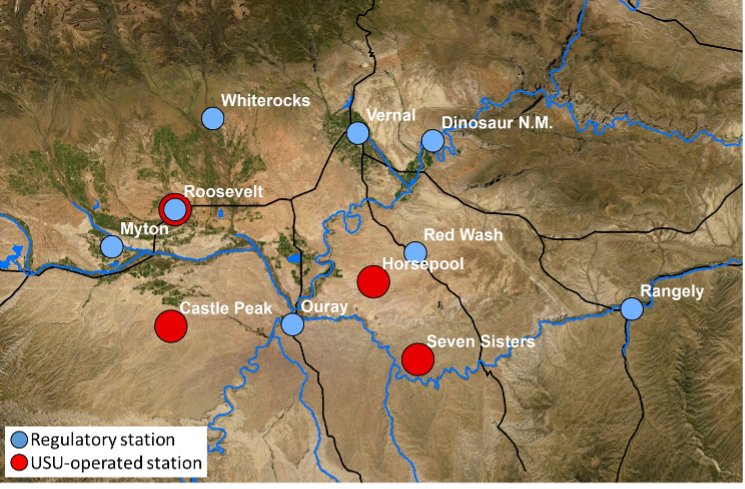
We will operate meteorology and air quality monitoring equipment at the following stations during the coming winter from December 1st through March 31st
- Horsepool
- Roosevelt
- Castle Peak
- Seven Sisters
These stations are not official regulatory monitors but are instead operated to:
-
Measure chemical conditions around the Uinta Basin that are not captured at regulatory stations. Most regulatory NOX instruments suffer from a high bias during winter inversion episodes and thus do not provide accurate NOX measurements during these periods; whereas, we measure NOX via an unbiased technique at Horsepool, Roosevelt, and Castle Peak. Our measurements of speciated organic compounds at Horsepool and Roosevelt are the only long-term organics measurements in the Uinta Basin (hydrocarbons, alcohols, and carbonyls). We also measure NOY, CO, particulate matter smaller than 2.5 μm (PM5), snow depth, solar radiation, and albedo at various wavelengths.
-
Provide information about the spatial distribution of ozone in the Uinta Basin region. Eight regulatory monitoring stations operate in the Uinta Basin, but they are not evenly distributed around the Basin. We operate ozone monitoring stations to provide a more spatially representative dataset to compare against results from our photochemical modeling work. Data from these stations can be downloaded from our website https://www.usu.edu/binghamresearch/data-access.
Most of our stations have been operating since 2010. The entire dataset, including data from regulatory stations and stations we operate, constitutes an essential long-term record of meteorology and air quality in the Uinta Basin.