
Organic Pollutant Fluxes at the Air-snow Interface
We are completing the final analysis of project data and preparing a peer-reviewed scientific publication summarizing the findings and outcomes of this multi-year research effort. This publication will document the results and contribute to the broader scientific understanding developed through the project.
Seth Lyman and KarLee Zager
Project End: Fall 2026
Funding: Utah Legislature, SSD1, Anadarko Student Research Endowment
Project Updates
Updated: July 2026
- Major Findings:
- The surface of snow can store and sometimes change certain air pollutants, especially organic compounds. However, our current research shows that this process likely has only a small effect on winter air quality in the Uinta Basin.
- The movement of some organic compounds between the snow surface and the air changes depending on how much sunlight is present, or in response to other atmospheric conditions.
- The surface of snow can store and sometimes change certain air pollutants, especially organic compounds. However, our current research shows that this process likely has only a small effect on winter air quality in the Uinta Basin.
- Current and Upcoming Work:
- We are completing the final stages of data analysis and beginning preparation of a scientific publication to report the study's findings.
- KarLee was awarded the best undergraduate student presentation for her talk about this topic at the National Atmospheric Deposition Program Spring Meeting. Watch her presentation at https://www.youtube.com/watch?v=ngcYDIq-uMc&t=89s.
- Problems:
- The data set is far more complex and is taking more time than we expected to complete the necessary work.
More Information
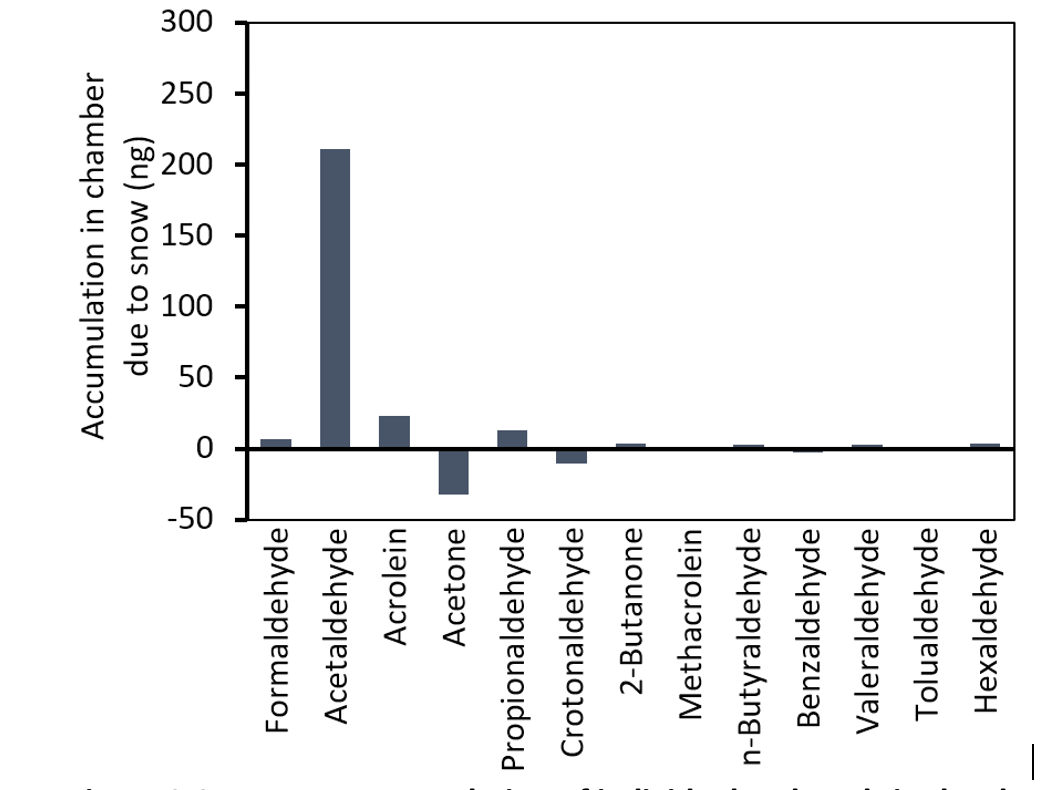
Average accumulation of individual carbonyls in the chamber due to snow, determined from the mass difference in the chambers with and without snow.
Determining Organic Pollutant Fluxes at the Air-snow Interface
A large body of work by others shows that carbonyl compounds, including formaldehyde and acetaldehyde, are emitted from snow when snow is irradiated with UV light, including UV from natural sunlight. Carbonyls are important precursors to wintertime ozone production. Most of this work has been conducted in the Arctic. Our hypothesis has been that carbonyl emission rates from snow in polluted environments, such as the Uinta Basin during winter inversions, will be greater than in the Arctic and that emissions could be high enough to significantly impact winter ozone.
We have measured fluxes of organic compounds at the air-snow interface in past years, including flux chamber measurements at the Horsepool field station and laboratory measurements under controlled conditions. Section 12 of our 2020 annual report describes some of this work, and Section 6 of our 2023 annual report gives more information. These measurements provide evidence that carbonyl compounds are emitted from the snow under some conditions. Figure 3-2 uses data from some of our laboratory measurements, showing that snow was a source of acetaldehyde and some other carbonyls.
The laboratory system is built within a chest freezer that has been divided into two sections. A temperature control system allows for differential cooling of each section with liquid nitrogen. For each of the two sections, the freezer lid is partially cut away and replaced with UV-transparent acrylic to allow natural sunlight to enter the freezer. Within each section, a PFA Teflon tray is filled with snow and placed within a UV-transparent PTFE Teflon bag. The bag is inflated with outdoor ambient air, and the air is circulated with a PFTE Teflon-lined pump. We allow the snow to incubate within the bags for several hours and then collect air samples from each bag to determine how air has changed within each one. We measure UV-A and UV-B light within the apparatus and analyze the contents of each bag for concentrations of a suite of 70 different hydrocarbons, alcohols, and carbonyls.
We completed all planned tests with this system in 2024 and 2025, and this project is almost complete. In 2026 we will complete analysis of collected data and prepare a manuscript for peer-reviewed publication.