
TAKEAWAY
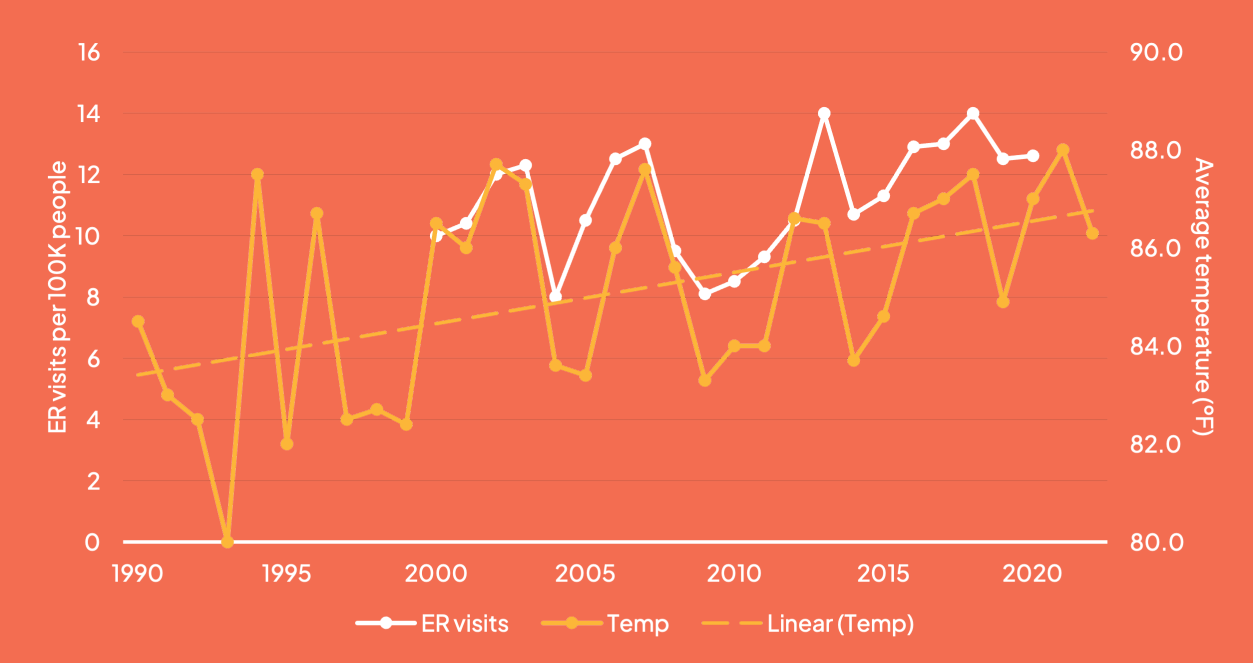
The hottest summer on record across the state occurred in 2021, and 2022 brought more extreme temperatures, including a record-breaking 34 days over 100 ºF in Salt Lake City.
Heat causes more deaths than any other weather-related hazard in the U.S.
Heat now causes more deaths than any other weather-related hazard in the U.S. Health impacts are greater for people without access to air conditioning and those who work or exercise outdoors—including visitors to Utah’s parks and protected areas[1][2]. Those with health conditions, older people, and children are also at higher risk. High temperatures in school buildings directly inhibit student learning[3], yet many schools in Utah lack air conditioning and cope with extremes by adjusting schedules or shortening school days. Utahns have historically relied on our cool nights to protect us from some of the serious health risks caused by extreme heat, but nighttime low temperatures are rising in urban heat islands[4] such as along the Wasatch Front. The health impacts of heat are also made worse for Utahns by summer air pollution: Ozone is typically most dangerous in urban areas on the hottest days, and hot, dry weather can exacerbate regional wildfires that create hazardous air quality.
Decision-makers in Utah have not yet had extensive experience responding to extreme heat[5], but many Utahns are now worried about the risks to their health, especially those in low-income neighborhoods most exposed to urban heat.
Solutions exist to help Utahns adapt to our hotter climate: Improvements in weather forecasting now allow for earlier heat warnings so that people can prepare themselves and care for at-risk family members and neighbors. Urban heat exposure can be reduced with growing adoption of green infrastructure and reflective roofing and paving materials. Transitioning to clean electricity sources can promote access to cooling while also reducing air pollution and helping avoid an even more dangerously hot climate.

References
- Jag, J. (2022, September 12). As another heat wave hits Utah, how hot is too hot in our national parks? The Salt Lake Tribune. https://www.sltrib.com/sports/2022/09/01/how-hot-is-too-hot-utahs/
- Goldstein, K., Howe, P. D. (2019). Dry Heat Among the Red Rocks: Risk Perceptions and Behavioral Responses to Extreme Heat Among Outdoor Recreationists in Southeastern Utah. Journal of Extreme Events, 6(3), 2050004. https://www.worldscientific.com/doi/abs/10.1142/S2345737620500049
- Park, R. J., Goodman, J., Hurwitz, M., and Smith, J. (2020). Heat and Learning. American Economic Journal: Economic Policy, 12, 306-339.
- Debbage, N. and Shepherd, J. M. (2015). The urban heatisland effect and city contiguity. Computers, Environment and Urban Systems, 54, 181-194.
- Esplin, E. D. and Howe, P. D. (2021). It’s a dry heat: Professional perspectives on extreme heat risk in Utah. Journal of Risk Research, 24, 1558-1575.
- NOAA. (September 2022). Climate at a Glance Statewide Time Series: Utah Average Temperature. https://www.ncei.noaa.gov/access/monitoring/climate-at-a-glance/statewide/time-series/42/tavg/1/10/1895-2022?baseprd=true&begbaseyear=1901&endbaseyear=2000
- CDC National Environmental Public Health Tracking Network. (2022). Age-adjusted Rate of Emergency Department Visits for HRI per 100,000 Population. https://ephtracking.cdc.gov/DataExplorer
- Iowa Environmental Mesonet. (2022). Archived NWS Watch, Warnings, Advisories. https://mesonet.agron.iastate.edu/request/gis/watchwarn.phtml