
TAKEAWAY
Dust pollution could become a larger problem as the Great Salt Lake’s playa gets drier
Rather than exceedances of air quality standards, it is the short-term exposure to hazardous chemicals carried in the dust that have garnered recent attention.
In the early to mid-1990’s, areas along the Wasatch Front were declared non-attainment Air Quality Standards with PM10, mostly during wintertime inversions. Since then, continued decreases in PM10 caused the airshed to be declared “maintenance” status in March 2020 with continued oversight through 2030.
More recently, however, PM10 has become a growing concern revolving around seasonal wind-blown dust potentially originating from the shores of the Great Salt Lake. These events frequently are observed in the spring and fall and are of limited duration
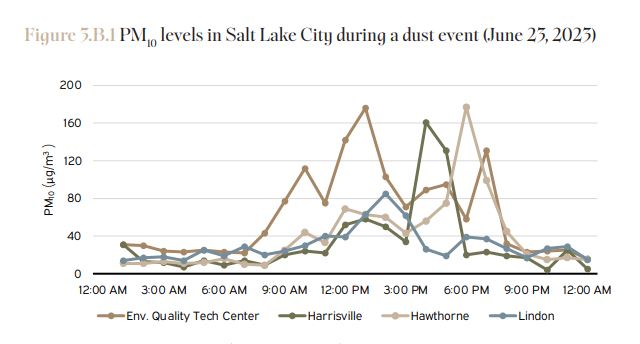
As an example, a roughly nine-hour event occurred on June 23, 2023, wherein the measured wind speed at the Salt Lake Airport doubled from around 11 mph to 22 mph, accompanied by a wind direction shift. Figure 3.B.1 shows the hourly averaged PM10 values increased considerably.
Rather than exceedances of air quality standards, it is the short-term exposure to unhealthy concentrations of hazardous chemicals carried in the dust that have garnered recent attention.
Research by several agencies and universities throughout Utah have shown Great Salt Lake dust
composition to be variable but typically dominated by calcium, silica, magnesium, aluminum, sodium, iron, and potassium. Numerous other elements have also been identified within air-borne dust, including arsenic, copper, manganese, nickel, selenium, strontium, thallium, and vanadium.
A recent analysis of PM10 collected at two regulatory sampling sites found that, during observed dust events, the potential for inhalation of most of the observed elements increased ten-fold, but exposure to only four of the elements (magnesium, calcium, vanadium, and strontium) were enhanced above background dust expectations. This suggests the wind-blown dust from the Great Salt Lake playa provided additional levels of these elements.
In 2023, a working group was formed among Utah Division of Air Quality personnel and investigators across universities and colleges in northern Utah to coordinate, encourage commonality in sampling and analytical methods, and develop benchmark comparison criteria. The group is currently working to prioritize cooperative PM10 sampling campaigns for dust sources and composition.
References
- Environmental Protection Agency (1995, July 28). ". Designation of Areafor Air Quality Planning Purposes;Utah; Designation of Ogden City PM10Nonattainment Area". Publicator. https://www.govinfo.gov/content/pkg/FR-1995-07-28/pdf/95-18520.pdf#page=1
- Utah Department of Environmental Quality (2020, July 30). "PM10 StateImplementation Plans and MaintenancePlans. ". https://deq.utah.gov/air-quality/pm10-state-implementation-plans-andmaintenance-plans
- Steenburgh, J.W., Massey, J.D., Painter, T.H (2012). "Episodic Dust Events of Uah’s Wasatch Front and Adjoining egion". Journal of Applied Meteorology and Climatology https://collections.lib.utah.edu/dl_files/a0/4d/
- Hahnenberger, M., and Perry, K.D (2015) . ". Chemical comparison of dust and soil from the Sevier Dry Lake, UT, USA. Atmospheric Environment, 113, -9." https://www-sciencedirect-com.dist.lib.usu.edu/science/article/pii/S1352231015300571
- Perry, K.D., Crosman, E.T., and Hoch, SW (2016-2019). "Results of the Great Salt Lake Dust Plume Study ". University of Utah Department of Atmospheric Sciences Report https://collections.lib.utah.edu/ark:/87278/s6qw8qhv