
TAKEAWAY
Measurements of ambient halogens will help assess the new halogen emission inventory.
Air quality in Utah is a complex and an ever-changing challenge impacting many areas of the state, but recent research has highlighted a previously underestimated class of chemicals that could make a difference in particulate matter and ozone levels along the Wasatch Front.
Halogens such as chlorine and bromine are highly reactive species, catalyzing numerous chemical reactions in the atmosphere. Although these species are probably best known for destroying the Earth’s protective ozone layer in the stratosphere, they might also play an outsized role in Utah’s ground-level air quality.
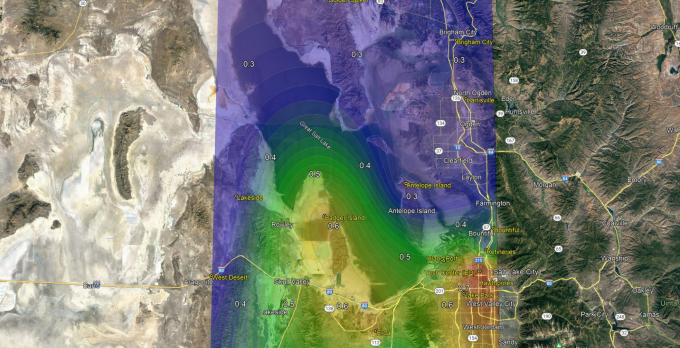
Halogens come from a variety of natural and anthropogenic sources including coal combustion, wastewater treatment, some mineral extraction, and sea spray. Despite being important for atmospheric chemistry, emissions from many of these sources are poorly constrained or sometimes, completely unknown. Utah’s recent directive (HB220) to create a halogen emission inventory will help with the State’s air quality modeling efforts and pollution control strategies, but a better understanding of ambient halogen concentrations is also a priority. The Utah Division of Air Quality and Utah State University are collaborating on a sampling campaign to better understand what halogen-containing compound concentrations look like along the Wasatch Front. Preliminary observations from the first phase of this three-part study (figure below) show enhanced hydrochloric acid concentrations along the southern part of the study area, including the Metro area and Badger island. The magnesium production operation of US Magnesium was offline during the sampling period. When complete, the study will constrain spatial variability of halogen levels and help identify hotspots and possible sources along the Wasatch Front
References
- Williams, C. (2023, February 22). "Bill to study halogen emissions, inspired by poor air quality report, clears first legislative hurdle". KSL TV. https://ksltv.com/527157/bill-to-study-halogenemissions-inspired-by-poor-air-qualityreport-clears-first-legislative-hurdle/a04d8f3575d0fc10682cb8df1fbd34f08860b909.pdf