
TAKEAWAY
Drought negatively impacts cattle and forage production on tribal lands, affecting economies and necessitating policies that support the resilience of Native American communities.
Tribal challenges include unsettled water rights, lack of resources to respond to drought conditions, and limited authority to prevent water pollution.
Indigenous people in the Colorado River Basin have claims to Colorado River water. Tribes have ancestral land and reservations in the basin and rely on the river for agricultural, cultural, and economic purposes. Unfortunately, legal challenges continue to shape claims and the access many native people have to that water
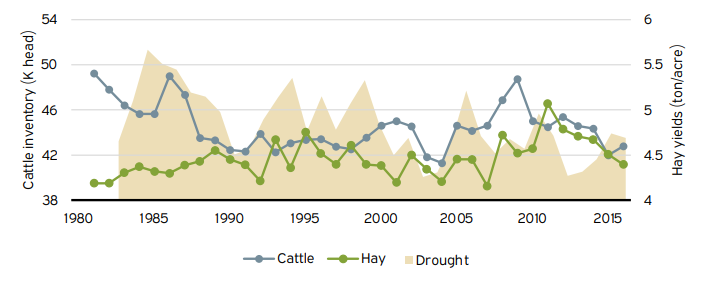
As part of the USDA-funded Native Waters on Arid Lands project, we examined the impacts of drought on tribal economies in the Southwest, focusing on reservations heavily reliant on agricultural production. Specifically, we evaluated the economic effects of drought on cattle and hay production sectors in Arizona, Nevada, New Mexico, and Utah and projected economic impacts given hypothetical drought scenarios
Drought has significant negative consequences on tribal economies, specifically on cattle and forage production, with cattle inventory decreasing with each successive year of drought.
The economic losses resulting from drought scenarios were substantial for large reservation areas, such as the Uintah and Ouray Reservation, Navajo Nation, and Tohono O’odham Nation. These losses have significant implications for the livelihoods of tribal communities, as agriculture plays a crucial role in their economic sustainability
Climate change and drought affect the viability of tribal economies and disrupt traditional foodways and ceremonies, creating a range of adverse effects on the well-being of individuals and communities.
To address the negative impacts of drought on reservation economies, the study suggests a need to tackle barriers that hinder tribal communities’ capacity to mitigate and adapt to drought and climate change. Some of these challenges include unsettled water rights, lack of financial and labor resources to monitor, prepare, and respond to drought conditions, and limited authority to prevent water pollution that originates outside reservations.
Our work underscores the importance of understanding and addressing the effects of drought on tribal economies. Developing targeted policies and support systems may enhance the resilience of Native American communities to climate-induced challenges and safeguard traditional ways of life.
Table 4.D.1 Reservations included in study
| Acoma Pueblo | Mescalero Apache | Tohono O’odham |
| Duck Valley | Moapa River | Uintah and Ouray |
| Goshute | Navajo Nation | Washoe |
| Hopi | Pyramid Lake | White Mountain |
| Jicarilla Apache | Pueblo of Isleta | Zuni Pueblo |
| Laguna Pueblo | San Carlos |
References
- Native Waters on Arid Lands. (n.d.) Native Waters on Arid Lands: Project Overview. https://nativewatersaridlands.com/project-overview/
- Drugova, T., Curtis, K.R., Kim, M.K. (2022). The Impacts of Drought on Southwest Tribal Economies. Journal of the American Water Resources Association, 58(5), 639-653. https://onlinelibrary.wiley.com/doi/epdf/10.1111/1752-1688.13018