
GREAT SALT LAKE DUST NEAR FARMINGTON BAY | MOLLY BLAKOWSKI
TAKEAWAY
Policymakers need to remain vigilant on the potential for emissive dust from the exposed playa of Great Salt Lake. Additional monitoring is likely required to provide accurate data for addressing this issue.
Great Salt Lake has fallen to unprecedented low levels, exposing hundreds of square miles of dry lakebed to the atmosphere. Recent studies have traced metal-laden dust from the lakebed across the Wasatch Front, raising considerable concerns for public health.
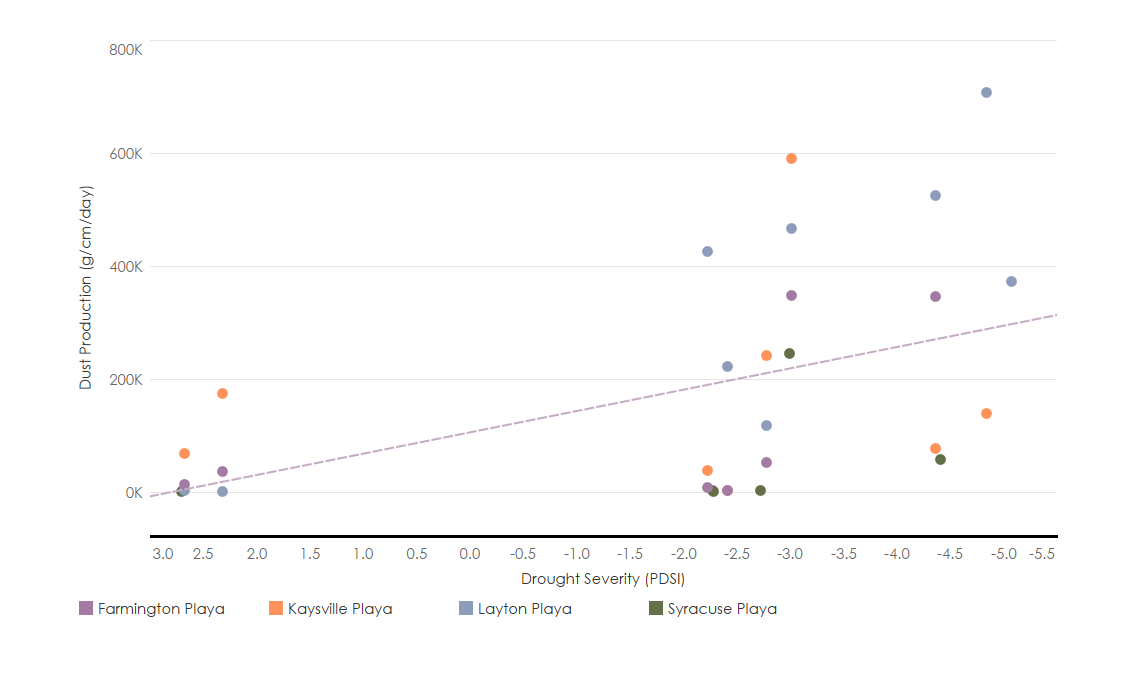
Between 2019 and 2021, Utah State University researchers have maintained a network of wind erosion samplers on the dry lakebed of Great Salt Lake. The amount of dust produced varied greatly by site, with most exhibiting the highest rates of wind erosion in 2021 (Figure 3.B.1). The research team found a significant association between dust production and drought conditions, which worsened between 2019 and 2021. Droughts reduce soil moisture and make soil surfaces more susceptible to emitting fine dust when bombarded by large, bouncing particles during high wind events. At the site with the highest rates of dust production, the research team found that particle size became more fine over time in response to the weathering of protective surface crusts in the surrounding area.
Paired with drought conditions, a gradual breakdown of surface crusts may lead to more frequent, low-intensity dust events of fine lakebed sediments by relatively low wind speeds. While particles of any size can impact human and ecosystem health, finer particles require less wind energy to travel farther from the lakebed, such as to the Wasatch Mountains, where they may speed snowmelt by laying down a layer of dark material on the white snow, increasing the absorption of the heat from the sun.
In addition to this project, researchers are also investigating different pathways through which populations may be exposed to harmful metals in Great Salt Lake dust, as well as evaluating the sources of metal pollution that have accumulated in lakebed sediments over time.
Figure 3.B.1 Rates of dust production from four wind erosion monitoring sites across the dry lakebed plotted against drought severity
References
- Carling, G.T., Fernandez, D.P., Rey, K.A., Hale, C.A., Goodman, M.M. and Nelson, S.T. (2020). Using strontium isotopes to trace dust from a drying Great Salt Lake to adjacent urban areas andmountain snowpack. Environmental Research Letters, 15(11). 114035.
- Lang, O.I., Mallia, D. and Skiles, S.M. (2023). The shrinking Great Salt Lake contributes to record high dust-on-snow deposition in the Wasatch Mountains during the 2022 snowmelt season. Environmental Research Letters, 18(6). 064045.
- Putman, A.L., Jones, D.K., Blakowski, M.A., DiViesti, D., Hynek, S.A., Fernandez, D.P. and Mendoza, D. (2022). Industrial particulate pollution and historical land use contribute metals of concern to dust deposited in neighborhoods along the Wasatch Front, UT, USA. GeoHealth, 6(11). e2022GH000671.