
PROMONTORY POINT | AARON FORTIN
TAKEAWAY
Intense precipitation events across the western U.S. are boosting woody plants like juniper and crowding out plants that animals feed on.
Woody plants have become more abundant around the world over the past 50 years. In the western U.S. this “woody plant encroachment” has resulted in doubling
woody cover that has induced $5 billion in lost forage production for animals and rangeland management costs. Utah State University researchers are examining why this is happening, how woody growth is likely to change in the future, and how control strategies for woody plants are likely to affect forage production.
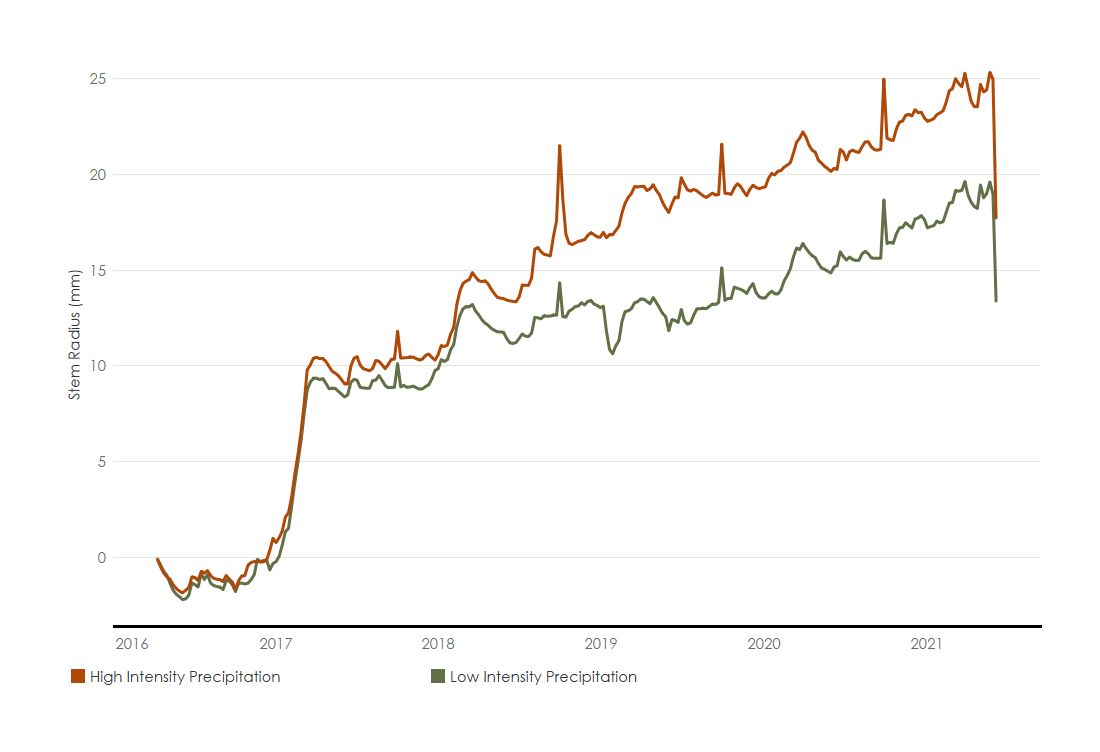
Larger precipitation events caused by a warmer climate change the way that water moves through plant canopies, soils, and into roots (Figure 4.C.1). Plants like sagebrush respond positively to larger precipitation events, which ”push” water into deeper soils where woody plant roots are better able to access it, giving them an ecological edge and increasing their growth. Small changes in root activity and distributions make a big difference on landscape scales, and these changes in precipitation patterns are contributing to increased woody plant growth around the world.
There are a few factors that make this topic especially complex to study: it is very difficult to measure water uptake by different species in the field, and responses in different environments, even within Utah, vary greatly. Researchers are exploring this process in more arid conditions in southern Utah by using hydrological tracers to measure water uptake by different species (e.g., juniper, pinyon pine, big galleta grass, prickly pear cactus, Indian ricegrass, etc.). These profiles can then be used to predict water uptake by different species on the landscape and aid their response to climate change. This data will help predict whether woody plant encroachment is likely to increase or decrease over time. It will also contribute to better understanding how shrub control will affect forage grass productivity.
Figure 4.C.1 Sagebrush stem growth where plants were either watered with “many small” (i.e., low intesity) or “few large” (i.e., high intensity) precipitation events
References
- Holdrege, M.C., Beard, K.H., Kulmatiski, A. (2021). Woody plant growth increases with precipitation intensity in a cold semiarid system. Ecology, 102(1)