
NORTHERN UTAH RANGELAND | AARON FORTIN
TAKEAWAY
Planting nutritious, low-cost patches of perennial plants on rangelands enhances livestock production and biodiversity while reducing the environmental impacts of grazing.
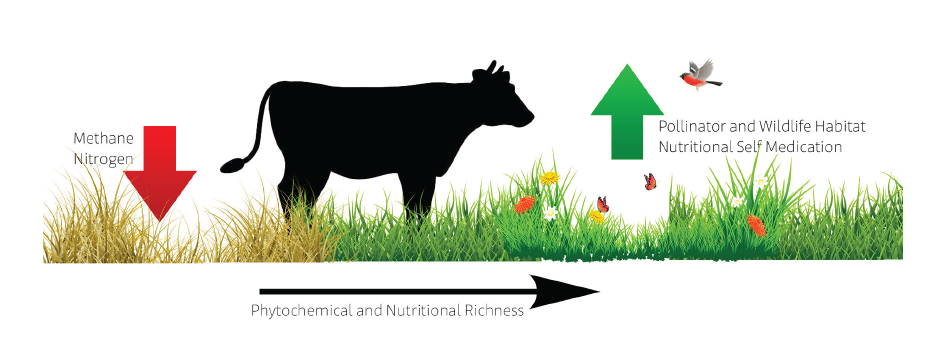
The Utah State University “Smart Foodscapes” project is finding ways to make range meat production more environmentally sustainable. This major research project is focused on increasing grazing animals’ health and productivity, boosting ecological diversity on Utah’s rangelands, and reducing the environmental impacts of grazing in the state. It explores effective ways to include diverse deep-rooted perennial legumes and high-nutrient herbs in resource patches across grass-dominated rangelands (Figure 4.F.1). These islands of ecological and nutritional diversity are added to grazing landscapes as a low-cost and sustainable supplement for beef cattle diets.
Carefully selected plants are strategically seeded in patches and tested for their support toward beef cattle performance; habitat for pollinators, mammals, and birds; environmental impact; and economic viability. Researchers are screening a wide selection of native and introduced plants for their ability to grow and persist in natural conditions. They also evaluate their chemical properties and measure the plants’ nutritional benefits. Results are disseminated through existing grazing schools. Surveys given to practitioners help researchers monitor how the results are adopted. A multi-institutional team of researchers and teachers have developed materials for the classroom that integrate related garden-based learning into science, technology, engineering, arts, and mathematics curricula. This transdisciplinary project is contributing to more sustainable beef production while engaging and educating current and future land stewards.
Figure 4.F.1 Phytochemical and nutritional richness (black arrow) increases with the taxonomic diversity provided by focal resource patches or “islands” with a broad array of legumes and herbs growing in a monotonous landscape
References
- Villalba, J.J., Beauchemin, K.A., Gregorini, P., and MacAdam, J.W. (2019). Pasture chemoscapes and their ecological services. Translational Animal Science, 3(2), txz003. https://doi.org/10.1093/tas/txz003
- Distel, R.A., Arroquy, J.I., Lagrange, S., Villalba, J.J. (2020). Designing diverse agricultural pastures for improving ruminant production systems. Frontiers in Sustainable Food Systems, 4, 215. https://doi.org/10.3389/fsufs.2020.596869
- Villalba, J.J., Ramsey, R.D., Athanasiadou, S. (2024). Review: Herbivory and the power of phytochemical diversity on animal health. Animal, 8/6, 101287. https://doi.org/10.1016/j.animal.2024.101287