
A.1.1 Ozone nonattainment areas and concentration trajectory
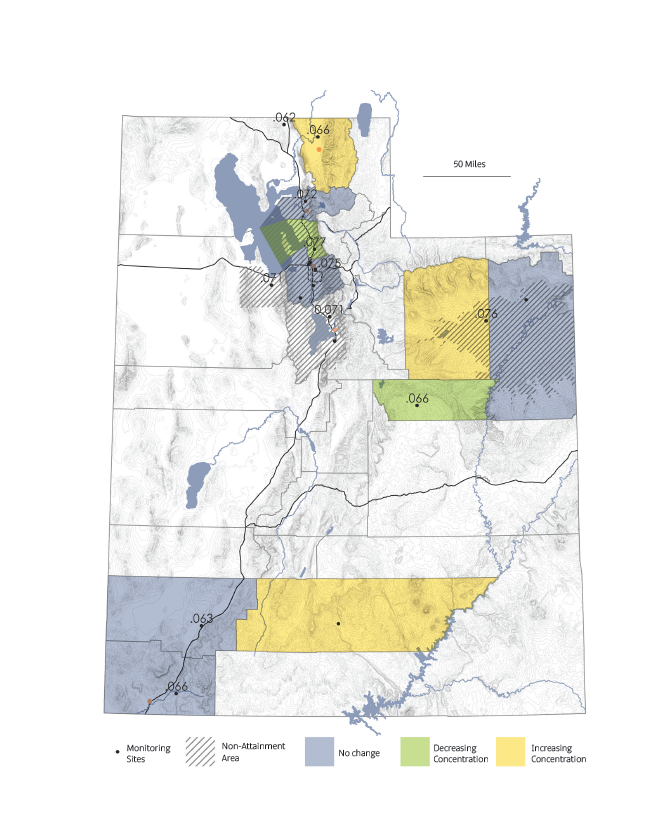
This map highlights air quality monitoring sites across Utah, labeling key sites with ozone (O3) design values. Design values compare a regional average with national standards to determine attainment. Regional ozone non-attainment areas are also highlighted as reported in the Utah Division of Air Quality (UDAQ) Marginalized Ozone Inventory (2020). Ozone trajectory was calculated using the difference between fourth-highest ozone days in 2020 and 2022. The resulting value is used to colorize the relevant county.
A.1.2 Statewide emissions
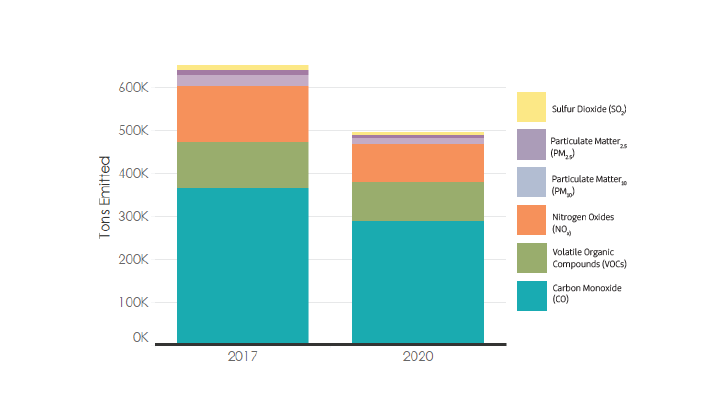
Every third year, the Division of Air Quality releases an extended emissions report detailing what has been released into the atmosphere. This chart indicates pollutants released and does not account for the concentration of those pollutants in the atmosphere. This chart sums emissions by pollutant, excluding emissions from biogenic sources and wildfires, from the last two triannual reports. Changes in monitoring strategies make comparisons between historic reports challenging.
The Environmental Protection Agency uses regional design values in comparison with set regulatory values to determine air quality attainment for each pollutant. Design values are calculated using an average of various relevant measures over three years. Information about the measure used to calculate design values and relevant regulatory values can be found in the following table sections. Ozone (O3) design values are determined by calculating using the fourth-highest annual concentration averaged over three years. A design value over the set regulatory value of 0.07 parts per million (ppm) is considered a violation and will cause the area to be moved into nonattainment. Ozone forms in the atmosphere when nitrogen oxides and volatile organic compounds react with sunlight. These, and a variety of other chemicals, are counted as pollutants within our atmosphere. The chart above details emissions for all currently measured pollutants.
The Environmental Protection Agency measures a variety of atmospheric pollutants, some have impacts on human health. Nitrogen oxides (NOx) and volatile organic compounds (VOCs) are responsible for forming ozone (O3) a powerful greenhouse gas. Ozone (O3) and particulate matter (PM10,2.5) or pollution from smoke and other small particles have the most direct impact on human health causing a host of respiratory issues. Carbon monoxide (CO) frequently coming from auto emissions is another greenhouse gas with some human health impact in large quantities.
There are currently 20 air quality monitoring sites in Utah covering 13 counties. Historic measures contributing to regional design values and relevant regulatory values are summarized alongside air quality index reports in the following sections.
References
- Utah Division of Air Quality. (2020, June). Marginal Ozone Inventory Uinta Basin, UT. [Report]. Utah Department of Environmental Quality. https://www.utah.gov/pmn/files/609997.pdf